Turning form with colour
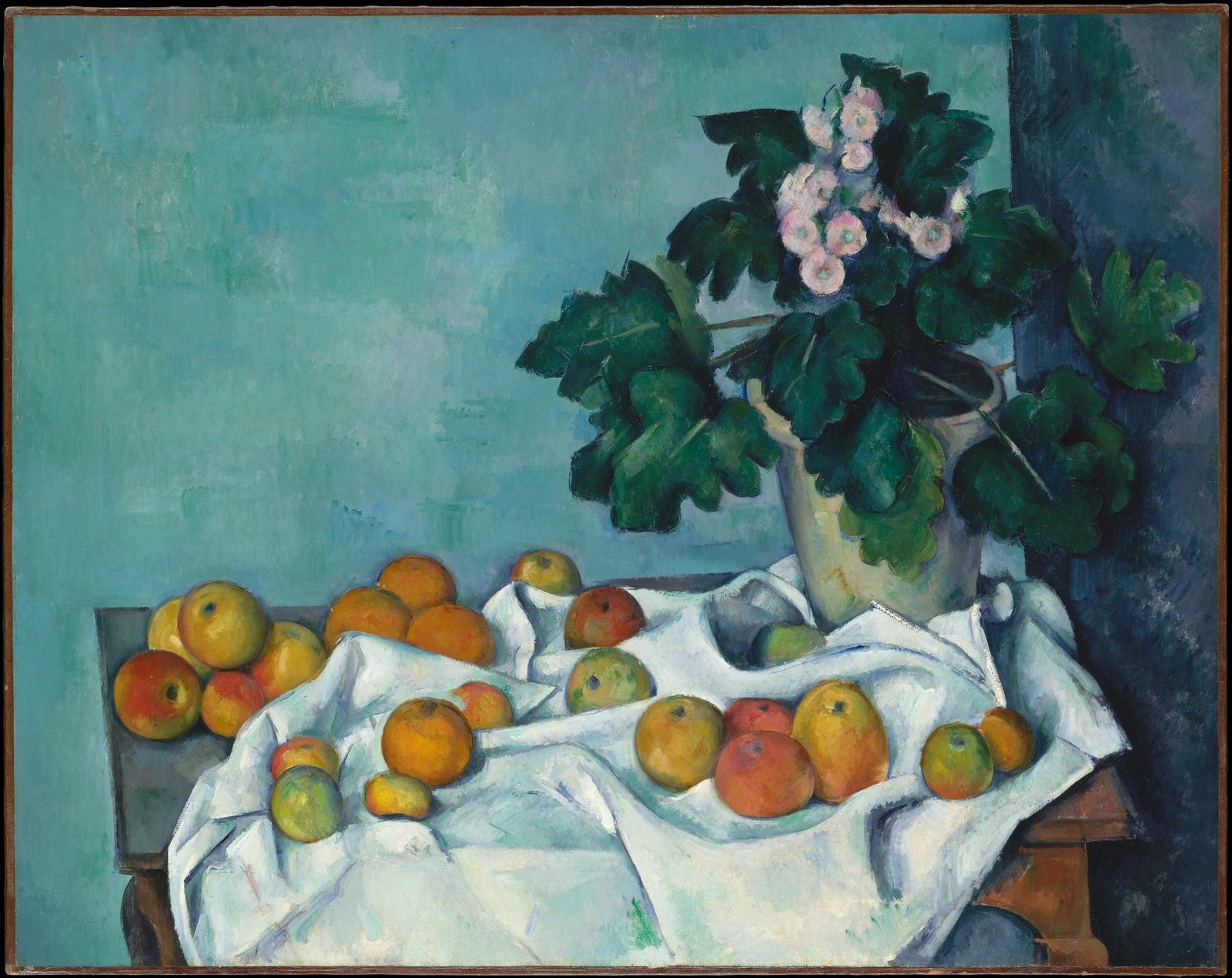
Cézanne turns an apple from yellow to orange to red to green as it rounds away from you
- Artist
- Paul Cézanne
- Title
- Still Life with Apples and a Pot of Primroses
- Date
- ca. 1890
- Medium
- Oil on canvas
- Image
- Public domain (CC0)
Open in Simple Art
Watch this story on iPhone and iPad, with offline downloads and a painting every day. This one is free in the app.
About 3 minutes of looking, in 10 parts.
Still Life with Apples and a Pot of Primroses
Apples on a white cloth, about the most ordinary subject in painting. Look how little here gets darker as it turns away from you. It changes colour instead.
Cézanne, 1890s
Cézanne spent decades on arrangements like this. A table of apples let him test how far colour alone could carry solid form.
Follow one apple round
Follow a single apple. Yellow at the top, then orange, then red as it turns away, and green right at the edge. It never simply gets darker. That green gives it away: it is the hue still travelling round the form.
Cool shadows on white
He makes the same decision on the cloth. There is not one warm grey in it. Every shadow is blue, lavender or grey-green, with a stroke of pure green, and the folds are faceted into flat planes, closer to folded paper than soft linen.
Drawn twice
Cézanne does this constantly. A green-blue edge runs down the side of this apple as a separate statement from the yellow inside it, and in places the two do not quite agree. He drew the apple, then painted it, and left both showing.
The background is not empty
From a distance the wall looks like nothing. Up close it is dozens of overlapping touches of closely related blue-greens, with lavender and grey-white worked through and bare canvas showing between them. He gives the air behind the fruit the same attention as the fruit.
Cut, not softened
The leaves are the darkest mass in the picture, and every one is cut hard against the pale wall, several reinforced with a navy contour. The stems are straight strokes laid right across the leaves. Nothing melts into anything.
The plainest flowers
The flowers should be the fussiest passage and they are the plainest: flat pink discs with a small pale centre and no modelling at all. They read as flowers because of their spacing and the darkness behind them.
Two viewpoints at once
Look at the rim of the pot. It is a wide open ellipse, so we are looking down into it from well above, yet the apples in front are seen from barely above their equator. Both can't be true. He keeps them anyway, because the open ellipse is the better shape.
One warm dark
The picture is cool almost everywhere, so he puts one block of warm red-brown wood at the very corner of the table, against the near-black hanging. That single warm dark, placed at the edge, holds the whole cool scheme down.
Look closer
8 details, each checked against a close-up of the picture.
-
apples, left cluster
Each apple turns from yellow through orange to red and green as it curves, changing hue rather than simply getting darker.
Follow one apple around. It starts yellow at the top, goes orange, then red where it turns away, and picks up a distinct green at the very edge. At no point does it simply get darker. The green is the key: it is not a shadow tone, it is the hue continuing to travel. Several apples carry a blue-grey contour, and the cloth behind them is shadowed in blue and lavender.
-
the worked background wall
The plain-looking wall is built from short parallel diagonal strokes in several close blue-greens, not laid in as a flat wash.
What looks from across the room like a plain blue-green wall is, up close, dozens of overlapping touches of closely-related hues - blue-green, sage, lavender, a warm grey-white - laid over one another without ever being blended into a single tone. Bare canvas weave shows through in places. My first reading called these parallel diagonals; they are not, they are irregular and broadly horizontal. But they are unmistakably separate touches.
-
apple with a visible contour
The apples carry a drawn blue-black contour line, and the colour inside does not always line up with it.
Look at the boundary of the yellow apple. There is a distinct green-blue edge running down its right side and under it, and it is a separate statement from the yellow inside - in places the colour and the contour do not quite agree with each other. The red apple below carries a blue-grey version of the same thing. These are not black outlines; they are contours made in colour.
-
the white cloth's folds
The shadows in the white cloth are blue and grey, and the folds are faceted into flat planes rather than rounded.
There is no warm grey anywhere in this white cloth. The shadows are blue, lavender and grey-green, with one startling stroke of pure green at the right. And the folds are not rounded - they are faceted, broken into flat planes with straight boundaries, so the cloth reads more like folded paper or a small mountain range than like soft linen.
-
the pot
The pot's rim is drawn as a wide open ellipse, implying a high viewpoint, while the objects around it are seen from much lower.
The pot's rim is a wide open ellipse - we are apparently looking down into it from well above. But the apples on the table in front are seen from barely above their equator, and the table edge is nearly level with the eye. Those viewpoints cannot both be true. Cezanne holds them anyway, because the open ellipse makes a better shape here.
-
the primrose flowers
The pink flowers are simple flat discs with a pale centre, each made from very few strokes.
For the most ornamental passage in the picture, the flowers are astonishingly plain: flat pale-pink discs, each with a small pale green-blue dot at the centre and one or two warmer pink strokes. There is no modelling inside any petal. They read as flowers entirely because of their spacing and their contrast against the very dark foliage.
-
the dark leaves
The leaves are dark green rounded shapes with hard, unblended edges where they meet the pale wall.
The leaves are dark green scalloped shapes with hard, unblended edges cut straight against the pale wall, several of them reinforced with a navy contour. The stems are drawn as straight pale-olive strokes that cut right across the leaf masses. Nothing softens into anything; the whole plant is assembled from cut-out shapes.
-
the wooden table edge
The table's wooden edge at the lower right is a warm red-brown, the only strong warm dark anywhere in the picture.
A block of warm red-brown wood at the corner of the table, sitting directly against the near-black blue-green of the hanging and the white of the cloth. In a picture that is otherwise cool almost everywhere, this is the only substantial warm dark, and it is placed at the very edge of the design.
Behind Cézanne's Primroses
Back in Aix
Paul Cézanne was born in Aix-en-Provence in 1839 and died there in 1906 [1]. He began painting in Aix in 1860 before studying in Paris. His early pictures were dark and heavily worked, and in the 1870s, encouraged by Camille Pissarro, he lightened his palette and started painting out of doors [2].
The Met dates this still life to about 1890 and connects it with his return to Aix that year [1]. It belongs to the same period as The Card Players, the series of Provençal peasants at cards that he began in 1890 [1][2].
The table helps with the dating. Its scalloped apron and bowed legs appear in other paintings and drawings made while he was living at the family estate, the Jas de Bouffan, in the early 1890s [1]. The table itself survived: John Rewald photographed it in the studio at Les Lauves around 1935, and it was still there in 1983 [1].
A rare living subject
Flowers were unusual for Cézanne. He worked so slowly that fresh blooms risked wilting, and he preferred to paint artificial ones [1]. Potted plants appear in only three of his still lifes, besides two views of the conservatory at the Jas de Bouffan and about a dozen watercolours [1].
A botanist consulted in 1982 identified the plant as closest to a Chinese primrose, Primula sinensis, and the same pink primroses in the same cream pot appear in one other canvas, Pot of Primroses and Fruit [1]. Earlier writers were less sure: catalogues of the 1930s called the plant a geranium and proposed dates ranging from about 1885 to 1894 [1].
Apples were another matter. Cézanne once told the critic Gustave Geffroy, while both were visiting Monet, that he wanted to astonish Paris with an apple [1].
A present for Monet
The painting's first recorded home was the Paris shop of Julien Tanguy, known as Père Tanguy [1]. Tanguy sold artists' supplies at 14 rue Clauzel from 1873, sometimes taking pictures in return for materials, and for a time he was Cézanne's only point of contact in Paris [3].
The painter Paul Helleu owned it next, and in 1894 he gave it to Claude Monet, sending it in late March through the dealer Durand-Ruel [1]. Monet thanked Helleu for "le Cézanne" in a letter of 21 March 1894, and on 30 March asked Durand-Ruel to send on "mon Cézanne" [1]. A Met publication of 1952 said that Cézanne himself had given the picture to Monet, but the museum's current catalogue credits Helleu, citing these letters [1].
Monet was a keen gardener with a hothouse at Giverny, and the catalogue suggests Helleu probably knew he would enjoy the subject [1]. He owned some fourteen oil paintings and one watercolour by Cézanne, the first acquired in the early 1870s from a dealer as part payment for one of his own [1]. In 1925 he lent this one to an exhibition at the Musée des Arts Décoratifs in Paris [1].
From Giverny to New York
After Monet's death in 1926 it passed to his son Michel, then through the dealers Paul Rosenberg, Bernheim-Jeune and Knoedler to the New York collector Adolph Lewisohn, who owned it by 1929 [1]. Lewisohn, born in Hamburg, was an investment banker and mining magnate known for collecting Barbizon and Impressionist painting [4].
He lent it to the Museum of Modern Art's first loan exhibition, Cézanne, Gauguin, Seurat, van Gogh, in November 1929 [1]. It passed to his son Sam A. Lewisohn in 1938 and came to The Met with Sam's bequest in 1951 [1]. Writing for the museum's Lewisohn Collection exhibition that year, Theodore Rousseau Jr. called it "one of the most balanced, carefully carried out works of the master" [1].
The Met's survey of Cézanne treats it as a mature work, built from colour rather than light and shadow [2]. The same essay notes that his way of building form with colour went on to influence the Cubists and the Fauves [2].
- Still Life with Apples and a Pot of Primroses (object record 51.112.1, with catalogue entry by Jane R. Becker, 2017) . The Metropolitan Museum of Art
- Paul Cézanne (1839–1906) (James Voorhies, Heilbrunn Timeline of Art History) . The Metropolitan Museum of Art
- Julien Tanguy . Wikipedia
- Adolph Lewisohn . Wikipedia