One glass still standing
Heda sets a single upright roemer among fallen silver, broken glass and a peeled lemon
- Artist
- Willem Claesz Heda
- Title
- Still Life with a Broken Glass
- Date
- 1642
- Medium
- Oil on panel
- Museum
- Rijksmuseum
- Image
- Public domain (CC0)
Open in Simple Art
Watch this story on iPhone and iPad, with offline downloads and a painting every day.
About 4 minutes of looking, in 9 parts.
Still Life with a Broken Glass
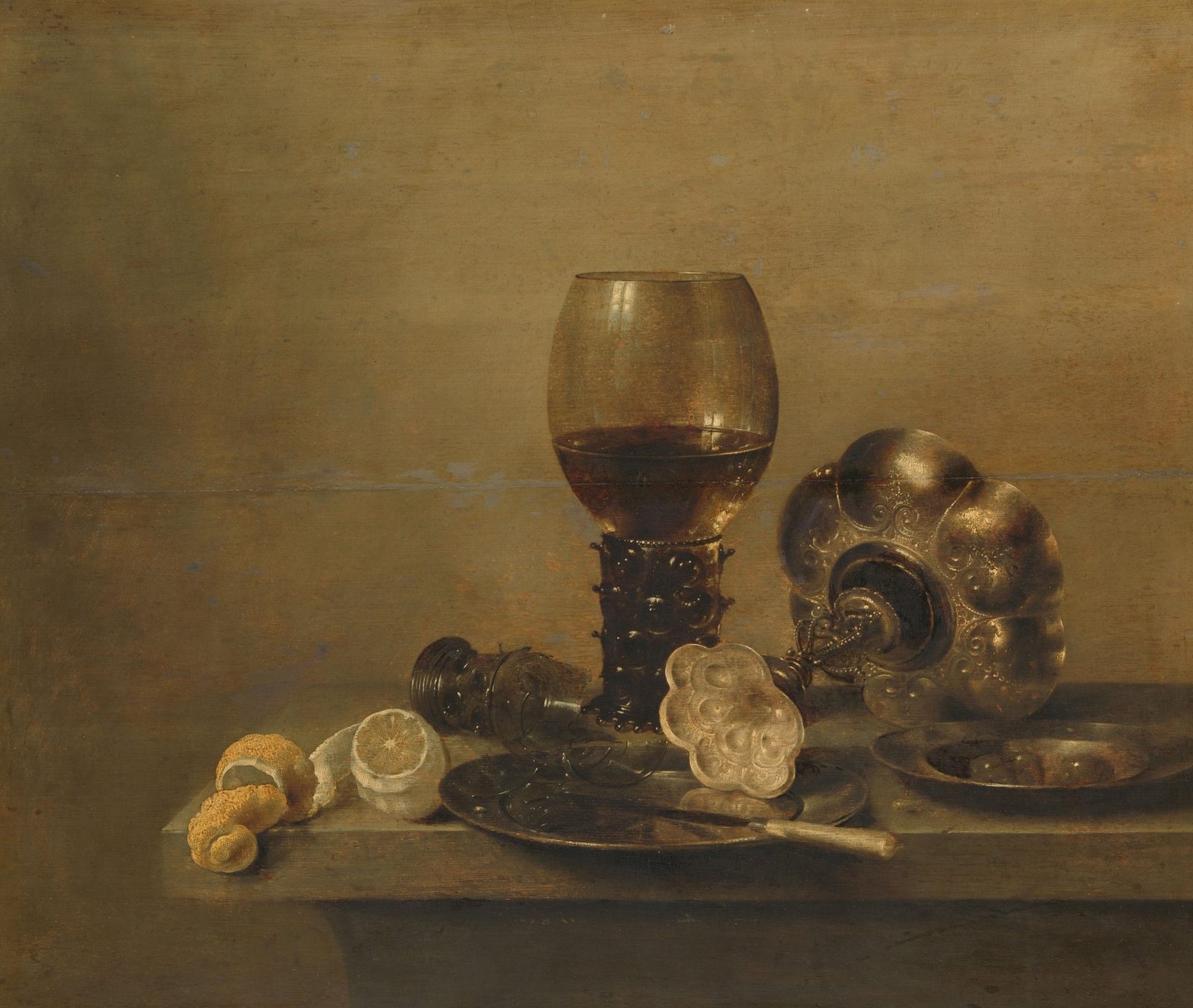
On the corner of a wooden table, one tall glass of wine stands upright. Around it, almost everything has fallen over. A second glass lies on its side, a large drinking bowl is tipped up on its rim, and a peeled lemon trails towards the edge. Keep that contrast in mind as we look.
Willem Claesz Heda, 1642, oil on panel
This is Still Life with a Broken Glass by Willem Claesz Heda, painted in 1642 in oil on panel and signed by the artist. The museum describes a corner of a wooden table, with a roemer of wine, an overturned drinking bowl, and a second roemer that has fallen and broken.
One vertical, many angles
The upright roemer is the one strong vertical. The wall behind takes up more than half the picture, and it is almost empty. Around the glass, the fallen things lie at angles, and the lemon peel leads your eye out towards the lower left.
Seeing through the glass
Light comes from the upper left. In the upright roemer, the top of the bowl is almost the colour of the wall, because we are looking straight through it. Lower down, the wine darkens the glass, and its surface is one crisp horizontal line, slightly tilted and broken where reflections cross it.
Knobs made by highlights
Down on the stem, the glass is covered in round knobs called prunts. Each one is made almost entirely by a tiny cream highlight on its upper left and a soft dark crescent beneath. There is no drawn outline. That small pair of marks is enough to lift every knob off the dark stem.
The tipped bowl
Move right to the large fluted vessel, the drinking bowl, tipped over on its side. It looks like silver. The brightest touches are small pale points on the ridges of its lobes, and lighter specks trace the engraved scrollwork, while the inside falls away into near black.
Standing and fallen
Now the fallen roemer, which the museum describes as broken. Its hollow is so dark that it merges with the shadow on the table, and only small white flickers on the rim and prunts show where it is. Drift back up to the standing glass. One you see through; the other you find only by its highlights.
A lemon in two yellows
At the corner of the table lies the peeled lemon. The curling rind runs from bright yellow on top into deep ochre in shadow, and its skin is dotted with tiny bumps, each a separate touch. Drift to the cut end beside it, where pale pulp fans out in short strokes.
A soft edge and a hard one
On the plate sits a pale rosette shape that looks like a biscuit. It has no outline. Its edge simply turns from chalky light at the upper left into ochre shadow, and its surface looks grainy. Then drift down to the knife, whose dark blade lies against the pewter with a hard, crisp edge.
Look closer
8 details, each checked against a close-up of the picture.
-
Upright Roemer Glass
The glass holds amber wine whose surface is marked by a crisp horizontal line.
The crop centers on a tall upright roemer glass whose transparent bowl is built up so the warm tan wall reads through it, with the upper half almost the value of the background and the lower half darkened by the pale amber liquid inside. A crisp horizontal line at roughly mid-bowl marks the liquid surface, slightly tilted and broken where reflections interrupt it. Below the bowl, the dark prunted stem reads as near-black silhouettes with small bright dabs of highlight sitting on each raised glass knob, indicating light from the upper left. At the lower right, a pale rosette biscuit shows embossed spiral ribs picked out by thin shadow lines, while the lower-left corner contains a fragment of a tipped vessel in deep brown with a metallic highlight along its rim.
-
Silver-Gilt Highlights
Small pale highlights sit on the curved ridges of the fluted vessel, with lighter specks tracing its engraved scrollwork.
The crop isolates a large fluted silver-gilt vessel tipped on its side, its scalloped lobes catching a warm raking light. Pinpoint and short stroke highlights of opaque pale cream sit precisely on the upper-right convex ridges, with smaller speckled highlights tracing the engraved scrollwork across the body. The interior cavity reads as near-black, framing a deep recess, while the metal surface transitions through warm amber, ochre, and umber in soft, glazed gradients. Edges between lit and shadowed zones are softened rather than crisp, suggesting successive transparent layers, and the decorative engraving is indicated by clustered pale dots and curls laid over a darker underlayer.
-
Glass Prunts
The stem of the roemer is decorated with small, protruding glass knobs called prunts.
The crop isolates the bulbous lower stem of a roemer, densely covered with rounded, protruding prunts. Each knob reads three-dimensional almost entirely through a tiny warm-cream highlight on its upper-left face and a soft dark crescent beneath, with no drawn outline. The body of the stem sits in deep near-black tonality, while the background is a warm mid-brown that lets the silhouette of the glass read clearly. At the top edge a band of amber liquid (the wine) appears, and at lower right a pale, scalloped form (a dish or plate) intrudes with a much lighter value key, giving a strong contrast to the dark stem.
-
Lemon Peel Texture
The lemon peel spirals downward with a transition from bright yellow to deep ochre in the shadows.
The crop isolates a peeled lemon whose rind curls downward in a tight spiral, the outer skin showing a dense pattern of small raised bumps (the oil glands) painted as individual dots and short dashes of bright yellow against a warmer mid-tone. The white pith along the cut edges is rendered in pale cream with soft, slightly blurred transitions into the yellow skin. Shadows under the curled peel deepen into rich ochre and near-brown, while cast shadow on the wooden ledge to the lower right fades into the warm umber table. The upper right shows the cross-section of a halved lemon with radial pulp segments barely legible under a pale wash.
-
Fallen Roemer
The fallen glass lies horizontally with its dark interior merging into the table shadow.
A dark Roemer lies on its side across a warm brown wooden tabletop, its bowl occupying the left half of the crop and its stem pointing right. The glass interior is rendered as a near-black hollow that bleeds into the cast shadow beneath the bowl, making the lower edge of the vessel hard to separate from the wood. Crisp white and pale-ochre flickers sit on the rim ring, the prunts, and along the curving belly, defining the silhouette more than the dark mass itself. A specular streak of warm umber runs along the bowl's underside, separating the glass from the table. To the right, a darker object with bead-like ornaments intrudes, and at lower left a halved lemon shows its pale segmented flesh.
-
Knife and Plate Edge
The knife blade creates a sharp, dark silhouette against the lighter surface of the pewter plate.
The crop centers on the right-hand edge of a shallow pewter dish, its rim curving as a pale, slightly desaturated band against the deep umber shadow of the table. A knife rests on the dish: its bone-colored handle (a soft cream with cooler grey-green shadow along the lower edge) is set at the right, while the steel blade extends leftward across the plate. The blade is painted as a near-black slab of tone, its upper edge a crisp, hard contour against the lighter pewter, and its lower edge catches a thin, broken sliver of cool light. Above and behind, the foot and lower body of a silver-gilt vessel rise, modeled with warm cream highlights and deep brown passages of reflected shadow.
-
Rosette Biscuit
The pale rosette-shaped object, which looks like a biscuit, has soft, unoutlined edges and a grainy surface.
The crop isolates a scalloped, rosette-shaped biscuit rendered in warm cream and tan tones, its surface built up of soft-edged circular bosses that read as the moulded petals of a flower. The edge is not outlined but instead modulated by a slow value transition from a pale, almost chalky highlight on the upper-left rim into a deeper ochre shadow on the lower-right lobe. A fine craquelure runs across the body, and a granular, stippled impasto gives the dough its porous, sugared look. Beneath the biscuit, a diffused reflection bleeds into the polished table, and to the left a darker mass (the silver-gilt vessel) presses the biscuit's edge into a cooler, neutral tone.
-
Halved Lemon Flesh
The interior of the lemon shows a pale, yellowish-white pulp with subtle directional brushstrokes.
The crop centers on a halved lemon viewed slightly from above, exposing a roughly circular cross-section of pulp. The interior reads as a pale yellowish-white mass organized by short, radial brushstrokes that fan out from a small off-center core toward a paler, raised ring of pith. To the left, a thick peeled half curls away, its rind rendered as a paler, slightly pitted mass with broken highlights. At far right, a dark glass body is reduced to a few crisp specular dots against deep umber; the wooden ledge below sits in a low-contrast olive-brown plane. Edges where pulp meets pith are softly turned, while the outer rind silhouette is firmer, suggesting a wet-into-wet blend for flesh and a drier pass for contour.
Still Life with a Broken Glass in context
A table corner and a doubtful digit
The Rijksmuseum describes the scene as the corner of a wooden table with an overturned drinking bowl, a roemer of wine, a second roemer that has fallen and broken, two pewter plates with a knife and olives, and a peeled lemon on the corner [1]. Only traces of the signature survive on the right edge of the table, read as 'Heda. 164[2?]' [1]. The museum dates the panel to 1642, but the question mark in its own transcription shows the last digit isn't certain [1].
An old structure, a looser grip
In the museum's 2007 catalogue, Jan Piet Filedt Kok calls this a fairly simple still life with the same monochrome tonality and structure as similar works from the 1630s, but finds less cohesion between the objects [1]. The tazza with engraved lobes, whose foot is reflected in the pewter dish, appears in earlier Heda still lifes dated 1631 and 1634 [1].
For comparison, the Thyssen-Bornemisza museum says that in the 1630s his compositions stopped being a random display of objects and sought a balance between vertical and diagonal elements [2].
Heda in the 1640s
Wikipedia, drawing on Ingvar Bergström's 1956 study, says that in the 1640s Heda began adding crumpled napkins and knocked-over vases, making it harder to keep order in a deliberately disordered scene [3]. The Thyssen-Bornemisza museum adds that in his last phase he brought in luxuries such as Venetian glass, ornamental silver and oriental porcelain, probably under the influence of Willem Kalf [2].
The Rijksmuseum's biography places several events around the date on this panel. Heda served as a corporal in Haarlem's St George Civic Guard from 1642 to 1645, took Hendrik Heerschop into his workshop in 1642, and saw his son Gerrit sign some works 'jonge Heda' between 1642 and 1644 [1]. The Thyssen-Bornemisza museum notes that father and son are hard to tell apart [2].
A collector's gift to the city
The painting was offered at the sale of Gijsbert de Clercq (1850-1911) in Amsterdam, held by F. Muller on 1 June 1897, as lot 34, and was bought in [1]. De Clercq gave it to the City of Amsterdam in 1898, and it has been on loan to the Rijksmuseum ever since [1].
The museum rates its condition as fair, with a severely abraded paint surface, discoloured retouching along the joins of its two oak planks, and discoloured varnish [1]. The paint is thin and smooth, with thicker strokes for the highlights on the silver [1].
- Willem Claesz Heda, Still Life with a Broken Glass (SK-C-610): object record and catalogue entry (Jan Piet Filedt Kok, 2007) . Rijksmuseum, Amsterdam
- Willem Claesz. Heda: artist biography . Museo Nacional Thyssen-Bornemisza, Madrid
- Willem Claesz. Heda . Wikipedia