Gold among the greys
How Heda makes one gilded tankard glow on a quiet table of glass, pewter and shadow
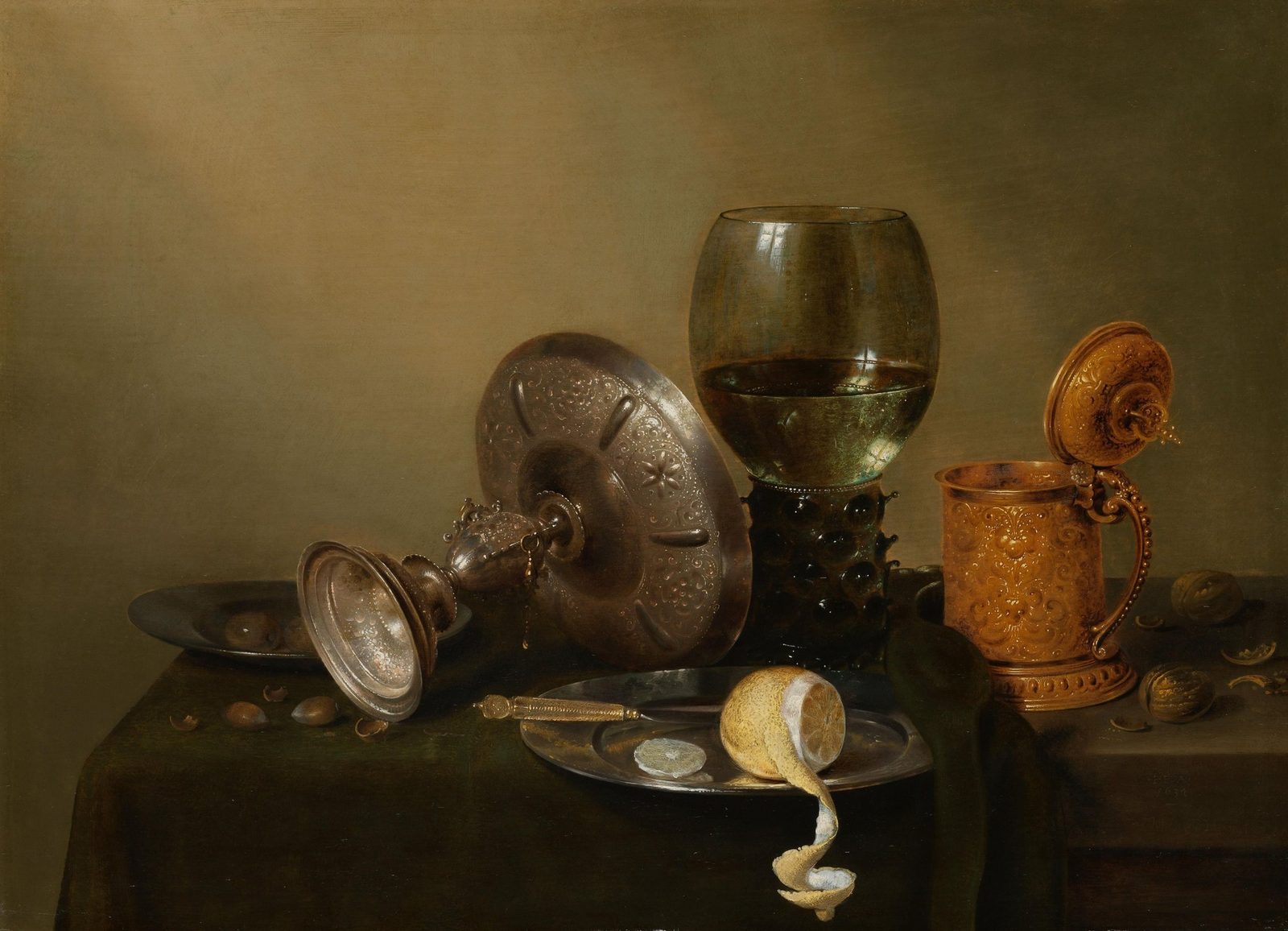
- Artist
- Willem Claesz Heda
- Title
- Still life with a Gilded Beer Tankard
- Date
- 1634
- Medium
- Oil on panel
- Museum
- Rijksmuseum
- Image
- Public domain (CC0)
Open in Simple Art
Watch this story on iPhone and iPad, with offline downloads and a painting every day.
About 4 minutes of looking, in 9 parts.
Still life with a Gilded Beer Tankard
A tall glass of wine, a stemmed dish tipped on its side, a gilded tankard with its lid thrown open, and a lemon half peeled. Nearly everything here is brown, grey or olive green. Look for the few places where the light catches, because that is where this painting happens.
Willem Claesz Heda, 1634, oil on panel
Willem Claesz Heda painted this breakfast piece in 1634, in oil on panel, and signed it at the lower right. The museum calls it a classic combination: a large roemer, a tazza on its side, and a pewter plate with a lemon. It was long credited to another painter, until restoration in 1918 revealed Heda's signature.
A low triangle
The objects build a low triangle. The tipped tazza holds the left, the tankard holds the right, and the tall roemer forms the peak. The edge of the table sits well below the middle, so everything rises against the plain wall behind.
A window in the glass
The light comes from the upper left, and the roemer shows it best. Near the top of the bowl is a tall pale shape that looks like the reflection of a window. Halfway down, one crisp horizontal line marks the surface of the wine, with a small bright highlight sitting on it.
Bright dots on dark knobs
Below the bowl, the stem is studded with round glass knobs called prunts. They are almost black, and each one carries a tiny white speck on its upper left side. There is no outline. The same small mark, repeated in the same place, is enough to make every knob swell.
Gold made of small touches
The museum describes the tankard as gilded silver, and it is the warmest thing on the table. Look at the raised ornament. The brightest golden touches sit only on the tops of the forms, while the hollows stay a deep brown. Then drift up to the open lid, where the light runs along the curve of the dome.
The peel that hangs free
On the pewter plate, the lemon has been partly peeled, and a long strip of rind curls down past the edge and hangs in the air. The pith inside the curl looks thick and spongy, painted in broken pale strokes. It is the one shape on the table that seems to move.
A ribbon of light
Follow the rim of the plate. Along its front edge, a thin ribbon of light separates the pewter from the dark cloth below. The knife handle appears to be gilded too, picked out in small grainy touches, while the blade thins almost to nothing where it meets the plate.
Dull against shine
At the far right lie a few walnuts and broken shells. After the glass, the gold and the pewter, they come as a relief. There is no sparkle at all, just a dull brown body, fine cracks and a soft shadow. Seen beside the tankard, they make the metal look brighter still.
Look closer
7 details, each checked against a close-up of the picture.
-
Roemer Glass
The wine level is marked by a crisp horizontal line with a bright specular highlight on the glass surface.
The crop centers on the bowl and prunted stem of a roemer glass. A crisp horizontal line cuts across the middle of the bowl marking the wine's surface, with a bright specular highlight (a small cream-white cluster) sitting just to the right of center on the glass body. Above the wine line the bowl reads as warm transparent amber with a tall, pale rectangular window reflection on the upper left; below the line the glass interior darkens into deep olive-green and umber, with curving greenish reflections in the lower bulb. At the bowl's foot a ring of tiny bright dabs separates the bowl from the dark prunted stem, whose rounded bumps are modeled with near-black values and pin-point highlights. To the left edge the overturned silver tazza is visible, its surface stippled with pale dots of chased ornament against a brown-ochre background.
-
Peeled Lemon
The lemon peel spirals downward with visible thickness and a textured, porous white pith.
The crop shows a partially peeled lemon resting on a pewter plate with a knife blade entering at the left edge. The exposed cut face of the lemon reveals segmented pulp in muted ochre tones, while a single broad strip of peel detaches at the upper right and spirals downward in a loose S-curve, twisting so the white pith faces alternately toward and away from the viewer. The pith reads as a thick, ridged, porous band of off-white to pale gray, with visible scumbled brushwork giving it a spongy, broken texture rather than a smooth surface. The yellow rind is stippled with darker brownish-ochre flecks, and the dark background pushes the peel forward through sharp value contrast along its outer edge.
-
Gilded Tankard
The tankard features high-contrast golden ochre highlights against deep brown shadowed recesses in the repoussé work.
The crop centers on a gilded tankard with an open, scrolled lid and a beaded handle rising to the upper right. Repoussé scrollwork, foliate bosses, and a beaded lower band are rendered with bright golden-ochre highlights catching the tops of the raised forms and deep umber-brown shadow pooling in the recesses. The brightest dabs are small, broken specks rather than continuous strokes, giving the gilt a granular, slightly crusted appearance. The rim catches a continuous band of warm light at upper left, falling off to a cooler brown at lower right, consistent with light from the upper left. Background is a muted olive-brown that sits close in value to the tankard's shadow side, so the silhouette of the vessel reads mainly through its own internal highlight pattern rather than against a contrasting field.
-
Glass Prunts
The nodules on the roemer stem have bright, pinpoint white highlights reflecting a light source from the left.
A vertical column of bulbous glass prunts climbs the roemer stem, each node carrying a small, hard white speck on its upper-left curvature. The prunts read as near-black silhouettes against the slightly lighter glass body, with the leftmost edge of the stem catching a cooler, lighter rim that separates it from the engraved pewter plate. A horizontal band of tiny beaded glass dots sits just under the bowl, each dot carrying its own miniature highlight on the same upper-left bias. At the top edge of the crop, transmitted light through the bowl turns the glass olive-green, the only chromatic break in an otherwise near-monochrome umber field.
-
Knife and Plate Edge
The rim of the pewter plate catches a thin ribbon of light that separates it from the dark cloth, and the thin knife blade tapers almost to nothing against the plate.
The crop isolates a horizontal band where a knife with an ornate gilded handle rests across an upright pewter plate, alongside a partially peeled lemon. The plate's rim catches a thin ribbon of light along its lower edge, separating it cleanly from the deep umber-black of the table beneath. The knife handle shows granular gold impasto with small dark puncture marks suggesting filigree, while its thin blade tapers to a near-invisible point where it meets the plate. The lemon's rind is built from broken yellow-ochre and cream scumbles over a warmer ground, with a pith ring described in cool white, and a curling peel trailing off the right edge.
-
Walnuts
The walnut shells show a matte, irregular texture with fine organic cracks and a soft shadow cast on the table.
Two walnut shells dominate the crop: an intact, rounded shell in the upper right with a network of fine meandering fissures catching faint cool light, and a halved shell in the lower center exposing a ridged, lighter interior kernel. Scattered shell fragments and slivers lie across a deeply toned, near-black tabletop. At the left margin, a curved gilded edge (the tankard) with a row of small dark studs shows warmer, slightly reflective tones that contrast with the matte organic shells. Shadows are soft-edged and pool beneath the shells toward the lower right, consistent with light from the upper left.
-
Tankard Lid
The open lid of the tankard reflects light on its curved upper surface and shows a detailed finial.
The crop isolates the upturned lid of a gilded tankard rendered against a dark olive background. The curved upper surface carries broad, broken strokes of pale ochre and cream that trace the convex swell of the dome, while the interior face reveals stamped or cast scrollwork outlined in impasto ridges of light. Deep umber and near-black passages sit in the recesses between the foliate ornaments, giving the relief its three-dimensional legibility. A small finial extends to the right, painted with a cluster of bright specular touches that read as gilded grape or foliate ornament. Edges between the lid and the background are softened with thin scumbled halos rather than hard contours.
Still Life with a Gilded Beer Tankard in context
Two signatures
This small panel carries two signatures. At the lower right is 'HEDA . / 1634', and beneath it a false one reading 'Johan d. Heem. ƒ. 1640' [1]. The museum's first catalogue, of 1809, listed the picture as a work by Jan Davidsz de Heem, and it is one of the Rijksmuseum's earliest acquisitions [1]. It came to Amsterdam from the Nationale Konst-Gallery in The Hague in 1808, but nothing is known of its earlier history [1]. Catalogues from 1853 onwards named first the Van der Pot and then the Van Heteren Gevers collection as its source, yet neither contained a painting with this subject [1].
From De Heem to Claesz to Heda
In the 1887 Rijksmuseum catalogue Bredius pointed out that the De Heem signature had been added later, and he gave the picture to Pieter Claesz instead [1]. It was catalogued under Claesz's name in 1887 and 1903 [1]. A restoration in or shortly before 1918 uncovered Heda's own signature and the date 1634 [1].
In the museum's 2007 catalogue, Jan Piet Filedt Kok explains that the names of both Claesz and Heda had fallen into oblivion in the eighteenth century, and that the De Heem signature was undoubtedly meant to make the painting easier to sell [1]. Wikipedia similarly notes that Arnold Houbraken mentioned Heda only briefly and that later writers left him out. It credits the French critic Théophile Thoré with rediscovering him in the nineteenth century [3].
A breakfast piece by formula
He calls the work a typical Heda breakfast piece: a green cloth set with the classic combination of a large roemer, a tazza on its side and a pewter plate with a lemon [1]. The Thyssen-Bornemisza museum credits Heda and Pieter Claesz together with developing this kind of still life, and notes that Heda reused a limited range of objects yet made each painting unique [2]. The tazza with petal motifs here turns up in many of his paintings dated between 1632 and 1654, including the Still Life with a Gilt Cup of 1635 [1].
A tankard seen only once
The addition is the gilded silver beer tankard with its lid, which appears only once in Heda's work and is probably German [1]. Writing in 1988, the scholar Segal compared it with a similar tankard made around 1610 in Nuremberg by Elias Geyer, a silversmith from Leipzig [1]. The catalogue doesn't link the tankard to Heda's own life, but he had ties to the trade. He married a Haarlem brewer's daughter in 1619 and, through family ties to several brewing families, became professionally involved in the beer industry [1].
The panel and the painter
The single oak panel may have been trimmed slightly at the left and right [1]. Tree-ring dating suggests it could have been ready by 1632, but more likely in or after 1634 [1]. The museum rates its condition as fair, with a thick varnish that has severely discoloured [1].
The Rijksmuseum gives Heda's birth as 14 December 1594 in Haarlem and his death there in 1680 [1]. Other sources are less precise. The Thyssen-Bornemisza museum says he was born in 1593 or 1594, and Wikipedia places his death in 1680 or 1682 [2][3].
- Willem Claesz Heda, Still Life with a Gilded Beer Tankard (SK-A-137): object record and catalogue entry (Jan Piet Filedt Kok, 2007) . Rijksmuseum, Amsterdam
- Willem Claesz. Heda: artist biography . Museo Nacional Thyssen-Bornemisza, Madrid
- Willem Claesz. Heda . Wikipedia