A table in shades of grey
How Willem Claesz Heda tells pewter, silver, glass and linen apart with almost no colour
- Artist
- Willem Claesz Heda
- Title
- Still Life with a Gilt Cup
- Date
- 1635
- Medium
- oil on panel
- Museum
- Rijksmuseum
- Image
- Public domain (CC0)
Open in Simple Art
Watch this story on iPhone and iPad, with offline downloads and a painting every day.
About 4 minutes of looking, in 10 parts.
Still Life with a Gilt Cup
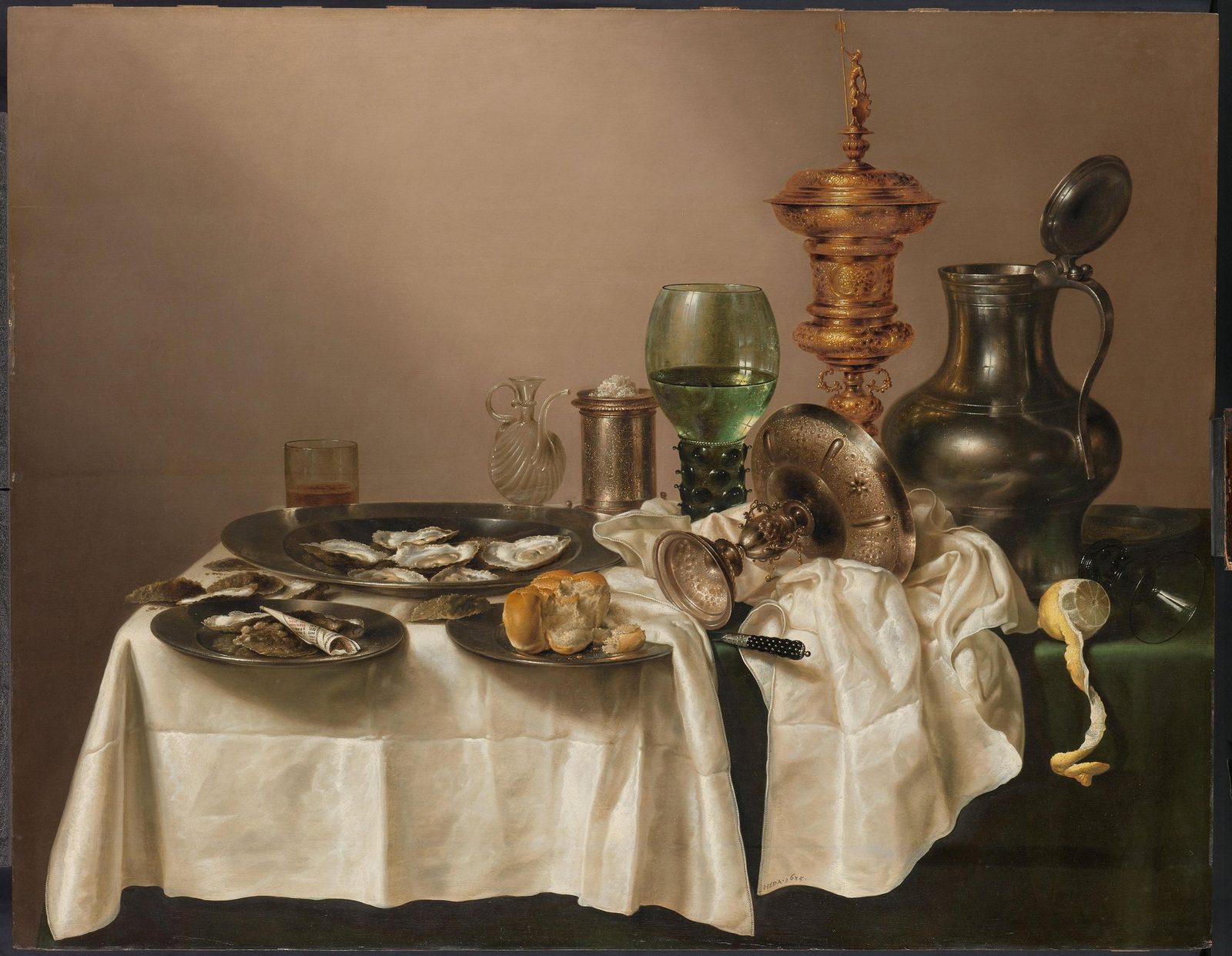
A table has been laid and then left. Oysters lie open, a roll is torn in half, and a silver bowl has tipped into the napkin. Above it all rises a tall gilt cup. Nearly everything here is grey, cream or brown.
Willem Claesz Heda, 1635, oil on panel
Willem Claesz Heda signed and dated this in 1635. It's oil on panel, over a metre wide. Heda specialised in tonal banquet pieces, near-monochrome tables where pewter, silver, linen and glass are told apart by small shifts of grey.
A long table and one tall cup
The design is simple. The tabletop runs across like a long shelf, and the gilt cup is the one strong vertical, near the right-hand third. Your eye tends to start at the little figure on its lid, slide down to the jug, then wander left along the plates.
The gilt cup
Come closer to the cup. It rises in stacked tiers, from a scrolled foot to a domed lid. The embossing seems to be suggested with tiny dark pits beside tiny bright dots. On the very top stands a small figure holding a spear.
Light on pewter
The light comes from the upper left, and the pewter jug shows it gently. A soft, pale highlight curves down its left shoulder with no hard edge, while the right side sinks towards black. Compare the sharp glints on the gilt cup. That difference helps tell the metals apart.
The green roemer
The strongest colour here is this green roemer, a wine glass with a studded stem. The museum says it holds white wine; you can see the level as a faint line across the bowl. A pale curved reflection inside looks as if it might come from a window.
Oysters and bread
On the pewter dish, the open oysters are pale and creamy inside, each edged with a hair-thin dark line. Now drift right to the torn roll. Its crust catches the light, and the broken crumb looks porous, made of short granular marks.
A half-peeled lemon
At the right edge sits a half-peeled lemon, its rind hanging in a long spiral off the table. The cut face is painted thinly, with fine lines for the segments. The peel looks more heavily loaded, with ochre-yellow touches along each twist.
Standing and fallen
Now compare two pieces of silver. The gilt cup stands upright in full light. Below it, a silver drinking bowl on a foot lies tipped into the napkin, showing its engraved underside with the white cloth reflected in it. One is on display; the other looks like a small accident.
The napkin and the signature
The napkins hold the widest range of tones in the painting, from near-black in the deepest folds to cool ivory on the ridges. The whites look bright mainly because of the darks around them. Now follow the cloth down. There, in small dark letters, is the signature: HEDA, 1635.
Look closer
9 details, each checked against a close-up of the picture.
-
Lidded Gilt Cup
The cup features intricate embossed gold decoration and a tall, slender finial.
A tall lidded gilt cup dominates the crop, rendered in warm yellow-browns with crisp specular highlights along its left-facing edges and a small standing figure finial holding a vertical staff or spear. The cup is built from stacked tiers—a domed lid, a wide rim, a cylindrical body bearing a circular medallion, a swollen lower bulb, and a foot with scrolled brackets—each tier separated by raised bands that catch thin lines of light. Embossed ornament (rosettes, scrollwork, stippled fields) is conveyed through miniature dark pits next to tiny bright dots rather than actual relief. Background is a flat warm grey-brown, pushing the gilt forward; a green-tinted glass enters at lower-left and a pewter dish and jug silhouette at lower-right.
-
Possible Signature
Faint dark lettering, possibly reading 'HEDA', is visible on the cloth near the bottom edge.
The crop shows the lower corner of a cream-toned linen cloth folded back against a dark brown table surface. A zigzag or scalloped decorative trim runs vertically along the left edge of the cloth. In the upper center, faint dark script reads 'HEDA' followed by what appears to be additional small characters (possibly a date). The cloth has soft tonal modulation from warm ivory in the lit areas to a slightly cooler grey-cream in shadow, while the table reads as a near-black brown with subtle wood-grain texture visible as faint horizontal streaks. The boundary between cloth and table is a sharp painted edge with no blending.
-
Pewter Jug Highlight
A soft, diffuse white highlight curves along the left shoulder of the jug.
A large dark pewter jug dominates the center, its bulbous body and tall cylindrical neck rendered in deep olive-browns grading to near-black in the core shadow on the right. Along the upper-left shoulder, just below the rim flange, a broad, softly-diffused pale highlight curves down and outward, following the convex swell of the form. A second, sharper pinpoint of brighter cream sits on the upper rim's inner left edge. The highlight is feathered—no hard contour line separates it from the mid-tone; the value transition is a smooth gradient. To the left, an ornate gilt cup shows warm golden relief; below, a roemer glass and rumpled white linen catch the same upper-left light.
-
Overturned Silver Bowl
An overturned silver drinking bowl on a foot shows engraved decoration and reflections of the white cloth.
The overturned cup's circular base displays fine engraved floral/radial motifs rendered in darker value against a warmer silver ground, with bright specular highlights concentrated on the left arc consistent with upper-left illumination. The bulbous stem shows ornate grapevine-like decoration with tiny gold-toned accents applied as small dots. The base merges softly into the rumpled white linen beneath; the cloth's folds are painted with cool gray shadows and bright peaks, with the cup's curved rim casting a subtle reflected warm tone into the adjacent linen. Beyond the stem, the tazza's own broad engraved bowl exhibits fine scrolling linework and stippled dot patterns with bright highlights along its rim and darkened center recess.
-
Green Roemer Glass
A green roemer, a glass with a studded stem, holds a pale liquid with a visible level line and a bright highlight on the rim.
The crop centers on a bulbous roemer glass rendered in olive-to-forest greens, its bowl swelling above a prunted stem of dark glass bumps ringed with raised knobs. A horizontal meniscus line crosses the lower third of the bowl, marking the wine level, with the liquid above reading as a paler yellow-green and the empty upper bowl reading as a cooler, desaturated green-grey. Bright opaque touches sit on the upper-left rim curve and along the left shoulder of the bowl, while a warm, near-white reflection arcs across the upper right interior, suggesting a window. The prunts cast small dark drop-shadows to their lower right, and we can see the back row of prunts through the transparent lower stem. Edges are crisp on the rim but soften through the belly where the glass body transmits the background color.
-
Lemon Peel
The lemon's cut face is painted thinly with fine segment lines, while the spiral peel carries more loaded ochre-yellow highlights.
The crop centers on a partially peeled lemon: the cut face sits upper-middle, exposing radial segment lines that converge on a small pale core, while a long spiral of peel descends and curls at the bottom. To the left, softly folded white linen shows broad, blended highlights against cool shadow. The lemon's interior is modeled with thin, slightly broken radial strokes marking the segment membranes, with a pale yellowish-cream tone overall; the paint surface here appears thinly layered rather than built up in distinct thick dabs. The outer rind of the peel shows thicker, more loaded ochre-yellow touches that catch light along the curl's ridges, contrasting with the smooth dark green-black ground behind.
-
Linen Folds
Deep brown shadows contrast with bright white highlights in the rumpled cloth.
The crop is dominated by a large sweep of rumpled cream-colored linen with deep recesses. The value range is wide: near-black warm browns in the deepest folds, medium ochre-tinted greys on the mid-tones, and a cool ivory-white on the highest ridges. Fold transitions are mostly soft, but crisp cast-shadow edges appear where the cloth meets itself. Fine parallel dark lines along the hem and an inner stripe indicate a single careful stroke laid wet-into-wet over a lighter base. The signature 'HEDA 1635' sits on a relatively flat mid-tone patch in the lower-center.
-
Shellfish Plate
The oysters are defined by thin, dark contours against a pale, creamy interior.
A large pewter-toned plate occupies the center, holding five open oyster shells whose interiors are pale cream and bone-white. The shells are bordered by very thin, dark brownish-grey contour lines that separate the bright flesh from the dark metal of the plate. Below the plate, additional oyster shells and a tipped vessel rest on rumpled white linen. At right, a torn roll of bread with golden-brown crust catches strong light, while a roemer glass and the base of a silver jug recede in the upper background. A consistent upper-left light source creates bright highlights on the left rims of shells, the bread's upper crust, and the glass base.
-
Bread and Knife
A small knife with a dark handle rests next to a piece of broken bread.
A torn loaf of bread sits on a pewter plate, its golden-brown crust catching light on the upper-left shoulder while the broken face exposes a pale, porous crumb rendered with short, granular marks. Crumbs scatter across the plate's reflective surface, which carries a sharp specular highlight along its front rim. At lower right, a small knife with a dark, riveted handle lies on the linen, its steel showing a cool grey-blue tone against the warm white drapery. The foot of the tipped silver bowl at upper right displays a hammered dimpled texture, its lit face brushed with cool greys and its shadow side pushed into deep umber.
Still Life with a Gilt Cup in context
Heda's grandest panel
In the Rijksmuseum's 2007 catalogue of Dutch paintings, Jan Piet Filedt Kok calls this sumptuous still life the largest and most impressive of Willem Claesz Heda's paintings [1]. Heda was born in Haarlem in 1594 and died there in 1680. Almost all his known paintings are still lifes, mostly breakfast and banquet pieces [1]. And this one is signed and dated 'HEDA. 1635' at the lower end of the left-hand edge of the tablecloth on the right [1].
The panel is made of four horizontally grained oak planks [1]. Heda painted the scene from the back to the front, leaving spaces in the background for the objects [1].
A step in a Haarlem tradition
Filedt Kok places the picture in a sequence within the Rijksmuseum itself. A large still life of about 1615 by Floris van Dijck marks the beginning of the Dutch tradition of this genre. A banquet piece of 1627 by Pieter Claesz shows it in its maturity, and this work illustrates the next stage [1]. Claesz's varied colours give way here to a more muted palette. Greys, some tending towards blue, predominate alongside whites, greens and yellows [1].
Heda and Claesz were both named as painters of banquet pieces in Samuel Ampzing's 1628 description of Haarlem [1]. Wikipedia describes the two as the leading exponents of the breakfast piece, working with subdued, almost monochrome palettes [3]. The Thyssen-Bornemisza museum likewise credits them jointly with developing the type, and singles out Heda's greys and earthy browns [2].
Silver lent by the guilds
The museum lists a pewter plate with bread, a pewter dish of oysters, a glass of red wine, a small glass jug for oil or vinegar, a silver salt cellar, a roemer of white wine, a silver tazza on its side, the covered cup of gilt silver, a pewter wine jug and a berkemeier lying down [1].
According to the catalogue, luxurious cups of this kind usually belonged to town councils and guild boards, were used on official occasions, and were evidently also lent to painters as models [1]. It points to a gilt cup crowned by St George in a painting of 1612 by Clara Peeters, and to a version with slightly different details by Claesz in 1624 [1]. Several of the objects return in other Heda pictures, among them the tazza with floral motifs in his 1634 Still Life with a Gilded Beer Tankard, the big pewter jug, and the little vinegar jug of Venetian glass [1].
A mirror image and its copies
Almost all of these objects reappear in Heda's Banquet Piece with Mince Pie in the National Gallery of Art in Washington, also dated 1635 [1]. That picture is as wide as the Amsterdam panel but much taller. It's painted on canvas, and is virtually its mirror image [1]. Heda made only a few such sumptuous still lifes. He painted the earliest on panel, and most of those after 1649 on canvas [1]. Several seventeenth-century copies of this painting exist on canvas, and one adds a woman on the left and a basket of cheese on the right [1].
From a French château to Amsterdam
According to a 1977 sale catalogue, the panel belonged to the Richedot family, whose collection was formed in Holland in the seventeenth century and kept from the eighteenth century until the 1970s at the family seat, the Château de Choisey near Dole in the Jura [1]. It was sold in Paris at the Palais d'Orsay on 13 December 1977 [1]. In 1984 the museum bought it from Noortman and Brod Gallery in London for 3,000,000 guilders. The purchase had support from the Vereniging Rembrandt, the Jubileumfonds, the Dutch State and the Rijksmuseum-Stichting [1].
- Willem Claesz Heda, Still Life with a Gilt Cup (SK-A-4830): object record and catalogue entry (Jan Piet Filedt Kok, 2007) . Rijksmuseum, Amsterdam
- Willem Claesz. Heda: artist biography . Museo Nacional Thyssen-Bornemisza, Madrid
- Pieter Claesz . Wikipedia