A watch left open
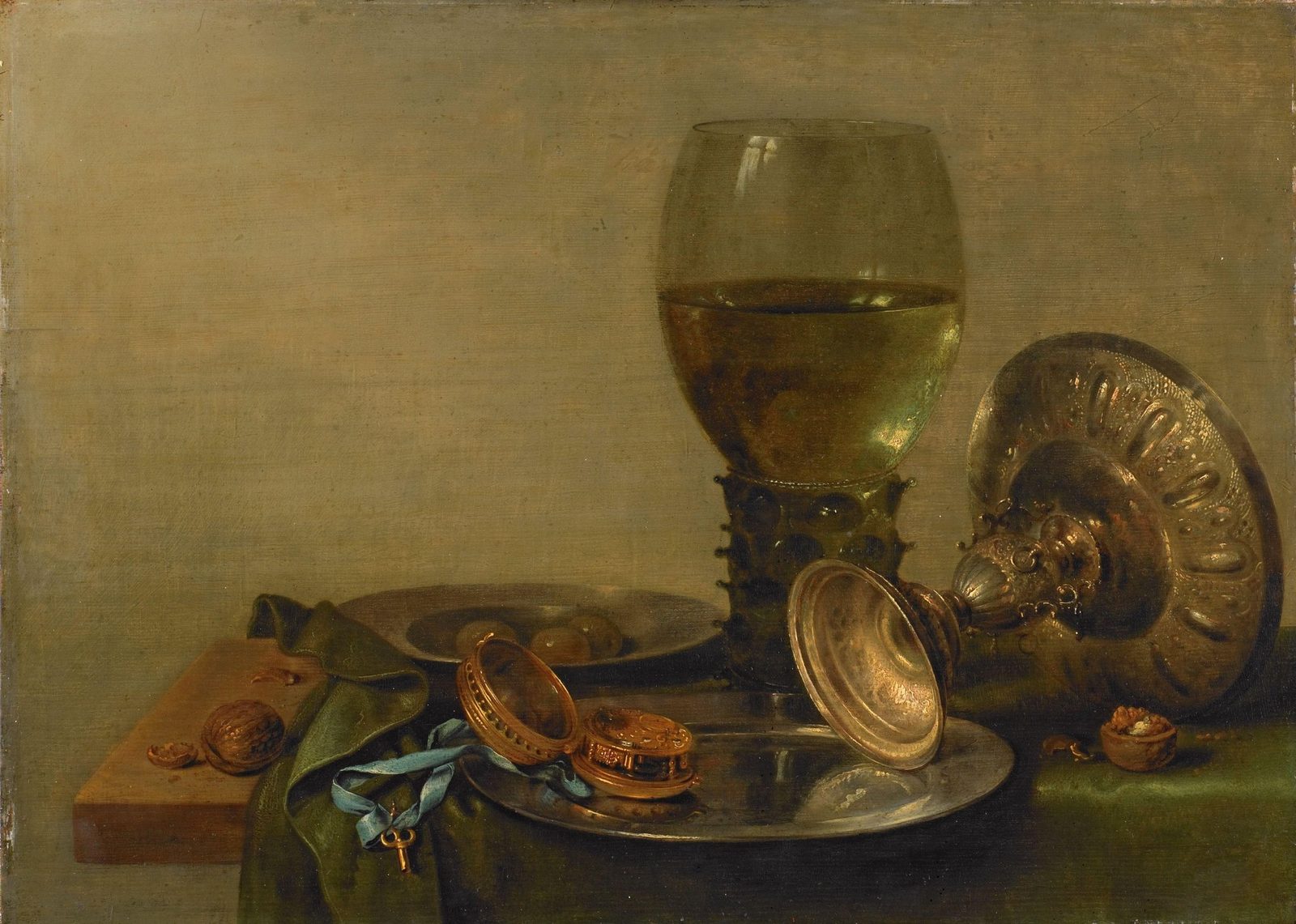
Heda lays a gold watch, a toppled silver tazza and a brimming roemer across a table in quiet greys and greens
- Artist
- Willem Claesz Heda
- Title
- Still Life with a Silver Tazza
- Date
- 1630
- Medium
- oil on panel
- Museum
- Rijksmuseum
- Image
- Public domain (CC0)
Open in Simple Art
Watch this story on iPhone and iPad, with offline downloads and a painting every day.
About 4 minutes of looking, in 9 parts.
Still Life with a Silver Tazza
A tall glass stands full on a table. Beside it a silver cup lies on its side, and in front a gold watch has been left open, trailing a pale blue ribbon. Almost everything is grey, olive or brown, and that hush is the first thing to notice.
1630, oil on panel
This is Willem Claesz Heda's Still Life with a Silver Tazza, painted in oil on panel. Traces of his signature and the date, Heda 1630, survive on the edge of the table at the left. The Rijksmuseum lists a roemer, a tazza, a small watch, two pewter plates, olives and walnuts on a partly covered table.
Upright glass, fallen cup
The table edge runs low across the picture, leaving a wide plain wall above. The roemer is the one tall upright. The toppled tazza makes a long diagonal down to the right, and the small objects, the watch, plates and nuts, are spread along the front edge.
One cool note
Nearly every colour here is warm or olive: the wall, the table, the green cloth, the gold. The exception is the ribbon. Its lit ridges are pale cerulean, and its undersides sink to deep navy. That one cool note is enough to pull your eye down to the front.
The line of the wine
Now look at the roemer. The bowl is built of muted greenish tones, and a crisp horizontal line crosses it where the liquid's surface sits. Up at the left edge of the rim, a soft highlight follows the curve. Below, the knobbly stem is almost black.
The open watch
In front lies the gold watch, its lid flipped open. Its gleam isn't one continuous line. Look at the rim, the pierced decoration and the little row of beads on the lid, and you'll find separate small dabs of cream and pale yellow, set where the light from the upper left would catch.
The tazza on its side
Now cross to the fallen tazza. We're looking at the underside of its bowl, where embossed lobes fan out from the centre. Each one catches a thin sliver of light along its crest, while the hollows stay dark, and a curved reflection glimmers inside the rim.
Walnuts, painted thicker
At the lower left are walnuts, and here the paint seems to change. The shells are made of short, thick dabs of light ochre over darker brown, with little commas of light along the ridges. The broken shell's jagged edge is built from separate touches, not a drawn outline.
Bumps on the stem
Go back up to the roemer's stem and its rounded glass bumps. Each one gets a faint olive light on its upper left and a near-black shadow below. There's hardly any white at all, yet you read every bump as round.
Look closer
8 details, each checked against a close-up of the picture.
-
The Roemer Glass
The liquid surface creates a sharp horizontal line with a bright highlight on the left rim.
The crop centers on a large roemer whose bowl occupies most of the frame, rendered in muted greenish-olive tones against a warm ochre ground. A sharply defined horizontal line crosses the bowl at roughly its midpoint, marking the meniscus of a translucent amber liquid; the surface reads as a crisp dark band with a subtle lighter rim. The upper-left edge of the bowl catches a bright, soft-edged highlight, while the lower bowl dissolves into deeper brown-greens where the glass thins and refracts the background. Below the bowl, the coiled stem and prunts are nearly black, with a few pinpoint speculars hinting at a wet, bumpy surface. The upturned foot of the toppled tazza intrudes at the lower right, and its embossed stem enters at the right edge.
-
Blue Ribbon Accent
A bright blue ribbon contrasts sharply against the dark green cloth and ochre background.
The crop centers on a loosely knotted blue ribbon whose folds twist in a roughly S-shaped gesture across the frame. The ribbon's lit ridges read as a pale cerulean-blue, while the underside of each loop drops into a deep navy that nearly merges with the surrounding darks. Behind it, a dark olive-green cloth is rendered with broader, slightly scumbled brushwork whose diagonal strokes catch muted highlights. At the upper right, a curved ochre-gold object shows a row of circular indentations painted with small curved marks. A small brass-colored fitting (key bow) sits at the bottom edge, painted with a warm yellow-ochre highlight against the green.
-
Watch Highlights
Small cream and pale yellow dabs pick out the rims, pierced decoration and raised bosses of the open gold watch.
The crop centers on an open gold watch with its hinged lid tilted upward to the left, exposing a deep brownish-amber interior that fades to near-black at the cavity's base. The gilt surface is rendered in layered warm ochres and umbers, with small dabbed accents of cream and pale yellow along the rim edge, the pierced gilt strapwork, and the raised bosses of the case. These light accents read as tiny comma-shaped strokes rather than continuous specular lines, and they cluster on convex ridges where the upper-left light would catch. A blue-green drapery spills across the lower left, its folds described with cool desaturated strokes that sit visually against the warm metal. The background is a softly modulated ochre field with faint horizontal brushwork suggesting a wall or ledge.
-
Toppled Tazza Bowl
The underside of the toppled silver tazza shows radial embossed lobes, each catching a thin highlight along its crest, with a curved reflection inside.
A tilted circular form dominates the frame, its elliptical profile indicating the bowl is seen at a sharp angle. Radial ridges fan outward from a central boss, each ridge catching a thin sliver of cream-yellow highlight along its crest while the troughs between remain in deep umber. A complex curved reflection occupies the upper-right interior: a series of nested arches and a domed bright shape, likely mirroring the objects nearby. The lower-left intrudes with the tazza's own ornate stem and a small floral form, painted with cooler grey-whites that read as metal rather than ceramic.
-
Beaded Watch Lid
The open lid of the gold watch is studded with a row of small beads, each painted as a discrete bright dab.
The crop shows the open lid of the gold watch dominating the left, its curved rim studded with a regular row of small bead-like protrusions rendered as discrete bright dabs against the warmer mid-tone of the metal. To the right sits the case of the same watch, decorated with rectangular panels containing dotted patterns, also painted with tiny concentrated highlights. The interior void of the lid falls into deep umber shadow, while the lower foreground carries a crumpled blue-green ribbon whose folds are described with cool greys and a few pale accents. Fine craquelure runs across the dark background and the metal itself, indicating an aged oil film. Edges where the gilded rim meets shadow are softened by glaze transitions rather than hard contours.
-
Walnut Shell Texture
Small, thick dabs of light paint create the jagged edges and interior of the walnut shells.
A whole walnut shell sits center, its ridged surface built from short, thick dabs of light ochre paint laid over a darker umber ground; the highlights cluster as small commas along the raised veins, leaving thin shadow channels between them. At left, a broken shell-half exposes a ragged rim where creamy, angular dabs sit against a brown-black interior, the jagged contour clearly made by discrete touches rather than a single contour line. A second partial walnut appears at the upper edge, painted with broader, looser strokes of warm brown. The wooden ledge below is rendered in flat, warm mid-tones with minimal detail, and a green cloth/ribbon at right shows soft vertical folds in muted olive and ochre.
-
Glass Stem Prunts
The textured 'prunts' on the glass stem have distinct highlights and deep shadows.
A column of rounded glass prunts climbs the left side of a dark, green-tinted vessel stem, each bump catching a faint olive highlight on its upper-left shoulder and dropping into a near-black shadow on its lower-right flank. A fine beaded or pin-pricked decorative band crosses horizontally near the top of the crop, with pale dots punctuating the dark glass. To the lower right, the thick foot-rim of a tazza curves in, its outer edge slashed by a warm, broken highlight against the cool interior shadow. The background is a flat, scumbled ochre-olive, sitting clearly behind the silhouette, and a fine network of craquelure runs through the whole paint film.
-
Wall Craquelure
A fine network of vertical and horizontal cracks is visible in the ochre paint layer.
The crop shows a largely flat ochre background with subtle tonal modulation, dominated by a warm olive-tan hue. Fine hairline cracks form a sparse network running predominantly along vertical and near-horizontal axes, reading as slightly darker threads against the surrounding paint film. Scattered small blemishes and faint lighter passages introduce minor value shifts, while soft warmer and cooler zones hint at uneven paint absorption or age-related surface discoloration. No hard edges interrupt the field, and the overall read is of a continuous, low-contrast plane punctuated only by these fine fissures.
Still Life with a Silver Tazza in context
An early, barely legible date
In the Rijksmuseum's 2007 catalogue, Jan Piet Filedt Kok calls this a previously unpublished breakfast piece and, going by an almost indecipherable date of 1630, one of Heda's early paintings [1]. The signature and date survive only as traces on the edge of the table at the left [1].
Heda's earliest still lifes, dated 1628 and 1629, are variants of similar works by Pieter Claesz, and the catalogue counts this one among them [1]. It cites his Vanitas still life of 1628 in the Museum Bredius in The Hague, which recalls Claesz's Still Life with a Skull and a Writing Quill of the same year, and his Still Life with a Rummer, Fish and Watch of 1629 in the Mauritshuis [1].
Two painters at one table
Filedt Kok suggests Heda and Claesz entered a period of friendly competition at this time, using the same or similar objects as models [1]. From 1630, he writes, there's no difference in quality between them in this kind of breakfast piece, though they handle light and technique differently [1]. Both painted series of variants in a horizontal format of roughly 45 by 60-70 centimetres, with a fairly monochrome palette and a large roemer of wine as a stock element [1]. But this panel is a little smaller, at 40.5 by 56 centimetres [1].
The two men are often named together as the leading painters of the ontbijt, or breakfast piece, in Haarlem, working with subdued, almost monochrome palettes [2]. They were already paired in 1628, when Samuel Ampzing's description of Haarlem mentioned both as painters of banquet pieces [1].
A tazza that changed hands
A tazza lying on its side appears in almost all of Heda's still lifes from 1630 onwards, and at least four different tazzas can be told apart [1]. This specific one shows up several times in his work between 1630 and 1633, and then in paintings by Claesz from 1635-1636 [1]. A sober variant by Claesz, dated 1636 and now in Berlin, also reflects the foot of the tazza in a pewter plate, but it leaves out the watch [1].
A Haarlem silver tazza, 16 centimetres high and close in type and decoration, carries the date mark 1617 and is kept in the Roman Catholic church of St Francis Xavier in Enkhuizen [1]. It isn't known whether Heda lent or sold his tazza to Claesz, or whether it was acquired in a lottery [1]. Following a suggestion by Pieter Biesboer, the catalogue thinks it likely that Heda's silver was made by the Haarlem silversmith Pieter Jansz Bagijn (c. 1600-48), a relative of his [1]. Heda's father was the Haarlem city architect Claes Pietersz Bagijn [1].
Painted from back to front
The support is a single oak panel, bevelled on all sides, with a thin, smooth off-white ground [1]. The paint was applied in smoothly blended strokes, with delicate, sharply defined impasto for the highlights, and the composition was built up from the back to the front [1].
The museum rates the condition as fair: the paint over the wood grain in the background is degraded and abraded, and the thick varnish has discoloured [1]. P. Koning gave the panel a complete restoration in Amsterdam at some point between about 1980 and 1990 [1].
A private loan
Little of the early history is recorded. According to the dealer P. de Boer, speaking in 2005, a private collector bought the painting from his Amsterdam firm around 1935 [1]. It's been on loan to the Rijksmuseum since April 2005, and the record also lists a loan to the Frans Hals Museum in Haarlem from the same month [1]. The museum notes that its provenance was compiled with a special focus on 1933-1945 and may be incomplete [1].
- Willem Claesz Heda, Still Life with a Silver Tazza (SK-C-1694): object record, biography and catalogue entry (Jan Piet Filedt Kok, 2007) . Rijksmuseum, Amsterdam
- Pieter Claesz . Wikipedia