Still Life with Melon and Peaches — A Walk Through the Canvas
Reading Manet's brushwork, beat by beat
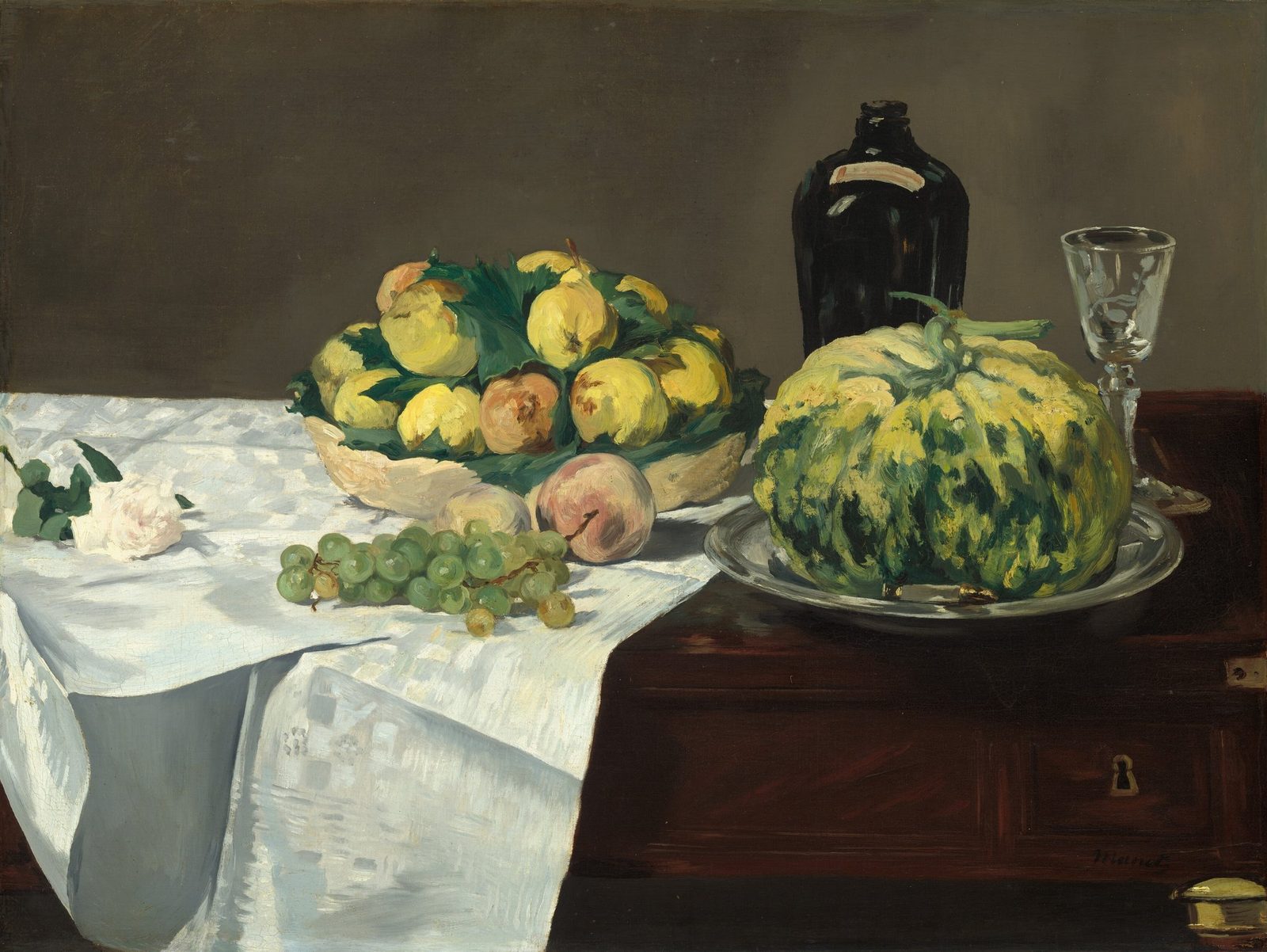
- Artist
- Edouard Manet
- Title
- Still Life with Melon and Peaches
- Date
- c. 1866
- Medium
- oil on canvas
- Image
- Public domain (CC0)
Open in Simple Art
Watch this story on iPhone and iPad, with offline downloads and a painting every day.
About 6 minutes of looking, in 12 parts.
Still Life with Melon and Peaches
Before you, a still life that does not behave the way still lifes are supposed to. The paint is loose, the edges are broken, and yet every fruit seems to glow. Edouard Manet's Still Life with Melon and Peaches, painted around 1866 in oil on canvas, invites a closer look at how he treats each material with the brushstroke it demands.
Manet, c. 1866
Manet was a mid-nineteenth-century French painter working between Realism and the dawn of Impressionism. He traded the polished academic finish for visible, loaded brushwork, and this small canvas is a clean demonstration of that modern manner.
Composition
Pull back and look at the structure. The three main masses — the bowl of peaches, the melon, and the dark bottle — form a loose triangle anchored on the strong horizontal of the tabletop. Your eye will travel from the white rose at lower-left, up into the warm peaches, down through translucent grapes, rightward to the melon, and finally up the bottle's white label to the goblet.
Light from the upper left
Notice where the highlights sit. The light comes from the upper left — you can read it on the left sides of the peaches, on the grape cluster, and along the goblet's rim — while shadows pool to the right of each object. It is soft, diffuse daylight, not a sharp studio lamp.
Warm against cool
The color scheme is built on a warm-cool tension. Orange-yellow peaches on the left meet cool greens of melon, grapes, and leaves on the right, all framed by a dark olive-brown wall and the white cloth. Warm accents cluster left of center, cool greens dominate the right, and the cool white cloth sweeps the lower half to balance both.
White rose
Start at the lower left with the white rose. From a distance it reads as a delicate flower, but up close it is only a few broad strokes of off-white and pale cream. There are no drawn petal edges; the form is suggested by adjacent blocks of light and shadow, with a soft pinkish tint pooled at the center of the bloom.
Peach and leaf
Move up into the bowl of peaches. Look where the warm orange-pink flesh meets the dark green leaves — the strokes end abruptly against each other, with no transitional mid-tone, no blending, no glaze. The complementary contrast does the descriptive work, and the viewer's eye mixes the colors optically. A few opaque, comma-shaped highlights sit on top of a pale underpainting.
Grapes and light
Drift down to the cluster of translucent grapes. Each grape carries a pale yellow-green highlight on its upper-left arc and a thin darker shadow along its lower right. Warm yellow underlayers show through the cooler green surface, hinting that the light is partly transmitting through the fruit, not only bouncing off it. Beside them, a peach is shaped with longer following strokes that wrap its volume.
Melon strokes
Now arrive at the focal point — the melon. Curving ridges of thick paint follow its rounded volume, and dark sap-green strokes are dragged wet-over-dry across a brighter yellow-green ground. The lighter ridges remain visible as broken interstices where the dark scumbles fail to cover them. Form is described by stroke direction and negative space, not by lighter paint laid on top.
Bottle label
Travel up the dark bottle to its white label. A single confident horizontal sweep of mixed cream-white with a touch of warm pink arcs across the upper third, and that softness does the descriptive work of a curving cylinder better than any drawn line would. The whites were dragged across a still-tacky black, which is why their edges feather and pick up dark hairs of the underlayer.
Goblet rim
Finally, the goblet on the right. Its thin rim is built from two or three small pale touches, not a continuous line — and the eye completes the curve. Inside the bowl, two darker vertical reflections descend as smeared grey-brown streaks, framed by lighter passages. The dark verticals are essentially the wall color showing through, not paint laid on top.
Brushwork tempo
Pull back to compare the melon's handling with the cloth beneath it. The melon is a contest of short, slashing, calligraphic marks; the drapery is made from long, sweeping vertical strokes of white, grey, and pale blue that follow gravity. Two opposite tempos in the same painting — Manet gives each material the brushstroke it demands, and the cloth stays cool and fluid beside the fruit's choppy energy.
Look closer
10 details, each checked against a close-up of the picture.
-
Focal melon and plate
The melon's form is built from broad, unblended strokes of green and yellow that remain distinct at close range.
The crop centers on a large ribbed green melon resting on a pewter plate, with a tuft of leaves at its crown and a sliver of a clear goblet at the right edge. The melon's form is constructed from separate, unblended strokes of yellow, chartreuse, mid-green, and dark forest green that sit side by side; lighter yellows cluster along the upper crests of the ribs while the deep greens fall into the troughs, building volume without any smooth gradation. Where strokes meet they leave visible ridges of paint, and the edge of the melon against the plate is broken by gaps and overlaps rather than a clean contour. The plate is rendered with broad sweeps of cool grey-white that read as reflective metal through tonal contrast rather than precise drawing.
-
Peach bowl warm and cool
Soft orange-pink dabs on the peaches sit directly beside cooler green leaf strokes without intermediate blending.
The crop is dominated by a mound of yellow peaches cradled in dark green leaves, with one centrally placed peach showing clear orange-pink dabs on its upper face. Where the warm peach flesh meets the leaf, the warm orange-pink stroke ends abruptly against a dark green stroke — there is no transitional mid-tone, glaze, or scumbled band; the two colors touch at a crisp, broken edge. Brighter yellow-cream highlights on the other peaches are laid on as opaque, curved dabs that sit on top of paler yellow underpainting rather than being blended outward. The dark olive background reads as a flat, thinly applied tone that shows the canvas weave in places, contrasting with the thicker, loaded strokes of the fruit and foliage.
-
Melon surface strokes
Curving ridges of thick paint follow the melon's rounded volume, with dark green dragged over lighter yellow.
The crop isolates the curved flank of a green-striped melon rendered in loaded, gestural strokes that arc from upper-left to lower-right around the form's volume. Dark sap-green strokes (#1E3A1F) are dragged wet-over-dry across a brighter yellow-green ground (#C9CF52), and broken passages of mid-tone olive (#6A7A2E) sit between them, allowing the lighter underlayer to read as ridges and the dark scumbles as the furrows. Impasto peaks catch the upper-left light along the left side of the melon; edges are unresolved and feather into neighbouring strokes rather than being drawn as outlines. The deepest passages pool toward the lower right, consistent with the stated upper-left light source, while the lightest, most buttery highlights cluster in the upper third.
-
Translucent grapes and peach
Each grape shows a yellow-green highlight on its upper-left side and a thin darker shadow on the lower right.
The crop shows a cluster of translucent green grapes rendered with loose, circular dabs of pigment; each grape carries a pale yellow-green highlight toward its upper-left arc and a darker olive-green tone on its lower-right curve. A large peach sits to the right, brushed with warm pink and ochre strokes that curve around its volume, while a partial fruit behind the grapes shows similar soft modeling. The white cloth on the left is laid in with broad, slightly directional strokes of cool off-white and pale lavender-grey, dropping into a bluish cast shadow along the grapes' lower edge.
-
Cloth fold long strokes
The drapery is made from long, sweeping strokes of white, grey, and pale blue that follow the cloth's fall.
The crop shows a section of a draped white cloth where a deep blue-grey shadow on the left meets a luminous white/cream fold running vertically down the right of center. Long, vertical brushstrokes follow the gravity of the fabric, with thin horizontal accents (likely a seam or fold edge) crossing mid-canvas. The right portion models the cloth in pale blue, warm grey, and off-white scumbles, while the upper left shows a tabletop edge and the upper right carries a few small grey dabs (possibly grapes or broken highlights). Fine craquelure is visible across the dark shadow and lighter passages alike, indicating aged oil paint.
-
Bottle label highlight
A horizontal band of light grey and white paint crosses the dark bottle, defining the label and shoulder reflection.
The crop centers on a dark, rounded bottle whose body is built from near-black and very dark teal strokes, punctuated by short vertical drip-runs of diluted grey and warm ochre beneath the label. A horizontal band of light paint arcs across the upper third, reading as the paper label caught in raking light: it is laid in with roughly four to five broken strokes of cream-white, a peachy-coral note near the left edge, and a slightly cooler grey at the right where the form curves away. Below, the bottle's shadow side meets a heavy impasto mass of melon flesh, where thick, directional strokes of pale yellow, cream, and yellow-green follow a curving contour. The background reads as a flat, muted olive-brown that pushes the bottle forward without competing.
-
White rose thick strokes
The rose is rendered with a few broad strokes of white and grey paint, lacking fine petal detail.
The crop isolates a white rose with attached green foliage and a glimpse of green grapes at the right edge, all resting on a pale cloth. The rose is built from thick, broad strokes of off-white and pale cream, with soft pinkish-rose tints pooled at its center and cool grey-violet notes defining the recessed areas between petals. Individual petal edges are not delineated; instead, the form is suggested through adjacent blocks of light and shadow that read as petals from a distance. A dark olive-green leaf overlaps the rose's left side, painted with broader, flatter strokes than the rose itself, and its right edge is blurred where it meets the petals. The surrounding cloth is rendered in long, sweeping horizontal and diagonal strokes of white and pale grey, and a network of fine craquelure runs across the entire surface.
-
Goblet rim and reflections
The goblet's thin rim is a pale grey line, while its bowl contains two vertical dark reflections from the room.
The crop centers on the rim and bowl of a clear stemmed goblet, framed at the upper left by the bright yellow-green flank of a ribbed melon and at the right by a sliver of warm reddish-brown wooden edge against a dark olive-brown wall. The goblet's thin rim is rendered as a broken pale grey-white arc, painted with a few short loaded strokes that catch the upper-left light source. Inside the bowl, roughly two darker vertical reflections descend as smeared grey-brown streaks flanked by lighter grey-white passages, with a soft white highlight mass near the lower curve of the bowl. The brushwork is loose and gestural: edges are left soft, the rim is interrupted rather than continuous, and reflections are described with single wet-into-wet drags rather than crisp delineation.
-
Cloth-to-wood hard edge
The boundary between the white cloth and dark wooden chest is an abrupt value jump with no soft blended transition.
The crop captures the lower-left of a still life where a white tablecloth meets a dark wooden surface along a sweeping curved diagonal. The cloth is built from directional off-white and pale cool strokes; the wood shows horizontal grain running across the lower half in very dark browns. At the meeting line the light strokes do not stop on a single knife-sharp edge - they thin into a narrow band of cool grayed tones (pale blue-grays) before the dark wood begins, so the boundary reads as a short transition zone rather than a hard cut. The value jump across that zone remains strong because the dark side sits at near-black while the cloth reads as a high value.
-
Pewter plate reflection
The plate beneath the melon carries muted grey-green strokes that mirror the fruit's lower contour.
The crop shows the lower belly of a green melon sitting on a shallow pewter plate. Vertical and slightly diagonal strokes of dark green, olive, and yellow-green build the melon's form, with brighter yellow-green highlights catching upper light. The plate beneath is rendered in cool greys and off-whites, with a clear curved upper edge that arcs across the middle of the crop. Two small brownish-ochre dabs rest on the plate in front of the melon. Muted greenish-grey strokes do appear along the plate's surface, particularly under and just to the right of the fruit, suggesting reflected color from the melon above. The plate's lower portion dissolves into a dark, warm brown table plane.
Still Life with Melon and Peaches in context
After Olympia
Wikipedia says Olympia caused an even bigger uproar at the Salon of 1865 than Le Déjeuner sur l'herbe had in 1863, with conservatives calling it immoral and vulgar [3]. The Metropolitan Museum's essay says Manet's modern scenes remained a target of criticism throughout the decade [2]. The museum dates this still life to about 1866 and gives its size as 68.3 by 91 centimetres [1]. Its visual description also points out two small details: a keyhole outlined in gold near the lower right corner of the table front, and the gilded top of one table leg [1].
French Wikipedia notes Manet had his studio at 34 boulevard des Batignolles from 1864 to 1866, and from 1866, according to Duret, a circle of artists and writers gathered around him at the Café Guerbois [4].
Saying everything with fruit
French Wikipedia quotes Manet's view that a painter can say everything with fruit or flowers, or even clouds alone [4]. It notes he painted still lifes mainly before 1870 and again in his last years, and that these subjects also sit inside his larger pictures, such as the basket of fruit in Le Déjeuner sur l'herbe and the bouquet in Olympia [4]. Among his fruit subjects it lists pears, melons and peaches [4].
The same article notes that some of his still lifes are almost dramatic, citing the Vase of Peonies on a Pedestal of 1864, with its tight framing and fallen petals [4].
Shown at the Alma pavilion
The painting was number 37, titled simply Fruits, in Manet's own exhibition on the avenue de l'Alma in 1867 [1]. Wikipedia says his mother worried that this costly show would use up his inheritance, and that major critics reviewed it poorly [5]. The museum's bibliography begins with Émile Zola's 1867 essay on Manet in L'Artiste, and with a caricature of the exhibition by G. Randon in Le Journal amusant of 29 June 1867 [1]. In that year Zola wrote, as Wikipedia quotes him, that Manet interprets nature "with a gentle brutality" [5].
Brussels, Paris, New York, Washington
The earliest owner the museum names is Léopold Baugnée of Brussels, whose sale at the Galerie Ghémar in Brussels on 22 March 1875 included it as number 44 [1]. It then belonged to Perouse in Paris [1]. A note citing the 1983 Manet catalogue adds that the painting was deposited with Durand-Ruel on Perouse's behalf in 1910 but removed [1].
The museum says it was sold, probably through the dealer Eugene Glaenzer, by 1913 to Eugene and Agnes Ernst Meyer of Mount Kisco, New York, and Washington, who gave it to the National Gallery in 1960 [1]. It was shown at Durand-Ruel in New York in 1913 and at the Metropolitan Museum in 1920 and 1921, before being lent there again in 1923 [1]. Later it appeared in the 1983 Manet retrospective in Paris and New York, and in Manet: The Still-Life Paintings in 2000 [1].
- Edouard Manet, Still Life with Melon and Peaches (1960.1.1): object record, visual description, provenance, exhibition history and bibliography (Internet Archive copy, 28 August 2025) . National Gallery of Art, Washington
- Rebecca Rabinow, 'Édouard Manet (1832-1883)', Heilbrunn Timeline of Art History, October 2004 (Internet Archive copy, 16 June 2026) . The Metropolitan Museum of Art, New York
- Olympia (Manet) . Wikipedia
- Édouard Manet . Wikipedia (French)
- Édouard Manet . Wikipedia