Reading Gauguin's Wood Tankard and Metal Pitcher
A camera walkthrough of form, light, and brushwork in an 1880 still life
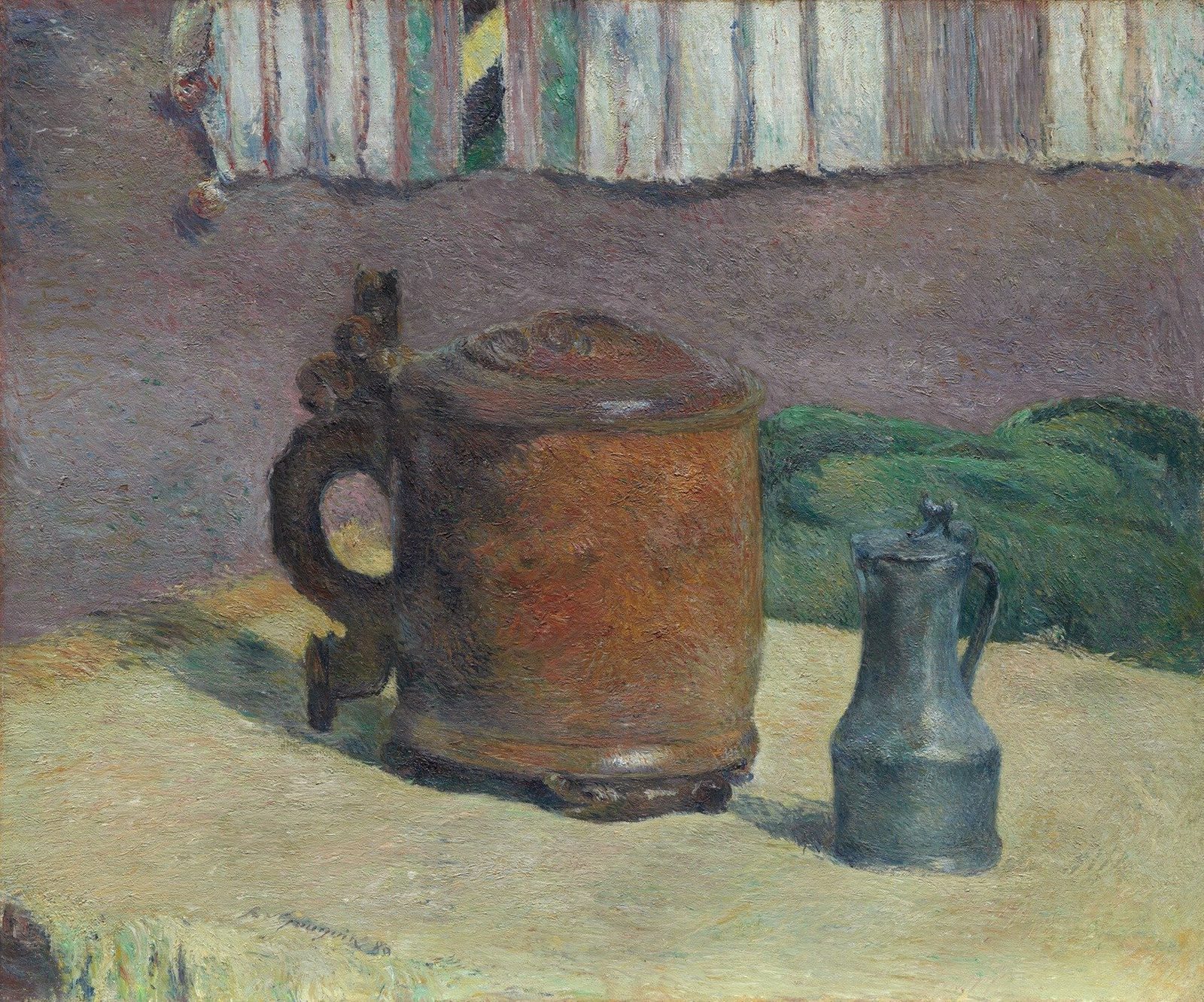
- Artist
- Paul Gauguin
- Title
- Still Life: Wood Tankard and Metal Pitcher
- Date
- 1880
- Medium
- Oil on linen canvas
- Museum
- Art Institute of Chicago
- Image
- Public domain (CC0)
Open in Simple Art
Watch this story on iPhone and iPad, with offline downloads and a painting every day.
About 8 minutes of looking, in 11 parts.
Two vessels, one curtain, one quiet drama.
Before you is a still life from 1880, painted in oil on linen by a young Paul Gauguin. Two humble vessels share a pale tabletop — a tall wooden tankard at center and a lidded metal pitcher at right — backed by a green box and a brightly striped curtain. Look past the subject and you'll see a study in temperature: warm wood against cool pewter, set against a muted mauve wall. Stay with me; in the next two minutes I'll walk you through how Gauguin builds form with brushstroke rather than line, and where the light is actually coming from.
1880, still a young painter.
This dates from 1880, when Gauguin was still working in a Pissarro-adjacent, Impressionist-influenced manner — long before the Post-Impressionist label would actually fit. The handling is loose, the brushwork is visible, the surface is alive. So when you hear this painting called Post-Impressionism, take it with a grain of salt; what's really on the canvas is closer to a still-Impressionist study of light and material.
An asymmetrical triangle, anchored by two horizontals.
Pull back and see the structure. The tall tankard forms the left and central mass, the pitcher the right vertex, the green box a horizontal base — an asymmetrical triangle. A strong horizontal band near the top — that's the curtain hem — and another near the middle, the table edge, divide the picture into three zones. The focal point sits slightly left of center, right where the tankard glows warmest. Let me drop a horizon line so you can feel those bands.
Light from the upper left, soft and diffused.
The light comes from the upper left. You can see it in the lid highlight on the tankard and in the way both vessels cast soft shadows to the right and slightly forward onto the table. There are no hard cast edges; this is diffused daylight, not a sharp window. The brightest cool highlight sits on the metal pitcher, while the tankard's lit side glows warm. It's a high-key picture overall — pale tabletop and striped curtain dominate, with deep accents only inside the tankard's mouth and the pitcher's body.
Warm against cool, against a mauve wall.
The color strategy is a clean warm-cool opposition: warm ochre tankard against cool blue-gray pitcher, grounded by a deep green box, all set against a neutral mauve wall that lets both vessels read clearly. The curtain's polychrome stripes — yellow, white, blue, green — supply accents that echo both ends of the temperature range. Now let me push in on that warm centerpiece, the wooden tankard.
A cylinder built from vertical strokes, not from line.
Here is the heart of the painting. The tankard's body is built from short vertical and slightly curved strokes that read as wood grain — warm ochre, burnt sienna, a reddish patch in the center, umber around it. The right side deepens into cool dark brown where the form turns from the light; the lid catches a pale pinkish highlight on its upper-left curve. Notice the edges — soft and slightly broken against the wall, never a hard contour. For students: try modeling a cylinder by tilting a flat brush and laying a column of short vertical strokes that curve slightly at the edges. The variation in stroke direction, not line, is what turns the form.
A handle defined by negative space.
Slide left to the handle. Look at how Gauguin defines form here — the dark oval mass is set against the mauve wall, and through the loop, the wall color itself is preserved as flat negative space. He didn't paint an interior; he reserved the background and let the void do the work. The handle's edge is built from loaded, directional strokes of dark brown-black that curve to follow the cylinder, with lighter warm accents along the upper-outer rim where the light grazes. The lesson: when an object is pierced by a hole or handle, protect the background color inside that opening early. It will read as true negative space and save you from inventing a convincing interior.
Scumbled green, no outlines.
Drop down to the green object behind the pitcher. The brushwork changes character: short, broken horizontal strokes that drag across the face, alternating dark forest green and olive with brighter yellow-green passages. The mauve wall actually peeks through the gaps, giving the shadows a warm-pink undertone. There is no outline where green meets the pitcher — just overlapping strokes. Try scumbling over a contrasting underlayer: let the lower tone show through broken strokes, and resist the urge to draw edges between objects. And notice, the brushwork here alone won't tell you if this is a box, folded fabric, or a cloth-draped parcel. Gauguin leaves it deliberately ambiguous.
Loaded verticals, broken edges, not ruled stripes.
Tilt up to the curtain. The verticality here is the picture's rhythmic backdrop — distinct bands of off-white, powder blue, sage green, dusty mauve, and one small patch of saturated yellow. The paint is loaded; you can see ridges and the weave of the canvas through the thinner passes. The stripes are not ruled — adjacent bands were laid while their neighbors were slightly wet, so edges bleed and break. The lower edge of the cloth is just a thicker horizontal sweep of brown-violet that covers the bottoms of the verticals without blending. Resist pre-planning an A-B-C-A-B sequence; lay each band as a single loaded vertical stroke and let the colors influence each other.
Broken color on a flat plane.
Now the tabletop. It looks pale and uniform at first glance, but up close it's a textbook in broken color: short horizontal strokes of cream, pale yellow, and warm ochre, with scattered touches of pink, mauve, and olive sitting unblended on top. The lower-left corner cools into green-tinged strokes that read as the table edge. The cast shadow of the pitcher is implied through value shift, not a drawn line. Practice broken color this way: don't pre-mix your cream and yellow on the palette; lay adjacent strokes with small gaps of underlayer showing through, and let a few contrasting notes sit on top unblended so the eye fuses the temperature rather than the brush doing the mixing.
A signature you have to hunt for.
Last stop — the signature. A word of caution: at this resolution, what looks like incised lettering in the lower left is hard to confirm. The crop I'm looking at reads as the same gestural brushwork as the rest of the tabletop, with a row of small dark dabs that could be misread as cursive. Elsewhere in the painting, the signature 'P. Gauguin 80' is integrated into the tabletop, painted with the same loading and stroke length as the surrounding marks and likely added before the paint fully dried. So when hunting for a signature in a reproduction, sample several magnifications before trusting a verbal claim — a real signature usually reads as a coherent sequence of dark or sharply contrasting marks, not just broken brushwork.
Look closer
6 details, each checked against a close-up of the picture.
-
Wooden Tankard
The tankard is rendered with warm ochres and browns using visible vertical and curved brushstrokes.
The crop centers on a cylindrical wooden tankard with a hinged lid and an ornately carved loop handle at left. The body is built from short, visible vertical and slightly curved strokes that read as wood grain, blending warm ochre, burnt sienna, and a central reddish patch into the surrounding umber. The right side deepens into cool dark brown as the form turns from the light, while the lid catches a pale pinkish highlight on its upper left curve. Edges are soft and slightly broken against the mauve wall, and a small footed base with bright cream accents lifts the vessel off the pale tabletop.
-
Curtain Texture
The curtain consists of distinct, thick vertical stripes of cream-white, mauve, green and blue paint, with one yellow-and-black patterned band.
The crop isolates the upper portion of the still life where a striped curtain meets a dark tabletop edge. Vertical brushstrokes dominate, laid down in parallel from top to bottom of the cloth, with soft, broken edges between bands rather than crisp lines. The palette includes warm off-whites, pale powder blues, a saturated sage/emerald green, dusty mauves, and a small patch of saturated yellow near the center-left. The lower edge of the cloth is indicated by a thicker, darker horizontal sweep of brown-violet paint that meets the strokes above without blending. Paint application is direct and loaded, with ridges and small gaps in the weave of the canvas showing through the thinner passes.
-
Tankard Handle
The handle of the tankard is defined by a dark brown outline and a circular void of the mauve background.
The crop shows the handle of a wooden tankard as a thick, oval mass of dark paint set against a mauve wall. The handle's edge is built from loaded, directional strokes of dark brown-black that create a soft but legible contour where the rim meets the background. Through the opening of the handle sits a patch of mauve-grey background paint, laid in slightly cooler, thinner strokes that read as flat negative space rather than a deep recess. Below the handle, a triangular wedge of warm yellow-ochre meets a darker olive-teal area, suggesting the tabletop edge and the shadowed base of the vessel. The brushstrokes around the handle curve to follow its cylindrical form, while the strokes in the void behind it lie more horizontally.
-
Green Object
The green form is rendered with broad, scumbled strokes of dark green and olive.
The soft green form dominates the mid-ground, built up with short, broken brushstrokes that drag horizontally across its face. Dark forest greens and olive tones alternate with brighter yellow-green passages, producing a scumbled surface where the mauve wall and underlying tints show through gaps in the paint. The top edge catches a brighter green highlight, while the right side and lower folds read cooler and darker, suggesting depth without hard contour. Where the green form meets the dark metal pitcher in front, the edge is left soft and unblended, with overlapping strokes rather than a clean seam.
-
Artist Signature
The signature is painted in small dark strokes on the lower left of the pale tabletop.
The crop reveals a densely worked surface dominated by short, diagonal, overlapping strokes in pale yellows, creams, and yellow-greens, with cooler teal and blue-green accents scattered through the mid-tones. A short row of small, dark, roughly oval dabs runs across the upper right, sitting on top of the lighter strokes rather than being scratched through them. That row of dark marks is the signature, 'P. Gauguin 80', painted on top of the pale strokes rather than incised. Edges between colour zones are soft and interlocked rather than crisp, and the overall value range stays light to mid, with only the small dark dabs pushing toward a true dark.
-
Tabletop Surface
The tabletop is painted with horizontal, broken strokes of cream and pale yellow.
The crop is dominated by the tabletop, rendered in short, horizontal, broken brushstrokes that layer cream, pale yellow, and warm ochre with scattered touches of pink, mauve, and olive green. In the upper right, the lower edge of a vessel (the wooden tankard) is visible, its reddish-brown and grey body meeting the table along a softly blurred cast-shadow edge rather than a crisp contour. A signature reading 'P. Gauguin 80' is integrated into the paint at lower-center, with the '80' picked out in a cooler green-grey. The lower-left corner drops into denser, slightly cooler green-tinged strokes that read as the table edge or a fall of cloth, while the rest of the surface remains light and broken.
Still Life: Wood Tankard and Metal Pitcher in context
Painted by a stockbroker
The Art Institute dates this still life to 1880, and its 2016 online catalogue lists it as cat. 1 among its Gauguins [1]. Wikipedia's biography says Gauguin took a job at the Paris Bourse in 1871 through the family friend Gustave Arosa, began painting in his spare time around 1873, and by 1879 was making 30,000 francs a year as a stockbroker, with as much again from dealing in art [3].
The same account describes his friendship with Camille Pissarro, his move in 1877 to a home with a studio in Vaugirard, and his showing of paintings at the Impressionist exhibitions of 1881 and 1882 [3]. It was the stock market crash of 1882 that eventually pushed him towards painting full time [3].
A picture under several names
The earliest trace the museum records is probably a deposit with the Goupil firm, listed as Goupil, Boussard and Valadon, by March 1893 [1]. A letter of 24 March 1893 from Maurice Joyant to Georges-Daniel de Monfreid lists a canvas described as a still life, 'pot et cafeterie', pot and coffee pot, which the museum links to this work [1].
The painting carried another title in the 1940s. It was shown at the Galerie Charpentier in 1946 and at Lyons in 1949 as 'Le Pot de terre et le pot de fer' [1]. During a 1999 to 2000 tour it was listed as 'Clay Jug and Iron Jug' [1].
A fable in the title
'Le Pot de terre et le Pot de fer' is the title of the second fable in Book V of La Fontaine's Fables, first published in 1668 [4]. In it, an iron pot persuades an earthenware pot to travel with it. The earthenware pot is soon broken to pieces by its companion, with a moral advising people to keep company only with their equals [4]. The museum's record doesn't say who gave the painting this name [1].
Through friends' hands
The record names Émile Schuffenecker as a possible owner, information Georges Wildenstein received from Schuffenecker's daughter Jeanne, and lists his brother Amédée as a possible owner after 1903 [1]. Schuffenecker had met Gauguin in 1872 at the broker Bertin, where both worked, and the two became close friends [5].
The later history is firmer. The painting was in a private collection in Paris by 1947, with a 'Dr B.' around 1949, and then with Mr and Mrs Robert E. Ricksen of Palm Beach, Florida, who sold it at Parke-Bernet, New York, on 21 October 1971 as lot 93 [1]. It passed to Nathan Cummings and in 1985 to the Sara Lee Corporation, which gave it to the Art Institute in 1999 as part of a Millennium Gift [1].
The museum's online catalogue opens its section on Gauguin's signatures with a detail of the signature on this canvas [2]. In 2017 the painting was shown in Gauguin: Artist as Alchemist in Chicago and at the Musée d'Orsay in Paris [1].
- Paul Gauguin, Still Life: Wood Tankard and Metal Pitcher, 1999.362: object record, provenance, exhibition and publication history . Art Institute of Chicago (public API)
- Signatures, in Gauguin Paintings, Sculpture, and Graphic Works at the Art Institute of Chicago (2016) . Art Institute of Chicago (public API)
- Paul Gauguin . Wikipedia
- Le Pot de terre et le Pot de fer . Wikipédia (French)
- Émile Schuffenecker . Wikipedia