Te burao (The Hibiscus Tree) — A Camera Walkthrough with Gauguin
An oil on canvas from 1892, read frame by frame for painters
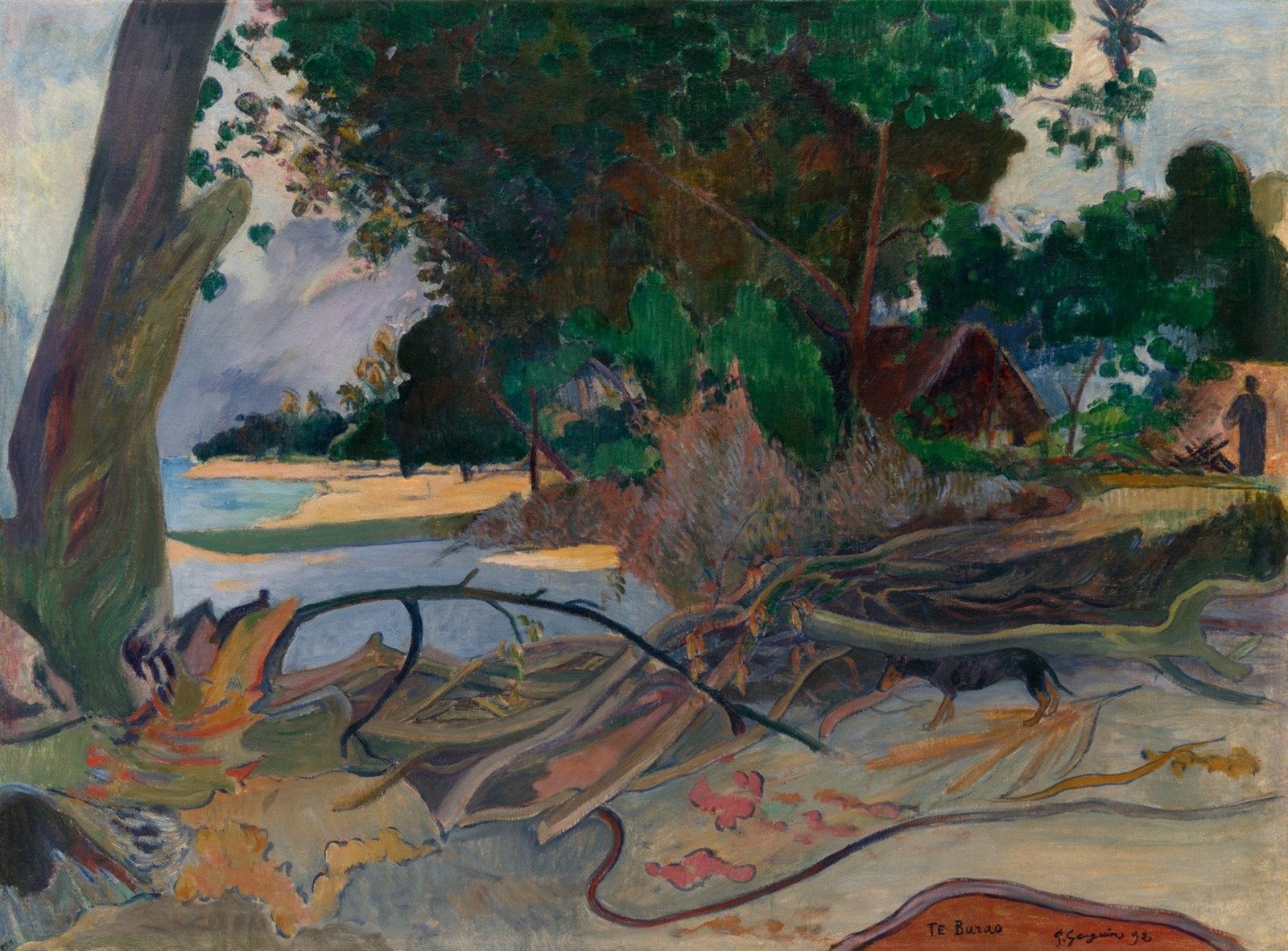
- Artist
- Paul Gauguin
- Title
- Te burao (The Hibiscus Tree)
- Date
- 1892
- Medium
- Oil on canvas
- Museum
- Art Institute of Chicago
- Image
- Public domain (CC0)
Open in Simple Art
Watch this story on iPhone and iPad, with offline downloads and a painting every day.
About 5 minutes of looking, in 12 parts.
A Tahitian jungle, framed
Before us is a Tahitian landscape: a single great tree dominates the left, dense green canopy arches overhead, and a curving beach with tangled roots sweeps down to a tiny dark figure on the right. This is Paul Gauguin's Te burao, the hibiscus tree.
Gauguin in Tahiti, 1892
Gauguin painted this during his first Tahitian period, working in oil on canvas with the flat, decorative color planes we now call Post-Impressionist. The inscription in the lower right, which we'll reach, will confirm the title and the date '92.
One vertical, one S-curve
Look at the structure. It is asymmetrical: a heavy vertical anchor on the left, balanced against a long S-curve that flows from the middle beach down through the roots to the lower right. The tree sits roughly on the left third, the small figure on the right edge — a classic left-weighted balance.
A raking tropical daylight
Light rakes in from the upper left, glancing across the sand and just catching the inner edge of the tree trunk while the canopy stays in deep shade. There are no hard cast shadows — only diffused tropical warmth playing against cool green.
Greens against warm ochres
The palette is a deliberate complementary clash: saturated jungle greens against warm ochres and rust, with violet-blue accents in the distant water and pink notes pulsing through the foreground. Warm tones push forward, cool tones recede.
Foliage as three values of green
Drift up into the canopy. There are no leaves drawn here at all — just three values of green, deep near-black in the recesses, mid sap green for the bulk, and a few yellow-green dabs catching the raking light. Each dab is laid side by side, edges left unblended, so the soft contact between them does all the work of suggesting density.
The bright band of beach
Drop down to the beach — the brightest passage on the canvas. Broad, flat strokes of yellow-ochre sand are pressed right up against a cooler blue water. Notice how the temperature jump, warm against cool, separates mid-ground from water without any drawn line.
Roots: contour, fill, highlight
Now move into the foreground roots. For each one, Gauguin lays down a single loaded dark contour, fills the interior with a flat plane of reddish brown, then runs a brighter highlight along the upper edge. All the volume comes from that off-set edge, not from gradual modeling.
Pink dabs on warm ground
Sweep across the sand between the roots and you'll spot small pink dabs scattered on the ochre ground. These are non-naturalistic — expressive flecks of saturated red-pink dabbed directly onto a muted field, doing nothing representational, just pulsing against the warm ground.
The dark silhouette on the right
Drift across to the right shore. A small figure stands there, painted as a near-flat silhouette in deep indigo-black, with no internal modeling. The broken, dry-brush edge against the lighter ground is doing all the descriptive work — this is shape and edge, not light-and-shade, and it quietly gives the jungle its human scale.
A soft wet-into-wet shoreline
Look closely where the sand meets the water. Instead of a crisp drawn line, there is a soft wet-into-wet kiss where the warm peach-orange bleeds slightly into the cool blue. That broken contact, not a gradient, is the lesson — resist over-blending.
Title and signature, lower right
In the lower right corner, two clusters of dark hand-applied marks sit on a warm sienna ground: 'Te Burao' and 'P. Gauguin 92,' brushed in one continuous gesture per letter. The inscription confirms both the Tahitian place and the year.
Look closer
7 details, each checked against a close-up of the picture.
-
The Silhouetted Figure
The figure on the right shore is a dark, simplified silhouette with minimal internal detail.
The crop centers on a tall, dark figure standing on the right side, rendered as a near-flat silhouette in deep indigo-black. The figure's outline is jagged and broken, with small interior variations of slightly warmer dark brown suggesting a shoulder and head, but no facial or anatomical detail is resolved. To the figure's left, a dark, sweeping root-like form crosses the foreground, echoing the figure's verticality. Above and behind, mottled dark greens form a canopy edge, while a broad band of sandy ochre and warmer rust-brown occupies the lower and upper-left areas, creating strong value contrast with the figure.
-
Foreground Root Tangling
The tangled roots are defined by sweeping, curvilinear lines and broad planes of reddish-brown color.
The crop isolates the foreground tangle of tree roots sweeping from left to right across pale sand. Long, sinuous dark contour lines—painted in a deep umber-green—snake diagonally across the panel, defining each root as an enclosed ribbon. Inside these outlines, broad, relatively flat planes of reddish-brown, rust and ochre are laid in, with brighter ochre highlights running along the upper edges of each form where light rakes from the upper left. The cooler, low-saturation sand around the roots reads as a near-white plane, which pushes the warm root masses forward; small dabs of saturated red-pink sit on the sand like fallen fruit. Edges are deliberate: crisp where the dark contour stops, but soft where the warm body color bleeds slightly past, giving a slightly out-of-phase, decorative rather than tightly drawn contour.
-
Pink Ground Accents
Small, dabbing strokes of saturated pink are scattered across the foreground ground.
The crop shows a sandy ground area interrupted by several saturated pink-red dabs of varying sizes scattered across the middle and lower portions. These pink marks are irregular, blob-like shapes with soft, slightly feathered edges that sit on top of a warm beige-ochre ground, and they do not touch each other. A dark reddish-brown curved line sweeps from the lower left toward the right, passing in front of and behind the pink accents, creating overlap. The background upper area shows warmer orange and brown tones with visible directional brushwork, and subtle blue-grey shadow patches lie near the pink dabs, suggesting they are placed on illuminated ground.
-
Sandy Beach Luminosity
The beach is a bright band of ochre and yellow that contrasts with the dark blue of the water.
The crop centers on a horizontal band of warm, ochre-toned sand that reads as the lightest passage in the frame, flanked by a dark green canopy mass above and a blue water passage to the left. The beach is laid in with broad, relatively flat strokes of yellow-ochre and pale sand, broken by a few short vertical touches that suggest small figures or posts near the tree base. The water is not a uniform dark blue: it carries a lighter, almost turquoise diagonal sweep in its upper area and a deeper, slightly greener blue along the shoreline edge, so the contrast with the sand is real but more nuanced than a single dark/light opposition. Edges between sand and water are crisp and unblended, with the sand color pushed right up to a sharp wet shoreline, while the boundary between sand and foliage is softer, with the dark green stippling down into the beach.
-
Canopy Foliage
The upper foliage consists of large, simplified dabs of varying green hues without fine leaf detail.
The crop shows the canopy rendered as broad, roughly oval dabs of pigment rather than any leaf-level detail. Three green registers sit roughly each visible: deep near-black greens in the recesses, mid-tone sap greens forming the bulk of the masses, and warmer yellow-greens catching raking light from the upper left. On the right, reddish-brown and ochre notes read as either sun-struck foliage or shadowed earth beneath. Dabs are placed side-by-side with soft, unblended edges so each stroke retains its own identity, and the canvas weave shows through where paint is applied more thinly.
-
Inscription and Signature
The text 'TE Burao' and 'P. Gauguin 92' are written in dark paint in the bottom right corner.
The crop centers on a warm reddish-brown ground traversed by clear vertical striations — the marks read as either upright wood grain or vertical brushstrokes running top to bottom. Dark, blurred glyph-like forms cluster in the upper-left quadrant and a second, fainter cluster appears to their right; the strokes are soft-edged and tonally near-black rather than crisp. A soft, darker curved boundary intrudes from the upper-right edge, separating the inscription plane from a deeper shadow zone. Overall the inscription reads as pigment laid onto a textured support, not as incised carving.
-
Shoreline Transition
The boundary between the sandy shore and the blue water is a soft, blended edge.
The crop captures the meeting point of pale aqua water (left) and warm peach-orange sand (right and upper). The blue is laid in as a broad, slightly mottled wash with a paler highlight band running through its lower portion; the sand is a flat, relatively unmodulated warm plane. Between them sits a narrow, irregular transitional zone where cool blue-green is dragged into the warm sand, creating a soft, broken edge rather than a crisp contour. A thin dark wisp of pigment marks the wet/dry interface, and the lower edge of the crop reveals a band of olive-green tone (vegetation) abutting the sand.
Te burao (The Hibiscus Tree) in context
A Tahitian picture on European cloth
The Art Institute's catalogue entry finds that Te burao is painted on a fine, tightly woven, twin-threaded cotton canvas, in contrast to the jute Gauguin typically used in Polynesia [2]. The authors add that, on the evidence of the cloth alone, one might be tempted to place the picture in France in 1894 to 1895, when he more often worked on canvases of this kind [2].
Gauguin prepared the surface himself, spreading a chalk and glue ground with a palette knife and roughening it with a brush while it was still wet [2]. The conservators estimate the original painted area at about 69 by 92 cm, which is close to a standard no. 30 landscape format. They suggest the narrow width of the cloth, 74 cm from selvage to selvage, probably set the size [2].
Rolled, shipped and restretched
Vertical cracks in the paint indicate that the canvas was rolled at some point. Presumably, like Gauguin's other Polynesian pictures, it was taken off its stretcher and rolled for shipment to France [2]. When it was restretched, about 1 cm of the composition was folded over each edge. This cuts off the bottom left of the hibiscus trunk [2].
In early December 1892 Gauguin told Georges-Daniel de Monfreid about a shipment of eight paintings. He advised him to moisten the backs lightly and put the nails back in the original holes so the canvases would not tear [2]. The letter does not name Te burao, but the catalogue argues the same instructions would have applied. The tack holes suggest Gauguin's holes were reused [2]. The canvas has never been lined, and the museum describes its condition as excellent [2].
The plants and the language
Notes to the catalogue entry draw on agroforestry studies of the plants in the foreground [2]. The beach hibiscus is native throughout the Pacific Islands. Its flowers, bark and roots have medicinal uses, its wood serves for building and fuel, and its processed bark can be braided into rope [2]. Pandanus trunks have been used for house building, and its leaves for baskets, hats, fans and roof thatch [2].
The authors note that, although Tahiti was a French colony, few Tahitians spoke French, so Gauguin began learning Tahitian soon after he arrived in 1891 [2]. They also suggest that he may have wanted the language as a way to enhance his sense of becoming a fellow 'savage', a word the catalogue keeps in quotation marks [2].
A New York modernist's sale
Before Chicago, the painting belonged to Marius de Zayas [1]. Born in Veracruz in 1880, de Zayas was an artist, writer and gallery owner. He opened the Modern Gallery in New York in 1915 and renamed it the De Zayas Gallery in 1919 [3].
The museum's record states that the painting was sold at de Zayas's sale at the Anderson Galleries, New York, on 23 and 24 March 1923, as lot 83, for $3,000, a price taken from an annotated copy of the sale catalogue in the museum's Ryerson Library [1]. It was bought with funds from Joseph Winterbotham and is one of thirty-five works in the Winterbotham Collection [1]. Earlier, in 1921, it had been shown at the Metropolitan Museum of Art's loan exhibition of Impressionist and Post-Impressionist paintings and at the Minneapolis Institute of Arts [1].
- Paul Gauguin, Te burao (The Hibiscus Tree), 1923.308: object record, provenance, exhibition and publication history . Art Institute of Chicago (public API)
- Cat. 28, Te burao (The Hibiscus Tree): catalogue entry by Richard R. Brettell and Genevieve Westerby, with technical study by Kristin Hoermann Lister, in Gauguin Paintings, Sculpture, and Graphic Works at the Art Institute of Chicago (2016) . Art Institute of Chicago (public API)
- Marius de Zayas . Wikipedia