The Big Tree — Gauguin's Te raau rahi (1891)
A camera walkthrough of scale, palette, and paint-handling for painting students
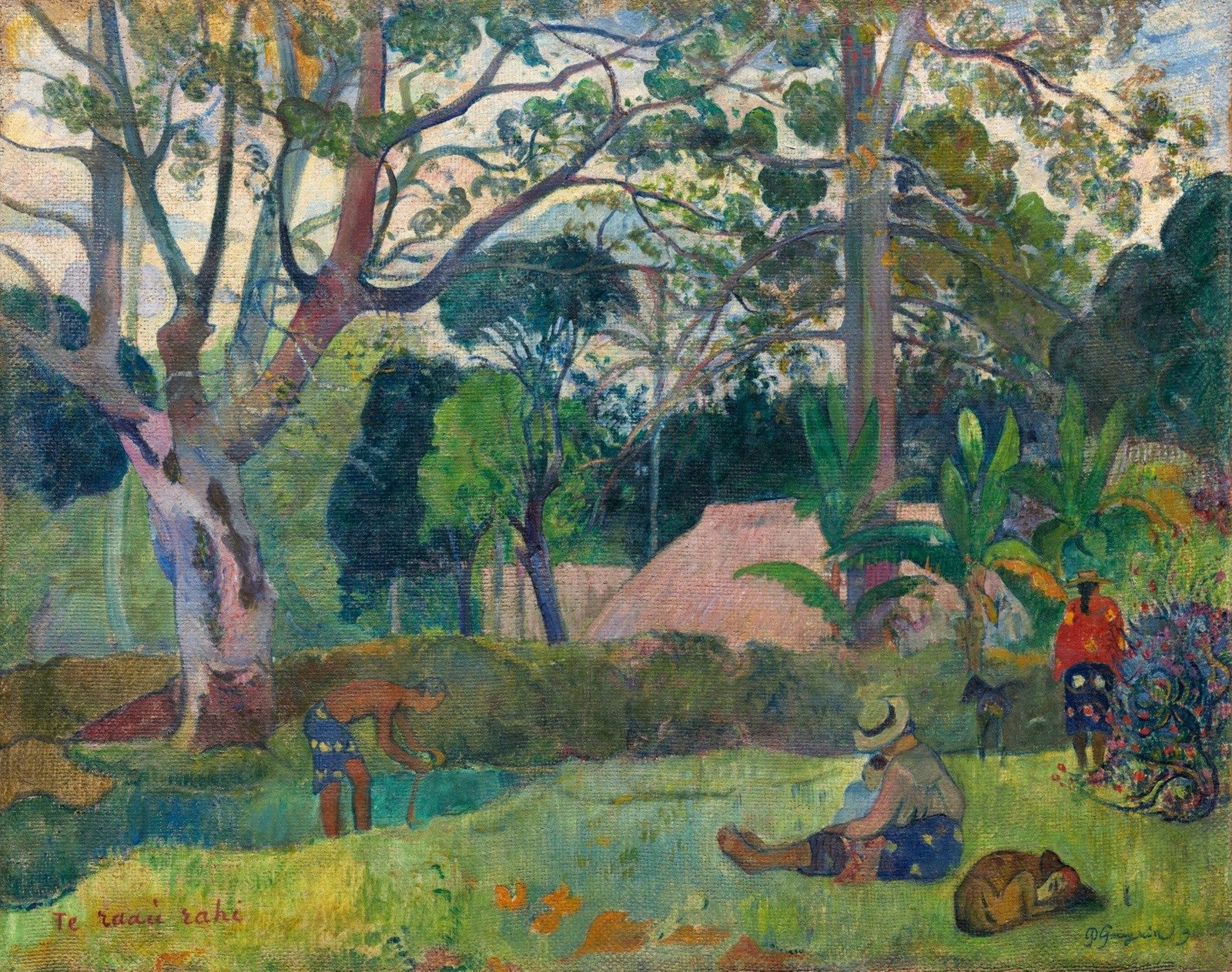
- Artist
- Paul Gauguin
- Title
- Te raau rahi (The Big Tree)
- Date
- 1891
- Medium
- Oil on jute canvas
- Museum
- Art Institute of Chicago
- Image
- Public domain (CC0)
Open in Simple Art
Watch this story on iPhone and iPad, with offline downloads and a painting every day.
About 6 minutes of looking, in 13 parts.
The Big Tree
We're looking at 'Te raau rahi' — The Big Tree — a 1891 oil on jute canvas by Paul Gauguin. A single massive tree dominates this Tahitian landscape, its pale trunk and spreading canopy filling the upper half of the picture while four small human figures stand absorbed in the grassy foreground.
Tahitian period
This is Gauguin searching for a less academic, more direct painting language. Look for the cues everywhere — flat areas of color, loose handling, and a palette pushed away from observed greens and browns toward something more emotionally true to a tropical scene.
A deliberate triangle
Now look at how Gauguin structures this canvas. The trunk on the left and the diagonal of the canopy form the hypotenuse, and the row of figures along the lower third forms the base. The horizon sits low at about forty-two percent — that's why the tree feels monumental and the figures feel absorbed.
Diffuse tropical light
The light is soft and overcast, with no hard cast shadows anywhere. Subtle highlights along the upper-left of the trunk and on the standing figure's red top tell us the light arrives from the upper left, but the overall key stays compressed and mid-valued. The scheme is analogous greens accented by complementary reds and warm ochres — temperature is doing most of the work.
A lavender trunk
Pull in on the focal trunk. This is not a brown trunk — Gauguin paints it in pale lavender, dusty pink, and cool off-white, with small patches of muted teal and ochre along its left flank. The marks suggest a mid-toned ground with thinner scumbled layers on top, and the jute weave shows through in lighter passages. The palette works because he is describing value and temperature, not local color.
Canvas weave through paint
Push up into the upper canopy and you'll see what makes the support itself part of the picture. The sky is a thin, semi-transparent pass of cream paint, and the regular grid of the jute weave reads through optically, mottling the tone. Branches are laid in as a single confident stroke of reddish-brown, and the foliage sits proud of the weave rather than soaking into it.
A flat roof plane
Drop your eye to the mid-distance thatched roof. It's a single sloping plane of pinkish-ochre built from short, parallel hatch marks — no light-to-shadow gradient, just a soft warm-to-cool change where the ochre meets the green intrusion. Gauguin lets the diagonal seam and one adjacent cool green do all the work of describing shape.
A gesture of the body
Down into the foreground. The bending figure on the left is reduced to a single gesture arc from the nape through the spine to the hips. The body reads as warm reddish-brown, with a deep blue wrap patterned in pale-yellow dots around the waist. Modeling is achieved by juxtaposed warm and cooler reddish strokes rather than blended transitions — pure Post-Impressionist alla prima.
Cool hat, warm legs
Move rightward. The seated figure seen from behind wears a wide-brimmed yellow-green hat and a flat dusty-blue torso, with bare russet-brown legs extending diagonally toward the lower left. Notice how the warm legs and cool garment sit against each other with no drawn line between them — temperature alone describes the edge.
Red as chromatic foil
And here is the loudest note in the painting — the standing figure's saturated red-orange top. The edge between red and green is jagged and painterly, with interlocking brushstrokes. A small area of saturated red is doing the work of balancing the entire dominant green field.
A dappled bush
Sweep to the right edge. The flowering bush is Gauguin's response to Pointillism — cool blues and violets dominate, but small touches of pink, red, yellow, and green punctuate the field. The form is built from clustered dabs over a darker underlayer, so the dark ground reads through the interstices and gives the foliage its depth.
The smallest presence
Look closely at the lower right. A fourth figure is curled into a tight C-shape on the ground, head tucked toward the knees. The body is a warm rust mass against the cool green, and its lower contour dissolves into the grass rather than being outlined — temperature alone does the shadow work.
Words on the surface
Two inscriptions sit in the lower corners. On the left, the title 'Te raau rahi' is painted in reddish-brown, the letterforms slightly soft-edged where pigment met the damp underlayer. On the right, over the green grass, a cursive 'P Gauguin' in dark navy-blue is drawn wet-into-dry with a fine round brush — confident, thin, and uninterrupted.
Look closer
10 details, each checked against a close-up of the picture.
-
The Pale Tree Trunk
The trunk is rendered with pale purples, pinks, and whites rather than natural browns.
The crop centers on a sinuous tree trunk painted in pale lavender, dusty pink, and cool off-white, accented with small patches of muted teal and ochre shadow along its left flank. The trunk splits into several thinner upward-reaching limbs in the upper portion, with loose dabs of green and ochre foliage stippled against a pale sky background. The brushwork is loose and visible, with directional strokes that follow the vertical thrust of the trunk, and the woven canvas texture shows through in lighter passages. A figure in a saturated red garment anchors the lower right, providing a chromatic foil to the pastel trunk. The edges between trunk and background are soft and broken, with colors bleeding into one another rather than meeting at crisp contours.
-
Jute Canvas Texture
The coarse weave of the jute support is visible through the thin paint of the sky.
The crop shows the upper canopy and branch network of the tree, with reddish-brown limbs crossing a pale cream sky and clusters of green foliage punctuating the interstices. A regular grid of canvas weave is clearly visible across the thinly painted sky passages, producing a mottled, granular surface where warp and weft threads show through the pigment. Edges between the dark branches and the sky are soft and slightly feathered, suggesting wet-into-wet or loaded-brush application rather than crisp drawing. Foliage is built from dabs of two distinct greens—a cooler dark teal and a warmer yellow-green—stippled or scumbled so each dab sits on top of the weave rather than filling it.
-
Standing Figure's Garment
The figure wears a bright red top that creates a high-contrast point against the green foliage.
The crop centers on a figure whose torso and upper skirt dominate the frame, wearing a saturated red-orange top and a deep blue lower garment decorated with small pink-and-white floral motifs. Behind and around the figure, the background is built from loose, broken strokes of dark green, teal, and ochre that read as dense foliage. The silhouette of the figure is softened rather than hard-edged: the boundary where the red top meets the green leaves is a jagged, painterly seam with small interlocking brushstrokes of one color touching the other. A wide-brimmed olive-yellow hat sits at the top of the figure, and a dark band suggests a face or shadow beneath it.
-
Title Inscription
The text 'Te raau rahi' is painted in a reddish-brown hue in the lower left corner.
The crop shows the hand-painted inscription 'Te raau rahi' in a warm reddish-brown pigment, read left to right across a field of loosely brushed yellow-green and ochre. The letter strokes are uneven in width: downstrokes appear thicker where the brush pressed and the 'T' and 'a' bowls show rounded, open counters with thin connecting arcs. Edges of the letters are soft and slightly feathered where pigment met the damp, broken underlayer, and a few serifs end in lifted, dry tails. In the upper right, faint dark marks (possibly a date or '114') sit in a cooler blue-green zone that contrasts chromatically with the warm text. The ground beneath the lettering carries short, multi-directional green and ochre strokes, and the inscription reads clearly because of the strong warm/cool separation rather than any hard outline.
-
Artist Signature
A cursive signature is visible in the lower right corner over the green grass.
The crop is dominated by a field of short, horizontal and slightly diagonal dabs of green pigment ranging from yellow-green highlights to deeper olive and teal-green shadows, laid with visible gaps that let a warmer undertone peek through. Across the lower center-right, a single cursive signature is painted in dark navy-blue pigment, reading something like 'P Gauguin' with a small green mark above it; the letterforms are thin, fluid, and slightly uneven in pressure, sitting on top of the grass rather than absorbed into it. The upper edge clips a slice of the composition: a vertical band of warm ochre on the far left (tree trunk), a small wedge of saturated red (the standing figure's garment), and a dark teal-green mass (foliage).
-
Bending Figure
The figure is bent forward, with a blue patterned wrap around their waist.
The crop shows a heavily bent-over figure leaning forward at nearly a right angle, painted in warm reddish-brown tones that read as exposed skin. A deep blue wrap with small pale-yellow circular motifs and a few lighter greenish accents is draped around the waist, with the cloth's lower edge falling against the upper legs. The background is a loose weave of olive greens, ochres, and dark browns, suggesting ground and foliage, applied in short, visibly directional strokes. Edges between figure and ground are defined more by color contrast than by drawn contour, though the upper back and head read as a fairly crisp silhouette against the surrounding mid-greens.
-
Seated Figure
The figure is wearing a wide-brimmed hat and is seated with legs extended.
The crop isolates a single seated figure seen from behind, occupying roughly the right two-thirds of the frame. A broad-brimmed hat, rendered in muted yellow-green, sits low on the head and curves into a soft point at top. Below it, the torso is blocked in as a flat passage of dusty blue with hints of pale flesh-pink along the back of the neck and shoulder. The legs extend diagonally toward the lower-left corner in a warm russet-brown that reads as bare skin, ending in simplified foot shapes. The surrounding ground is built from short, parallel strokes of mid-green, blue-green, and a few yellow-green accents, with no crisp boundary where the figure meets the grass — the blue garment simply bleeds into the surrounding green through soft, broken edges. Background foliage above is a mottled wash of darker greens with small dabs of warmer brown, indicating distance without detail.
-
Thatched Roof Highlights
The roof is rendered in flat pink and pale ochre tones without strong directional shading.
The crop is dominated by a large sloping plane of pinkish-ochre that reads as a thatched roof, with a dark blue-black tree trunk anchoring the left edge and a patch of cool green foliage intruding from the upper right. The roof surface is built from short, parallel hatch marks in pink, salmon, and sandy beige, with a faint diagonal seam running from upper center down toward the lower right. Values stay remarkably even across the plane — there is no clear light-to-shadow gradient, only a soft warm-to-cool shift where ochre warms against the green intrusion. Edges between roof and tree are crisp and silhouetted, while the lower roof edge dissolves into smaller broken dabs of green, pink, and ochre.
-
Flowering Bush
The bush on the right consists of small, dappled blue and purple strokes of paint.
The crop shows a swirling mass of foliage rendered through short, dabs and comma-like strokes layered over a dark ground. Cool blues and violets dominate the upper and central portions, but the bush is actually a polychromatic mix that also includes small touches of pink, red, yellow, and green punctuating the cooler field. The edges of the bush are not outlined; instead, the form is built up from clustered dabs that create a soft, broken silhouette against a warm reddish-orange background on the left and a greenish ground below. Paint application is visibly thick and loaded, with individual marks remaining distinct rather than blended.
-
Sleeping Dog
A dog is curled up asleep on the ground in the lower right foreground.
The crop is dominated by a mossy olive-green field that occupies most of the upper and right areas, applied with short, slightly directional dabs that read as grass without describing individual blades. In the lower right a brown dog is curled into a tight C-shape, its head tucked toward its hindquarters; the body is built from a warm rust-brown mass with a paler ochre-pink muzzle and a dark slash of near-black shadow along the crown. A saturated blue shape intrudes from the upper left, its lower edge soft and feathered where it meets the green, while the dog's lower contour dissolves into the same green rather than being outlined. Highlights on the dog's upper back and the top of the head appear as warmer, lighter passages aligned toward the upper left, consistent with the stated light direction.
Te raau rahi (The Big Tree) in context
Mataiea, autumn 1891
Gauguin reached Papeete on 9 June 1891. The catalogue places this painting in the autumn of that year, when he was living in a Tahitian house in the village of Mataiea, some forty miles south of the capital [2]. It was among the first canvases he started there, after months of drawing local plants, animals and people [2].
In his letters of the time he called these drawings 'documents' and research, rather than paintings [2]. The catalogue cautions that no firm sequence can yet be established for his Tahitian paintings of 1891. Richard Field proposed that this was the sixth, partly because it leans more towards description [2].
Two pictures, one title
The Cleveland Museum of Art owns another 1891 Gauguin, The Large Tree, measuring 74 by 92.8 cm and inscribed lower left 'Te raau rahi' [3]. Cleveland describes four women seeking shelter under a large tree, and the leaves of a second tree patterning a pink thatched roof [3].
The shared title matters because a Te raau rahi was one of eight Tahitian paintings in Den Frie Udstilling, the 1893 Copenhagen exhibition organised by Gauguin's wife, Mette [2]. In a letter of 8 December 1892 he asked Monfreid to add Tahitian titles to four pictures, including one he called 'Le paysage grand arbre' [2]. Field has argued that the Cleveland canvas was the one shown. But the Chicago authors think the evidence favours their own, partly because a close variant of the Cleveland composition, Te fare maori, was certainly in the show [2]. They accept that the question can't be settled for sure [2].
Writing to Mette the same day, Gauguin translated Te raau rahi as 'Le grand arbre' and warned that the language had several meanings [2].
Wax rather than varnish
The same letter told Monfreid to wash the paintings carefully and then wax them [2]. Analysis found a beeswax coating directly on the paint of the Chicago picture, probably original, under a later natural-resin varnish that was removed in 1996 [2]. The conservators suggest that waxing may explain why the first painted inscription flaked or was scraped away, and that it leaves open a role for Monfreid in repainting it [2].
The mission and its framing
Gauguin had asked the Ministry of Public Education and Fine Arts for an official assignment in March 1891, and received a 'mission' to study the customs and landscapes of Tahiti from an artistic viewpoint [2]. The catalogue treats that language critically, setting it beside the fact-finding expeditions that accompanied colonial expansion, and calls Gauguin's own written picture of a carefree Tahiti 'somewhat Panglossian' [2].
Lent, then given
The museum's online record gives no provenance text [1]. A label on the back shows that Mr and Mrs Walter S. Brewster of Chicago lent the picture to a Gauguin loan exhibition at Wildenstein & Co., New York, in 1936, under the title 'Tahiti (Te Raau Rahi)' [2]. It entered the Art Institute in 1949 as a gift of Kate L. Brewster [1].
- Paul Gauguin, Te raau rahi (The Big Tree), 1949.513: object record . Art Institute of Chicago (public API)
- Cat. 27, Te raau rahi (The Big Tree): catalogue entry by Richard R. Brettell and Genevieve Westerby, with technical study, in Gauguin Paintings, Sculpture, and Graphic Works at the Art Institute of Chicago (2016) . Art Institute of Chicago (public API)
- Paul Gauguin, The Large Tree, 1891, 1975.263: object record . Cleveland Museum of Art (Open Access API)