Monet's House at Argenteuil: A Lesson in Light
1873 · Oil on canvas · A camera walkthrough for painters
- Artist
- Claude Monet
- Title
- The Artist's House at Argenteuil
- Date
- 1873
- Medium
- Oil on canvas
- Museum
- Art Institute of Chicago
- Image
- Public domain (CC0)
Open in Simple Art
Watch this story on iPhone and iPad, with offline downloads and a painting every day.
About 6 minutes of looking, in 11 parts.
A Garden in Full Sun
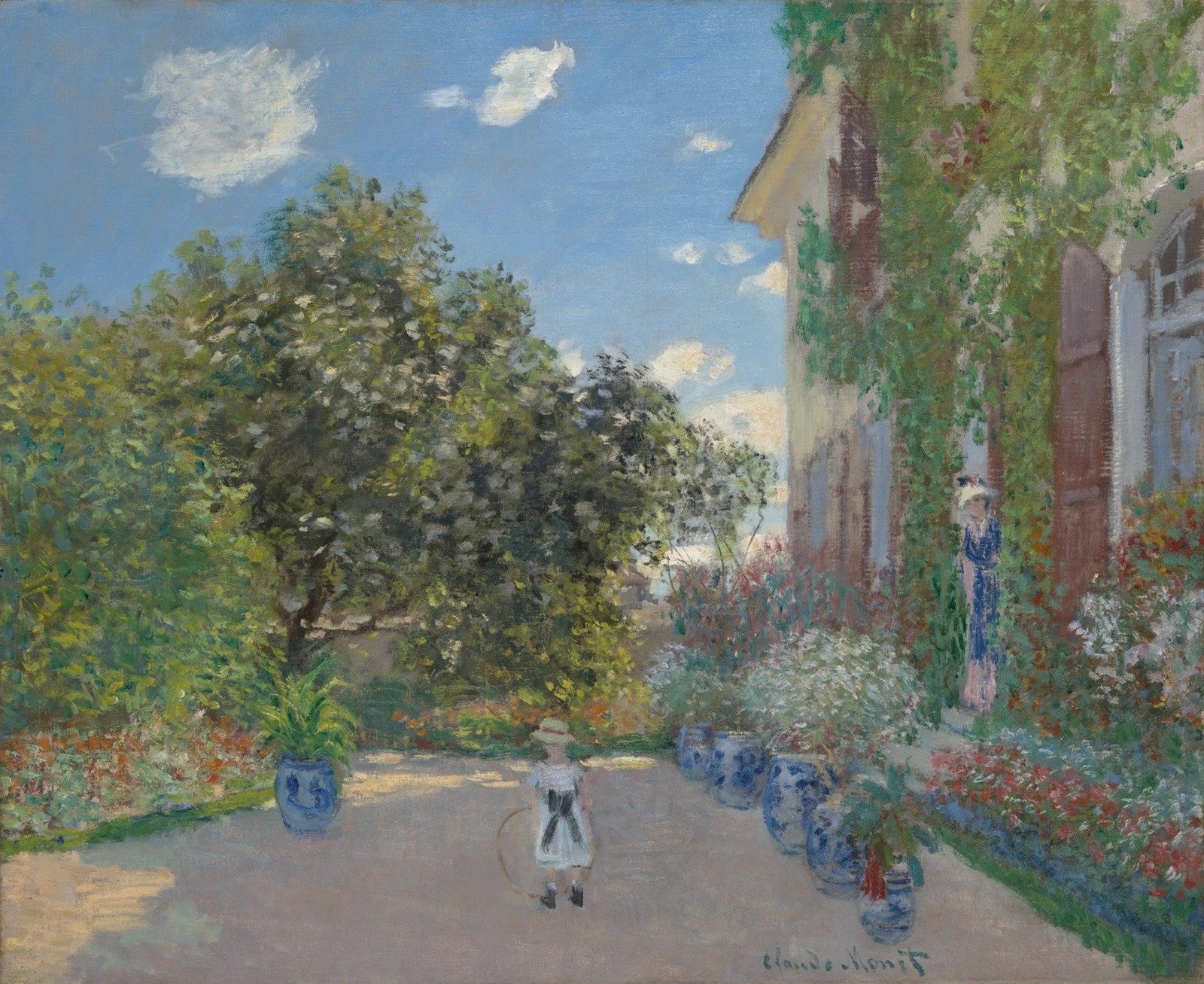
Stop here for a moment. Before we touch brushwork, look at the whole picture: a sunlit garden pressing against a vine-covered house, two small figures, a row of blue and white pots leading your eye along a path. This is Monet's own house at Argenteuil, painted in 1873, the kind of ordinary summer afternoon he turned into the heart of Impressionism. Notice the energy — nothing is still, every surface flickers with light.
Monet at Home
This is not a commissioned landscape. Monet is painting his own doorway, his own garden, his own family life. The woman in blue is almost certainly his wife Camille. Painted in oil on canvas, the work belongs to that burst of mid-1870s Impressionism when painters carried their canvases outdoors to capture real weather and real daylight.
Right Third, Diagonal Roof
Step back to the whole canvas and feel the structure. The sunlit house wall forms a strong vertical anchor along the right third of the picture, and the roofline cuts a diagonal back into the sky, leading your eye deep into the garden. A dense mass of trees on the left balances the architecture, while the path slicing through the middle carries the figures toward you. Two guides do the work: thirds and diagonals.
Shadows Without Black
Move up to the shadow under the eaves. Look closely: there is no black anywhere in this passage. Instead, the shadow is built from muted violets, dusty mauves, slate greys, and small notes of warm umber — the chromatic grey you get by mixing the complement of sunlight. The edge where shadow meets the lit wall is fractured into small comma-like strokes, not a hard line. The fall line drops straight from the roof edge into the recess.
Cool Pots, Warm Path
Now drop down to the row of ceramic pots. Their cool cobalt and ultramarine sit against the warm terracotta of the path and the ochre of the house wall, and that temperature contrast is what pushes them forward in space. Watch how the whites are not painted over the top — they are reserved as negative space, with the dark blue dabs laid around and over them so the eye assembles glazed ceramic from the contrast itself.
Where the Eye Lands
Follow the diagonal up to the woman at the door. She is the focal point, framed by the dark recess of the doorway and the lit wall of foliage beside her. Her dress is built from short vertical and slightly diagonal strokes of cobalt, ultramarine, and warmer periwinkle, with a few pinkish-mauve notes through the skirt. Notice how the dress dissolves into the leaves on the left — no drawn contour, just color temperature shifting the silhouette.
Implied Hoop, Real Impasto
Drop your eye down to the small child on the path. Watch the dress: those thick, opaque highlights catch the upper-right light in real impasto, and the shadowed left side cools into pale lavender-grey. Now the hoop — it isn't drawn. A single gestural dark stroke loops beside the dress, intentionally soft and ambiguous, and your brain completes the circle. That ambiguity keeps the mark alive.
Dabs That Read as Sun
Sweep up into the trees on the left. This is Monet's signature broken brushwork: short, distinct dabs of pale yellow, cream-white, and light green laid over mid-tone greens and darker blue-greens. The lightest ten percent of these strokes are doing eighty percent of the light work, and the highest-value dabs cluster along the upper-right edge of the foliage mass — exactly where raking sun from the upper right would catch the leaves.
A Lost Edge Against the Sky
Follow the eye path out along the roofline into the sky. That boundary between the warm dark roof and the cool blue sky is not a drawn line. It is a transition zone three to five brushstrokes wide, with a couple of intermediate blue-grey notes sitting in the mix. Look at how the sky dabs feather into the roof — softness built from the overlap itself, not from blending.
Rhythm of Dabs
Pull into the flowerbed at the lower edge. Saturated red and pink marks are laid as separate, rhythmic dabs, not blended shapes. A horizontal band of mid-blue blooms reads against darker green foliage beneath, and a sliver of green ground breathes between every stroke. This is divisionism: let the eye mix the colors at a distance instead of the brush on the canvas.
Two Figures, Two Brushes
Slide from the woman at the door down to the child on the path. Two figures, two completely different brush strategies. The woman is built from thin, vertical, broken strokes of cobalt, painted concurrently with the foliage so her edges dissolve into the leaves. The child is built from thick impasto — real ridges of white pigment catching the light — with a single gestural dark stroke implying the hoop. Same family of subject, two different languages of paint.
Look closer
8 details, each checked against a close-up of the picture.
-
Woman in Blue
The woman's blue dress is composed of vertical strokes of cobalt and white, blending into the shaded doorway.
The crop centers on a standing figure in a long blue dress and a white, flower-trimmed hat, flanked by dense green foliage on both sides. The dress is built from short, vertical, and slightly diagonal dashes of saturated cobalt, ultramarine, and a warmer periwinkle, with pinkish-mauve notes lifting through the skirt. The hat reads as a cluster of creamy white and pale yellow dabs with a small red-pink accent on top, and the face is just a few warm peach and ochre touches — too thinly painted to show features. Edges between the figure and surroundings are soft and broken: cobalt strokes meet dark green foliage without a drawn contour, and on the left the dress dissolves into the leaves rather than ending at a clean line.
-
Child with Hoop
The child's white dress is rendered with thick impasto highlights and a distinct dark line for the hoop.
The crop centers on a small child figure rendered in loose, broken impressionist brushwork. The white dress is built up with thick, opaque highlights that catch the upper-right light, while the shadowed left side of the garment cools into pale lavender-gray. A dark, loosely curved shape loops beside the dress on the left, reading as a hoop, though its contour is intentionally soft and ambiguous rather than crisply drawn. The figure stands on a warm pinkish-tan path against a mottled wall of ochre, green, and brown foliage tones, with small dark strokes anchoring the shoes at the bottom.
-
Foliage Texture
The leaves are formed by short, juxtaposed dabs of light yellow, pale green, and white paint.
The crop reveals a dense mass of foliage rendered with short, distinct dabs of paint rather than blended passages. Bright dabs of pale yellow, cream-white, and light green sit on top of mid-tone greens and darker blue-green passages, producing a dappled, sun-flecked read. The upper-left corner opens to a soft blue sky interrupted by a few thin, horizontal white strokes that read as distant cloud. Edges between dabs are crisp in the highlights and slightly softer where the paint is loaded thickly, suggesting impasto application. The lightest dabs are concentrated along the upper and right contours of the foliage mass, consistent with raking light from the upper right.
-
House Wall Shadow
The shadow under the eaves is rendered in muted purples and greys rather than black.
The crop captures the upper-left corner of a sunlit house: a sliver of pale blue sky, a warm thatch/collar in ochre and cream, and a vertical wall face dropping into a deep shadow zone. That shadow is built from a dense scumble of muted violets, dusty mauves, slate greys, and small notes of warm umber, with no trace of pure black. The edge where shadow meets light along the roofline is fractured into small, comma-like strokes rather than a hard contour. Green foliage patches (dabs of viridian, sap green, and yellow-green) intrude on the right and bottom, scumbled over the wall's shadow tones so the wall reads as partly veiled by leaves.
-
Ceramic Pots
The pots feature bright blue pigments contrasted with white highlights to simulate glazed ceramic.
The crop shows a diagonal procession of blue-and-white ceramic pots receding from lower right to upper left, each rendered with broken, dabbed brushstrokes rather than smooth gradients. Dark cobalt and ultramarine patches sit on a creamy white ground, with the pigment applied as discrete flecks so that the underlying canvas weave reads through in places. Edges are deliberately soft—the contours of the jars dissolve into adjacent foliage and the cool pinkish-grey path, with no hard outlines defining the silhouettes. Highlights cluster on the upper-right curves of each pot, while cool blue-grey shadows pool on the left flanks and where pots overlap, giving a clear sense of raking light from the upper right.
-
Garden Flowers
The red and pink flowers on the right are small, rhythmic dots of saturated paint.
The crop isolates a diagonal strip of flowerbed meeting a pale, cream-coloured path at lower left. A horizontal band of saturated mid-blue dabs crosses the middle, reading as a row of small blue blooms against darker green foliage beneath. Above the blue, dense clusters of red and pink marks are laid as separate, rhythmic dabs rather than blended shapes; some dabs carry bright pink centres while others read as deeper crimson. Edges between colours are soft and broken, with individual strokes remaining visible as discrete touches of paint. No figure is visible in this tight crop; the composition is built entirely from floral colour notes and the underlying green ground.
-
Roofline Transition
The edge of the roof meets the sky with a soft, slightly blurred boundary.
The crop is dominated by a diagonal soft edge running from upper-right to lower-center, where a field of broken light-blue sky strokes meets a darker passage of warm browns, deep umbers, and olive-greens below. The boundary is not a drawn line but a transition zone roughly 3–5 brushstrokes wide where the blue passages feather into the darker mass, with one or two intermediate blue-grey notes sitting in the mix. Above the edge, the sky reads as separate dabs of pale cyan and mid-blue placed side by side, leaving small canvas-coloured gaps between them. Below the edge, the marks are shorter, more loaded, and warmer, with a small cluster of yellow-green strokes in the lower-left corner catching the raking upper-right light.
-
Artist Signature
The signature 'Claude Monet' is visible in a thin, dark script at the bottom right.
The crop shows a handwritten signature reading 'Claude Monet' executed in a thin, dark bluish-black fluid medium across a warm, mottled pinkish-beige ground. The lettering sits on an uneven, slightly textured support where warm pinks, ochres, and cooler mauve tints intermingle, suggesting a painted layer rather than bare canvas. A blurred dark teal-gray smudge occupies the upper right, partially overlapping the support and unrelated to the inscription. The script strokes vary in thickness, with tapered beginnings and ends and a confident connected 'M' that loops back toward the baseline.
The Artist's House at Argenteuil in context
The Maison Aubry
Monet settled in Argenteuil in December 1871. According to the Art Institute's catalogue, he produced around 180 canvases there in nearly seven years [2]. Wikipedia gives a lower count of at least 150 pictures of Argenteuil and its surroundings, so the total depends on how the works are counted [3]. Purchases by his dealer Paul Durand-Ruel paid for a spacious rented house and garden, where the family lived from the end of 1871 until the summer of 1874 [2].
The catalogue says the house had last been rented by the painter Théophile Ribot and was probably recommended by Édouard Manet, who knew the owner, Mme Emilie-Jeanne Aubry [2]. It stood at the corner of the rue Pierre Guienne and the boulevard Saint-Denis, down the street from the station, and its staff eventually included a gardener and two domestic servants [2].
A house full of painters
The catalogue describes the house as the first where Monet could entertain journalists, collectors and fellow painters, including Renoir, Sisley, Caillebotte, Boudin and Manet [2]. It also notes that a proposal for a series of group exhibitions, which would begin in 1874, was composed and signed in Monet's living room on the rue Pierre Guienne [2]. Wikipedia reports that Argenteuil has been called the single most important site for the birth of Impressionism [3].
Jean in other gardens
Monet rarely painted domestic interiors there. The catalogue counts this as one of only a handful of canvases showing Camille and Jean at home [2]. It compares the picture with Camille and Jean Monet in the Garden at Argenteuil and Le déjeuner, where Jean is seated or looks out, noting that only the Chicago canvas shows him alone, standing and facing away [2]. The catalogue suggests, as a tempting possibility rather than a proven link, that Monet had in mind Manet's The Railway, begun in 1872, where a girl in a white dress with a bow at the back also turns away [2]. It also points to Camille at the Window, Argenteuil, in the Virginia Museum of Fine Arts, where a woman who may be a housemaid looks out over the same courtyard [2].
Reading the family into it
Some scholars have read Jean's isolation and the small figure in the doorway as signs of strain within the Monet family [2]. The catalogue disagrees, noting there is no evidence that Monet meant to suggest estrangement, and that a mother watching over a child of Jean's age fits his other paintings of the boy [2]. Its author, Gloria Groom, argues instead that Monet probably knew such a lush, family-centred suburban scene would appeal to his Parisian public [2].
Through Potter Palmer's hands
The painting's early history is uncertain. Wildenstein proposed a sale to Alexandre Dubourg in 1873 and to Durand-Ruel in 1882, but the dealer's archives couldn't confirm that either record refers to this picture [1]. Durand-Ruel in Paris acquired it on 29 April 1890 for 1,500 francs from a seller the archives don't name, and sold it to Potter Palmer of Chicago on 8 July 1891 for 5,000 francs [1].
Palmer sold it back to Durand-Ruel in New York on 23 November 1894 for $2,500, and Martin A. Ryerson bought it on 24 April 1912 for $6,200 [1]. It entered the Art Institute with Ryerson's bequest in 1933 [1]. When Durand-Ruel exhibited the painting in New York in 1895 and 1911, the catalogues dated it 1872, a year earlier than the date the museum now gives [1].
- Claude Monet, The Artist's House at Argenteuil (1933.1153): collection record with description, provenance and exhibition history (public API) . Art Institute of Chicago
- Gloria Groom, 'Cat. 15, The Artist's House at Argenteuil, 1873', with technical report by Kimberley Muir, in Monet Paintings and Drawings at the Art Institute of Chicago (public API) . Art Institute of Chicago
- The Artist's House at Argenteuil . Wikipedia