Between the tomb and the gold
El Greco sets an anxious crowd of apostles beneath a calm heaven in the centrepiece of his first great commission
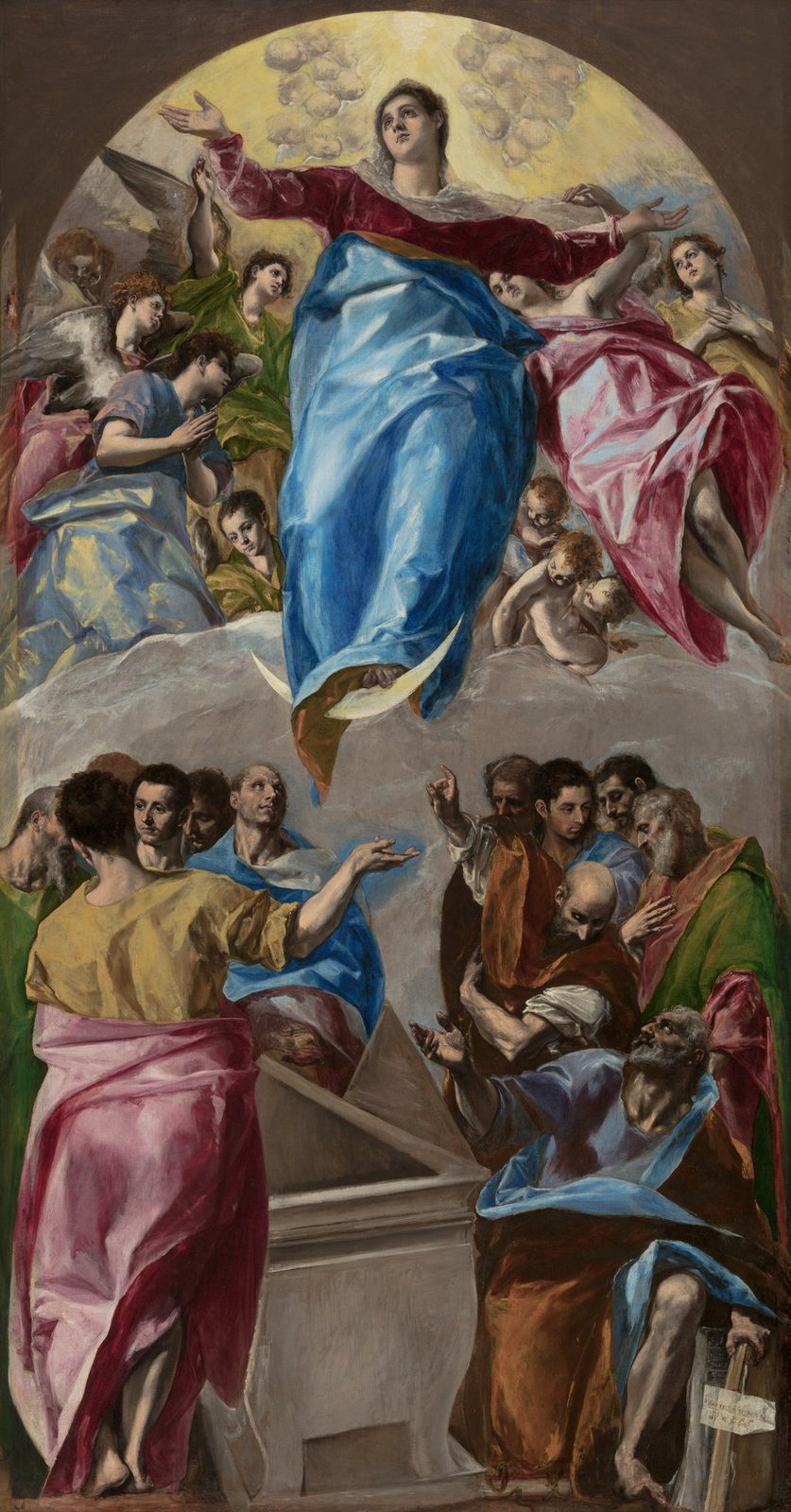
- Artist
- El Greco (Doménikos Theotokópoulos)
- Title
- The Assumption of the Virgin
- Date
- 1577–79
- Medium
- Oil on canvas
- Museum
- Art Institute of Chicago
- Image
- Public domain (CC0)
Open in Simple Art
Watch this story on iPhone and iPad, with offline downloads and a painting every day.
About 4 minutes of looking, in 10 parts.
The Assumption of the Virgin
This canvas is tall and narrow, and it's split in two. Below, a crowd of men gathers round an open stone tomb. Above, a woman in blue rises on a bank of cloud, arms spread wide, into a sky of gold.
El Greco, 1577 to 1579, oil on canvas
This is El Greco's The Assumption of the Virgin, painted in oil on canvas between 1577 and 1579. It was the centre of his first major commission, an altarpiece for the convent of Santo Domingo el Antiguo in Toledo. A paper at the lower right carries a Greek inscription with his name and the year 1577.
Earth below, heaven above
There are two zones here: the apostles on earth below, and the angels in heaven above. A strip of grey cloud divides them, and a central line runs from the tomb straight up through the Virgin's body to her face. Notice how many figures are packed into so narrow a space.
A sky that gives off light
At the very top, the light seems to come from the sky itself. It's palest just behind her head and turns to deeper yellow and ochre further out. Faint grey cherub heads float in the gold, so softly painted that they almost dissolve into it.
Blue, crimson and a little green
Come down to her body. The bright blue of her mantle meets the crimson of her sleeve along a fairly crisp edge, with almost nothing between them. Beside her, an angel in green adds a third colour. In a picture full of golds and reds, that blue holds the centre.
A hand reaching out
Now drop to the lower left, where an apostle stretches his arm out across the tomb. The back of the hand and forearm catch a warm peach light, while the underside of the wrist falls into cool greyish brown. The fingers are splayed, as if caught mid-gesture.
The empty tomb
Below that hand is the tomb itself, its lid tilted open. The inside is plain, flat grey, with no body in it. Thin highlights pick out the stepped mouldings on the front. Around it, the crowd presses in with crimson cloaks and raised hands.
A face turned upwards
Back at the top, look at her face. Her eyes turn steeply upwards. The lit skin is a pale, almost chalky cream, and the shadows along the jaw and beside the nose turn a cool greyish green rather than simply darker. Only the lips and cheek are warm.
Calm angels on the cloud
On the right, a group of small angels nestle together on the cloud. Their backs move from warm cream into cool reddish grey, and their outlines soften into the paint around them. They're calm and inward-looking, quite unlike the crowd below.
Rougher paint below
Compare one of the apostles at the lower right. His brown robe is laid in broad, loose sweeps, and the pale blue cloth across his lap carries single bright strokes along each fold. The paint down here looks rougher and more restless, like the figures.
Look closer
9 details, each checked against a close-up of the picture.
-
The Virgin's Face
The eyes are upturned and the skin tones are pale with subtle greyish shadows.
The crop isolates the Virgin's head in three-quarter view, turned slightly to the viewer's right with her eyes tilted steeply upward, the whites of the eyes catching light from above. Skin is rendered in pale, almost chalky cream tones that shift into cool greyish-greens along the jaw, the side of the nose, and beneath the lower lip, while warmer peach rises only at the lips and the cheekbone. A loose, broken halo of white veil frames the face, and the red mantle below is laid in with broad, smeary strokes of deep crimson over a darker burgundy underlayer. The yellow background is built from broad, dragged strokes of warm ochre, with a brighter passage around the upper right of her head.
-
Mantle Highlights
The highlights on the blue mantle consist of sharp, liquid-like white and pale-blue streaks.
The crop isolates a section of blue mantle dominated by elongated, diagonally descending highlight passages that run roughly upper-left to lower-right, conforming to the fold of the drapery beneath. The lightest passages read as cream-white (#e8eef2) and pale powder-blue (#a8c8e0), laid over a mid cobalt layer (#4a78b5) and into deeper ultramarine shadows (#1e4a8a). Edges between highlight and mid-tone are softly feathered rather than crisp, with the white passages built up in successive thin strokes that let the cooler blue show through at their margins. A warm ochre tone peeks in at the very top edge and a brown-orange tone at the lower right, indicating the highlight strokes terminate where adjacent garments begin.
-
Primary Color Contrast
The bright ultramarine blue of the mantle directly abuts the crimson of the sleeves.
The crop is dominated by a sweeping expanse of ultramarine blue mantle that fills the right two-thirds of the frame, broken by lighter cerulean highlights and deeper prussian-blue recesses. At the top edge, a band of saturated crimson (the sleeves) meets the blue along a crisp, slightly irregular contour with minimal blending. On the left margin, a young angel's head with curling brown hair and a green tunic appears, providing a third color zone whose green stands between the warm crimson and the cool blue. The blue drapery reads as fluid, layered strokes with visible directional brushwork, and the white highlights on the folds are applied as broad, soft passages rather than sharp lines.
-
Empty Sarcophagus
The interior of the stone tomb is shaded in a neutral grey with no figure inside.
The crop centers on the empty sarcophagus: its open lid tilts up and back at roughly 45°, framing a deep interior rendered in flat, neutral mid-greys with only minimal modulation along the receding back plane. The tomb's front face has three stepped horizontal moldings, each catching a thin highlight on its upper lip and dropping into a narrow cast shadow underneath, producing a stacked, banded reading. To the upper left, a bowed head with crimson-wrapped shoulders intrudes into the frame, the hood/mantle painted in saturated red-magenta with cool blue-grey shadows defining the folds. At the upper right, two hands rise with extended index fingers; their flesh is modelled with warm ochre lights against a darker brown background drape. Edges between the sarcophagus and the figures are crisp, while the interior grey is painted wetly without hard contours.
-
Pointing Apostle
The apostle's right hand is outstretched with fingers slightly splayed toward the Virgin.
The crop shows an elongated right forearm and hand rising diagonally from the lower-left toward the upper-right, with fingers splayed in a gesturing pose. The back of the hand and forearm catch warm peach and ochre flesh tones on the upper/right-facing surface, while the underside of the wrist and the inner forearm drop into cooler grayish-brown shadow. A saturated blue mantle folds diagonally beneath the arm, with a sliver of deep crimson visible at the lower edge and a fragment of a face/chin at the upper-left. The background to the right is a soft, mottled pinkish-gray, and the edges of the fingertips are soft but still legibly defined against it.
-
Celestial Mandorla
The golden background transitions from a bright center to a softer, diffused yellow edge.
The crop centers on the Virgin's upward-tilted head against a luminous mandorla. A near-white core of light sits directly behind and above her crown (top-center, ~0.05–0.20), transitioning outward into saturated lemon-yellow and then into dusty ochre where the cherub heads cluster along the upper-left and right edges. The cherub forms are suggested with cool gray-violet half-tones, not fully drawn—their features dissolve into the gold rather than being outlined. The Virgin's white veil is laid in with broad, soft-edged strokes that lose their boundary into the yellow ground, while her crimson sleeve below is built from thicker, more opaque impasto that holds a hard edge against the lighter background.
-
Crescent Moon
A thin, pale crescent moon curves beneath the hem of the Virgin's blue mantle.
The crop centers on a thin, pale cream-yellow crescent moon curving across the left and reappearing as a second sliver on the right, framing the Virgin's descending foot. Her mantle is rendered in two blues — a saturated mid-blue in lit passages and a near-navy in the deep folds — with loose, sweeping strokes that follow the drape's fall. The exposed foot/leg is warm ochre-brown, modeled with a darker silhouette on its right edge and a lighter, slightly pinkish highlight along the upper curve where light strikes it. Below, the muted neutral grey-brown ground allows the bright slivers to read as luminous; the apostle's upturned face in the lower-left is constructed from warm earth tones with thin scumbled highlights on the brow and cheekbone.
-
Cherub Blending
The edges of the cherubs' bodies blend softly into the surrounding golden clouds.
The crop isolates three overlapping cherub heads and shoulders rendered with rapid, broken brushwork. The central figure's back and shoulders are built from warm cream strokes that grade into cool, reddish-grey shadows along the spine and underarm, with the contour dissolving into adjacent neutral passages rather than meeting a defined line. The blue mantle at the left edge is laid in with broad, low-contrast strokes, while the crimson sleeve at upper right is set in with a few thicker, slightly opaque accents. Curling hair is suggested with quick comma-like touches of yellow-ochre and raw umber against the pale flesh, and the transition from skin to surrounding atmosphere is feathered rather than outlined.
-
Bottom-Right Drapery
The brown and blue robes are rendered with broad, sweeping strokes and high-contrast highlights.
The crop centers on a bearded elder's lap where a saturated brown robe and a pale sky-blue mantle overlap. The blue cloth is built from two contrasting value systems: creamy off-white highlights that sit on top of the paint and a saturated mid-tone beneath, with the brightest accents applied in single, confident strokes along the crest of each fold (visible as the ribbon of light passing diagonally from upper-left to mid-right). The brown robe below is laid in with broad, dry, semi-transparent sweeps where the warm underlayer shows through, and several strokes are dragged nearly horizontally to define the knee's contour. Edges between fabrics are softened by thin overlaps rather than hard lines, and a small triangular patch of raw ground or scumbled warm paint is visible where the blue mantle tucks behind the knee, indicating an alla prima wet-into-wet stage.
The Assumption of the Virgin in context
A church for two patrons
In mid-1577, soon after arriving in Spain, El Greco won the two largest commissions of his career so far: The Disrobing of Christ for Toledo Cathedral, and three altarpieces for the Cistercian convent of Santo Domingo el Antiguo [3]. Between 1576 and 1579, the convent church was rebuilt in a classicising style. Money came from Diego de Castilla, dean of the cathedral, and Doña María de Silva (1513 to 1575), a Portuguese gentlewoman who had served the Empress Isabel. The church was meant as a burial place for them both [3]. The Art Institute notes that the whole programme turns on death and salvation [1].
According to the Prado, Diego chose El Greco on the advice of his son Luis de Castilla. Luis had met the painter at the Farnese palace in Rome in 1571 [3]. El Greco designed the structure of all three altarpieces and the five sculptures on top of the main one, and he painted the canvases too [3].
Eight canvases or nine
The Assumption, more than four metres tall, was the central canvas of the high altar, with four saints at the sides and the Trinity above [1][3]. The Art Institute says it was larger than anything El Greco had painted before, and that the commission made his name in Toledo, where he worked for the next 37 years [2]. The paintings were in place in the main retable by September 1579 [1]. A paper at lower right carries a Greek inscription stating that Doménikos Theotokópoulos, Cretan, showed this in 1577 [1].
The sources count the paintings differently [2][3]. The Prado says El Greco contracted to paint eight canvases, and that a Holy Face by him was added years after the church was consecrated, over a carved coat of arms above the Assumption [3]. The Art Institute speaks of nine paintings, which seems to include that later addition [2].
Out of the church
The painting stayed in the church for more than 200 years [2]. On 13 August 1830 the 19-year-old Infante Sebastián Gabriel de Borbón bought it for 14,000 reales de vellón. A copy by Luis Ferrant and Carlos Luis de Ribera, costing 8,000 reales, took its place [2][3]. The original lining and stretcher still carry his crowned SG stamp [2].
The dates for what followed differ. The Art Institute says his collection was seized in 1835 and returned in 1861, while the Prado gives 1836 and 1859 [1][2][3]. The Prado adds that his collection went to Pau in France in 1868, and the painting was shown there in 1876 [1][3]. After his widow's death, it was offered for sale in Madrid in 1902 but bought in. It was then lent to the Prado, where it appeared in the museum's first El Greco exhibition [1][3].
Mary Cassatt's search for a buyer
The American painter Mary Cassatt saw the Assumption in Madrid in 1901 and tried to place it with an American museum [2]. The Metropolitan Museum, the Museum of Fine Arts in Boston, the Pennsylvania Academy of the Fine Arts, and the collectors Henry and Louisine Havemeyer all declined [2]. In October 1904 she persuaded Durand-Ruel to buy it for 100,000 francs, about $17,000, with money from Henry Havemeyer [1][2].
The Art Institute's president, Charles L. Hutchinson, had it shipped to Chicago [2]. At the first vote, on 7 June 1906, the trustees were split; at a second meeting on 17 July they agreed unanimously to buy it, taking out a loan [2]. The museum says a gift from Nancy Atwood Sprague in 1915, in memory of her husband Albert Arnold Sprague, repaid the loan, and the credit line records her gift [1][2]. The Prado's account simply says she acquired and donated it in 1906 [3].
Cleaned and lent
The painting had been only lightly cleaned over the centuries before a full conservation treatment and technical study began at the Art Institute in 2017 [2]. That work led to the 2020 exhibition El Greco: Ambition and Defiance, which the museum's article calls the painting's first exhibition since it entered the collection [2]. The collection record, however, also lists showings at the Art Institute's Century of Progress exhibitions of 1933 and 1934 and at the Grand Palais in Paris in 2019 to 2020. So, that statement should be read with care [1].
In 2025 it went to the Prado for El Greco. Santo Domingo el Antiguo, bringing together eight of the nine works for the church for the first time since they were dispersed [3]. Of the original paintings, only the two Saint Johns and the Resurrection remain in the church today [3].
- El Greco, The Assumption of the Virgin (1906.99): collection record with description, inscription, provenance and exhibition history (public API) . Art Institute of Chicago
- Rebecca Long, 'The Many Lives of El Greco's Assumption of the Virgin' (6 April 2020) . Art Institute of Chicago
- El Greco. Santo Domingo el Antiguo (exhibition, 18 February to 15 June 2025): exhibition text and section on the dispersal of the works (Internet Archive copy, 5 December 2025) . Museo Nacional del Prado, Madrid