The Bathers — A Cézanne Walkthrough
Reading a late Cézanne with a painter's eye
- Artist
- Paul Cezanne
- Title
- The Bathers
- Date
- 1899-1904
- Medium
- Oil on canvas
- Museum
- Art Institute of Chicago
- Image
- Public domain (CC0)
Open in Simple Art
Watch this story on iPhone and iPad, with offline downloads and a painting every day.
About 6 minutes of looking, in 13 parts.
A late Cézanne, opened up
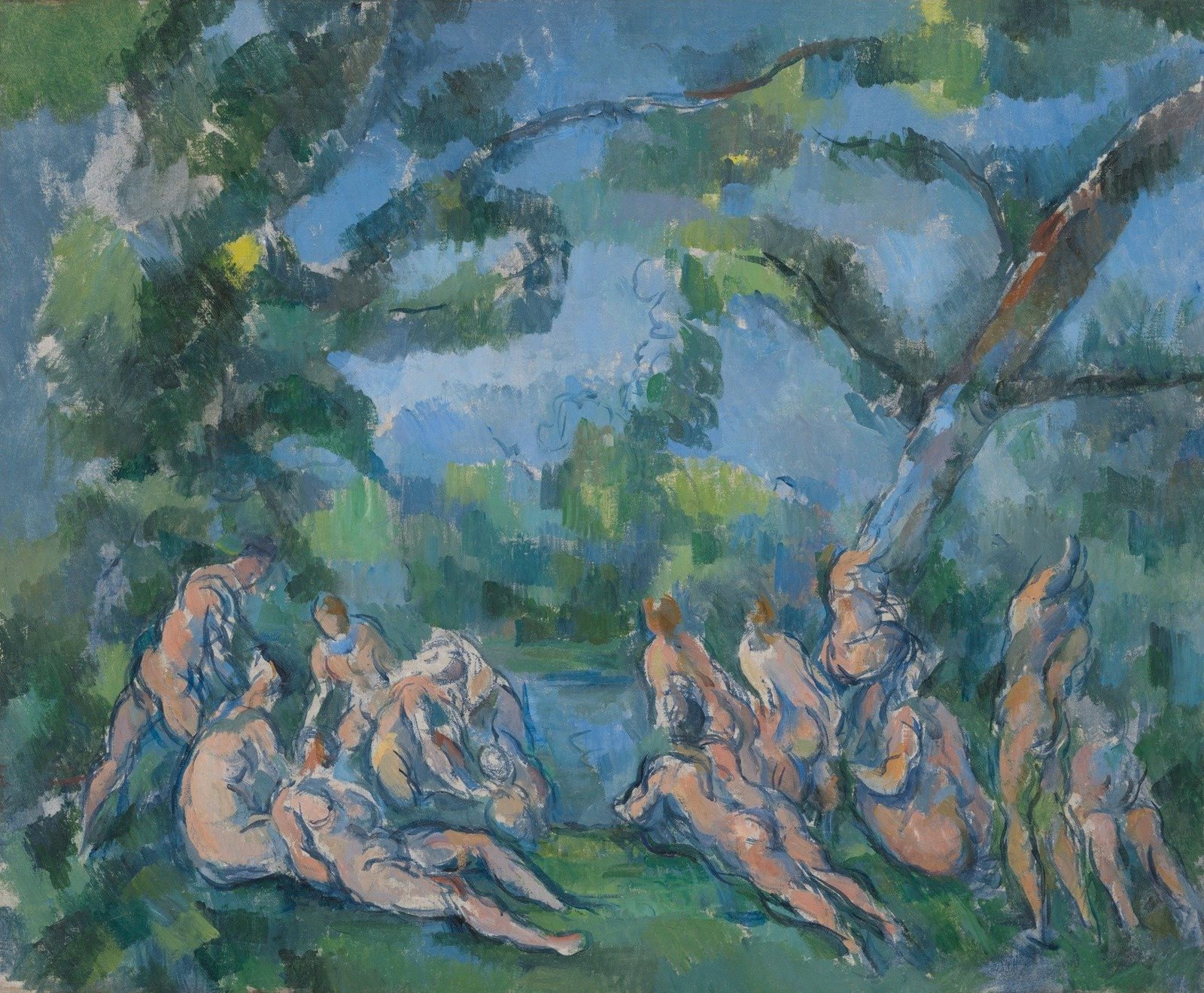
Before us is one of Cézanne's great late canvases — a wedge of warm bodies, cool foliage, and open sky that almost refuses to behave like a 19th-century picture. We're going to walk through it as a painter would, watching how the surface is actually built, patch by patch.
The Bathers, 1899–1904
This is The Bathers, by Paul Cézanne, an oil on canvas worked on between 1899 and 1904, in his late Post-Impressionist manner. Try to read it less as an illustration of nudes in a landscape and more as a construction site — a problem in volumes, temperatures, and parallel patches of color.
A wedge, not a rectangle
Tilt your eye to the right and you'll find the engine of the composition: a single leaning tree trunk drives a long diagonal from the lower right corner up into the canopy. Cézanne sets that diagonal against the horizontal band of bathers across the middle, so the whole canvas becomes a wedge opening onto the sky — a triangle, not a rectangle.
Diffuse, even, atmospheric
The light here is diffuse and atmospheric — soft, even daylight from above, with no single sharp sun and almost no hard cast shadows on the figures. Note the high-key structure: the sky is the lightest passage, the foliage a broad mid-value band, and the deepest accents sit in the trunk and shadowed leaves.
Cool meets warm across the canvas
Color is doing most of the work. The sky is a cool blue, the foliage sits in blue-greens and olives, and against both, the bathers erupt in warm peach, ochre, and rose. The temperature strategy is deliberate: cool at the top, warming sharply through the figure band, then cooling again in the foreground grass. Cool and warm, talking across the canvas.
A trunk built from parallel strokes
Drift in on the tree trunk on the right. Every stroke here runs on the same slanted axis — upper right to lower left — and they're laid side by side, not blended. Lit side: warm orange-brown. Shadow side: dark blue-green. In between: mid blues and ochre grays. The cylinder isn't modeled with a gradient; it's modeled with three or four parallel color planes. This is the same logic he's about to use on the bodies.
A figure in a few decisive strokes
Move down into the right side of the bather group. Watch this seated figure: torso, thigh, and bent knee are written with just a handful of decisive strokes — warm peach on the lit planes, deep brown and dark teal-blue carving the shadow side. There is no drawn outline. The green foliage simply bleeds into the flesh, and her edge softens into the leaves. Late Cézanne is fundamentally about this economy of means.
The focal cluster, faceted and warm
And here is the heart of the painting — the central reclining group, where the warmest flesh tones and the densest figure clustering meet. Bodies are built from distinct, faceted patches of paint: rose, salmon, pale ochre sitting directly next to cool blue-greys and lavender shadows. Volume comes from temperature contrast, not tonal gradation. Highlights are broken, opaque dabs of pinkish white laid over a thinner tinted half-tone.
Where blue sits on top of peach
Pull closer to where a bather's torso meets the leaves. The cool blue-green strokes of the foliage are not politely stopped at the body — they overlap, they sit on top of the warm peach. That blue is doing double duty: it's both the shadow on the figure and the surrounding space pushing in. The figure isn't drawn first and then colored; it's fought for, patch against patch, in the same vocabulary as the trees.
Shadows painted in blue, not black
Drop down to the reclining figure's legs and look at the shadow under the calf and behind the knee. It is unmistakably blue and blue-green, not gray, not black, not burnt umber. The grass is then dragged right up into the shadow in saturated green. This is the trick: shadows on warm flesh are painted with a cool complement, never with a darkened local color.
The ground, same logic, cooler key
Compare that to the foreground grass. Short vertical and diagonal strokes of green and blue-grey, layered, with cooler underpainting showing through to do the shadowing. The strokes don't all run the same way — some are short dabs, some longer sweeps — but they're all faceted, all left unblended. The body and the hillside are solved with the same logic, just at different scales.
Two temperatures, one vocabulary
Hold two crops side by side — the central bather group and the foreground grass. The figures are warm, faceted, with cool blue shadows. The grass is cool, faceted, with cool blue underlayers. Same brush, same edge logic, opposite temperatures. Cézanne is telling you the body and the earth are the same material problem.
The sky edge: a broken seam
Finally, lift your eye to where the dark foliage meets the open sky. That boundary is not a drawn line — it's a series of jagged, abutting color blocks, with lighter sky flecks sitting inside the green mass and dark leaf shapes punching up into the blue. The crisp, broken seam is the description of form. Resisting the urge to soften it is the lesson.
Look closer
8 details, each checked against a close-up of the picture.
-
Central Bather Group
Figures are constructed from faceted patches of ochre, rose, and blue-grey paint.
The crop centers on a cluster of reclining and seated nudes whose bodies are built from distinct, faceted patches of paint rather than blended transitions. Warm flesh tones—rose, salmon, and pale ochre—sit directly next to cool blue-greys and lavender shadows, so volume emerges through color temperature contrast rather than tonal gradation. Highlights are laid in as opaque, broken strokes of pinkish white and cool white along shoulders, thighs, and knees, with little smoothing at the edges. Contours are loose: blue-grey and green strokes from the ground encroach into the limbs, dissolving boundaries between body and grass. Background foliage is similarly planar, with darker olive and teal patches defining the tree mass on the right.
-
Tree Trunk Structure
The trunk consists of parallel, slanted brushstrokes of brown, blue, and green.
The crop isolates a tree trunk constructed from a series of roughly parallel, slanted brushstrokes running from upper-right to lower-left. Each stroke is laid down as a distinct, faceted patch of color with visible edges; strokes abut rather than blend. The trunk's lit side carries warm orange-brown marks (near the upper right and lower right); the shadowed side reads as dark blue-green; intermediate passages use mid blues and ochre-touched grays to bridge the two. Background sky and foliage read as separate, similarly faceted patches sitting behind the trunk rather than modeled atmospherically.
-
Flesh and Foliage Transition
Cool blue-green strokes of the landscape overlap the warm peach tones of the figures.
The crop shows interlocking nude female figures rendered in warm peach and salmon flesh tones, set against a background of cool blue and deep green foliage. Constructive brushstrokes are clearly visible: short parallel patches of color build the curves of shoulders, backs, and hips without using contour lines. Cool blue strokes are layered on top of the warm flesh in several places, particularly across the upper torso and along the right side, while dark green and teal patches of foliage sit behind and beside the bodies. Edges are soft and broken, with no hard outlines separating figure from ground; instead, the transition is achieved by juxtaposed color notes. The flesh reads as both warm and cool simultaneously because of the blue overlays functioning as shadow and as interpenetrating background.
-
Figure Shadowing
Shadows on the reclining figure's legs are rendered in blue and green rather than black.
The crop isolates a reclining figure's legs and feet resting on green ground. Flesh is built from warm pinks and peach strokes, while the cool shadow zones along the inner thigh, behind the knee, and under the calf are clearly painted in blue and blue-green rather than neutral or black. The grass at lower right uses saturated green patches that press up against the figure's outline. Brush edges between flesh and ground are soft and broken, with small green flecks appearing inside the shadowed flesh near the heel.
-
Upper Sky Boundary
The edge of the foliage is a series of jagged, unblended color blocks against the blue sky.
The crop shows the upper boundary where dense foliage meets open sky. The sky is built from flat, parallel patches of medium blue (#6E8DB0) with a darker horizontal band of grey-blue (#4A6680) cutting across the upper third, suggesting cloud or atmospheric depth. The lower half is dominated by dark blue-green foliage mass on the left, with brighter yellow-greens (#A4B860) breaking through on the right. The boundary between sky and foliage is not a drawn line but a series of abutting color blocks — the dark foliage shapes jut up into the sky in sharp, angular silhouettes while lighter sky-toned flecks sit inside the green mass.
-
Foreground Grass
Short, vertical and diagonal strokes of green and blue create the texture of the ground.
The crop is dominated by a field of green ground on the right and lower portions, with a diagonal pale flesh-toned form (part of a reclining bather) cutting across the upper left. The grass area is built from parallel and overlapping strokes in multiple greens mixed with blue-greys, varying in length from short dabs to longer sweeps. The strokes do not all read as vertical; many run on a shallow diagonal from lower-left to upper-right, with some longer horizontal passes visible in the mid and lower zones. The flesh form is outlined with a dark blue contour that turns the corner at the lower right, where a small pink-orange stroke marks a soft edge.
-
Seated Figure Back
The curve of the back is built from three distinct, overlapping planes of color.
The crop isolates the curving back and shoulder of a seated figure rendered in broad, faceted patches. The flesh is built from warm peach-ochre tones that are partly overlaid and bordered by cooler blue-violet passages, with small arcs of green from the surrounding landscape showing through at the lower edge. The transitions between planes are achieved through adjacent color rather than drawn outlines, so edges read as soft color shifts. The strongest warm plane sits upper-center, a darker blue-violet plane wraps the lower-left contour, and a third warm band re-emerges near the lower right, supporting the claim of three overlapping color planes.
-
Rightmost Figure
The figure's form is defined by a few decisive strokes of light peach and deep brown.
The crop isolates a seated or kneeling nude figure whose torso, thigh, and bent knee emerge from surrounding green and blue foliage. Form is built from roughly parallel patches of warm peach (≈#d68a6a) and salmon (≈#c97864) on the lit planes of the chest, shoulder, and upper leg, while deep brown (≈#3d2a20) and dark teal-blue (≈#2c4858) strokes carve the shadow side and the contour against the leaves. Edges are softened by adjacent green strokes that bleed into the flesh rather than by drawn outlines, so the figure sits within the landscape rather than on top of it. Cool blue-grey accents (≈#7a8a9c) on the knee and hip read as reflected light from the sky, balancing the warmest peach on the upper torso.
The Bathers in context
One of about a hundred and thirty
Cezanne painted around 130 bather pictures, which is fewer than his landscapes, still lifes or figure paintings. In his last dozen years he worked on three large bather compositions. They are now in the Barnes Foundation, the National Gallery in London and the Philadelphia Museum of Art [2]. Paul Smith's catalogue entry compares the figures in the Chicago canvas with those three. Five of its figure types appear in the Barnes picture and six in the London one, and seven of these eight types return in Philadelphia [2]. He cautiously suggests that the Chicago painting was begun around the same time as the London one and before the Philadelphia one [2].
Thirteen figures, or fourteen
The two scholars who studied the poses most closely, Mary Louise Krumrine and Giulia Ballas, each count thirteen figures, but they agree on only twelve, so the catalogue's diagram shows fourteen, two of them in the loosely painted area just left of centre [2].
Several poses have long pedigrees. A seated bather on the left probably descends from the seated nude in Manet's Luncheon on the Grass, itself based on a river god in an engraving after Raphael [2]. A figure with a raised arm goes back to the Queen of Sheba in Cezanne's own Temptation of Saint Anthony, and the prone bather is based on the Sleeping Hermaphrodite in the Louvre, which he sketched [2]. Smith reads the deliberately blurred signs of gender as a sign that the bodies mattered to Cezanne more as physical mass than as men or women [2].
Arcadia without models
According to his dealer Ambroise Vollard, Cezanne dreamt of posing nude models in the open air but never could, partly because women intimidated him [2]. So the setting is generic. Even so, the catalogue loosely connects it to the country around Mont Sainte-Victoire and the river Arc near Aix, which show up in other bather pictures [2]. It also links the theme to the idea of Provence as a modern Arcadia. This notion was encouraged from the late 1890s by the poet Joachim Gasquet and his circle, who wrote of nymphs and satyrs living as part of the landscape [2].
Contours borrowed from watercolour
The technical report finds that Cezanne laid out the figures and branches in dilute ultramarine. He then added blue contours at every later stage, using darker and thicker blues as he went [2]. Smith compares this with a watercolour of the same years in Winterthur, and suggests that the open, transparent look of the canvas comes from watercolour practice [2]. The canvas is the finest of about seventy Cezannes analysed so far. But its ground was already worn before he began, which suggests it was an old or cheap piece [2]. Pink strokes near the tree on the right may mark a figure he planned and abandoned [2]. A treatment in 2021 removed synthetic varnishes, and the picture is now shown unvarnished [2].
Dealers, a Chicago collector and a shifting date
The painting passed from Vollard to the Paris collector Jacques Zoubaloff. His sale in June 1927 included it as lot 113, and it then went to Jos Hessel and Paul Rosenberg [1][2]. It reached Chicago through the Chester H. Johnson Gallery, and by 1929 it belonged to Amy Irwin McCormick, wife of Colonel Robert R. McCormick [1][2]. After she died in 1939 it passed to him. He then gave it to the Art Institute in 1942 in her memory [1].
Its date has moved around. At the Art Institute's Century of Progress exhibitions in 1933 and 1934 it was listed as about 1890, while later shows gave 1900 to 1905 [1]. The museum now dates it 1899 to 1904. The picture itself is neither signed nor dated [1][2].
- Paul Cezanne, The Bathers, 1942.457: object record, label text, provenance and exhibition history . Art Institute of Chicago (public API)
- Cat. 11, The Bathers, 1899-1904: entry by Paul Smith, technical report by Kim Muir with Giovanni Verri, in Cezanne Paintings and Watercolors at the Art Institute of Chicago (2026) . Art Institute of Chicago