Like a playing card
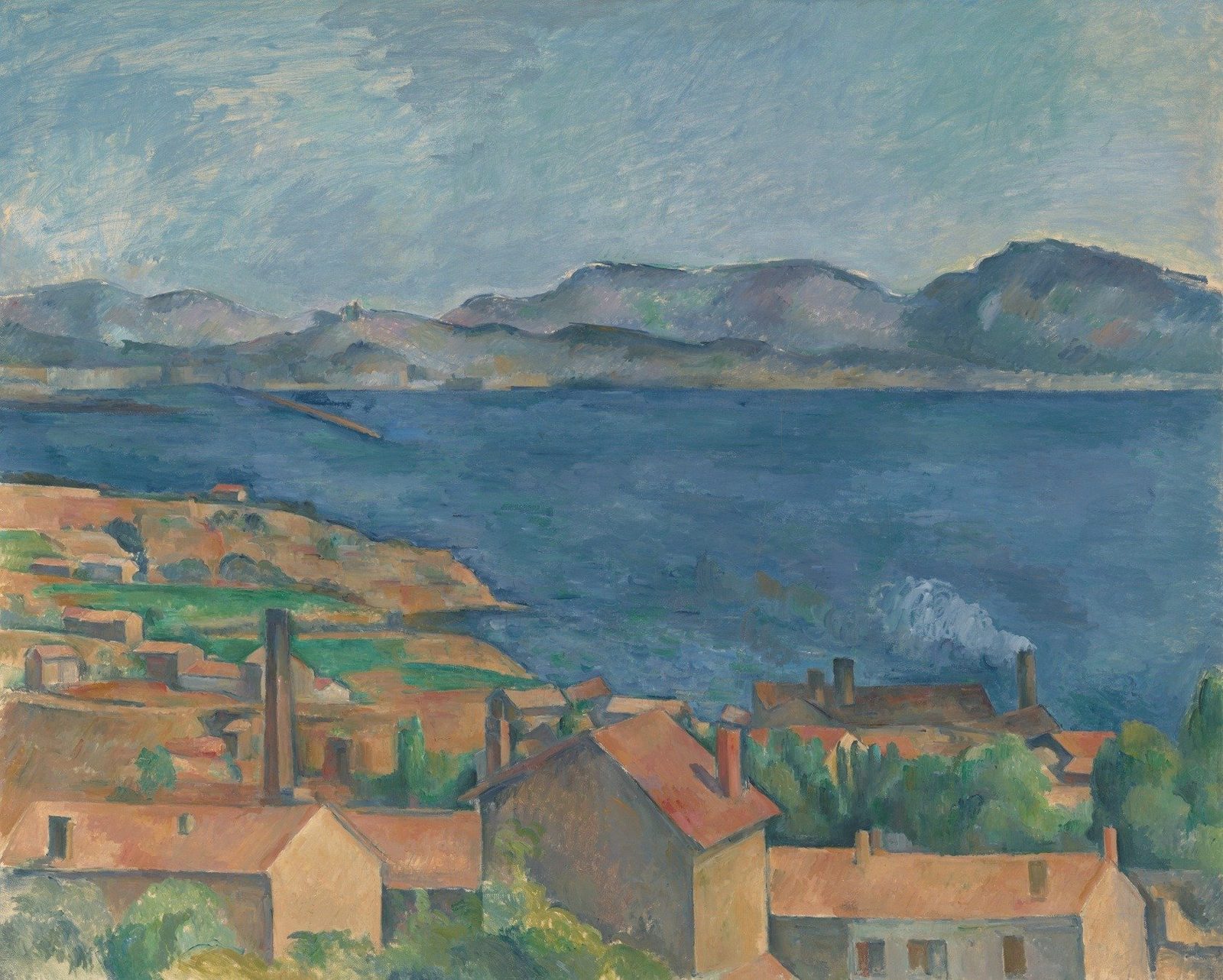
Cézanne stacks roofs, sea, mountains and sky into firm blocks of warm and cool colour
- Artist
- Paul Cezanne
- Title
- The Bay of Marseille, Seen from L'Estaque
- Date
- c. 1885
- Medium
- Oil on canvas
- Museum
- Art Institute of Chicago
- Image
- Public domain (CC0)
Open in Simple Art
Watch this story on iPhone and iPad, with offline downloads and a painting every day.
About 4 minutes of looking, in 9 parts.
Looking down on L'Estaque
We're looking down over a jumble of orange roofs to a wide, deep blue bay, with a line of mountains on the far side. A tall chimney rises among the houses on the left. It's a calm view, but look how solid everything feels, even the water.
Cézanne, about 1885, oil on canvas
This is Paul Cézanne's The Bay of Marseille, Seen from L'Estaque, painted around 1885 in oil on canvas, and now in the Art Institute of Chicago. Years earlier, writing to his friend Camille Pissarro about two small sea views from this coast, Cézanne compared the scene to a playing card, with its simple shapes and colours. He painted more than a dozen views like it in the 1880s.
Four zones
The museum describes the canvas as four zones: buildings, water, mountain and sky. You can see them stacked one above the other. The bay takes up the broad middle, and the far shore runs across a little above centre. Against all those horizontals, the chimneys are almost the only things standing upright.
Warm below, cool beyond
Now look across the town to the water. The roofs are orange and ochre, then a strip of green runs along the shore, then the deep blue of the bay. Warm things sit near us and cool things lie further off. Towards the right, a small puff of white smoke drifts out over the water.
Roofs in blocks
Come down to the roofs at the lower left. Each slope seems to be built from separate patches of orange, salmon, pale ochre and a greyish violet, laid side by side and not blended. The patches run with the slope of the roof, so the brushwork itself tells you which way it tilts.
A chimney among the roofs
Here's the tall chimney on the left. It's a narrow column of blue-grey, rust and ochre, with strokes that seem to run mostly upwards. There's no drawn outline. Its edge comes from cool paint sitting against the warm roofs and the green behind it.
A corner without a shadow
On this house in the middle, two sides of the roof meet at a ridge. One side is warm orange and salmon, the other turns a cooler purple-brown and greyish rose. The light seems soft and even, and there's no cast shadow here. The change of colour alone turns the corner.
Where land meets water
Follow the shoreline on the left. There's no single line for the coast. Ochre slopes give way to dabs of olive and dark green, and then to the horizontal blue strokes of the water. The edge is made of patches placed next to each other.
The far mountains
Lift your eyes to the mountains. Their crest is made of short, angled strokes of dusty purple, slate blue and muted teal against the pale sky. Where ridge meets sky there's a step in colour and tone rather than an outline.
Look closer
6 details, each checked against a close-up of the picture.
-
Central Town and Bay
The composition transitions from warm terracotta roofs to a deep blue bay via a strip of green vegetation.
The crop is organized in three horizontal bands: warm terracotta rooftops with chimneys and one tall smokestack at the bottom, a middle strip of green and rust vegetation along a curving shore, and a broad expanse of deep blue bay above. The roofs are built from broad, parallel planes of red-orange pigment that follow the slope of each surface, with edges between tiles softened rather than crisp. Across the bay, horizontal strokes of varying blue describe a calm surface, broken by a white plume of smoke drifting left from a factory chimney on the shore. The far shore is rendered in cooler, muted blue-lavender, and the smokestacks create the only strong verticals in an otherwise horizontally stratified composition.
-
Constructive Stroke on Roofs
The roofs are built from parallel, diagonal patches of orange and ochre rather than blended gradients.
The roof planes are constructed from discrete, roughly parallel patches of warm color — orange, salmon-pink, ochre, and cooler greyed-violet — laid side by side rather than blended. Edges between adjacent patches stay visible as soft but definite boundaries, creating a faceted, quilted surface across each sloping roof. The triangular gable on the right uses broader, flatter strokes of pale ochre, while the sloped roof to its left shows more frequent, narrower bands of varying warm hues. A small dark rectangle (chimney or dormer) interrupts the upper roof with a near-vertical hard edge, contrasting with the diagonal rhythm of the surrounding patches.
-
Leftmost Smokestack
The smokestack is a rigid vertical rectangle of brown and grey that breaks the horizontal plane of the roofs.
A tall vertical column (the smokestack) occupies the left third of the crop, painted in dark blue-grey at the top, warm rust-brown through the middle, and a lighter ochre band near the base. To its right, roof planes angle downward in warm terracotta and ochre strokes, with a band of deep teal-green (a field) cutting horizontally behind the stack. Brushstrokes on the chimney are mostly vertical, parallel to the form, while roof and water planes run in opposing diagonal/horizontal directions, creating a clear cross-axis. Edges between the stack and surrounding planes are softened by adjacent color rather than drawn as hard lines, and atmospheric haze at the top bleeds the chimney's silhouette into the sky.
-
Mountain Ridge Line
The boundary between the mountains and the sky is a jagged, simplified edge of muted purple and blue.
The crop isolates a horizontal band of mountain ridges silhouetted against a pale, cool sky. The uppermost ridge reads as a jagged but simplified line built from short, angled strokes in dusty purple, slate blue, and desaturated teal. Below it sits a secondary ridge in slightly warmer green-blue with a band of ochre and pale earth tones suggesting a valley or settlement strip. At the bottom edge a thin ribbon of deeper blue water separates the land from the mountain mass. Edges between sky and summit are softened by adjacent hue rather than by hard line, while lower ridges show crisper, more directional stroke breaks.
-
Roof and Gable Facets
The roof and the gable wall use distinct shades of orange and yellow to suggest volume without strong shadows.
The crop shows a roof slope meeting the house's gable-end wall along the roofline. The roof plane at right is built from warm orange, salmon-pink and pale ochre strokes laid in loose parallel diagonals. The gable wall at left/center shifts to cooler, muted purple-brown and grayish-rose, with the same diagonal stroke rhythm. Edges between planes are defined by abrupt temperature change rather than by drawn lines or cast shadows. A small green-yellow tree mass in the lower left and a thin red chimney on the right provide vertical anchors against the horizontal roof planes.
-
Coastline Transition
The shoreline is defined by a thin, irregular band of ochre and green separating land from water.
The crop captures the diagonal interface where the terracotta-toned landmass on the left meets the blue bay on the right. Short, blocky strokes in ochre, salmon, and muted yellow define the sunlit slopes and rooftops, while denser dark-green and teal dabs indicate trees and shadow pockets along the descent. The shoreline itself is not a single line but a layered transition: pale ochre earth bleeds into olive and blue-green brushstrokes, which in turn give way to the cooler horizontal strokes of the water. Edges are softened through adjacent rather than blended touches, with no hard contour drawn between land and sea.
The Bay of Marseille, Seen from L'Estaque in context
A banker's son from Aix
Paul Cézanne was born in Aix-en-Provence on 19 January 1839. His father, Louis-Auguste, began as a hatter and became a banker [3]. At the Collège Bourbon in Aix he became close friends with Émile Zola [3]. At his father's wish he enrolled to study law in 1859, but he spent his time drawing and writing poems [3].
In 1861, against his father's objections and with Zola's encouragement, he went to Paris [3]. The École des Beaux-Arts turned him down, and he drew instead at the Académie Suisse, where he met Camille Pissarro [3]. Their friendship began as master and pupil, and by the 1870s they were painting landscapes side by side at Pontoise and Auvers [3].
A family retreat by the sea
Cézanne knew L'Estaque long before this painting. His first recorded visit was in 1864, to a house his mother rented there as a summer retreat [2]. During the Franco-Prussian War of 1870 to 1871 he lived in the village with Hortense Fiquet and avoided conscription [3]. From 1883 to 1885 he rented a house of his own above the station, and the Art Institute's catalogue thinks this view was probably the last he painted there [2].
The famous comparison to a playing card comes from a letter to Pissarro of 2 July 1876, about two small sea views he had just begun nearly a decade before this canvas [2]. The catalogue calls the letter much misunderstood. It reads it as Cézanne complaining that the fierce sun turned things into flat coloured silhouettes, the opposite of modelling, so he had to wait for gentler weather [2].
Finding the exact spot
A photograph taken in February 2024 by the catalogue's author, Paul Smith, shows Cézanne's viewpoint today [2]. Across the bay are the peaks of the Massif de Marseilleveyre, about seventeen kilometres away [2]. The tall chimney on the left belonged to a tile factory called La Tometière, and the smoking chimneys at the right to a group of tile works by the old Tour Saumaty [2]. The catalogue attributes the intense blue of sea and sky to the mistral, the cold wind that also scatters the smoke [2].
The Metropolitan Museum owns a sister painting made from higher up [2]. Because it still shows the Tour Saumaty, which was demolished in 1885, the catalogue thinks the Met's version is the earlier of the two [2]. Comparing the Chicago picture with the site, Smith finds that Cézanne squeezed the scene sideways by nearly 20 per cent [2].
A working landscape
L'Estaque was a fishing village, a growing seaside resort and an industrial site all at once. Its tile works were expanding, and construction of a large Rio Tinto mining works began there in 1881 [2]. Zola described the factory smoke and the red earth dug for clay in his novella Naïs Micoulin of 1884 [2].
Cézanne's letters suggest mixed feelings about these changes [2]. In 1878 he complained to Zola that the people of Marseille cared only for money. And in 1902 he lamented to his niece that progress had ruined the once picturesque shore with seafronts and electric light [2].
Vollard, Amsterdam, Chicago
The dealer Ambroise Vollard acquired the painting from the artist around 1899 [1][2]. It was sold to the Amsterdam collector Cornelis Hoogendijk, possibly in May 1899 [1]. His heirs placed it on deposit at the Rijksmuseum and sold it in 1920, in shares, to Paul Rosenberg, Jos Hessel and Galerie Durand-Ruel [1]. The Chicago collector Martin A. Ryerson bought it through Hessel on 12 June 1920 and bequeathed it to the Art Institute in 1933 [1].
- Paul Cezanne, The Bay of Marseille, Seen from L'Estaque, 1933.1116: object record, label text and provenance . Art Institute of Chicago (public API)
- Cat. 4, The Bay of Marseille, Seen from L'Estaque: catalogue entry by Paul Smith, technical report by Kim Muir with Giovanni Verri, in Cezanne Paintings and Watercolors at the Art Institute of Chicago (2026) . Art Institute of Chicago
- Paul Cézanne . Wikipedia