Two visitors on a working beach
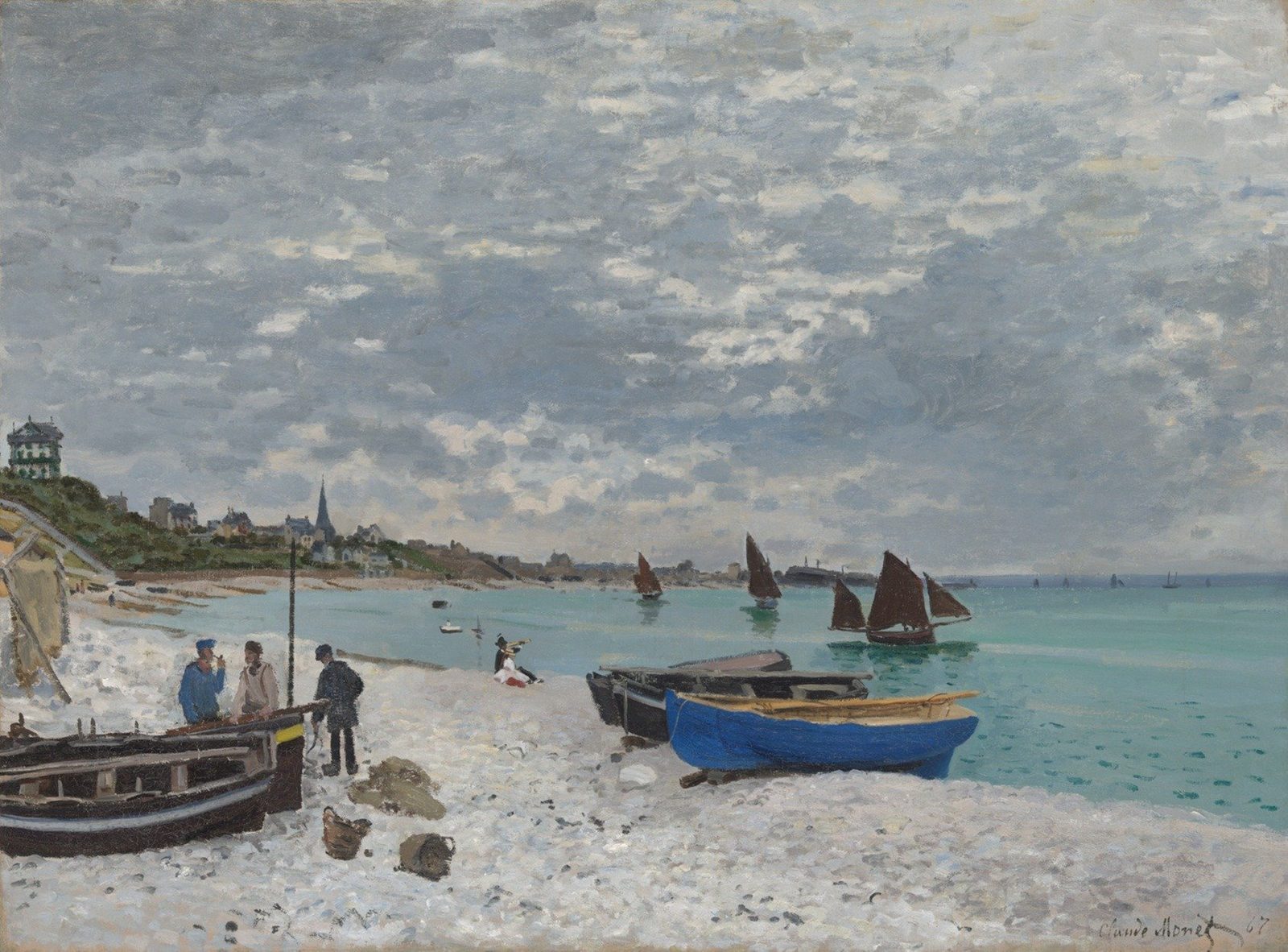
Monet sets a pair of holidaymakers among the fishing boats at Sainte-Adresse, under a huge silver sky
- Artist
- Claude Monet
- Title
- The Beach at Sainte-Adresse
- Date
- 1867
- Medium
- Oil on canvas
- Museum
- Art Institute of Chicago
- Image
- Public domain (CC0)
Open in Simple Art
Watch this story on iPhone and iPad, with offline downloads and a painting every day.
About 4 minutes of looking, in 10 parts.
A big sky over a small beach
Most of this canvas is sky, a ceiling of grey and white cloud. Below it lies a pale beach with dark fishing boats, a few people, and one boat painted a startling blue. Let's see how such a small cast holds such a big, empty space.
Claude Monet, 1867, oil on canvas
This is Claude Monet's The Beach at Sainte-Adresse, painted in oil on canvas in 1867. That summer he stayed with his aunt at Sainte-Adresse, near Le Havre, where he had grown up. The museum notes that the railway was turning this fishing village into a seaside resort.
A low horizon and a long shore
The horizon sits a little below the middle, so the sky takes more than half the picture. The shoreline runs on a long diagonal from the left, carrying your eye along the water's edge towards the boats. Nearly everything of interest sits on or just below that line.
A silver, overcast light
Look up into the clouds. They seem to be laid in broad, sweeping strokes of grey, white and blue, and where strokes cross you can glimpse the colour underneath. There's no sun to be found. The light is soft and silvery, and it appears to come from this pale sky.
A town fading into the haze
On the left, the town fades into the distance. Its houses are soft blue-greys, close in tone to the sky, and only the church spire stands out as a darker upright. Keeping far-off things pale and low in contrast is what pushes them back.
Two visitors, one dash of red
Now find the two small seated figures by the water. The museum describes a man in a dark hat looking through a telescope and a woman in a straw hat with a scarlet ribbon. Their smart clothes suggest holidaymakers. A dash of red is enough to make you find them.
The blue boat
Then there's the blue boat, the most saturated colour in the whole picture. The hull looks like a fairly flat mass of blue, with a warm ochre band laid along the rail on top. Behind it, a darker boat makes the blue seem brighter still.
A beach of separate marks
Come down to the beach in the foreground. Up close it's a scatter of short, separate marks, pale blue, lavender, cream and peach, set side by side rather than smoothed together. From a step back, they read as a pebbly shore.
Fishermen in a few strokes
On the left, three fishermen stand by their boat. Their faces are only a few dark strokes, a line for the brow and a shadow for the nose, with no eyes or mouths drawn. Yet you can still tell which way each man is turning.
Dark sails, crisp edges
Out on the water, the fishing boats carry dark sails. Their edges look crisp and angular against the pale sea and sky, the sharpest shapes in the painting. Three steps of value do the work: dark sails, a middle-toned sea, and a light sky.
Look closer
8 details, each checked against a close-up of the picture.
-
Blue Boat and Shoreline
The bright blue boat is flanked by a yellow-ochre trim and rests on a surface of dabbed white and gray paint.
The crop centers on a bright blue rowboat whose hull reads as a saturated cobalt mass, edged along the upper rail by a warm yellow-ochre band that traces the gunwale in a slightly broken, uneven line. Behind it sits a darker, near-black skiff with a pale tan interior, partially occluded. The foreground is a dense field of small, stippled dabs in white, lavender-pink, and cool gray, evoking pebbles and shell fragments rather than a continuous plane. The water behind is laid in horizontal teal and pale-green strokes, with two distant sailing vessels at the upper right rendered as quick, dark silhouette shapes. Edges throughout are soft where wet colors meet and firmer where the ochre trim meets the blue hull.
-
Beach Texture
The sand is composed of short, thick, multi-colored dabs of paint rather than blended washes.
The crop resolves into a dense field of short, comma-shaped dabs of paint laid side by side rather than smoothed together. Cool pale tones — soft blue, lavender-gray, and near-white — sit alongside warm cream, peach, and dusty rose, producing a speckled surface where neighbouring strokes differ in both hue and value. Three darker shapes (a tall ochre-brown mass at upper left, a small rounded dark form lower-centre, and a brownish-pink curved shape upper-centre) read as figures or objects partly buried in the speckled ground; their edges are broken into the surrounding dabs rather than outlined. A small patch of saturated blue appears in the upper-right corner, and the overall layering is thin but visible — each dab sits slightly proud of the canvas, catching light along its edges.
-
Seated Figure in Red
A small seated pair carries a dash of saturated red paint, contrasting with the surrounding cool tones.
The crop isolates a seated couple on the sand against a pale band of chalky blue-green sea. In the lower-center sits a compact figure whose lap is marked by a saturated, warm red shape that reads clearly as the focal accent against the surrounding cool atmospheric tones. To the right, a dark, roughly modeled form (likely the hull of a boat) anchors the lower right with deep grays and hints of ochre. Edges throughout are soft and broken; the red sits next to a cool blue-gray that bleeds into it, with no hard contour separating the figure from the sand.
-
Standing Figures
The figures' faces are suggested by a few dark strokes without defined facial features.
The crop shows three standing figures arrayed behind a wooden boat-edge with a yellow horizontal accent. The left figure wears a blue cap and blue jacket rendered in mid-value ultramarine strokes; the middle figure is a high-key cream/ivory form with a dark brown head and shoulders; the right figure is a near-silhouette in dark navy-black. Faces are reduced to a few short dark strokes (a vertical nose shadow, a horizontal brow line, a dark patch for hair/beard) with no drawn eyes or mouths. Edges between figures and the pale sand background are softened by broken, adjacent strokes of similar value rather than outlined contours. A vertical dark post bisects the upper center, and a brown wooden plank with a yellow strip runs across the lower foreground.
-
Distant Horizon and Spire
The town and church spire are rendered in soft, muted blue-grays that blend into the atmosphere.
The crop shows a distant town silhouette rendered as a horizontal band of low-contrast blue-grays, punctuated by a single dark church spire that rises into a cloudy sky. The spire's left edge is the sharpest contour in the field, defined by a narrow stroke of near-navy against paler cloud, while the spire's right edge dissolves into adjacent atmospheric strokes. Building masses are described with broad, broken dabs of warm and cool grays; roofs read as soft horizontals with no hard outlines. The foreground slopes in with greenish and ochre flecks, and a thin band of red-brown suggests a roof near the spire's base.
-
Sailing Vessels
The dark sails are defined by sharp, angular silhouettes against the luminous sea and sky.
The crop shows several dark sailing vessels with triangular sails set against a pale sky and turquoise sea. The sails read as deep brown-black shapes with angular, faceted outlines where the leech and luff meet the luminous background. Edges along the sail contours are crisp yet slightly broken, with the pigment stopping abruptly against the wet-into-wet sea and the lighter cloud layer above. A horizontal band of dark hull and town silhouette stretches across the upper third, creating a second edge tier below the sky. Values are organised in three steps: the near-black sails, the mid-value sea, and the high-value sky, which together produce a clear figure-ground separation.
-
Cloud Handling
The clouds consist of broad, sweeping strokes of gray, white, and blue with visible overlap.
The crop shows only sky, composed of broad, sweeping brushstrokes that travel mostly along diagonal axes, roughly upper-left to lower-right, with a secondary set tilting the opposite way. No hard edges appear anywhere; cloud boundaries are implied by where a pale gray stroke is laid next to a cooler blue stroke, rather than by drawn lines. White and cream highlights sit on top of mid-value blue-grays, and where strokes cross you can see the lower color through the gaps in the upper one, so layers read as interlocked rather than stacked. Values stay tightly bunched in a high-key range, with the darkest notes being a soft slate blue rather than true shadow.
-
Artist's Signature
The signature 'Claude Monet' and a date are visible in the lower right corner.
The crop is dominated by a loosely worked, scumbled ground of pale cream, dusty rose, and cool grey-blue strokes that read as wet-into-wet with visible directional drags. Across the lower edge runs a single dark, thin cursive inscription reading 'Claude Monet' in a brown-black ink or paint, terminating in a flourish, followed to the right by the digits '67' in a more upright, lighter hand. The letterforms sit crisply on top of the brushed ground with no feathering into the surrounding paint, indicating the mark was applied after the paint was dry or nearly dry. Edges of the signature strokes are sharp and calligraphic, contrasting strongly with the soft, broken edges of the background where adjacent strokes of different hues meet without blending.
The Beach at Sainte-Adresse in context
A difficult summer at his aunt's
Sainte-Adresse is a coastal suburb just north-west of Le Havre, where Monet spent much of his childhood and his aunt owned a villa [2]. The Art Institute's catalogue says that early in 1867, on learning his companion Camille Doncieux was pregnant, Monet moved into his aunt's house and travelled discreetly to Paris, where he had arranged care for her, to keep the situation from his disapproving family [2].
Wikipedia's account of Camille adds that his father urged him to end the relationship, and that he stayed with his aunt partly so that she would keep paying him a monthly allowance [3]. Their son Jean was born in Paris on 8 August 1867, and Monet came back for the birth for several days before returning to Sainte-Adresse [3]. Relations with his father were tense that summer, and his father is probably the man in the foreground of Garden at Sainte-Adresse, painted in the same months [4].
The work went on regardless. By the end of June Monet told Frédéric Bazille he had some twenty canvases well under way, and in July he complained he was losing his sight and a doctor had told him to stop painting outdoors [2].
A pair with the regatta?
The canvas is often treated as a companion to Regatta at Sainte-Adresse in the Metropolitan Museum of Art, which is very close in size and shows the same stretch of beach [2]. The catalogue notes that there is no evidence Monet meant to show or sell them as a pair [2]. The Chicago picture has fishermen and dark-sailed boats at low tide under cloud, while the New York one has tourists and white-sailed yachts on a sunny day at high tide [2].
Infrared imaging shows the two were once closer [2]. At an earlier stage there were four or five well-dressed holidaymakers on the shore at the right and a group of white-sailed pleasure boats on the water, all later painted out, and the three fishermen at the left were late additions with traces of charcoal near their heads [2]. In June Monet wrote he was painting the regattas at Le Havre with crowds on the beach, and the catalogue suggests he began this canvas in that spirit before changing its subject [2].
A lighter palette
Two years earlier Monet had made his Salon debut with two large seascapes of this coast, painted in the studio from smaller studies and dominated by greys and browns [2]. This canvas was painted at least partly outdoors and revised in the studio, and its palette is lighter and cooler [1][2].
It is painted on a ready-primed linen canvas with a light warm grey ground under a pinkish-beige one, which still shows at the edges and through breaks in the brushwork [2]. One of the few areas of real impasto is the seated woman's dress, made from a few strokes of almost pure lead white [2]. The signature 'Claude Monet 67' at the lower right has the name in dark brown and the year in reddish purple, which the catalogue says may mean they were added at different times [2].
Shown nine years later
Monet sold the painting to the dealer Durand-Ruel on 28 February 1873 for 400 francs, when it was recorded as 'Marine, temps gris' [1]. It may have been shown in London in 1874, but the museum marks that as possible only [1]. In April 1876 it hung at the second Impressionist exhibition as La Plage à Sainte-Adresse, listed as belonging to M. Faure [1]. The museum says Jean-Baptiste Faure probably owned it by then, while noting that the Durand-Ruel archives cannot confirm his purchase [1].
Durand-Ruel bought it back in January 1893 for 7,000 francs and sold it days later to Henri Véver for 8,000 [1]. At Véver's sale in 1897 it went for 9,000 francs to an agent for Georges Kohn, and in 1920 Durand-Ruel and Bernheim-Jeune bought it jointly for 40,000 francs [1]. Annie Swan Coburn of Chicago bought it in 1923, and it came to the Art Institute with her bequest in 1933 [1].
- Claude Monet, The Beach at Sainte-Adresse (1933.439): collection record with description, provenance and exhibition history (public API) . Art Institute of Chicago
- Gloria Groom and Jill Shaw, 'Cat. 13, The Beach at Sainte-Adresse, 1867', with technical report, in Monet Paintings and Drawings at the Art Institute of Chicago (public API) . Art Institute of Chicago
- Camille Doncieux . Wikipedia
- Garden at Sainte-Adresse . Wikipedia