Van Gogh's The Bedroom — A Walkthrough in Color and Brushwork
A camera-led study of Van Gogh's 1889 bedroom interior, moving from the whole canvas into the brushwork that builds it.
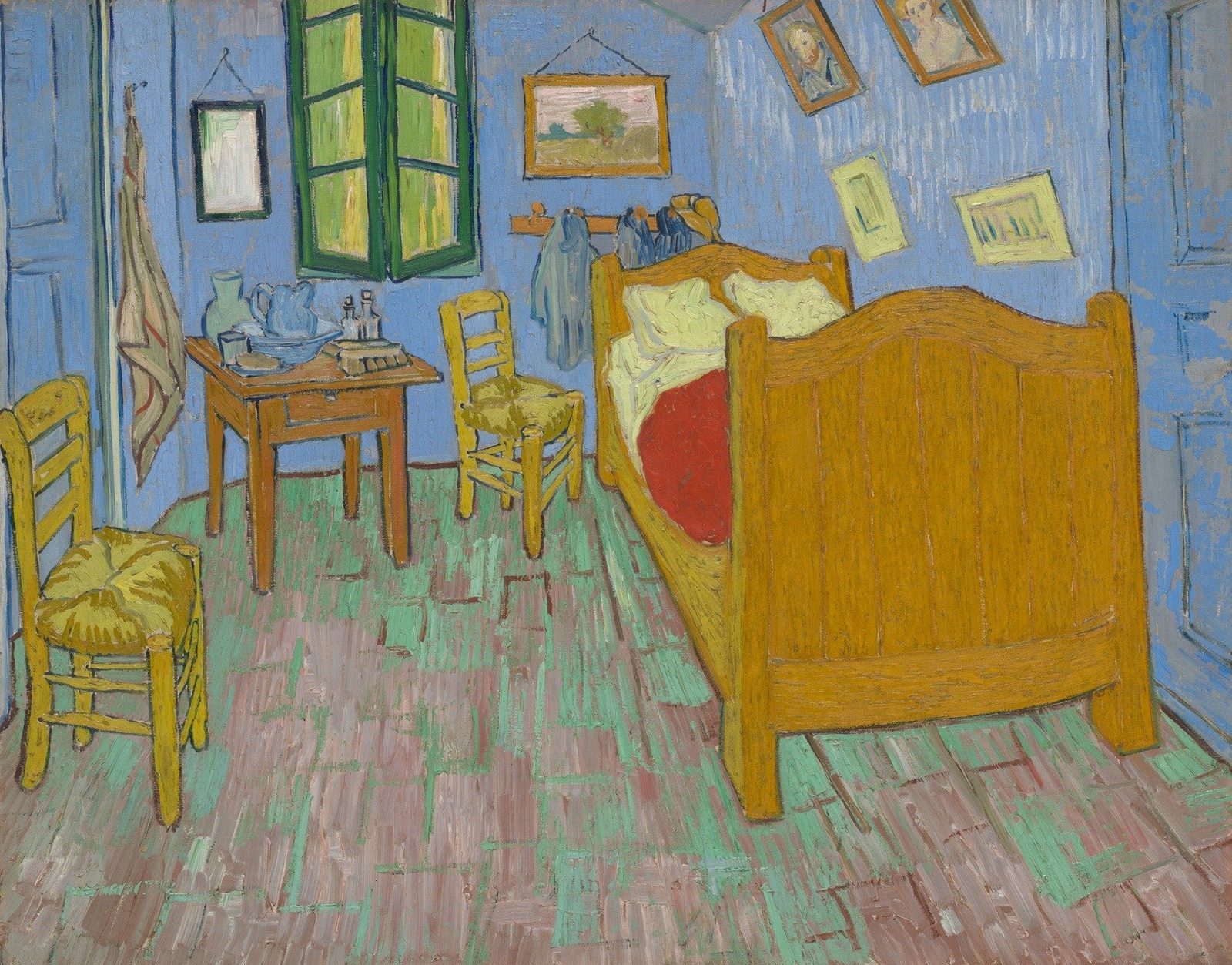
- Artist
- Vincent van Gogh
- Title
- The Bedroom
- Date
- 1889
- Medium
- Oil on canvas
- Museum
- Art Institute of Chicago
- Image
- Public domain (CC0)
Open in Simple Art
Watch this story on iPhone and iPad, with offline downloads and a painting every day.
About 7 minutes of looking, in 12 parts.
A Bedroom Made of Color
Before us hangs a small private bedroom, painted in 1889 by Vincent van Gogh in oil on canvas. The walls breathe a deep cobalt, the bedframe blazes in butter yellow, and against a white pillow a single blanket blazes in saturated vermilion. The room feels less like a measured interior than a stage set waiting for its inhabitant. Pause here and let your eye find the red — that's where Van Gogh wants you to start.
A Post-Impressionist Interior
Van Gogh painted this as part of a small group of bedroom interiors meant to express absolute restfulness. Working in a Post-Impressionist idiom, he pushed the complementary clash of blue and yellow, simplified daylight into flat color zones, and laid the paint on so thick you can read every ridge of the brush. The tilted perspective is deliberate — the floorboards lean toward you like a runway.
Tilted Stage
Look at the diagonals. The bed stands as a massive vertical on the right, while the chairs and a small table counterweight it on the left. But the true scaffolding is the floor: those alternating pink and green plank stripes run diagonally into depth, dragging the eye back toward the wall. The horizon sits unusually high, around the upper third, so the floor dominates the lower half and the room feels pressed forward, almost tilted toward the viewer.
Light from the Upper Left
The light enters from the open window on the upper left, but it isn't the dramatic raking sunlight of a Dutch master. It's flat, diffuse interior daylight — high-key overall, with no deep cast shadows. The brightest passages are the yellow bed and chairs, the blue walls sit a half-step darker, and the red blanket is the deepest, hottest note. Color, not tone, is doing the structural work here.
The Window
Now move up to the green-shuttered window — this is the room's light source, and it's been simplified into pure color zones. Each shutter panel is a stack of yellow-green vertical strokes, with bright lime highlights on the upper and inner edges where daylight would strike. Dark green vertical outlines divide each shutter into four panels, and those crisp dividers carry the eye downward. Try following the panel highlight flow as the camera holds here.
Bed and Red Blanket
Drop down into the focal mass: the yellow-ochre bedhead and its red blanket. The yellow reads as a flat block of color, with the recesses between the planks implied by stroke direction rather than painted shadow. The blanket is something else — a swelling, rounded form built from densely packed vermilion strokes, shifting toward brick-red in the hollows near the pillow and toward orange-red on the exposed fold below. It's the chromatic heart of the painting.
Modeling the Blanket
Look closely at how the blanket is modeled — it isn't glazed, it isn't blended. The dark hollows are achieved by laying a deeper red stroke physically on top of a lighter one, the impasto ridge sitting proud. The brightest vermilion is reserved for the area that advances most, the darker reds pushed into the recesses. And notice how the stroke direction follows the curve of the form, so the paint itself describes the volume.
The Yellow Chair
Slide across to the chair on the left. It's a complementary color study: yellow against blue, green against pink. But here's the move — where yellow meets blue, Van Gogh has placed a thin, dark ochre-brown contour. That deliberate line isn't realism; it's a graphic device to keep the two complementaries from muddying into each other and to crisp the chair's silhouette against every background. The rush seat fans out in curved strokes that follow its concavity.
Wall as Paint, Not Paint as Wall
Now examine the blue wall itself. It isn't flat color — it's a dense weave of vertical strokes in adjacent blues: cobalt, ultramarine, a paler sky-leaning tint, an occasional lavender. Each stroke sits on the next as a raised ridge; the edges are crisp, not blended. This is what Post-Impressionist impasto looks like when it's used to model a plane through texture alone, without resorting to cast shadow or detail. The plane reads as vertical because the strokes are vertical.
Plank Floor as Color Blocks
Down to the floor — and this is a Post-Impressionist signature. There are no drawn gaps, no ruled lines between planks. Instead, alternating rectangular dabs of milky pink-mauve are dragged across a mint-green ground, and the ridges of each dab cast their own tiny shadows. A few rust-red and yellow interruptions break the rhythm. Try it yourself: paint a plank floor with only two contrasting hues in alternating dabs, no lines — the paint itself will read as separation.
The Hard Edge
Bring the camera up to where the curved yellow headboard meets the blue wall — and notice there is no transition. No softening, no wet blending. The yellow and blue sit directly against each other in a hard, irregular meeting line. This is a deliberate choice: let one color set, then butt the next against it, and let the eye supply the contour through simultaneous contrast. It flattens the space and makes the room feel constructed, almost stage-like.
Ceramic on the Table
Finally, the small white pitcher and basin on the yellow-orange table. Even the ceramic is handled non-naturalistically: the pitcher's body is built from just two colors, a near-white highlight and a cool light blue for the shadow mass. The blue was probably laid first and the white dragged over it while still damp, so the cool undertone peeks through at the breaks. The result is a white object that contains its own shadow without a single stroke of gray.
Look closer
7 details, each checked against a close-up of the picture.
-
Bed and Red Blanket
The red blanket consists of saturated vermilion strokes with darker orange-red shading.
The crop is dominated by a tall yellow-ochre wooden footboard rendered with vertical plank divisions and thick vertical strokes, with the curved mass of a red blanket visible behind and to the left of it. A white pillow sits atop the red, its folds described with creamy yellow-white strokes. The blanket is built from densely packed, short impasto strokes that read as saturated vermilion in the mid-tones, shifting toward darker brick-red in the recessed curves near the pillow and toward orange-red along the lower exposed fold. The bed's yellow strokes run parallel to the plank grain and are applied as a flat, even value block, while the blanket strokes are more gestural and follow the swelling form. Floor planks beneath show alternating pink-rose and sage-green verticals, butting up against the bed's foot in hard edges.
-
Floor Impasto
The floor is composed of thick, rectangular dabs of green, pink, and mauve paint.
The crop shows a field of heavily built-up rectangular paint dabs, each roughly the size of a small brush load, oriented predominantly vertically with shorter horizontal strokes intersecting them. Most marks are a milky pink-mauve (the 'planks') set against a slightly cooler mint-green ground that fills the spaces between. A few darker rust-red dabs and a strip of yellow along the upper-left edge break the two-tone rhythm. Stroke edges are crisp and clearly separated because each dab sits on top of, rather than blends into, its neighbour; the impasto ridges cast tiny shadows that emphasise the rectangular shape of every mark.
-
Yellow Chair Contrast
The yellow chair is outlined with a darker ochre or brown line against the blue wall.
The crop centers on a yellow rush-seat chair set against a blue wall and green-pink plank floor. The chair is constructed with thick, opaque yellow strokes, and along its left edge and backrest posts there is a clearly visible darker ochre/brown contour where yellow meets blue — a deliberately drawn separating line, not just a hue shift. The rush seat is rendered with curved, fan-like strokes that follow the seat's concavity, using a paler yellow for highlights and a greenish-olive for the recessed tufts. The blue wall behind carries long vertical brushstrokes; the floor reads as diagonal planks with alternating pink and green stripes. Van Gogh's hallmark is the black/dark outline that crisps the chair silhouette against every background color.
-
Window and Shutters
The green shutters have dark vertical outlines and light green highlights facing the interior.
The crop centers on a window with two open shutters painted against a blue wall. Dark, near-black green vertical bands form the outer edges and central meeting edge of the shutters, with thinner dark green lines dividing each shutter into four horizontal panels. Each panel is filled with thick, vertical strokes of yellow-green to lime, with brighter yellow highlights near the upper and left edges suggesting daylight raking in. The blue wall around the shutters is built from short, diagonal impasto strokes that contrast with the more vertical shutter brushwork.
-
Washbasin and Pitcher
The ceramic pitcher is rendered with white highlights and a light blue shadow.
The crop centers on a ceramic pitcher and washbasin sitting on a yellow-orange wooden tabletop against a blue wall. The pitcher's body is built from pale off-white and light grey-blue strokes on its upper/left surfaces, while the shadow side falls into a cool light blue with violet undertones. Thick impasto marks are clearly visible as individual ridges of paint; edges between the pitcher and the bowl are defined by a darker blue contour rather than hard line. The washbasin repeats the same white-to-blue value shift, its rim catching a brighter white highlight that suggests raking light from the upper-left. The wooden table below is rendered in short, horizontal orange-ochre strokes with darker brown seams.
-
Wall and Bed Junction
The edge of the yellow bed headboard meets the blue wall without a blended transition.
The crop captures the curved top of a yellow-ochre wooden headboard against a blue wall, with a white pillow tucked between them and a small patch of red in the lower-left corner. The boundary where the yellow wood meets the blue wall is a hard, irregular edge: the two colors sit directly next to each other with no softened transition or wet-in-wet blending. The blue is applied in vertical, slightly diagonal strokes of mid-value blue, while the yellow headboard is built from multiple short, directional dabs in ochre, golden yellow, and dark brown. Thick impasto ridges cast tiny shadows along the curved silhouette of the headboard, confirming the paint sits proud of the surface.
-
Wall Texture
The blue wall is painted with broad, vertical brushstrokes of varying shades of cobalt.
The crop isolates the blue wall flanking the framed landscape, where the pigment reads as dense, ridged impasto rather than flat color. Strokes are predominantly oriented on a near-vertical, slightly diagonal axis (upper-left to lower-right), and adjacent strokes visibly differ in hue and value: a deeper ultramarine sits beside a paler sky-leaning cobalt, with occasional lavender and teal-blue interruptions. Edges between strokes are not blended wet-into-wet but left as crisp, raised ridges that catch light, producing a tactile, woven surface. A thin dark contour frames the hanging cord at the picture's apex, and the wall's lower edge meets the orange wooden peg rail with a broken, loaded contact rather than a clean line.
The Bedroom in context
Four rooms on Place Lamartine
On 1 May 1888 Van Gogh rented four rooms in the right wing of 2 Place Lamartine in Arles, the building now known as the Yellow House [11]. His bedroom was one of two small upstairs rooms facing the square, while the other became Paul Gauguin's guest room [11]. According to Wikipedia, the bedroom wasn't rectangular but trapezoid, and the Van Gogh Museum confirms that the skewed corner of the back wall was real rather than a mistake [9][10].
The Art Institute notes that Gauguin admired the first Bedroom when he arrived, and describes its colours as inspired by the theories of Georges Seurat [2]. The house itself was badly damaged in an Allied bombing raid on 25 June 1944 and later demolished [11].
Two letters, two palettes
On 16 October 1888, after resting his tired eyes, Van Gogh sent Theo a sketch of a new no. 30 canvas of his bedroom [3]. Looking at it, he wrote that it 'should rest the mind, or rather, the imagination' [3]. He described butter-yellow furniture and a scarlet blanket, saying he had removed shadows and cast shadows so the room was coloured 'in flat, plain tints like Japanese prints' [3].
The colour list quoted in the Art Institute's label features pale lilac walls, a floor 'in a broken and faded red', a chrome yellow bed and chairs and a blood-red blanket. This matches the letter Van Gogh wrote to Gauguin the next day, 17 October [1][4]. In it he added that the only white was the small note of the mirror, and admitted he often worked 'almost like a sleepwalker' [4]. The label introduces this passage as a letter to Theo, so the two sources differ on the recipient [1][4].
Flood, damp and a repetition
On 30 April 1889 Van Gogh told Theo that, while the house stood unheated during his stay in hospital, flood water had come within a few feet of it and damp had spoiled a study, which the letters' editors identify as the first Bedroom [5]. He suggested having it lined cheaply, but in the end Theo sent it back to Saint-Rémy unlined so that Vincent could copy it [6].
On 5 or 6 September 1889 he reported, 'I've redone the canvas of the Bedroom' [7]. He worried that quickly painted, thickly loaded studies didn't adhere firmly to their canvas. The editors connect this worry with substantial areas of paint loss found on the Chicago repetition [7]. Later that month he listed a smaller Bedroom among reductions for his mother and sister, a no. 20 canvas now in the Musée d'Orsay [8][10].
Telling the versions apart
Wikipedia notes that the three versions are easiest to tell apart by the small pictures on the right-hand wall; in the first, they repeat Van Gogh's portraits of Eugène Boch and Paul-Eugène Milliet [10]. The Van Gogh Museum reports that the first version has discoloured over time, and that its walls and doors were originally purple rather than blue [9]. The Art Institute's 2016 exhibition Van Gogh's Bedrooms brought all three canvases together and presented technical research on how each was made [2].
From Theo to Chicago
Van Gogh sent this canvas to Theo with the first version in December 1889 [1][12]. After Theo's death it passed to his widow, Johanna van Gogh-Bonger. She sold it to the Paris dealer Jos Hessel by 1901, when it was shown at Bernheim-Jeune as La Chambre de Vincent à Arles [1]. The Viennese collector Carl Reininghaus owned it from at least 1909 to 1914 [1].
Paul Rosenberg sold it to the Chicago collector Frederic Clay Bartlett in December 1926. Bartlett gave it to the Art Institute that same year as part of the Helen Birch Bartlett Memorial Collection [1].
- Vincent van Gogh, The Bedroom, 1926.417: object record, label text, provenance and exhibition history . Art Institute of Chicago (public API)
- Van Gogh's Bedrooms (exhibition, 14 February to 10 May 2016) . Art Institute of Chicago
- Letter 705, to Theo van Gogh, Arles, 16 October 1888 . Van Gogh Museum and Huygens ING, Vincent van Gogh: The Letters
- Letter 706, to Paul Gauguin, Arles, 17 October 1888 . Van Gogh Museum and Huygens ING, Vincent van Gogh: The Letters
- Letter 765, to Theo van Gogh, Arles, 30 April 1889, with editors' notes . Van Gogh Museum and Huygens ING, Vincent van Gogh: The Letters
- Letter 776, to Theo van Gogh, Saint-Rémy, about 23 May 1889, with editors' notes . Van Gogh Museum and Huygens ING, Vincent van Gogh: The Letters
- Letter 800, to Theo van Gogh, Saint-Rémy, 5 and 6 September 1889, with editors' notes . Van Gogh Museum and Huygens ING, Vincent van Gogh: The Letters
- Letter 806, to Theo van Gogh, Saint-Rémy, 28 September 1889, with editors' notes . Van Gogh Museum and Huygens ING, Vincent van Gogh: The Letters
- Vincent van Gogh, The Bedroom, 1888 (s0047V1962) . Van Gogh Museum, Amsterdam
- Bedroom in Arles . Wikipedia
- The Yellow House . Wikipedia
- Letter 829, to Theo van Gogh, Saint-Rémy, about 19 December 1889, with editors' notes . Van Gogh Museum and Huygens ING, Vincent van Gogh: The Letters