A bath seen from above
Cassatt tips the floor up and crowds every surface with pattern around one small, everyday task
- Artist
- Mary Cassatt
- Title
- The Child's Bath
- Date
- 1893
- Medium
- Oil on canvas
- Museum
- Art Institute of Chicago
- Image
- Public domain (CC0)
Open in Simple Art
Watch this story on iPhone and iPad, with offline downloads and a painting every day.
About 3 minutes of looking, in 8 parts.
The Child's Bath
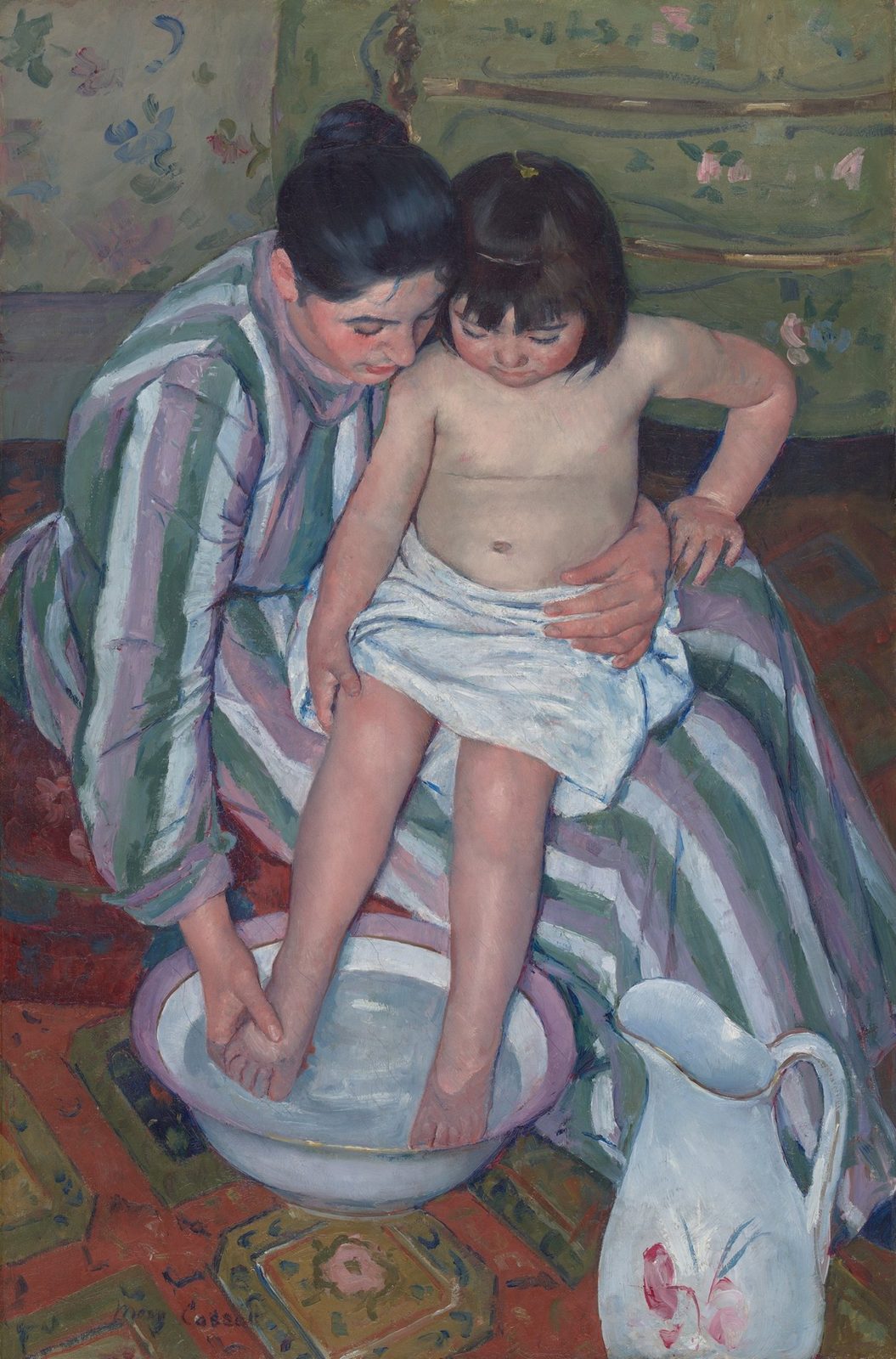
A woman holds a small child on her lap and washes one of the child's feet in a basin. Both of them look down at the water. Nothing dramatic happens, yet their two heads lean so close that they almost become one shape.
Mary Cassatt, 1893, oil on canvas
This is The Child's Bath by Mary Cassatt, painted in oil on canvas in 1893. The Art Institute of Chicago bought it in 1910, the first work by Cassatt to enter its collection. The museum links it to her intense interest in Japanese art during the 1890s.
Looking steeply down
Notice where we're standing. We look steeply down on the pair, so the carpet seems to tilt up and lie flat against the canvas. The two heads make the top of a triangle that widens down to the basin, while the striped robe sweeps out to the lower right.
Light on the jug
The light is soft and seems to come from the upper right. You can test that on the jug. Its brightest whites sit along the rim and the shoulder, and the pink flower on its side is set down in just a few quick strokes.
Warm skin, cool water
Down at the basin, warm pink legs meet cool water. The reflections are only soft blue-grey smudges, set a little to one side rather than traced. Around the bowl the carpet is a strong brick red, and the woman's hand closes round the child's foot.
Skin without outlines
Now back up to the child's body. The skin is built from pale cream and pink, warmest at the cheeks and tummy, with soft grey-lavender shadows along the side. There's hardly a drawn line here. The form comes from changes of tone.
Flowers on the wall
Compare the wall behind them. The flowers are loose dashes of blue-violet and pink, laid over a grey-green ground and left unblended. Beside the smooth skin they look almost like handwriting. Pattern is everywhere in this picture: wall, robe, carpet and jug.
A name on the carpet
At the bottom left, Cassatt has signed her name in blue paint, right on the carpet. It sits among the shapes of the rug rather than in a clear corner, one more mark in a floor full of pattern.
Look closer
5 details, each checked against a close-up of the picture.
-
Floral Wallpaper
The floral motifs are loose, unblended dashes of blue-violet and pink paint laid over a grey-green ground.
The crop isolates a section of patterned wallpaper rendered with discrete, comma-shaped and curl-shaped dabs of paint over a scumbled grey-green ground. Most motifs read as blue-violet and dusty pink dashes, with only a few strokes veering toward olive or teal; the paint sits clearly raised against the smoother background, indicating a loaded brush applied without blending. A horizontal purple-lavender band crosses the lower third, and at the lower right a striped fabric (the robe) shows parallel bands of white, pale blue and rose. Edges between stroke and ground are crisp rather than softened, and the background itself is unevenly wiped, allowing the wall colour to show through in places.
-
Flesh Tones
The child's skin uses a blend of pale creams, pinks, and soft grey shadows.
The child's flesh is built from soft, blended passages where warm pinks concentrate in the cheeks and around the navel, then feather outward into pale cream on the chest and shoulders. Cool grey-lavender shadows sit along the left flank, beneath the chin, and under the arms, creating soft half-tone transitions rather than hard edges. The contour of the torso is suggested more by value shifts than by drawn line, and the surface shows the slight scumbling and dry-brush tooth typical of worked oil paint. Highlights on the right pectoral and shoulder ridge are the brightest passages, indicating a light source from the upper right.
-
Pitcher Highlights
The brightest whites are concentrated on the upper rim and shoulder of the pitcher.
The crop isolates the upper body of a ceramic pitcher rendered in pale blue-white, with the heaviest impasto highlights concentrated along its upper rim and shoulder where light catches the rounded form. A thin ochre-gold contour line traces the front edge of the rim, separating it from the cool interior shadow. Below, a pink rose with accompanying green leaves sits on the pitcher body, painted with confident, sketchy strokes that read as decoration rather than botanical illustration. The background is a flurry of broad vertical strokes in muted lavender, sage, and off-white — the unresolved stripes of the robe seen at close range — and the right-side handle is barely indicated by a few broken strokes in purple and ochre.
-
Feet in Basin
The water in the basin appears to hold soft, broken blue-grey reflections of the child's legs, while the woman's hand holds one foot.
The crop centers on a child's two feet resting in a white enamel basin. Soft blue-grey passages in the water mirror the warm pink skin above, but the reflections are broken and diffused rather than mirror-sharp — the water reads as a series of horizontal and slightly diagonal smudges of cool hue that sit beside, not directly under, the legs. The basin's rim is rendered as a thick lavender-white ellipse with a darker violet contour on the shadowed left side, and a bright catchlight runs along the right inner edge. Craquelure is visible across the flesh and the basin's flat plane, indicating an older oil layer that has dried and cracked. The skin on the right leg is brighter and more saturated, while the left leg and foot are cooler and lower in value, consistent with light from the upper right.
-
Artist Signature
The signature, in blue paint, sits on the patterned carpet at the bottom left.
The crop centers on the handwritten name 'Cassatt' rendered in a dark navy-blue pigment, sitting on a warm red-orange diagonal band. The letters are formed with a loaded brush in a single confident pass — the 'C' opens with a thin, dryish start and thickens on the downstroke, the 'a' and 's' loops show a fluid wrist turn, and the terminal 'tt' is a quick double cross-stroke. Around the signature, the red ground breaks into adjacent zones: a cooler blue diagonal at upper right runs from the edge inward, and an olive-gold passage at lower right carries loose scumbled dabs of darker paint. Edges between red and blue are slightly softened, suggesting wet-on-near-dry contact rather than crisp masking.
The Child's Bath in context
Chicago's first Cassatt
The Art Institute of Chicago dates The Child's Bath to 1893 and records it as oil on canvas, 101.3 by 67.3 centimetres. It's signed 'Mary Cassatt' in blue paint on the floor at bottom left [1]. The museum bought it in 1910 through the Robert A. Waller Fund, making it the first work by Cassatt to enter the collection [1].
The museum's text describes a woman steadying 'a young charge' on her lap and does not say she is the child's mother [1]. Other writers, including Wikipedia, call the pair mother and child [2], so the relationship is best left open, as the story does.
A painting with many names
Its route to Chicago is well recorded. Cassatt sold it to the dealer Durand-Ruel in Paris on 24 November 1893; it went to Harris Whittemore of Connecticut on 17 January 1894, was sold back to Durand-Ruel in New York on 4 February 1899, and was bought by the museum in 1910 [1]. Its title changed as it travelled: La Toilette de l'Enfant at Durand-Ruel's Paris exhibition of November to December 1893, La Toilette in New York in 1895, The Toilet in Philadelphia in 1898, and The Bath at the Art Institute in 1954 [1].
One detail doesn't quite fit. The 1898 Philadelphia catalogue lists Durand-Ruel as the lender, though by the museum's provenance Whittemore didn't sell the painting back until 1899 [1]. Wikipedia says Whittemore lent it to the dealer for the 1895 New York show [2]. That suggests further loans, but the sources cited here don't settle the point.
After the Japanese prints
In spring 1890 Cassatt visited a large exhibition of Japanese ukiyo-e prints at the École des Beaux-Arts in Paris and then made a set of ten colour etchings in open admiration of them, according to the Metropolitan Museum [3]. A 2006 essay in the journal Emerging Infectious Diseases quotes a letter in which she urged Berthe Morisot to go and see the Japanese prints [4]. The Art Institute links the steep view from above, the carpet that seems to stand upright and the pattern spread across the canvas to that engagement with Japanese art [1].
Wikipedia points to Kitagawa Utamaro's print of a woman washing a baby in a tub, of about 1801, as a likely model for the subject [2]. That comparison comes from later writers rather than from Cassatt herself.
Women caring for children
The Met's biography says Cassatt trained in Philadelphia and Paris, was invited by Degas in 1877 to join the Impressionists, and was the only American officially associated with the group, showing in four of their eight exhibitions [5]. Later, it says, she made a speciality of the mother and child theme in paintings, pastels and prints [5]. The essay in Emerging Infectious Diseases counts more than twenty works over six years exploring women's close relationships with children [4].
The same essay connects the subject to French public health. Cholera epidemics in the mid-1880s led officials to promote regular bathing, and after 1870 French mothers were encouraged to care for their own children rather than employ others [4]. How far Cassatt meant the painting to reflect these campaigns is a matter of interpretation.
1893 and Chicago
In the year she painted The Child's Bath, Cassatt also completed a mural on the theme of Modern Woman for the Woman's Building at the World's Columbian Exposition in Chicago, at the invitation of Bertha Honoré Palmer [4]. The Art Institute's bibliography for the painting begins with Maud Howe Elliott's 1893 book on art in the Woman's Building [1]. But the records cited here don't say that the painting itself was shown at the fair.
Durand-Ruel kept the picture in view for years. The museum's exhibition list places it in Paris, New York, Philadelphia and Cincinnati between 1893 and 1903 [1]. The Met notes that failing eyesight curtailed Cassatt's work after 1900. She gave up printmaking in 1901 and painting in 1904, and died in 1926 [5].
- Mary Cassatt, The Child's Bath (1910.2): object record, provenance, exhibition history and bibliography . The Art Institute of Chicago
- The Child's Bath . Wikipedia
- Colta Ives, Japonisme, Heilbrunn Timeline of Art History (2004) (Internet Archive copy) . The Metropolitan Museum of Art, New York
- Polyxeni Potter, Women Caring for Children in 'the Floating World', Emerging Infectious Diseases 12, no. 11 (November 2006) . Centers for Disease Control and Prevention
- H. Barbara Weinberg, Mary Stevenson Cassatt (1844-1926), Heilbrunn Timeline of Art History (2004) (Internet Archive copy) . The Metropolitan Museum of Art, New York