The Dead Toreador — A Walkthrough with Manet
Reading a Salon-period figure painting through diagonal, value, and a single warm patch
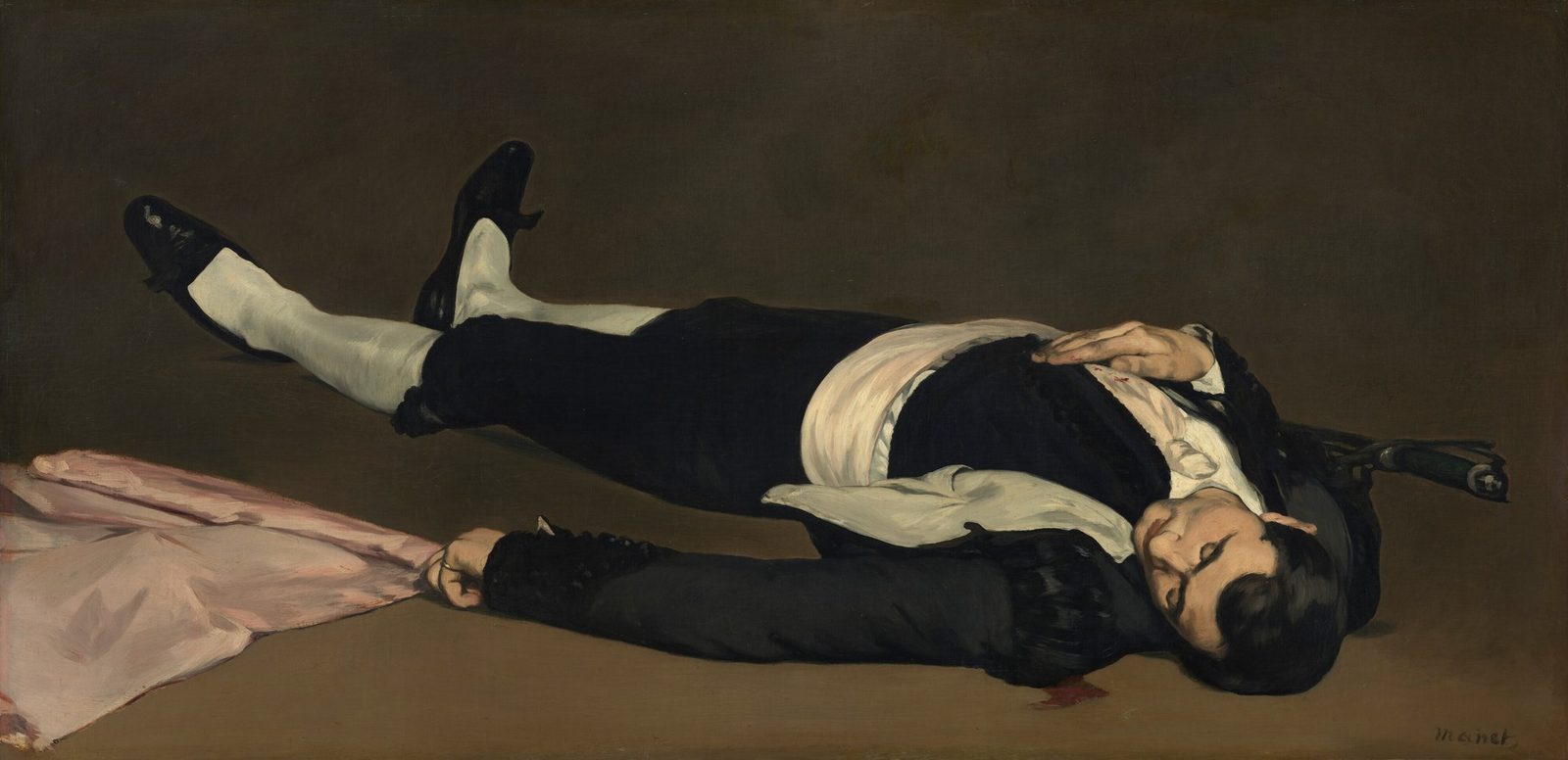
- Artist
- Edouard Manet
- Title
- The Dead Toreador
- Date
- probably 1864
- Medium
- oil on canvas
- Image
- Public domain (CC0)
Open in Simple Art
Watch this story on iPhone and iPad, with offline downloads and a painting every day.
About 5 minutes of looking, in 11 parts.
A body cut by the frame
A male figure lies cut by the canvas edge, posed on a featureless floor in stiff studio light. There is no bull, no ring, no crowd—only the body, a cape, and a few props. The image reads instantly as a still life with a figure inside it.
Manet, probably 1864, oil on canvas
This is Edouard Manet's The Dead Toreador, painted probably in 1864, oil on canvas. Manet treats a moment of bullring death the way a still-life painter treats fruit—a found arrangement on a floor, with the narrative implied rather than dramatized.
One diagonal carries the picture
The whole painting rests on a single dominant line: feet in the upper left, head in the lower right. A pink cape in the lower left counterweights it. Follow the guide overlay and you can see Manet builds his structure almost entirely on this diagonal.
Soft raking light from upper left
Light comes from the upper left, diffuse and even, the kind a photographer would call studio light. The body sits in mid-shadow, the white sash catches the brightest value, and the floor reads as a flat olive-brown. Manet is not painting sunlight—he is painting a controlled key-value pattern.
One warm patch in an olive field
The whole painting is essentially a monochrome olive-brown field interrupted by a single warm accent. That accent is this pink cape at the lower left—cropped hard by the picture edge, so it reads as a fragment rather than a complete object. The swatches show you the cool grey-violet shadow tucked into the fold.
Fingers that melt into cloth
Watch how the hand disappears into the cape. There is no drawn contour. The fingers are just three short dark strokes that trail off into the rose shadow of the fold. The hand and the cloth share the same edge, and that single wet-into-wet softness is what makes the grip believable.
Three strokes make a cylinder
Move up to the white sash, the brightest passage in the painting. Manet models this cylindrical fold with only a few unblended sweeps—warm ivory along the light-facing ridge, a cool grey for the form, and a near-black tuck where the sash disappears behind the bolero. The strokes keep their own edges; the form lives in the breaks between them.
The face as a mosaic of tiles
Now look at the face. There is no smooth modeling here. A single flat patch of grey-beige forms the cheek and temple, and it meets the inky black of the hair along a hard, almost drawn edge with no scumbled halftone between. The closed eye and moustache sit on top as three confident dark strokes. The face is built like a mosaic, not blended like a portrait.
The wound is one dragged stroke
At this scale you can finally see what the painting is really about. Just below the hairline, a small dark crimson smear sits on the brown floor. It is the wound, painted with a single drag of a loaded brush, edges left broken and irregular. Manet hides the entire narrative in one accidental-looking stroke.
A leg as light and dark masses
Follow the diagonal up to the feet. The stocking is just a few broad, slightly uneven strokes that ride the canvas grain. The shoe is a flat near-black silhouette, and only a couple of broken grey-white dabs on the upper shoe read as a buckle highlight. A limb becomes a pattern of light against dark—no anatomical modeling required.
A sword in three moves
Beside the head, the sword identifies the figure as a toreador. Manet describes it in the same shorthand: one dark silhouette for the blade, one thin grey-blue line for the raking light along the edge, and one bright dab on the pommel. The whole prop is three loaded strokes—and that restraint keeps it subordinate to the body.
Look closer
8 details, each checked against a close-up of the picture.
-
Head and wound
The face is painted with olive-green shadows in the eye sockets, a wax-pale forehead, and a small dark-red pool of blood on the floor just below the hairline, all set against an inky black jacket.
The cropped region isolates a male head tilted back against a dark jacket, with the face turned slightly toward the viewer. The forehead and cheek are rendered in warm pale flesh tones, while the hollows beside the nose and around the closed eyes carry distinct olive-green shadows. Dark eyebrows arch over the closed lids, the mouth is faintly shadowed, and the head dissolves into a mass of inky black hair flowing toward the lower right. At the bottom-left edge of the crop, a small smear of dark red pigment sits on the brownish ground plane just below the hair, reading as pooled blood. White fabric (sash or shirt) crowds the upper-left corner with broad, loaded brushstrokes, and a dark curved object—possibly a sword hilt—enters the upper right against a flat olive-brown background.
-
Pink cape
The cape is the only saturated warm hue in the painting, applied with visible horizontal strokes of pale rose and grey-violet, and its left edge is cropped by the picture frame.
The crop isolates a folded expanse of pale rose fabric set against a flat olive-brown ground. Broad horizontal sweeps of pink-grey paint describe the surface of the cape, with thin parallel strokes of grey-violet tucked into the recesses of each fold to register shadow. A deeper, slightly more saturated rose marks the crease where the fabric doubles back near the upper edge. The left side of the cape is cut off abruptly by the picture's edge, with no contour line — the form simply exits the frame. The lower right is bounded by a soft, irregular meeting with the dark olive ground, achieved with a few dragged strokes rather than a hard outline.
-
White sash
The white sash is built from broad, unblended strokes of ivory and pale grey that model the fold under diffuse light, with the brightest ridge facing the upper left.
The crop isolates a curved band of white fabric (the toreador's sash) that arcs from the upper right down to the lower center, set against an almost black jacket mass on the right and a deep neutral ground above. The sash is built from long, parallel brushstrokes of warm ivory and pale cool grey that follow the cylindrical roll of the cloth rather than blending into a smooth gradient. The brightest band sits along the upper-left facing edge, while a clear cast shadow falls on the lower-right underside where the sash tucks behind the dark bolero. Edges between the white and the black are crisp and slightly irregular, painted wet-into-wet but not feathered.
-
Stockings and shoes
The white stocking is rendered with broad, slightly uneven strokes that leave the canvas texture visible in the highlights, while the shoe is a flat, near-black shape with a single small white highlight on the buckle.
Two black shoes and a section of white stocking dominate the crop against a flat olive-brown ground. The stocking is built from long, broad sweeps of off-white paint that follow the diagonal of the leg; the strokes overlap slightly and the underlying canvas weave shows through where the paint thins in the mid-tones. The shoes read as near-silhouettes: dense, unmodulated black, with only a couple of small, broken gray-white dabs on the upper shoe reading as a buckle highlight, and a few dragged strokes of lighter pigment suggesting a worn sheen on the second shoe. Edges between stocking and shoe are crisp in places and slightly smudged in others, where a dark stroke has been pulled over the white. The background is a single, uninflected tone with no visible brushwork, pushing the legs forward as a flat cut-out.
-
Face paint handling
The eyebrows and closed eyes are painted with a few parallel dark strokes, while the cheek is a single flat patch of grey-beige that abuts the black hair without any transitional halftone.
The crop isolates the dead toreador's head, rotated so the crown points right and the chin drops left. The face reads as broad, relatively unmodulated planes: a single warm grey-beige patch forms the cheek and temple, meeting the dense black of the hair along a hard, almost drawn edge with no scumbled transition. Closed eye and eyebrows are registered with short, loaded dark strokes that sit on top of the flesh tone rather than being modeled into it. The white shirt collar at top-left is a thick opaque passage, and the bolero reads as a near-uniform near-black.
-
Blood pool
A small, irregular patch of dark red paint sits on the brown floor just below the hairline, applied with a thin, dragged stroke that is distinct from the smoother ground around it.
A roughly triangular patch of dark crimson paint sits on the left side of an ochre-brown ground, its right edge feathered and dragged in a horizontal-to-diagonal motion while its upper edge abuts a dense mass of near-black hair. The red mass shows tonal variation: a slightly cooler, darker red-brown in the lower-left lobe, shifting to a warmer, more saturated crimson along the upper rim where it meets the dark hair. The surrounding ground is a warm tan-brown with faint scumbled lighter passages and visible canvas weave, particularly in the lower half where a small, pale buff dab of impasto sits isolated near the center. The transition between the blood patch and the brown floor is a soft, broken edge rather than a crisp contour, and the upper boundary against the black hair is even softer, almost absorbed into the dark mass.
-
Hand and cape
The fingers gripping the pink cape are reduced to three dark silhouetted strokes that melt into the rose-grey shadow of the fabric fold, with no drawn contour separating hand from cloth.
The crop shows a horizontally oriented painting passage with a pale, loosely brushed hand at center-right curling around a swathe of pink fabric. The cape on the left is built from broad, parallel strokes of cream, rose, and cool grey-pink, with a sharper pink-rimmed fold edge defining its upper contour. Where the fingers meet the cloth, three short, dark brownish-grey strokes trail off into the rose shadow of the fabric without a continuous drawn line, so the silhouette of the fingertips dissolves into the fold. The background is a flat olive-brown, and a near-black mass (the bolero) sits to the right, butting directly against the wrist with a hard, unblended edge.
-
Weapon
The weapon lying beside the head is a thin, dark shape with a grey line for the blade and a small white highlight on the metal fitting, painted with the same economical shorthand as the costume.
A long, slender dark shape runs horizontally across a warm brown ground, narrowing toward the left and swelling into a rounded hilt form on the right. A thin grey-blue stroke traces the upper edge of the shaft, suggesting a beveled blade catching raking light from the upper left. At the right end, a small bright dab marks a metal fitting, while a separate dark curve below it reads as a quillon or guard. The edges between the dark weapon and the umber background are soft and slightly broken, not crisp silhouettes. Everything is achieved with a handful of loaded strokes rather than blended modeling.
The Dead Toreador in context
Part of a larger Salon picture
Wikipedia says the painting began as part of a larger composition, Episode from a Bullfight, which drew on Goya's Tauromaquia prints and on the bullfight scenes of Alfred Dehodencq [2]. The museum's exhibition history lists the canvas at the Salon of 1864 as number 1282 [1]. The Metropolitan Museum's essay notes that critics found errors of perspective in that bullfight picture, whose fragments are now in Washington and at the Frick Collection in New York [3].
According to the Met, Manet's other painting at that Salon, The Dead Christ with Angels, was attacked for its lack of decorum [3]. Wikipedia reports a suggestion by John Hunisak that Manet may have chosen a religious subject because of the hostile reception to his recent modern scenes [5].
The critics and the knife
Wikipedia says that many critics linked the dead figure to A Dead Soldier, then attributed to Velázquez and in the Pourtalès collection, and later acquired by the National Gallery in London [2]. Théophile Thoré-Burger claimed the toreador was boldly copied from it, a charge Baudelaire firmly rejected [2]. Critics also mocked the composition's lack of relief, its proportions and its unreal space [2].
Stung by this, Manet cut the canvas up, keeping two pieces [2]. French Wikipedia adds that Bertall caricatured the picture in Le Journal amusant, and that the second piece, now at the Frick, was trimmed to keep three toreros at the barrier, at the cost of the left figure's feet and part of the crowd [4]. Wikipedia says Manet reworked the dead figure substantially after the cut, and that the signature on the Frick fragment was added after his death [2].
Spain before the journey
French Wikipedia notes that Manet did not visit Spain until 1865, and suggests he knew bullfighting from the writings of Théophile Gautier and Prosper Mérimée [4]. It also says he kept a stock of costumes in his studio, supplied by a Spanish dealer in the passage Jouffroy [4]. After seeing a real corrida in 1865, he wrote to Baudelaire that it was one of the most beautiful, curious and terrible spectacles one could see [2].
A second life as The Dead Man
The fragment was shown at the Galerie Martinet in Paris in February 1865, and in Manet's own exhibition on the avenue de l'Alma in 1867 under the title L'Homme mort [1]. It then travelled to Le Havre in 1868 and Lyon in 1869 [1]. French Wikipedia lists an 1868 etching of the figure, and says Manet reused it, reversed, in his 1871 lithograph Civil War [4].
According to the museum, Manet sold the work in 1872 to Durand-Ruel, who sold it in 1874 to Jean-Baptiste Faure [1]. Faure sold it back to Durand-Ruel in 1892, and through Cottier and Co. of New York it went in 1894 to Peter A. B. Widener at Lynnewood Hall, Elkins Park [1]. It was shown at the World's Columbian Exposition in Chicago in 1893 and came to the National Gallery with the Widener Collection in 1942 [1]. In 1999 the Frick Collection reunited the two fragments in an exhibition [1].
- Edouard Manet, The Dead Toreador (1942.9.40): object record, visual description, provenance, exhibition history and bibliography (Internet Archive copy, 28 October 2025) . National Gallery of Art, Washington
- The Dead Man (Manet) . Wikipedia
- Rebecca Rabinow, 'Édouard Manet (1832-1883)', Heilbrunn Timeline of Art History, October 2004 (Internet Archive copy, 16 June 2026) . The Metropolitan Museum of Art, New York
- Édouard Manet . Wikipedia (French)
- The Dead Christ with Angels . Wikipedia