A light between them
How Rembrandt lets one hidden glow pick out an accuser, a soldier and an apostle who will not admit who he is
- Artist
- Rembrandt van Rijn
- Title
- The Denial of St Peter
- Date
- 1660
- Medium
- oil on canvas
- Museum
- Rijksmuseum
- Image
- Public domain (CC0)
Open in Simple Art
Watch this story on iPhone and iPad, with offline downloads and a painting every day.
About 4 minutes of looking, in 9 parts.
The Denial of St Peter
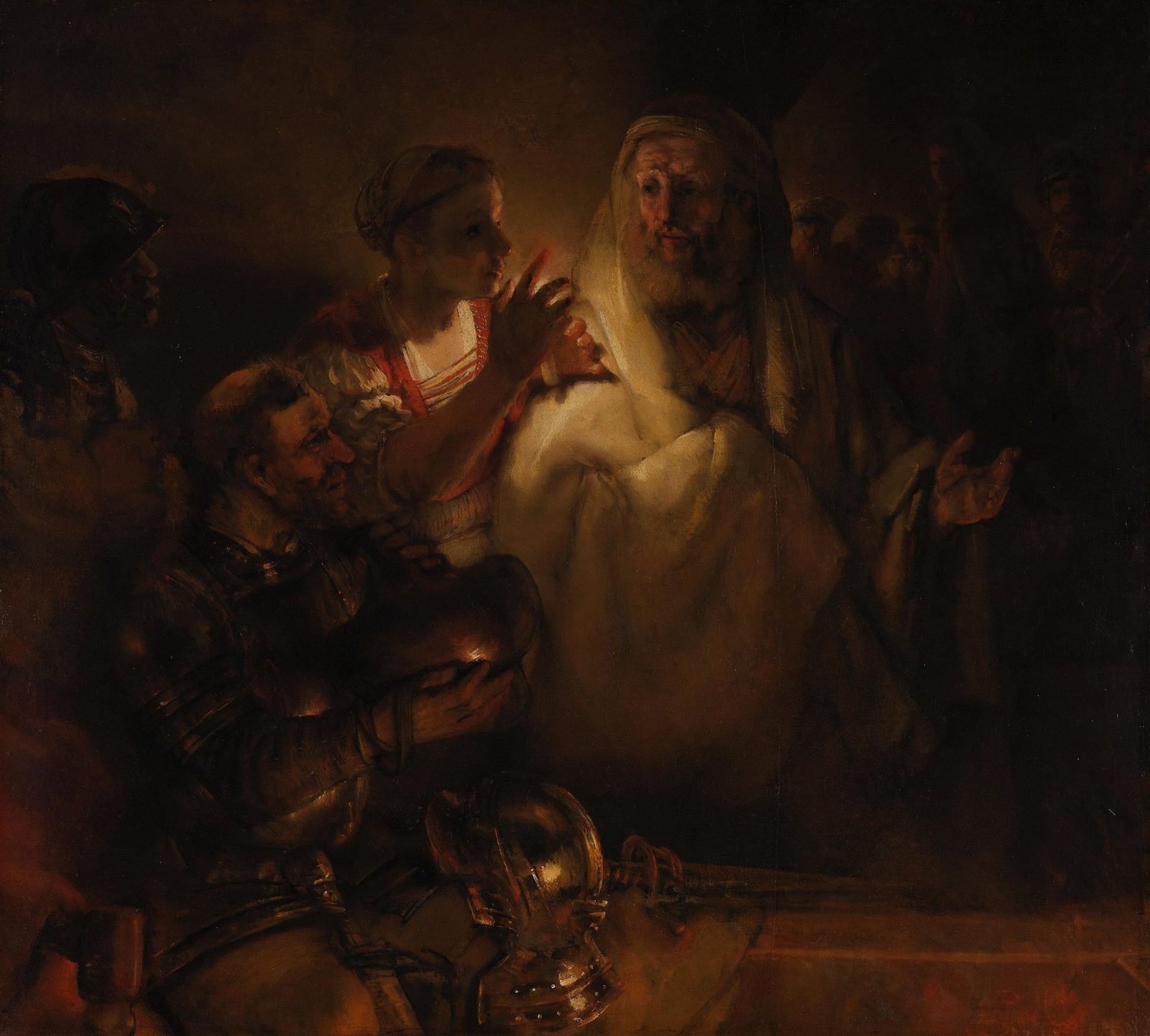
In a dark room, a young woman holds up her hand and peers closely at an old man in a pale cloak. He doesn't meet her eye. He seems to look past her, almost towards us, and opens his other hand. Nearly everything else sinks into brown shadow.
Rembrandt, 1660, oil on canvas
This is Rembrandt's The Denial of St Peter, signed and dated 1660, in oil on canvas. The Rijksmuseum explains the scene. While Christ is questioned by the high priests at night, Peter waits outside. A maidservant recognises him as one of the disciples, and three times he denies it.
A triangle of figures
The main figures make a tight triangle. Peter's head is the peak, and the base runs across the lower part of the picture. A second line climbs from the seated soldier's face up to the woman's raised hand. Both lead you to the narrow gap between her and Peter.
Where is the light?
So where is the light coming from? The brightest patch is Peter's cloak, right beside the woman's hand. Look at her fingers. Their tips glow orange-red, as if light were shining through them, so the source seems to be hidden just behind her hand. Her face, her collar and Peter's cloak all catch it.
The soldier looks up
Below her, a soldier in armour turns his head and looks up. Only his forehead, the bridge of his nose and his upper eyelid catch the light, with a tiny bright speck in the eye. His jaw and mouth melt into the dark, yet that small glint is enough to tell you where he's looking.
A face without edges
Now come to the woman's face. Where the lit cheek turns into shadow there's no line at all, only a soft fall of mid-tones. Then drift down to her bodice, a wedge of cream edged in red. The red deepens to oxblood as it turns from the light, and it's the strongest colour in the picture.
Peter's beard
Across to Peter. A streak of pale paint runs down the left side of his beard, closer to warm cream than to white, and it looks slightly raised above the darker browns around it. You can see separate, loaded strokes along it. That is what makes the beard catch the light so brightly.
An open hand
Peter's other hand is open, fingers loosely spread, in warm flesh tones against near-black. Only the lit tips of the fingers and the edge of the thumb are clear. The rest dissolves into shadow. Further right, the museum notes, Christ is being led away in the background, looking back over his shoulder at Peter.
Thick paint on the helmet
Drop down to the helmet at the bottom. Where the light hits the dome and the plates, the paint looks thick and buttery, standing up from the surface, while the darks behind it look thin and rubbed in. Thick paint catches real light, so these highlights shine without needing to be any brighter.
Look closer
7 details, each checked against a close-up of the picture.
-
The Accusation
The woman's raised hand is held up close to the old man, its fingers soft-edged and glowing orange-red against the dark, beside her striped red-orange sleeve.
The crop centers on a young woman in profile whose raised right hand extends an index finger toward a bearded older man on the right. The fingers are spread and glowing, held up in front of his pale cloak at chest height, as if shielding a light. Paint handling is thick and loaded in the highlights—the cream collar, the woman's striped red-orange sleeve, and the man's pale beard—while the hair and background drop into near-black passages of thin, scumbled pigment. Edges along the hand are soft, the fingers partly lost into the surrounding shadow, and the man's cloak dissolves where the fingers approach, suggesting a wet-into-wet reworking after the hand was first laid in.
-
Defensive Palm
The man's left hand is open with the palm facing outward.
The crop isolates the defensive palm gesture at the right edge: an open hand, palm outward, with fingers loosely splayed and slightly curled, painted in warm, ruddy flesh tones against a near-black ground. The thumb sits low-left of the cluster, while the four fingers taper upward and rightward, their upper contours catching a thin, broken highlight that betters the raking upper-left light. Edges are predominantly soft and lost; only the lit crests of the fingers and the outer rim of the thumb resolve against the void. Underneath the hand, cooler brown-grey forms suggest a beard or draped cloth receding into shadow, and at the lower centre a faintly modelled face tilts upward, mostly dissolved into umber.
-
Armor Impasto
The highlights on the helmet and cuirass are applied as thick, raised strokes of paint.
The crop isolates a soldier's helmet (upper right quadrant) and the front of a cuirass (lower half). The brightest highlights — the dome of the helmet near the right-center and the broad ribbed plate of the breastplate at the bottom — read as physical relief, with paint sitting noticeably above the surrounding film. These highlights are opaque, buttery, and slightly warmer than the leaner, more transparent dark passages behind them. Mid-tones are dragged wet-into-wet, blurring the transition from highlight to shadow, while the strongest lights keep a crisp, almost stamped edge where the loaded brush came straight down. Color moves from near-black in the recesses, through a chocolate umber across most of the metal, into a yellowed-ochre on the hottest hits, with faint vermilion flecks along the rim.
-
Beard Highlights
The beard is rendered with thick, bright white highlights against dark shadows.
A vertical streak of cream-toned paint runs down the left side of the beard, sitting over warm reddish-brown mid-tones that transition into deeper brown-black shadow toward the right and lower edges of the beard mass. The highlight reads more as pale yellow-ochre and warm cream than as bright white. Loose, loaded brushstrokes are visible along this streak, with the lighter paint appearing slightly raised against the darker passages. The face above has pinkish flesh tones with a dark eye-socket shadow, and a hand in the lower left shows pink-red flesh against the beard mass.
-
Red Bodice Accent
The woman's bodice contains a saturated red pigment that contrasts with the umber background.
The crop is dominated by a V-shaped wedge of pale cream fabric outlined by saturated red-brown trim, set against a much darker umber sleeve or shadow mass on the right. The red is not flat: it shifts from a warmer, lighter vermillion near the cream fabric's edge (around x≈0.55, y≈0.45) to a deeper oxblood where it recedes into shadow at the upper right. The cream area shows horizontal red striations laid over the lighter ground, suggesting trim or fold shadows rather than uniform color. Edges between the red trim and cream are soft and slightly feathered, while the outer contour against the dark sleeve is harder, almost a single loaded stroke. Visible directional brushwork on the red follows the fabric's diagonal, with short parallel marks reading as folds.
-
Soft Facial Transitions
The transition from the woman's cheek to the shadow is a soft, blurred gradient.
The crop captures the right side of a young woman's face in three-quarter view, the cheek and bridge of the nose raked by a single, strong light from the upper left. The lit ridge of the nose and the cheekbone are built in warm, ruddy ochre, while the hollow of the eye socket and the jaw-side of the face recede into a cool, olive-brown shadow. Where the lit cheek meets the shadow, there is no drawn line: the value drops through a feathered, atmospheric passage of mid-tones that drift over several millimetres of paint. At the very bottom of the crop a sliver of a bright white collar and a warm red-orange sleeve intrude, and on the right edge a whitish crescent — a brushed highlight — sits on what reads as the bridge of the nose.
-
Soldier's Expression
The soldier's face is partially lit, showing his gaze directed upward.
The crop isolates a head in three-quarter profile turned to the right, emerging from an almost black field on the left. Light rakes in from the upper left, striking the forehead, the bridge of the nose, the upper cheek, and a sliver of the lower eyelid, while the jaw, mouth, and neck dissolve into deep umber and near-black shadow. The gaze is angled upward toward the right, read chiefly from the catching of light on the upper lid and the small white speck at the iris. Loose, loaded strokes of warm flesh (sienna, cadmium-orange) sit against thin dark glazes, and a few cream-ochre dabs at the upper right read as the polished rim of a helmet catching the same raking source. Edges are largely soft and lost, except where a firmer stroke defines the nose ridge and the inner corner of the eye.
The Denial of St Peter in context
A candle between her fingers
The Rijksmuseum's Dutch catalogue says Caiaphas's maidservant stands beside Peter with a candle in her hand, while on the left two soldiers in armour wait, one of them seated at a table drinking from a jug [1]. The flame itself can't be seen, but a 1780 catalogue of the comte de Baudouin's collection, quoted in the museum's provenance notes, already described the servant studying Peter by a light she held between her fingers [1]. The same text called the effect of a picture lit only by that candle astonishing, and noted that the four main figures are life-size [1].
The 1780 description also reads the background more closely than the eye easily can today. It describes Christ standing before three judges in turbans, with two soldiers, one of whom holds his hands tied behind his back [1]. The museum's own summary adds that Christ is being led away and looks back over his shoulder at Peter [1].
Signed, with a qualification
The canvas is signed and dated 'Rembrandt 1660' at lower right [1]. The museum's public page names Rembrandt as the painter, but a short label line in its own linked-data record for the painting reads 'Rembrandt van Rijn and workshop, oil on canvas, 1660' [2]. Neither record explains the wording. So it is safest to read it as the museum allowing for studio help rather than as a settled verdict on who painted which parts [1][2].
Rembrandt around 1660
The painting belongs to a difficult period in Rembrandt's life. A Leiden University article on his legal affairs says he went bankrupt in 1656 by voluntarily surrendering his goods, a procedure known as cessio bonorum, and later moved to a much smaller three-room house at 184 Rozengracht [3]. His partner Hendrickje and his son Titus set up a company that sold his work, and he received some kind of salary from it, at least on paper [3]. The same article says it is unclear whether this arrangement worked in practice [3].
From Amsterdam to St Petersburg and back
The early history is uncertain. The museum tentatively links the painting to two large Rembrandts, one of Jacob wrestling and one of the denial of Peter, listed in the estate inventory of the Amsterdam collector Marten Davidsz van Ceulen (1617-87), and marks that link with a question mark [1]. It may also be the large Rembrandt of the subject recorded with the marquis de Voyer in Paris by 1752, again with a question mark [1]. And it was in the sale of the comte de Vence in Paris on 9 February 1761, as no. 49, where it fetched 500 francs [1].
By 1780 it belonged to the comte de Baudouin, who in 1781 sold it with 118 other paintings, through Melchior Grimm, to Empress Catherine II of Russia for the Hermitage [1]. The Vereniging Rembrandt explains that in the late 1920s the young Soviet Union sold large numbers of artworks to help pay for its first five-year plan [4]. Then in 1933 the Soviet government sold the painting through the London dealer Colnaghi, together with Rembrandt's Titus in a Monk's Habit, for 800,000 guilders, to the Vereniging Rembrandt for the Rijksmuseum [1]. The society notes that it marked its fiftieth anniversary that year by helping to acquire three Rembrandts [4].
- Rembrandt van Rijn, The Denial of St Peter (SK-A-3137): object record, description and provenance . Rijksmuseum, Amsterdam
- The Denial of St Peter: linked-data object record (id 200107933) . Rijksmuseum, Amsterdam
- Rembrandt made a mess of his legal and financial life (Corine Hendriks, 16 November 2021) . Leiden University
- De verloochening van Petrus: acquisition record . Vereniging Rembrandt