Reading El Greco's Feast in the House of Simon
A painter's eye-path through the late Toledo workshop
- Artist
- El Greco (Doménikos Theotokópoulos) and workshop
- Title
- The Feast in the House of Simon
- Date
- c. 1608–14
- Medium
- Oil on canvas
- Museum
- Art Institute of Chicago
- Image
- Public domain (CC0)
Open in Simple Art
Watch this story on iPhone and iPad, with offline downloads and a painting every day.
About 5 minutes of looking, in 11 parts.
A moment of recognition
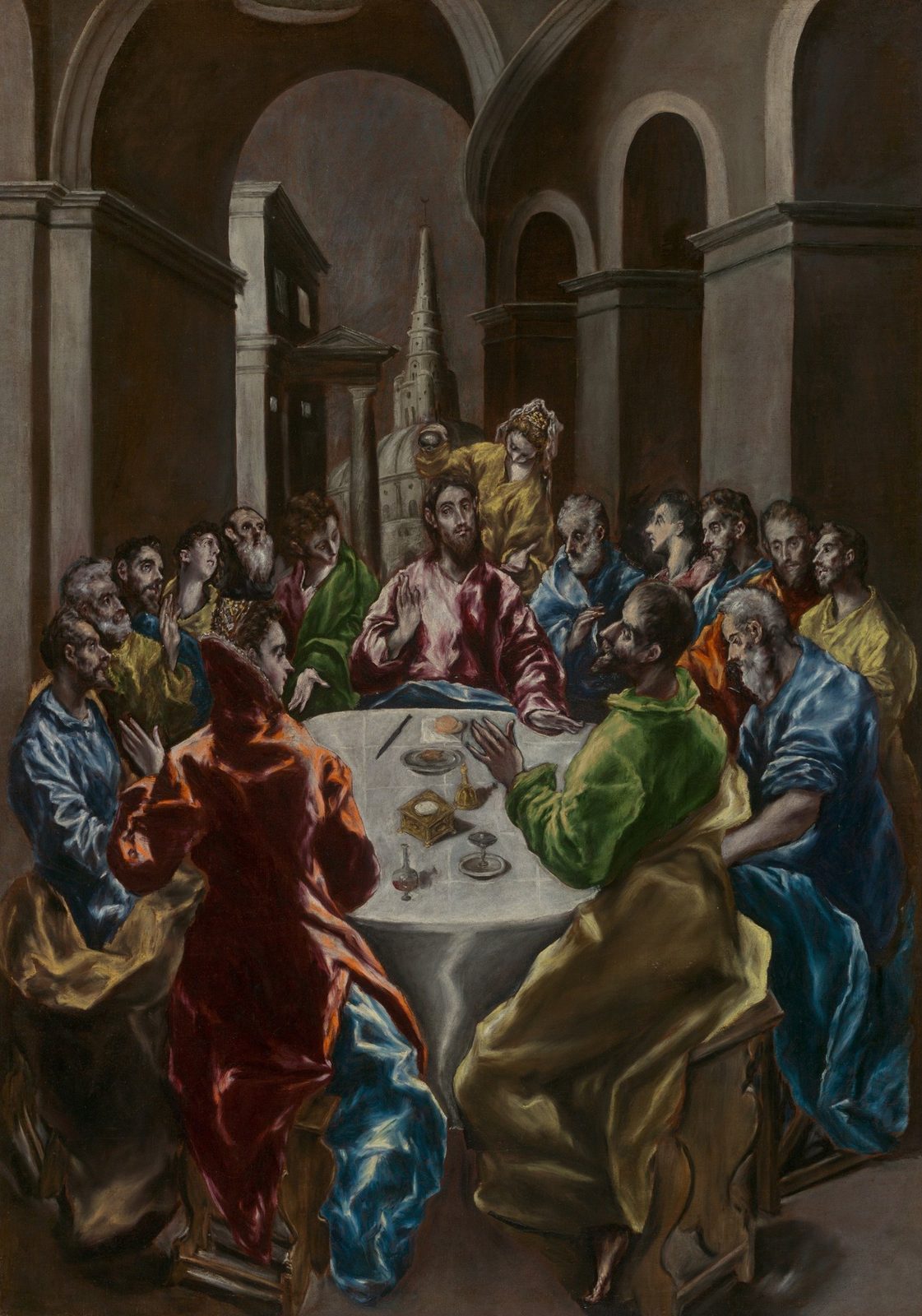
Step into a hushed room crowded with bearded faces. Our camera rests on the full canvas first, so you can feel the press of bodies around a single round table. At the center, a haloed figure in rose-pink robes sits almost unnaturally still while everything around him seems to lean in.
El Greco, late workshop
This is The Feast in the House of Simon, oil on canvas, datable to around 1608 to 1614, from the late Toledo workshop of El Greco, Doménikos Theotokópoulos. Look for the long attenuated limbs, the acid palette, and the way faces seem stretched and lit from within — all signatures of his late mannerist production.
Pyramid on a pyramid
Now notice the geometry. A center-cross overlay reveals how the entire group locks into a pyramid with the haloed Christ at its apex, while an inverted triangle — the kneeling figure at lower left and the two flanking apostles' raised hands — points up to the same focal point. The round table and the arches echo that concentric order.
Theatrical tenebrism
Light pours in from the upper left, raking across the faces and the white tablecloth while the architecture behind dissolves into deep shadow. It is high-contrast mannerist tenebrism: near-black recesses framing a luminous mid-value cluster of faces. Watch how that single light source unifies the whole composition.
Red against blue-green
Our eye lands first on the kneeling Magdalene in saturated red-orange. The warm cadmium scumbles sweep diagonally across her body, with deep burgundy pooling in the recesses. Right beside it, a teal-leaning blue-green robe sits unblended, and that shared edge is the hottest, brightest line in the passage. Try placing your warmest red directly against its complement without letting the edges melt.
Christ's face
Drift up the diagonal of her back to the central face. The modeling is gradual, with no hard transitions — highlights and half-tones blend through thin, dragged scumbles. Light hits the left forehead, the bridge of the nose, the left cheekbone, and the lower lip, while the right side of the face sinks into cool umber shadow. The lesson: block a unified mid-tone first, then add only two values.
Fluid drapery highlights
On the maroon robe covering that central figure, watch how the highlights are not pure metallic white but rose and pinkish-cream — a local hue mixed with a little lead white. Long loaded brushstrokes travel the full length of each fold in a single pass, dragged while the underlayer is still damp. Mimic that by loading your brush so the stroke can travel the ridge in one motion.
Acid yellow rising
Now lift the eye to the standing woman pouring from a vessel just behind Christ. Built from dirty olive-ochre shadows to straw-yellow highlights, this luminous mass is framed by a near-black void on three sides. Practice building form inside a single hue: lay a uniform mid-yellow, push darks with a burnt-umber mix of that yellow, and pull lights with a cooler pale yellow only on the highest ridges.
Workshop hands
Drift across the half-circle of apostles to the figure on the far right. His face is more loosely finished than the central ones — the beard a smear of grey and ochre, the eye socket a quick hollow, the cheek fading into shadow without a resolved terminator. Streaky yellow drapery rides over a cobalt robe. This is hierarchy of finish at work: leave supporting faces less resolved and the focal ones advance.
White cloth as pivot
Lower the camera to the table. The pale grey-white cloth is the brightest plane in the painting, a neutral pivot that lets every saturated robe sing around it. Notice the sharp cast shadows beneath the casket, the glass, the knife — each tipped toward the lower right, confirming that single high-left key light. Try this: paint one cast shadow with one loaded stroke, matching its angle, not its outline.
Sketchy table objects
Sweep in closer. A gilded casket, a silver chalice, a small glass flask — each described in only three values and a handful of horizontal touches. No outlines, no descriptive ornament. Try painting one tabletop object in only light, mid, and dark with a small dry brush over a hatched ground. The objects feel heavy precisely because nothing is drawn.
Look closer
9 details, each checked against a close-up of the picture.
-
Central Figure's Face
The face features soft modeling and a faint, glowing halo around the head.
The crop shows a close-cropped head and shoulders of a bearded male figure with warm, olive-tinged flesh tones. The light rakes from the upper left, illuminating the left forehead, the bridge of the nose, the left cheekbone, and the lower lip, while casting the right side of the face and the socket beneath the brows into soft, cool umber shadow. The modeling is gradual, with no hard transitions; highlights and half-tones blend through thin, dragged scumbles. A faint golden-yellow glow (the halo) breaks through behind the dark hair on the upper right, and the rose-pink robe below is set in with broad, low-contrast strokes. The eyes are large, dark, and almond-shaped, edged with a thin darker line that loses definition where it meets the iris.
-
Drapery Highlights
Sharp, metallic white highlights are applied with long, fluid brushstrokes on the red robe.
The crop is dominated by a deep maroon robe with broad, sweeping passages of paint that establish the principal folds. Highlights along the ridges read as rose and pinkish-cream rather than bright metallic white, with a few warmer cream touches near the left edge where an adjacent figure's sleeve appears. The transitions from shadow to light are mostly soft and brushed wet-into-wet, though a handful of crisp pink-rose strokes on the upper-right ridge hold a slightly harder edge. A small wedge of saturated orange-gold on the right margin belongs to a neighbouring figure or object, not the robe itself. Overall the surface looks scumbled and thinly worked in places, with the highlight ridges layered over a darker, more saturated underlayer.
-
Complementary Drapery
Saturated red-orange fabric of the seated figure sits adjacent to the blue-green robe of the apostle.
The crop centers on a mass of saturated red-orange drapery, brushed with broad, gestural strokes that sweep diagonally from upper left to lower right, following the body's posture. Highlights along the raised folds are laid in with thin, warm cadmium-like scumbles — visible as crisp, almost broken edges where the orange rides over a darker maroon underlayer. Deep burgundy shadows pool in the recesses, with the darkest values reading as near-black violet. To the right, a blue-green robe is built from cooler, slightly more opaque strokes in teal and cerulean, its folds catching white-blue highlights. To the left, an olive-green-yellow garment sits in deeper shadow with softer, more blended edges. The warm orange and cool blue-green sit on adjacent diagonals, producing a near-complementary tension that the eye reads as vibration.
-
Tabletop Chiaroscuro
The white tablecloth is brightly lit with deep, dark shadows beneath the plates and hands.
The crop shows a circular table draped in a pale grey-white cloth, with a faint grid of crease lines marking where plates once rested. From upper left, raking light brightens the top-left quadrant of the cloth while the lower-right falls into cool, bluish shadow. Sharp, hard-edged cast shadows pool beneath the knife, the small plate, the golden box, and the wine glass — each shadow tipped toward the lower right, confirming a single, high-left key light. A green-sleeved arm and a pale hand intrude from the right, their lit edges crisply defined against the muted ground; the red-orange seated figure on the left reads as a saturated chromatic counterweight to the neutral tabletop.
-
Peripheral Apostle
The apostle on the far right has less defined facial features compared to the central figures.
The crop isolates two figures pressed close together: a partial face on the left with a downward gaze, and a bearded man on the right turned in profile, wearing a saturated yellow mantle over a deep blue robe. The right apostle's face is rendered with looser, more summary brushwork than the left figure: the beard is a smear of grey and ochre strokes, the eye socket is a quick hollow, and the cheek transitions into shadow without a fully resolved terminator. The yellow drapery shows streaky, diagonal brushwork with cooler greenish passages in the folds, while the blue robe below is built in broad, almost unblended strokes of cobalt and ultramarine. Edges between the two heads are soft and unarticulated, allowing them to read as a single mass against a dark ground.
-
Yellow Robes
The woman's garment is a bright, saturated gold-yellow that contrasts with the dark background.
The crop centers on a standing female figure in a gold-yellow robe, cropped just below the chin and at the lower hip. The yellow mass is built from a range of values running from a dirty olive-ochre in the deepest folds to brighter straw-yellow highlights along the convex ridges; a sleeve curls at lower-center where a small hand is half-visible. Below the yellow, a deep oxblood/rose drapery drops in heavy vertical pleats, its folds catching pinkish highlights on the lit side. A muted slate-blue garment intrudes on the right edge, and the background is a near-black void that frames the yellow on three sides.
-
Table Objects
Small plates and a rectangular dish are rendered with minimal, sketchy brushwork.
The crop shows four table objects on a cool gray surface: a gilded rectangular casket upper left with a pale oval inlay on its lid, a tall-stemmed silver-toned chalice center-right, a small glass flask with reddish liquid lower left, and a brown cup-shape between flask and casket. The tabletop reads as a continuous field of pale warm grays crossed by loose diagonal hatches that shift slightly darker toward the lower right, with the cloth folds suggested only by interruptions in the hatch direction rather than drawn creases. Edges between objects and table are kept wet-soft; the casket's gilt is a flat ochre read with three quick tonal notes (warm light, mid, dark) and almost no descriptive ornament, while the chalice is built from a few stacked horizontal touches that imply bowl, stem, and disc base without contour lines.
-
Apostle's Gaze
An apostle on the left looks upward with an open-mouthed, expressive facial expression.
The crop isolates two heads and a raised open hand against a near-black ground. The bearded man at left tilts his chin up, lips parted, eyes cast toward the upper right; the younger figure beside him mirrors that upturned gaze with a smoother jaw. The hand in the lower centre is raised with fingers open, articulated with thin lighter strokes along the knuckles. Drapery falls in saturated yellow-ochre on the right and a deep ultramarine blue at the lower edge, both rendered in long, slightly dragged strokes that leave the weave faintly visible. Edges between face and background are soft and broken, while the highlights on nose bridge, lower lip and fingertips are placed with a single light-loaded stroke.
-
Distant Tower
A slender, pale tower is visible through the central arch against a dark grey sky.
A tall, slender spire rises vertically through the frame, painted in pale cream and warm grey with darker umber accents marking tiered openings and structural bands. The tower sits against a mottled dark brown-grey sky where brushwork is loose and streaky, with no crisp contour between masonry and atmosphere. In the lower third, the hand of the standing woman in yellow holds up a dark round jar, with only a small architectural corner visible at the far left edge. Edges throughout are soft and slightly broken, the tower's silhouette read as a tonal mass rather than a hard line.
The Feast in the House of Simon in context
A supper at Bethany
Matthew's Gospel sets the episode in Bethany, in the house of Simon the leper. A woman with an alabaster box of precious ointment poured it on Jesus's head as he sat at the table [2]. The disciples objected to the waste, but Jesus defended her, saying she had done it for his burial [2]. The woman pouring from a small vessel behind Christ in this picture appears to follow that account, in which the anointing is of the head rather than the feet [2].
A design shared out
The Art Institute dates the canvas to about 1608 to 1614, the final years of El Greco's life, and credits it to the artist together with his workshop [1]. The museum notes that it has the bold highlights, elongated figures and strong colour of his late work, but that he had assistants carry out parts of the scene to his design [1]. It adds that the heads reflect several different hands, and that the fantastical architecture behind the figures, unlike any other background by El Greco, may have been conceived by an assistant [1].
Jorge Manuel
Among those hands the museum probably counts Jorge Manuel Theotocópuli, El Greco's only son and a leader of the workshop in its later years [1][3]. Born in Toledo in 1578, he trained in his father's studio. After his father's death in 1614 he concentrated on architecture, and from 1625 was master builder at Toledo Cathedral [3]. A Supper in the House of Simon is among the works illustrated under his name in Wikipedia's article on him [3].
The question of his share has stayed open. The Chicago canvas was lent to the 2014 exhibition El Greco: Arte y Oficio at the Museo de Santa Cruz in Toledo. It was discussed there in José Álvarez Lopera's catalogue essay on what he called the problem of Jorge Manuel [1].
Three versions in one inventory
No picture of this subject appears in El Greco's own estate inventory [1]. However, the 1621 inventory of everything owned by Jorge Manuel, his father's sole heir, lists three versions of it as items 123 to 125, as transcribed by Francisco de Borja de San Román in 1927 [1]. The museum therefore says only that the Chicago painting was possibly in the artist's possession in 1614 and possibly passed to his son [1].
Bilbao, Paris, Vienna and Vermont
The later history is patchy. The canvas was probably with a Guinea family in Bilbao. Manuel Cossío in 1908 placed it with a Plasencia family there, though the museum says this can't be verified [1]. By 1908 it belonged to Alexandre Berthier, Prince of Wagram, in Paris. By 1911 it was with the Galerie Miethke in Vienna, and by 1914 with Durand-Ruel in New York [1].
Joseph Winterbotham, Jr., of Burlington, Vermont, owned it by February 1929 and lent it to the Art Institute in 1930 [1]. The museum bought it through the Winterbotham Fund in 1949 [1]. It was shown in Toronto in 1944 under the title Christ in the House of Simon. More recently it appeared in the Grand Palais exhibition Greco in Paris in 2019 to 2020, and in El Greco: Ambition and Defiance in Chicago in 2020 [1].
- The Feast in the House of Simon (collection record) . Art Institute of Chicago
- Matthew 26:6-13 (King James Version) . Bible Gateway
- Jorge Manuel Theotocópuli . Wikipedia