Reading Winslow Homer's The Herring Net
A camera walkthrough for painters
- Artist
- Winslow Homer
- Title
- The Herring Net
- Date
- 1885
- Medium
- Oil on canvas
- Museum
- Art Institute of Chicago
- Image
- Public domain (CC0)
Open in Simple Art
Watch this story on iPhone and iPad, with offline downloads and a painting every day.
About 5 minutes of looking, in 11 parts.
A moment of pure tension
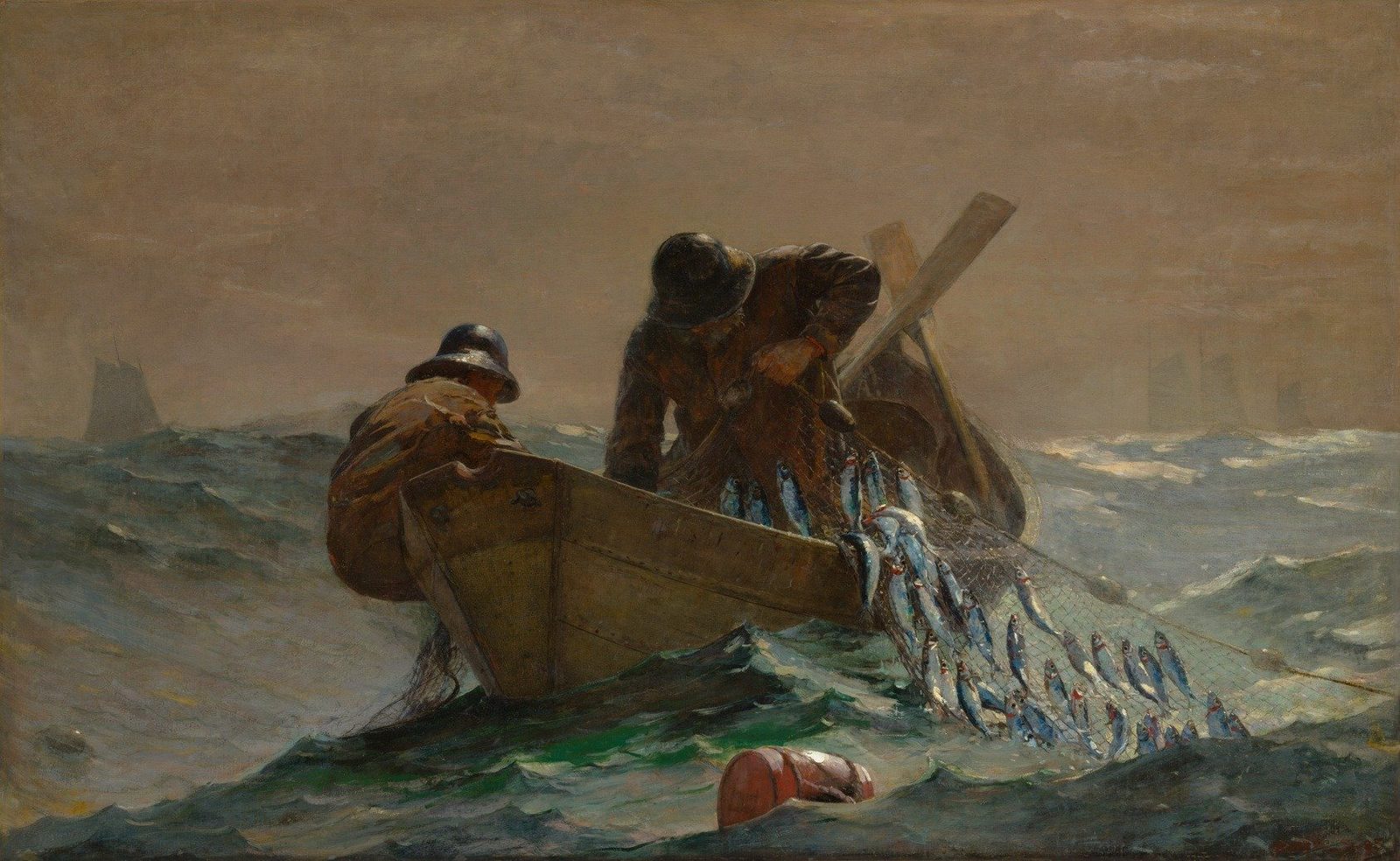
We are looking at Winslow Homer's The Herring Net, painted in 1885 in oil on canvas. Two men in a small wooden dory haul a bursting net of silver fish over the gunwale, the whole boat leaning hard against a choppy sea. Watch the picture as a whole first — notice how nothing in it stands upright, and that shared lean is the entire drama.
Realism with an Impressionist sea
Homer works here as an American Realist — the figures and hull are held solid and modeled — while the water and sky dissolve into broken, plein-air brushwork. The tag of Impressionism fits the handling of light on the waves, not the drawing. We'll move through the painting along the eye path the composition itself invites.
One tilted axis
The whole painting rests on a single strong diagonal. The tilted boat and figures lean from upper right down to lower left, while the net of fish sweeps in a counter-diagonal from upper center down toward the lower right. Watch the diagonal overlay — those two slanted axes crossing is what creates the feeling of motion.
Backlit from the upper right
Drop into the standing figure. Homer backlights the whole scene from the upper right. Look at that thin warm rim catching the right shoulder and the brim of the sou'wester. The figure reads almost as a silhouette — reserve your lightest strokes for where the sun wraps around the edge, and let the rest of the oilskin sink into deep shadow.
Silver fish in loaded dabs
Slide your eye down into the net. The fish are not painted detail by detail — they are a dark blue-grey mass, and each fish is essentially one confident loaded dab of white and pale ochre dragged across the wet dark. Try this yourself: place a loaded dab of light paint over a wet dark, then leave the edge unblended and let the dark halo do the silhouette work for you.
One red note
Follow the cascade of fish down to the lower right and you land on the red buoy. A single saturated rust-red against the teal-green water, and the only high-chroma accent in the whole painting. The highlight curves along the top edge of the cylinder, and notice how the meeting line between buoy and water stays soft and broken — no hard contour.
Impasto wave crests
Pull back into the water around the buoy. Homer built these wave crests with ridged, impasto paint — the brush dragged horizontally and then flicked upward at the lip of each crest to form foam. The ridges of the stroke themselves catch real light. Resist the urge to over-blend; the impasto is the effect.
A face without lines
Drift back up to the seated fisherman on the left. The sou'wester throws his face into deep shadow and Homer gives us almost no lines. A warm orange glow licks along the jaw where the backlight rakes through; the brow is a cooler grey; the nose is one shadow notch. The features are implied entirely through value and temperature, not drawn.
Body and boat share one tilt
Now look at the standing figure's torso and the gunwale below it — they tilt on the exact same axis. That shared gesture line is what makes the labor feel physical. Homer unified posture and hull before he modeled any interior detail: one dark silhouette mass, then a few rim-light strokes along the lit edge.
Where hull meets water
Settle on the edge of the boat. The gunwale is kept crisp and decisive — Homer wanted the hull to read as solid — but the moment the plank meets the water, that edge dissolves into choppy, broken strokes. The boat stays a boat, the water keeps moving, and the contrast in edge hardness does the storytelling.
Sails that almost aren't there
Lift your gaze toward the horizon. Two pale verticals — distant sails, almost ghosts. Homer dragged them in with a barely-damp brush into the warm sky and then softened them immediately. No outlines. Just one tone against another, the whole thing reading as atmosphere and distance.
Look closer
9 details, each checked against a close-up of the picture.
-
Fishermen and Net
Two figures in dark oilskins lean over a boat's gunwale as silver fish spill from a net.
Two figures in deep brown oilskins bend forward over a wooden gunwale, rendered as near-silhouettes against a warm pinkish-tan sky. The boat's interior and plank side are a warm umber-ochre with visible grain in the brushwork. Over the right edge of the boat, a mesh net cascades down into choppy green-blue water, its load of small fish tilted on the diagonal. The fish carry sharp silver-white belly notes against cool grey-blue backs, with small red accents at the gills/mouths where they've been hooked. Edges range from crisp on the foreground fish to dissolved and atmospheric in the background waves and distant horizon.
-
Fish Highlights
The fish are rendered with thick, quick dabs of white and light blue paint over darker grey tones.
The crop shows a cluster of small silver fish spilling from a net over the gunwale of a wooden dory. The fish are built from cool, dark blue-grey underpainting overlaid with short, lifted dabs of white, pale blue, and warm ochre that read as wet, reflective bodies. The net is suggested through regular crossing diagonals in dark olive-brown, with a few fish interrupting the grid where they press against the mesh. The wooden gunwale is handled with horizontal brown strokes carrying a thin paler rim, while the water below is broken into loose, choppy touches of green, slate, and cream. Edges throughout are soft and unresolved, with the fish silhouettes melting into the net and background in places.
-
Backlighting on Figure
A bright rim of light outlines the right shoulder and head of the standing fisherman.
The crop is dominated by a near-silhouette figure turned slightly away, with the bowed head and right shoulder catching a thin warm rim against a mid-value ochre-brown background. The oilskin is built from broad, unblended strokes of dark umber, raw sienna and near-black, with a few short, lighter scumbles along the right shoulder and hat brim that read as transmitted light rather than direct highlights. Edges are soft and partly lost into the background at the back of the head, while the front of the jacket and face side resolve into harder, darker contours. A small saturated red-orange passage sits at lower right, contrasting with the surrounding dark browns, and the overall value structure is compressed into a narrow mid-to-dark range punctuated by that one warm edge.
-
Wave Crests
The water consists of thick, directional impasto strokes of white and pale green.
The crop captures a turbulent sea surface rendered with thick, ridged paint laid in roughly horizontal sweeps. White and pale-green peaks break across the center, with the whitest highlights catching the upper edge of each crest where the stroke turns slightly upward. Beneath the foam, mid-value greens and blue-grays sink into the troughs, while a dark olive band runs across the upper edge where hull or rigging meets water. Edges are mostly soft and blended where the paint is dragged, but the white crests read as discrete dabs loaded onto a wet or partially wet ground.
-
Red Buoy
A saturated red buoy contrasts with the teal-green water in the foreground.
The crop isolates a cylindrical red buoy sitting in choppy water, painted with broad, visible strokes that follow its curved form. The buoy's body is a saturated rust-red built from warm reddish-browns, with a paler pinkish highlight along the upper rim where light from the upper right catches the rounded top; a creamy white band or rope wraps around its midsection. The water is constructed from layered, broken marks of dark teal-green and olive, with lighter green-yellow flecks reading as wave tips and foam. The buoy's edge against the water is soft in places where the warm and cool tones are juxtaposed with short, loose strokes rather than a crisp contour, allowing the form to feel embedded in the moving surface.
-
Standing Figure's Stance
The figure's torso is tilted at an angle mirroring the lean of the boat.
The crop isolates the standing figure's upper body and the boat's gunwale in the lower right. The figure is rendered as a near-silhouette in deep umber-brown oilskin, with a bright catchlight on the crown of the head where backlight wraps over the brim. The torso leans rightward in a curved posture, and the boat's gunwale edge at the bottom right slopes down to the right in a parallel tilt. Loose, loaded brushwork defines the oilskin folds along the back, while the sea at the left is built from short, choppy strokes in muted blue-gray against a warm neutral sky.
-
Seated Fisherman's Face
The seated figure's facial features are softly blended with minimal hard lines.
The crop isolates the seated fisherman's head and neck, dominated by a dark oilskin sou'wester whose brim throws the face into deep shadow. A warm, translucent orange glow licks along the right jawline and neck, where the backlight rakes through the silhouette. Facial features are not drawn with lines; they emerge only as soft value transitions—slightly cooler grey at the brow, faint warm shadow at the cheek, a darker notch suggesting a nose. The hat surface shows a few tiny bright scuff dots (wear) along the brim edge catching the rim light, while the rest of the form stays as one continuous dark mass.
-
Boat Hull Edge
The edge of the boat is defined by a dark brown line meeting a lighter, shimmering water edge.
The crop shows the side of a wooden boat hull rendered in warm, muted browns with cooler greyish shadows. A dark vertical edge runs along the left side, defining the boat's gunwale, while horizontal seams suggest planking across the hull. The wood tones range from ochre-brown highlights to deeper umber shadows, with small dark spots reading as nail heads or knots. Along the lower edge, choppy greenish-teal water meets the hull in a soft, broken transition rather than a hard line.
-
Distant Sails
Small, pale grey vertical shapes representing distant sails are softly blurred into the sky.
The crop shows a hazy, warm grey-brown sky occupying the upper two-thirds, with a small dark vertical shape near the center and a fainter, even more reduced vertical smudge to its right—both read as distant sails. Their edges are soft and feathered into the surrounding atmosphere, with no hard contour lines. Below, a band of dark, choppy water carries scattered lighter touches of pale grey and ochre that catch raking light on wave crests. The overall value structure is low-contrast, with the warm sky pushing the cool-dark water forward in space.
The Herring Net in context
From the North Sea to Maine
The Art Institute of Chicago says that Winslow Homer's time in a fishing community at Tynemouth, England, in 1881 fundamentally changed his life and work [1]. Wikipedia places him more precisely in Cullercoats, a fishing village in the parish of Tynemouth, from April 1881 to November 1882 [2][3]. There he painted mostly watercolours of working men and women, and his palette became more sober and his pictures larger and more ambitious [2].
Back in the United States, Homer moved in 1883 to Prouts Neck, on the coast of Maine near Scarborough, and lived in a remodelled carriage house on his family's land, close to the ocean [2]. A studio built for him there was completed in 1884 [4].
Three fishing pictures of 1885
The Herring Net is one of three paintings of fishermen at sea that Homer finished at Prouts Neck in 1885 [4]. The others are The Fog Warning, whose description Wikipedia quotes from the Museum of Fine Arts, Boston, and Lost on the Grand Banks [4][5]. All three show the hard lives of North Atlantic fishermen, and The Fog Warning, like this picture, combines the danger of the sea with its bounty [4][5].
The canvas measures 76.5 by 122.9 centimetres and is signed in red paint on the water at lower right, 'Homer 85' [1]. The museum sees the subject as the heroic effort of fishermen at their daily work [1].
Shown under more than one name
The painting was first shown at the National Academy of Design's autumn exhibition in New York, from November to December 1885, as number 395 [1]. And Chicago saw it early, at the World's Columbian Exposition of 1893 [1].
Its title was not fixed. At the Carnegie Institute in Pittsburgh in 1908 and at the Metropolitan Museum of Art's memorial exhibition of Homer's paintings in 1911, it appeared as Banks Fishermen [1]. A Knoedler show in 1949 listed it under both names [1]. The museum's catalogue of 1925 already called it Herring Net [1].
A Chicago collector
The first owner the museum can name is Charles W. Gould of New York, who had it by 1908 and kept it until 1915 [1]. That year it passed to M. Knoedler and Company and was sold to Martin A. Ryerson of Chicago [1]. Ryerson, a lumber heir who became the richest man in Chicago by the age of 36, served as honorary president of the Art Institute and also owned paintings by Monet and Renoir [6].
After Ryerson died on 11 August 1932, the painting went to his widow, Carrie Hutchinson Ryerson, who died in 1937 [1]. It entered the Art Institute that year as part of the Mr. and Mrs. Martin A. Ryerson Collection [1]. Since then it's been lent to exhibitions including Homer, Ryder and Eakins at the Museum of Modern Art in 1930 and the Winslow Homer retrospective shown in Washington, Boston and New York in 1995-96 [1].
- Winslow Homer, The Herring Net (1937.1039): object record with description, inscriptions, provenance, exhibition history and publication history . Art Institute of Chicago (public API)
- Winslow Homer . Wikipedia
- Cullercoats . Wikipedia
- The Fog Warning . Wikipedia
- Lost on the Grand Banks . Wikipedia
- Martin A. Ryerson . Wikipedia