Towers made of air
How Monet lets a London sunset dissolve the Houses of Parliament into strokes of colour
- Artist
- Claude Monet
- Title
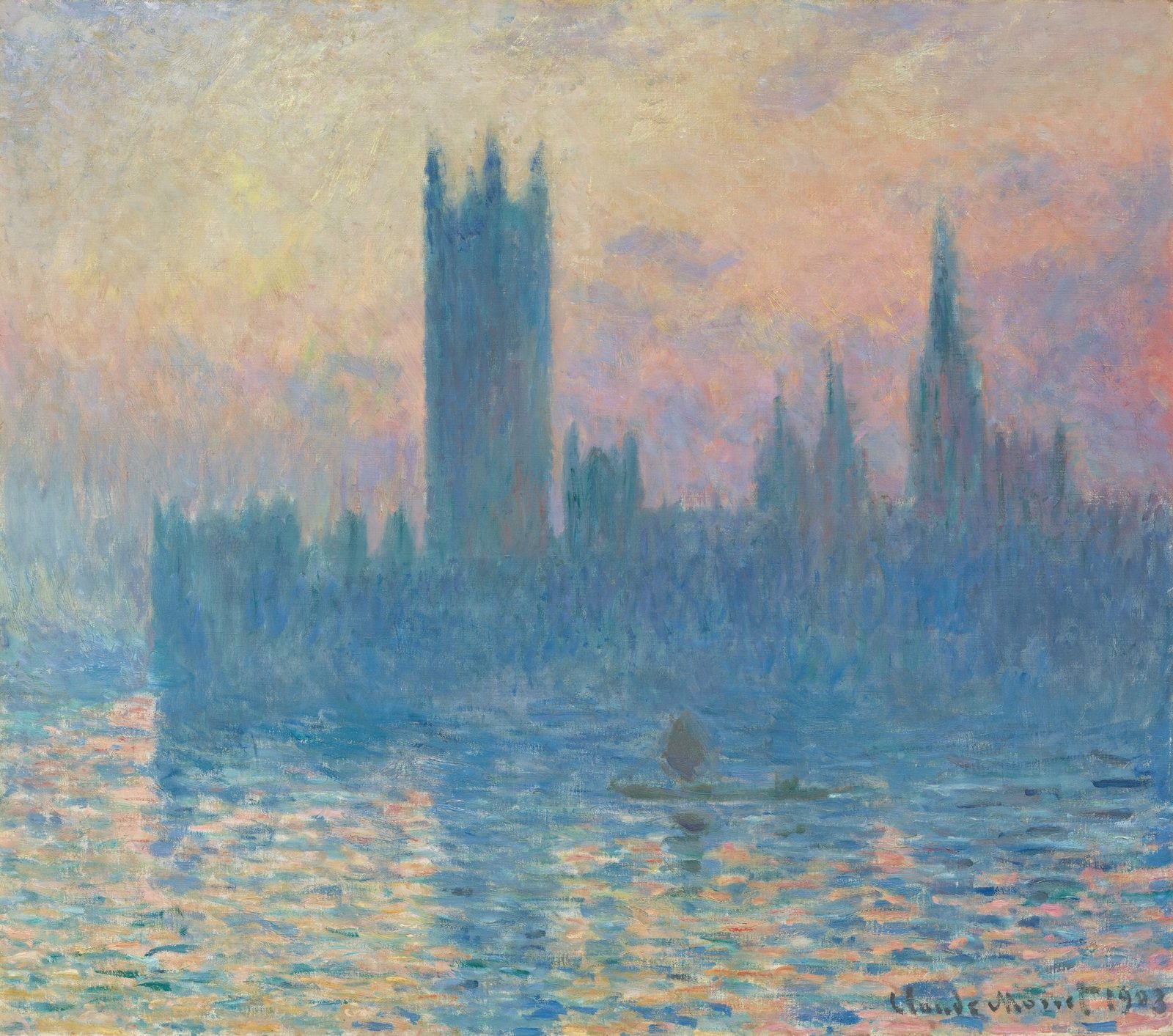
- The Houses of Parliament, Sunset
- Date
- 1903
- Medium
- oil on canvas
- Image
- Public domain (CC0)
Open in Simple Art
Watch this story on iPhone and iPad, with offline downloads and a painting every day.
About 3 minutes of looking, in 9 parts.
Towers against a sunset
A row of towers stands against a pink and peach sunset, and not one of them has a firm edge. Below, the river repeats them in broken colour. Notice first how little of the building is actually there.
Claude Monet, 1903, oil on canvas
This is Claude Monet's The Houses of Parliament, Sunset, painted in oil on canvas. He signed and dated it 1903 at the lower right. A year later it was shown in Paris, in an exhibition of his views of the Thames.
Three bands and one tower
The picture is built in bands: sky, a low line of buildings, then the river filling the bottom third. One tall tower breaks the line just left of centre, and it is the darkest shape on the canvas.
Warm and cool, side by side
Look at the sky at the upper right. Peach gives way to pale lavender and a touch of turquoise, but the colours aren't smoothed together. They sit in separate strokes, side by side, and your eye does the mixing.
A tower with no edge
Now the tall tower. Its top breaks into three soft points, and where the dark meets the pink sky there's no line at all. The blue looks layered, with hints of green and red worked in. Right at the tips, the dark seems to thin out and scatter into the sky.
A skyline that never closes
Move right along the skyline. The smaller towers are made of soft vertical dabs that never join into an outline, and warm sky shows through the gaps. Stand back and they become buildings. Come close and they fall apart.
Water in separate touches
Drop down to the water at the lower left. It's a patchwork of short horizontal touches, peach, cobalt, green and cream, laid side by side rather than blended. In the thinner places the canvas seems to show through.
The sky, repeated below
At the lower right, the warm sky comes back in the water as scattered dabs of coral and pale orange on blue violet. Below them, darker strokes look like the deepest part of the reflection. Even the signature is written in short horizontal pulls, like the ripples around it.
Vertical against horizontal
Now compare the tower with the water. The buildings are made of vertical strokes, the river of short horizontal ones. It's the same broken colour each time, simply turned on its side, and that change of direction does much of the work of telling solid from moving.
Look closer
8 details, each checked against a close-up of the picture.
-
Main tower silhouette
The tallest dark silhouette has three peaked spurs along its top edge and no hard contour where it meets the pink sky.
A tall, dark blue-teal silhouette of a tower rises vertically through the center, its top edge broken into three soft, peaked projections (a central spike flanked by two shorter points). The silhouette is rendered in layered blues ranging from deep ultramarine to teal, with hints of greenish and reddish strokes woven into the mass. Where the dark tower meets the pink-orange sky, the contour is entirely dissolved — pink and blue interpenetrate in soft, feathery brushstrokes with no hard edge. Below, the tower's reflection mirrors downward, slightly lighter and more broken, while a smaller secondary silhouette sits at the lower right.
-
Broken water strokes
The water here is made of separate, choppy horizontal touches of peach, emerald, and cobalt that remain unblended on the surface.
The crop consists of short, horizontal brushstrokes layered side-by-side rather than blended. Discrete touches of peachy-pink (around the upper-middle and scattered throughout), cobalt/cerulean blues, and emerald-teal greens sit as individual marks, with cream and ochre accents breaking up the transitions. Canvas weave is visible through thinner passages, and stroke edges are crisp where the brush deposited load and softer where it dragged. Values range from pale cream highlights to deeper navy-blue shadows, with the darks concentrated in vertical streaks that read as fragmented reflections rather than continuous water.
-
Tower crown dissolve
The tips of the three main spires dissolve into the sky with soft, fuzzy edges where dark and light pigments intermingle.
The crop captures three vertical spires rendered in deep cobalt-blue silhouettes against a hazy, cream-to-peach ground. The crown tips do not terminate in hard contours; instead the dark pigment thins out and scatters into adjacent lighter paint, producing a frayed, granular edge where the blue is broken by the underlying warm tones. Layering appears thin and washy in the upper register, with the weave of the canvas occasionally peeking through scumbled passages. The right side of the crop shifts toward a softer pink-cream, suggesting atmospheric haze, while the left spire reads as the darkest, most saturated silhouette.
-
Warm flecks in water
Short, distinct strokes of coral and pale orange are laid over the blue-violet water in the lower right quadrant.
The crop shows a field of short, broken brushstrokes laid primarily in horizontal and slightly diagonal directions across a blue-violet ground. Coral, salmon, and pale orange flecks are dotted throughout, most densely in the middle and lower right areas, sitting as warm interruptions on the cooler base. In the bottom third, a band of darker, more vertical strokes—deep blue, gray-green, and near-black—cuts through the horizontals, suggesting reflected architecture or shoreline. The canvas weave is visible between strokes, and many marks retain distinct edges rather than blending fully, indicating either relatively dry application or successive layering.
-
Right-hand dissolving spires
The dark shapes to the right of the main tower are built from uneven, soft vertical dabs that never form a continuous outline against the lighter sky.
The right side of the crop is built from several vertical masses of dark blue-green pigment standing against a warm pink-peach sky. Each mass is made of discrete vertical dabs and short strokes that never close into a continuous outline; warm sky color reads through gaps and bleeds into the silhouettes, especially along their left edges where peach and lavender flecks interrupt the dark. The darks are not uniform but modulate from a cool teal at the upper spires to a muddier blue-violet lower down, where the tower bases merge with river reflections. The lower third shifts to bluer, more horizontal strokes that read as water, but even these dissolve the foot of the towers rather than anchoring them to a hard baseline.
-
Cooled sky passage
The upper-right sky shifts from peach to pale lavender and turquoise with visibly separate strokes that are not blended into a single flat wash.
The crop captures a luminous sky passage where warm peach and salmon pinks (left and center) meet cooler lavenders, dusty pinks, and a small turquoise-blue accent in the upper right. Brushstrokes are short, slightly broken, and laid in varied diagonals—some rising left-to-right, others nearly vertical—leaving tiny slivers of underlying paint and even canvas weave visible between marks. Edges between color zones are soft and unblended; adjacent strokes sit beside one another rather than being smoothed into a gradient, so the eye reads peach against lavender against blue as distinct touches. Value stays high overall (light-on-light), with only modest contrast: a few slightly deeper mauve and pale-rose scumbles on the right pull the cool zone back slightly, while the warmest peach mid-left reads as the brightest passage.
-
Left bank haze
The dark shape on the far left is painted with loose vertical strokes that break apart before reaching the waterline, leaving no hard edge.
The crop is dominated by thin, scumbled washes of cool blue and turquoise with a band of warm peach-pink at the top. On the left third, a cluster of darker blue-green vertical strokes suggests a building mass, but these strokes are short, broken, and stop well before any clear horizontal waterline is established. Below the dark cluster, the surface is built from short horizontal drags of pale blue, lavender, and off-white that read as agitated water with no meeting edge to the verticals above. No hard contour defines where architecture ends and water begins; instead the two zones blend through shared cool pigment and broken mark-making.
-
Signature and date
The dark inscription reading 'Claude Monet 1903' is woven into the lower-right water with short horizontal strokes that follow the ripple pattern.
The crop shows a horizontal band of dark, short, slightly irregular dashes running left-to-right across the middle, spelling out the artist's signature and date in dark blue-black pigment. These marks sit on top of and between horizontal streaks of pink, peach, pale blue, and white that read as water reflections beneath a hazy sunset sky. The canvas weave is visible through thinner passages, especially in the upper third where pale orange and blue patches are scumbled together. The signature letters are not solid forms; they are built from two-to-four short horizontal strokes each, with small gaps where the lighter underlayer shows through, so the edges of the letters are broken rather than crisp.
The Houses of Parliament, Sunset in context
A window at St Thomas' Hospital
Monet made nearly a hundred views of the Thames on stays in London between 1899 and 1901 [2][3]. The Metropolitan Museum says he painted Waterloo Bridge and Charing Cross Bridge from his room at the Savoy Hotel, and the Houses of Parliament from St Thomas' Hospital across the river [2]. Wikipedia notes every painting of Parliament shares that one viewpoint, from a window or terrace at the hospital, and roughly the same canvas size of 81 by 92 cm [3]. The Washington picture fits, at 81.3 by 92.5 cm [1].
The same article dates the first of these canvases to about 3.45 in the afternoon of 13 February 1900 [3].
Finished at Giverny
Monet no longer finished his pictures in front of the motif. He kept reworking the London canvases at Giverny and sent for photographs to help, which drew some criticism [3]. The Met quotes a 1903 letter to his dealer Durand-Ruel in which he refused to send a single London picture, explaining that he needed them all in front of him and was developing them together [2].
This canvas is signed and dated 1903 [1], the year of that letter [2]. Whether such studio work weakened the record is debated. Wikipedia cites a 2006 study of the sun's position in the series which concluded that the pictures still contain elements of accurate observation [3].
Thirty-seven views at Durand-Ruel
The paintings were finally shown at Durand-Ruel's gallery in Paris in 1904, in an exhibition titled Vues de la Tamise à Londres [1][2]. The Met gives the dates as 9 May to 4 June 1904 and the total as thirty-seven canvases [2]. And the Washington picture was no. 29 [1].
Matching works to that list isn't always easy. The Met notes that scholars have disagreed over which entry its own fog picture was, and that Monet discussed the selection in a letter to Durand-Ruel of 28 April 1904 [2]. The National Gallery's bibliography cites the same pages of Lionello Venturi's published archives of Impressionism [1].
Fog, Turner and Whistler
Monet first went to London in 1870, during the Franco-Prussian War. Wikipedia says his fascination with the city lay mainly in its fogs [3]. Writers have also pointed to Turner and Whistler, who shared his interest in London's atmosphere, and the article notes that his admiration for Turner grew in the late 1880s [3]. It also reports a 2023 study linking the hazier contours in Turner's and Monet's work to rising air pollution [3].
Sold from the show
According to the Gallery, Durand-Ruel sold this canvas in 1904 to Edmond Décap of Paris [1]. The painting passed by inheritance to Maurice Barret-Décap and was sold at the Hôtel Drouot on 12 December 1929, where Chester Dale bought it [1]. It entered the Gallery with his bequest in 1963 [1].
- Claude Monet, The Houses of Parliament, Sunset (1963.10.48): object record, visual description, provenance, exhibition history and bibliography (Internet Archive copy, 13 April 2026) . National Gallery of Art, Washington
- Claude Monet, The Houses of Parliament (Effect of Fog) (56.135.6): catalogue entry, provenance, exhibition history and references (Internet Archive copy, 27 September 2024) . The Metropolitan Museum of Art, New York
- Houses of Parliament (Monet series) . Wikipedia