Warm laughter, cool stoneware
How Judith Leyster holds a flushed face and a grey jug together with one light and a red feather
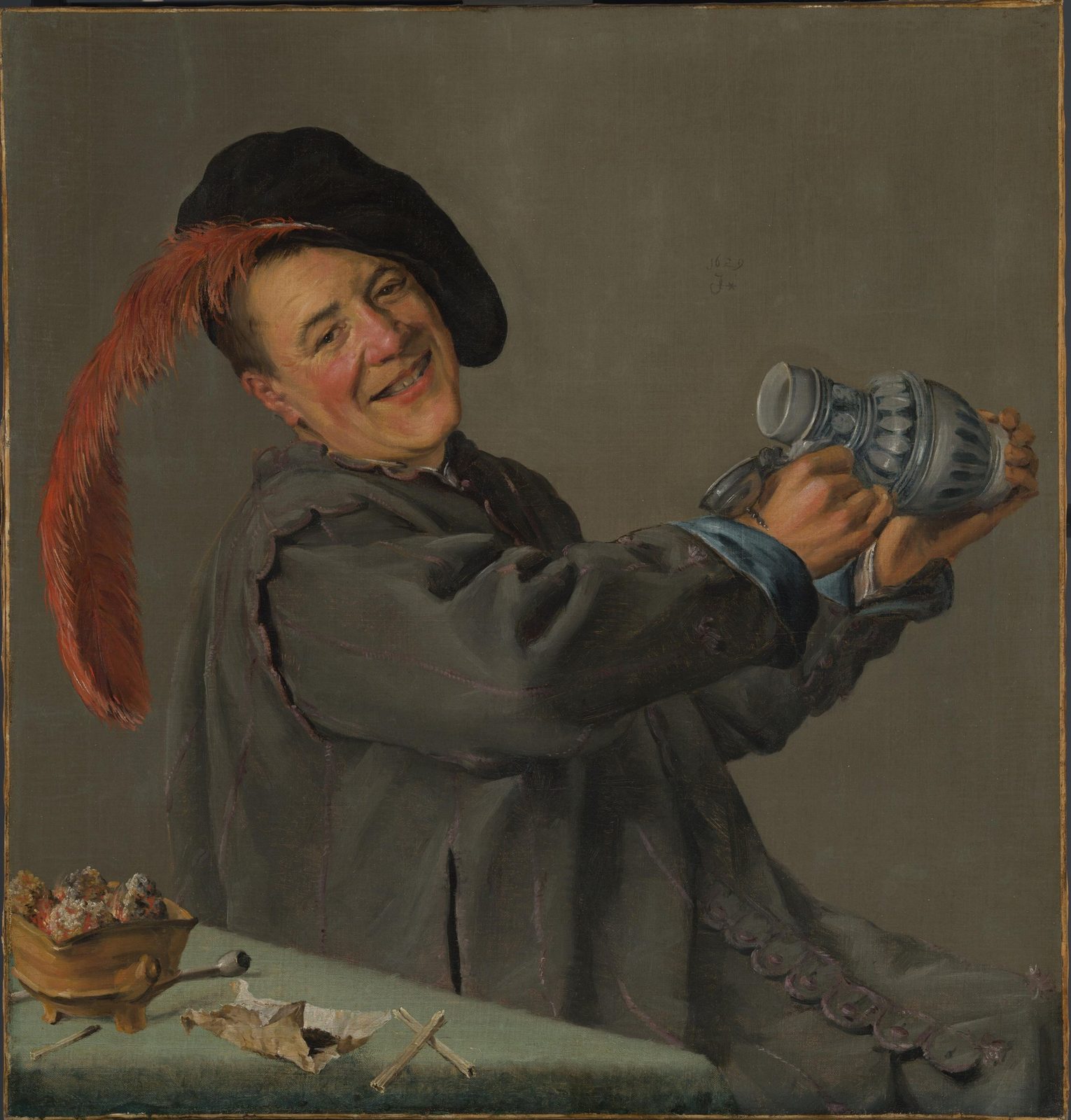
- Artist
- Judith Leyster
- Title
- The Jolly Drinker
- Date
- 1629
- Medium
- oil on canvas
- Museum
- Rijksmuseum
- Image
- Public domain (CC0)
Open in Simple Art
Watch this story on iPhone and iPad, with offline downloads and a painting every day.
About 4 minutes of looking, in 9 parts.
A laugh and an empty jug
A man laughs out at us, his cheeks flushed, holding up a grey-blue stoneware jug. A red feather spills down from his black hat. The museum describes him showing off that the jug is empty, so the drinking, it seems, is already done.
Judith Leyster, Haarlem, 1629
This is The Jolly Drinker by Judith Leyster, painted in oil on canvas in 1629. The Rijksmuseum calls her Haarlem's only female master painter. Because her style is close to that of her fellow townsman Frans Hals, the picture was long given to him. Her monogram, JL with a star, was only found in 1893, above the jug on the right.
Curves that meet at the face
Now follow the big shapes. The plume sweeps down the left edge, the dark coat runs off to the lower right, and his arms carry you across to the jug. The laughing face sits near the upper left, roughly where those movements meet.
Thick paint where the light lands
Come in close to the face. The light arrives from the upper left, and where it lands, on the bridge of the nose and the top of the cheek, the coral-pink paint looks thick enough to stand up from the surface. These marks are left slightly broken rather than smoothed. Around them the hat and collar are painted thinner, so the face comes forward.
A feather in long strokes
Drop to the red plume. It seems to be built in layers: deep maroon in the hollows, a middle red for the body, and bright orange pulled along the fibres that face the light. Each mark follows the curve in one movement, and the ragged outer edge looks like the brush skipping.
Dabs of fire in the fire pot
Down at the lower left, a small footed fire pot sits on a green table, with a long pipe stretching to the right. The embers are clustered dabs of orange, brick red and chalky white over an almost black base. It is the same warm family of colour you saw in the feather and the face.
Where the coat disappears
Now look at his shoulder, where the dark coat meets the background. The two are so close in tone that the edge simply dissolves in places. A slightly lighter, purplish stroke picks out only the folds that turn towards us. Elsewhere you read the form from small shifts inside the dark green.
Knuckles in a few touches
Travel out along his arm to the hand gripping the jug. The knuckles are just small dabs of a lighter, pinker flesh tone sitting on the ridges. Where the thumb overlaps the jug, warm flesh is pressed into the cool grey without a hard line.
One white stroke on the rim
On the jug itself, a single thick stroke of white curves around the rim. It is probably the brightest note in the whole picture, set against the cool, ribbed grey-blue body. One confident mark gives you both the shape of the opening and the direction of the light.
Look closer
7 details, each checked against a close-up of the picture.
-
Laughing Face
The highlight on the nose and cheek consists of thick, bright white-pink impasto strokes.
The crop isolates a laughing man's face tilted up into light from the upper left, with a wide-open mouth and crinkled eyes. Thick, warm coral-pink impasto runs down the bridge and bulb of the nose and clumps along the upper cheekbone, where the paint reads as physically raised against the cooler mid-tones. The highlight edges are softened into the warm flesh rather than left crisp, with smaller broken flecks of lighter pink pulled forward on the cheek. The shadowed side under the hat brim drops into warm umber-browns, while loose, broad greenish strokes suggest a ruff or coat collar at the bottom edge.
-
Red Plume
The red feather is composed of long, dragged, linear strokes that vary in saturation from deep red to orange.
The crop isolates a single large red plume set against a flat, thinly painted olive-gray background. Long, dragged linear strokes follow the curve of the feather from upper right downward and back up, with individual barbs suggested by short flicks and skips along the outer edge. Saturation shifts from deep maroon in the recessed core to vivid orange and pale yellow-orange along the raised fibers on the upper-left facing side, where the light catches. A small dark patch at the upper right marks where the plume enters a black hat, and subtle vertical drag marks are visible in the background at the right edge.
-
Stoneware Jug Rim
A crisp, bright white highlight defines the upper edge of the jug's rim.
The crop centers on the open mouth of a blue-gray stoneware jug, with two hands gripping its lobed body. A thick, opaque white brushstroke traces the upper edge of the rim, curving around the oval opening; it reads as the most brilliant note in the image, set against cooler gray-blue tones below it and a muted olive-gray field. The hands are modeled from the same upper-left light, showing warm rose and sienna flesh with cooler reflected tones in the recesses between the knuckles. The jug's body has alternating ribs of darker blue-gray and lighter glazed highlights, suggesting a turned, ridged surface.
-
Brazier and Embers
The embers are rendered as small, distinct dabs of orange and white paint atop a dark base.
A footed copper-toned brazier sits on a muted green table surface, its interior filled with embers built up from clustered dabs of cadmium-orange, brick-red, and chalky white over a near-black base. The brazier's rim catches a warm ochre highlight on the upper left, while its belly falls into a deep umber shadow on the right, with three small paw-like feet anchoring it. A long pipe stem extends horizontally to the right, terminating in a small bowl, and a pale shell-like form occupies the lower right corner. Surface craquelure threads diagonally across the brazier, confirming the aged oil-paint ground beneath the loose, gestural marks.
-
Grip on Jug
The knuckles of the right hand are highlighted with small, dabbed strokes of a lighter flesh tone.
The crop centers on a right hand gripping a blue-gray stoneware jug, with the thumb hooked over the belly and the fingers curling out of view to the right. Small, dabbed strokes of a lighter, slightly pinker flesh tone sit on the upper ridges of the knuckles, reading as the highest lights on the hand. The cuff of a dark coat with a blue-gray lining frames the lower left, its inner edge softly blended into the wrist rather than meeting it with a hard line. The contour where the thumb overlaps the jug is broken and softened, with warm flesh notes pressed into the cool gray of the stoneware. Fine craquelure runs across the entire surface, and the background is a flat, muted olive-gray.
-
Coat Collar and Shoulder
The edge of the dark coat blends softly into the olive-brown background without a hard outline.
The crop captures the sitter's coat collar and shoulder rendered with loose, loaded brushwork in a dark olive-green mass. A sinuous, reddish-purple contour snakes along the lapel, defining the silhouette where the coat turns forward, but this edge is broken and intermittently lost against the olive-brown background of similar value. The paint application is wet and gestural, with bristle marks visible especially along the shoulder ridge. At the upper right corner, a flicker of saturated orange and pale flesh-tone (the underside of the hat brim and red feather) sets up a strong warm-cool contrast against the muted greens below.
-
Coat Buttons/Trim
The buttons along the lower right of the coat are suggested by rounded, slightly lighter gray-brown strokes.
A diagonal band of pinkish-mauve decorative trim runs from upper left to lower right across a dark olive-gray coat, painted with curling, loop-like forms that suggest braided or scroll-patterned braid. The trim shows tonal variation, with lighter rose-pink highlights and deeper purplish-gray shadows giving a suggestion of relief against the dark ground. In the lower right area, beneath the looping trim, a few small, rounded, slightly lighter gray-brown dabs appear to mark button positions on the coat's edge. The surrounding coat is a flat, dark olive-gray with thin, scumbled brushwork where the weave and aged surface show through, and a small patch of lighter green cloth appears at the lower left.
The Jolly Drinker in context
A fool from the Haarlem stage
The Rijksmuseum also catalogues this picture as 'A Fool Holding a Jug, known as The Jolly Drinker' [1]. In the museum's 2022 catalogue entry, Jonathan Bikker says Leyster probably took the single-figure format indirectly from the Utrecht Caravaggisti by way of Frans Hals, and cites Gerard van Honthorst's Merry Violinist of 1623 as an example of the outlandishly dressed tippler [1]. Her closest model, he argues, was more likely a picture by Hals of around 1628-29 identified as Monsieur Pekelharing, a stock character in contemporary farces [1].
Pekelharing means 'pickled herring', a food that causes unquenchable thirst [1]. Bikker notes that the baggy grey coat with violet piping, tassels and large buttons differs from the red costume of Hals's figure, but that both would have been recognised as fool's dress [1].
Smoke, drink and vanity
Unlike Hals's Pekelharing, Leyster's drinker is also a smoker, with a Gouda pipe and tobacco beside him [1]. Smoking gear first appears in Haarlem still lifes by Pieter Claesz and Floris van Schooten in the 1620s, and Bikker reads the table set parallel to the picture plane, with two wood chips jutting over its edge, as a sign that Leyster knew this new development [1].
Doctors and moralists of the time treated smoking and drinking as almost interchangeable vices, both linked to vanity [1]. Petrus Scriverius's 1628 Latin poem on tobacco, translated into Dutch in 1630, had a title page showing a skull with Gouda pipes in its mouth [1]. The beret with its long red ostrich feather may derive from Hals's Young Man Holding a Skull of around 1626-28, and Bikker suggests Leyster may have valued it partly for that association with vanity [1].
Built from the back forward
The canvas is twice the size of Leyster's other dated painting of 1629, The Serenade, and has been assumed to be her largest picture, although her surviving work suggests she preferred wooden panels [1]. Technical study shows the composition was built from the back to the front, with the face and hands laid over a warm flesh-coloured undermodelling and the coat painted in open zigzag strokes of grey [1]. The table, the ember pot and the jug were all first planned smaller, and the figure's left hand was changed in shape and position [1]. The museum rates the condition as fair, with extensive abrasion in the thinly painted shadows, costume and tablecloth [1].
Out of Hals's shadow
Leyster was baptised in Haarlem on 28 July 1609, the daughter of a silk weaver who named his house 'De Leystar', or the Lodestar, and later took that name himself [1]. Joining the Guild of St Luke in 1633, she married the painter Jan Miense Molenaer in 1636. She was buried in Heemstede on 10 February 1660, and only about 20 paintings by her are now accepted [1]. The National Museum of Women in the Arts says she painted most of her work between about 1629 and 1635, noting that her output fell sharply after her marriage [2].
When the picture was sold in Paris on 24 April 1890, it was catalogued as by J. Hals, a son of Frans. The entry also noted an earlier attribution to Jan Steen and a monogram read as Hals's [1]. The Rijksmuseum dates the recognition of her actual monogram, JL with a star, to 1893 [1]. That same year, according to the women's museum, a painting acquired by the Louvre was found to carry her monogram under a false Hals signature, a discovery that revived interest in her work [2]. In January 1897, the Rijksmuseum bought the canvas from the Paris dealer Franz Kleinberger for 4,500 guilders, and it has been on loan to the Frans Hals Museum in Haarlem since 1960 [1].
- Judith Leyster, The Jolly Drinker (SK-A-1685): object record and catalogue entry (Jonathan Bikker, 2022) . Rijksmuseum, Amsterdam
- Judith Leyster: artist profile . National Museum of Women in the Arts, Washington