Goya's Marquesa de Pontejos: Anchoring a Portrait in Landscape
A narrated walkthrough of how centered composition, cool tonal mass, and warm accents steer the eye
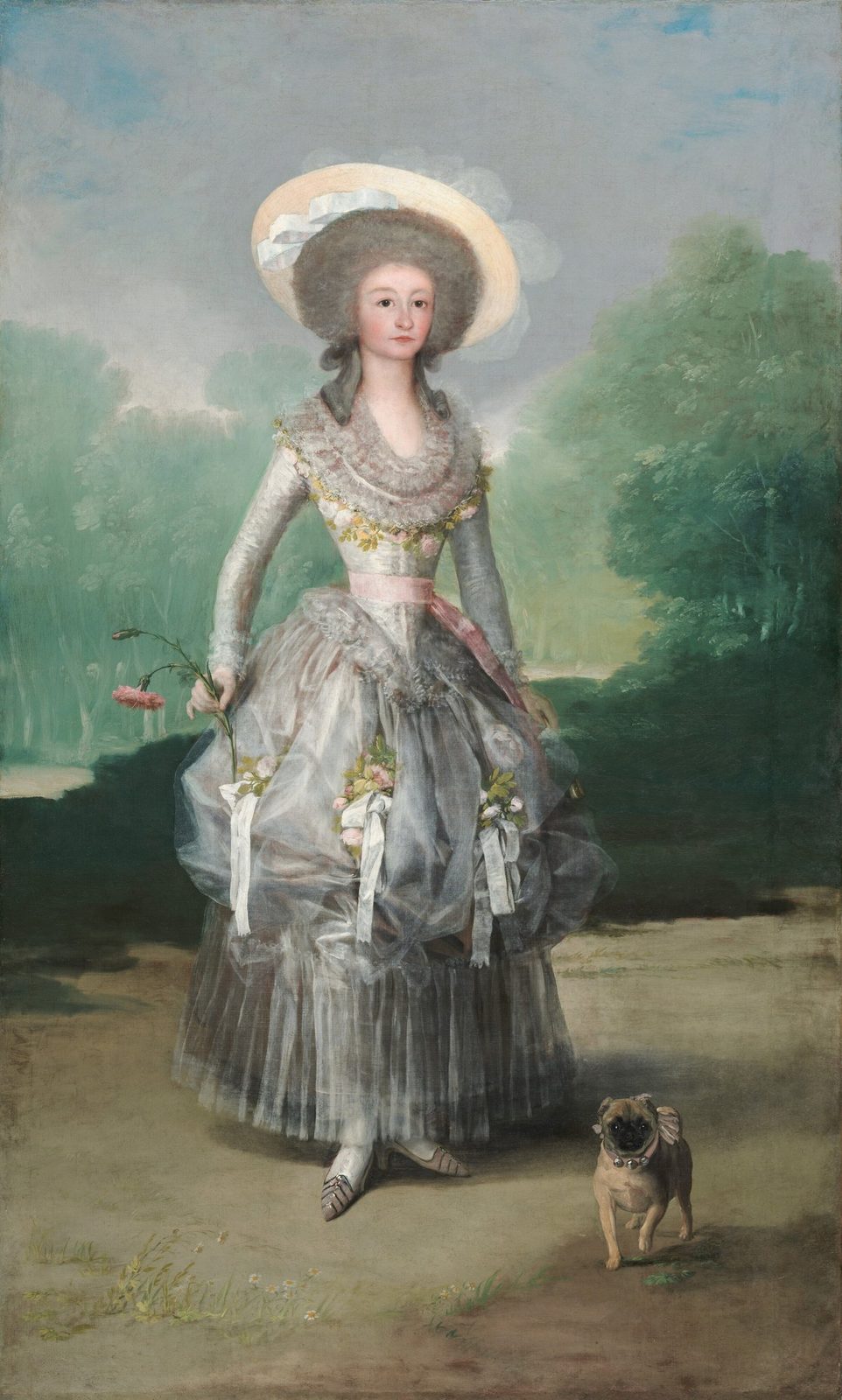
- Artist
- Francisco Goya
- Title
- The Marquesa de Pontejos
- Date
- c. 1786
- Medium
- oil on canvas
- Image
- Public domain (CC0)
Open in Simple Art
Watch this story on iPhone and iPad, with offline downloads and a painting every day.
About 5 minutes of looking, in 11 parts.
A figure centered in open landscape
Before you is a full-length portrait that feels less like a court formality and more like a quiet afternoon in a garden. A young woman stands centered against an open landscape, and almost everything in this canvas is working to direct your eye to her face.
Goya, c. 1786, oil on canvas
This is Francisco Goya's portrait of the Marquesa de Pontejos, painted around 1786, just before he became court painter to the Spanish crown. It belongs to a transitional moment when late Rococo elegance is already giving way to a more naturalistic openness.
A centered vertical triangle
Step back and look at the silhouette. Goya builds a centered, vertical pyramid: the wide hat, the triangular sweep of the gown, and the small pug offset to the lower right. Notice how the figure bisects the canvas almost perfectly, anchoring the entire composition.
Light from the upper left
Light enters softly from the upper left, filtered and gentle, not the hard theatrical spotlight of an earlier Baroque portrait. The brightest note in the entire picture is reserved for the cream ribbon on the hat brim — Goya uses it like a halo to frame the face.
Face beneath the brim
Drift in on the face. Light strikes the left forehead, the bridge of the nose, the left cheekbone, while the right eye socket and the right cheek recede into a cooler, slightly greenish half-shadow cast by the wide hat brim. That brim shadow is soft-edged, dragged down through the hair, and the flesh is re-established on top — a very controlled wet-into-wet blend.
Hat, ribbon, and straw
Pull up to the hat. The white satin ribbon is doing enormous work: its upper folds hold near-white warmth while the lower folds drop into cool blue-gray, and the eye mixes that single value step on the canvas. The straw beneath is scumbled dry over a warm ground — texture implied by soft tonal shifts rather than by linear marks.
Pink carnation, warm accent
Now follow the gaze downward to the right hand. A single dusty-rose carnation is held between thumb and forefinger, its slender green stem arcing in one confident gesture against the cool silver-gray dress. This is the first warm chromatic note below the face, and Goya places it exactly where your eye will travel next.
Silver-gray gown over warm ground
Continue down the gown. The silver-gray mass is not painted flat at all: long vertical scumbled strokes of cool gray are dragged over a warmer underpainting, and through that gauzy layer you can read three pink-and-white rose bouquets tied with white satin ribbons. Note how the bouquet accents are reserved — re-asserted with thicker, more opaque strokes — so depth is built from value and saturation rather than from hard edges.
Pug at the lower right
The eye reaches the lower right corner and finds the pug — a small, almost decorative counterweight to the towering figure above. Goya paints the face and the metallic collar bells last, reserving the highest-contrast catch-lights for the final dabs, while the soft tan body is blended wet-into-wet around them.
Foliage against the sky
Now look at the trees to the figure's right. Here the brushwork turns abstract: small dab-like strokes clustered into pom-pom foliage masses, a softer dissolved edge where leaves meet sky, deeper forest green pooling in the lower recesses. Compare that atmospheric looseness with the crisp contour of the figure's sleeve — that contrast is what pushes her forward in space.
Faint silhouette at left
Sweep back to the middle-left distance. Between two passages of sage foliage, a paler, slightly bluer vertical shape barely emerges from the surround — a human silhouette that Goya did not draw but allowed to remain as a lost-and-found edge. Its identity is unresolved in the image, and that ambiguity is the prompt: who is this distant figure, and what is the marquesa looking at?
Look closer
7 details, each checked against a close-up of the picture.
-
Face beneath the hat brim
The sitter's face is lit from the upper left, with the right cheek and eye socket falling into a soft shadow cast by the wide hat brim.
The crop shows a young woman's face framed by a wide, pale-straw hat brim and softly rendered silver-gray hair. Light enters from the upper left, striking the left forehead, the bridge of the nose, and the left cheekbone with warm pinkish highlights, while the right eye socket, right cheek, and the right side of the jaw recede into a cooler, slightly greenish-gray half-shadow. The shadow under the hat brim is soft-edged rather than crisp, with a gentle gradient from the dark mass of hair into the skin tone at the temples. Edges along the jawline and neck are feathered and lost, while the contour against the hat on the upper right is comparatively harder. Subtle craquelure runs across the surface, and the lips are built from a muted rose with a tiny cooler highlight on the lower lip.
-
Pug dog at lower right
A small pug with a black muzzle, pale brown body, and a dark collar featuring round metallic ornaments stands on the sandy ground looking forward.
The crop isolates a small pug in a vertical portrait orientation. The dog's head is rendered with a dark, almost black muzzle built from short, loaded brushstrokes that sit over a warmer underlayer, while the pale tan body uses broader, softer strokes with cooler grey-brown shadows along the underside and inner legs. A pinkish ribbon with loose, sketchy edges drapes over the crown and back, applied with quick directional marks rather than tight description. The dark collar carries three round metallic ornaments whose highlights are single dabs of pale grey-white over a dark base, reading convincingly as polished metal. A small pinkish-red blob on the lower chest reads as a loose scribble of paint rather than a finished form, and the background fades into atmospheric olive-brown with no sharp horizon. The ground plane is scumbled with greenish touches of vegetation and warm sand tones, and faint craquelure crosses the whole surface.
-
Pink flower in the right hand
A pink carnation with a slender green stem and narrow leaves is held between the thumb and forefinger of the right hand.
The crop shows a pink carnation with a deeply fringed, ruffled bloom head rendered in dusty rose tones, attached to a slender curving green stem with two narrow leaves and a small closed bud at the top. The flower is gripped delicately between thumb and forefinger of a softly modeled hand painted in warm peach flesh tones. The stem arcs in a graceful curve from the hand down to the lower right where it meets a white ribbon detail on the silver-gray dress. The background is a loose, scumbled sage green landscape that pushes the crisp flower forward.
-
Hat ribbon and straw brim
A white satin ribbon tied in a bow rests on the straw brim, with its upper folds catching the brightest light in the upper half.
The crop reveals a wide straw hat brim in warm beige tones framing a white satin ribbon bow at upper left. The ribbon's upper folds hold the brightest value, near-white with cream warmth, while the lower folds recede into cool blue-gray shadows that contrast with the warm hat. The straw brim shows soft, blended transitions rather than crisp individual straws, suggesting a scumbled or dry-brushed technique. A network of fine craquelure runs across the entire surface, indicating aged oil paint. The hair beneath is rendered in cool dark browns with soft edges into the hat's interior shadow, and the right edge of the face barely enters the lower right corner with warm flesh tones against a muted blue-gray ground.
-
Translucent overskirt and floral ribbons
The gray overskirt is rendered with loose, semi-transparent vertical strokes through which three ribbon-tied floral bouquets are visible.
The crop isolates the mid-to-lower skirt of the gown, where three bouquets of pink and white roses with green foliage are tied with white satin ribbons, all visible through a gauzy silver-gray overskirt. Vertical, scumbled brushstrokes define the overskirt's folds, with the dark underskirt and warm flesh-toned petticoat reading clearly through the semi-opaque gray layer. The white ribbons are painted with thicker, more opaque highlights along their crests, while the bouquet flowers sit in sharper focus where the overlying fabric lifts away. Soft, dry edges along the vertical seams suggest the upper layer was laid on thinly, allowing the warm brown ground to influence the cooler gray passages.
-
Right-hand foliage
The background trees on the right are built from dabbing strokes of sage and deep green with soft, dissolved edges where they meet the sky.
The crop isolates a tall mass of foliage on the right side of the landscape, set against a pale blue-grey sky to the left. The leaves are built from small, dab-like strokes that cluster into rounded pom-pom forms, with brighter sage and yellow-green dabs sitting on top of a darker teal-green underlayer. The left edge of the foliage dissolves softly into the open sky through scumbled, hazy brushwork, while the right edge and lower portion darken into deep forest greens where shadow accumulates. Vertical streaks of slightly lighter green suggest thin trunks or branches glimpsed between the foliage masses, and the whole area shows fine age crackling across the paint surface.
-
Faint background tree trunks
Pale, vertical tree trunks stand in the left-middle distance between two darker green passages of foliage.
The crop is dominated by a low-chroma sage and olive green field built from soft, scumbled passages of paint, with a few lighter sky-toned openings near the top. A faint vertical lighter form sits left of center, its edges blurred into the surrounding foliage and it is simply another pale tree trunk, slightly paler than those around it. The carnation on the right provides the strongest local contrast: a saturated salmon-pink bloom with a darker rose throat, supported by a sharply defined olive-green stem and an unopened bud. Below the horizon line, values darken to a deep forest green, and a sliver of the figure's silver-gray sleeve enters at the lower right corner.
The Marquesa de Pontejos in context
A bride from a wealthy house
María Ana de Pontejos y Sandoval was born on 11 September 1762, the only child of a very wealthy family with houses in Madrid, Cádiz, Santander and Torrejón de Ardoz [2]. She married Francisco de Moñino y Redondo in 1786. He was the Spanish ambassador to Portugal and brother of the Count of Floridablanca, the king's first minister from 1777 to 1792 [2]. The Gallery thinks Goya probably painted her for this first marriage. They find that date consistent with her age, costume and his style [1][2]. She only became the fourth Marquesa de Pontejos when her father died in 1807, so the title in the picture's name came later [2].
Her life after the portrait was eventful. She married three times. With her third husband, the liberal Joaquín Pérez Vizcaíno, she had to flee Spain in 1822 and only returned in 1833 [2]. She died on 18 July 1834 [2].
Goya in the 1780s
Goya came to court through his brother-in-law Francisco Bayeu, who found him work designing cartoons for woven hangings at the royal factory [2]. The Gallery's catalogue counts sixty-three cartoons by 1792. Wikipedia gives a lower figure for his first five years, so the totals depend on the period counted [2][3]. He was elected to the Real Academia de San Fernando in 1780 and became its deputy director in 1785 [2].
His first important portrait commissions came in 1783, from Floridablanca and from the Infante Don Luis, and his circle of patrons soon grew to include the Duke and Duchess of Osuna [2][3]. In 1786 Charles III made him painter to the king [2][3]. A portrait of Floridablanca's new sister-in-law fits squarely into this network of patrons [1][2].
French dress, Spanish bearing
The catalogue notes that Spanish noblewomen liked French fashion but usually wore it only on their private estates, because many Spaniards thought foreign styles unpatriotic [2]. The very narrow waist has been read as satire, but the catalogue links it to the heavy corseting of the time [2]. It also suggests that the roses and the carnation allude to the marriage [2].
Writers have often cited Gainsborough, Reynolds, Boucher and Fragonard. But the catalogue finds no specific borrowing and thinks Goya probably knew Gainsborough only through prints [2]. Instead, it sees Velázquez in her erect posture and aloof gaze. The text argues that this mix of French costume and Spanish pose mirrors Floridablanca's circle, which tried to reconcile French ideas with Spanish tradition [2].
Second thoughts in the paint
The Gallery's technical notes record a red ground showing where the paint is thin or worn. They also note contour changes at the left side of the waist and at the hem, and a shift in the position of the feet [1]. The canvas was lined and put on a new stretcher in 1968 [1]. Early in the twentieth century Aureliano de Beruete saw another version with a Madrid dealer, but it hasn't been traced since [2].
From the family to Mellon
The portrait stayed with the sitter's heirs, passing through her third husband to the Marqueses de Miraflores [1][2]. It was lent to a Goya exhibition in Madrid, which the Gallery's web page dates to 1900 and its printed catalogue to 1910, and to the Prado's Goya exhibition of 1928 [1][2]. In July 1931 it was sold through Mrs Walter Schoellkopf and M. Knoedler and Co. to Andrew W. Mellon, and it entered the National Gallery of Art with his gift in 1937 [1].
- Francisco Goya, The Marquesa de Pontejos (1937.1.85): overview, provenance, exhibition history, technical summary and bibliography (Internet Archive copy, 21 April 2025) . National Gallery of Art, Washington
- Jonathan Brown and Richard G. Mann, Spanish Paintings of the Fifteenth through Nineteenth Centuries (Systematic Catalogue, 1990): Goya biography and entry 1937.1.85 (Internet Archive copy of the PDF) . National Gallery of Art, Washington
- Francisco Goya . Wikipedia