Constructing Stillness: Cézanne's The Plate of Apples
A narrated, camera-driven walkthrough of Paul Cézanne's c. 1877 oil on canvas, aimed at painting students
- Artist
- Paul Cezanne
- Title
- The Plate of Apples
- Date
- c. 1877
- Medium
- Oil on canvas
- Museum
- Art Institute of Chicago
- Image
- Public domain (CC0)
Open in Simple Art
Watch this story on iPhone and iPad, with offline downloads and a painting every day.
About 5 minutes of looking, in 11 parts.
A still life that won't sit still
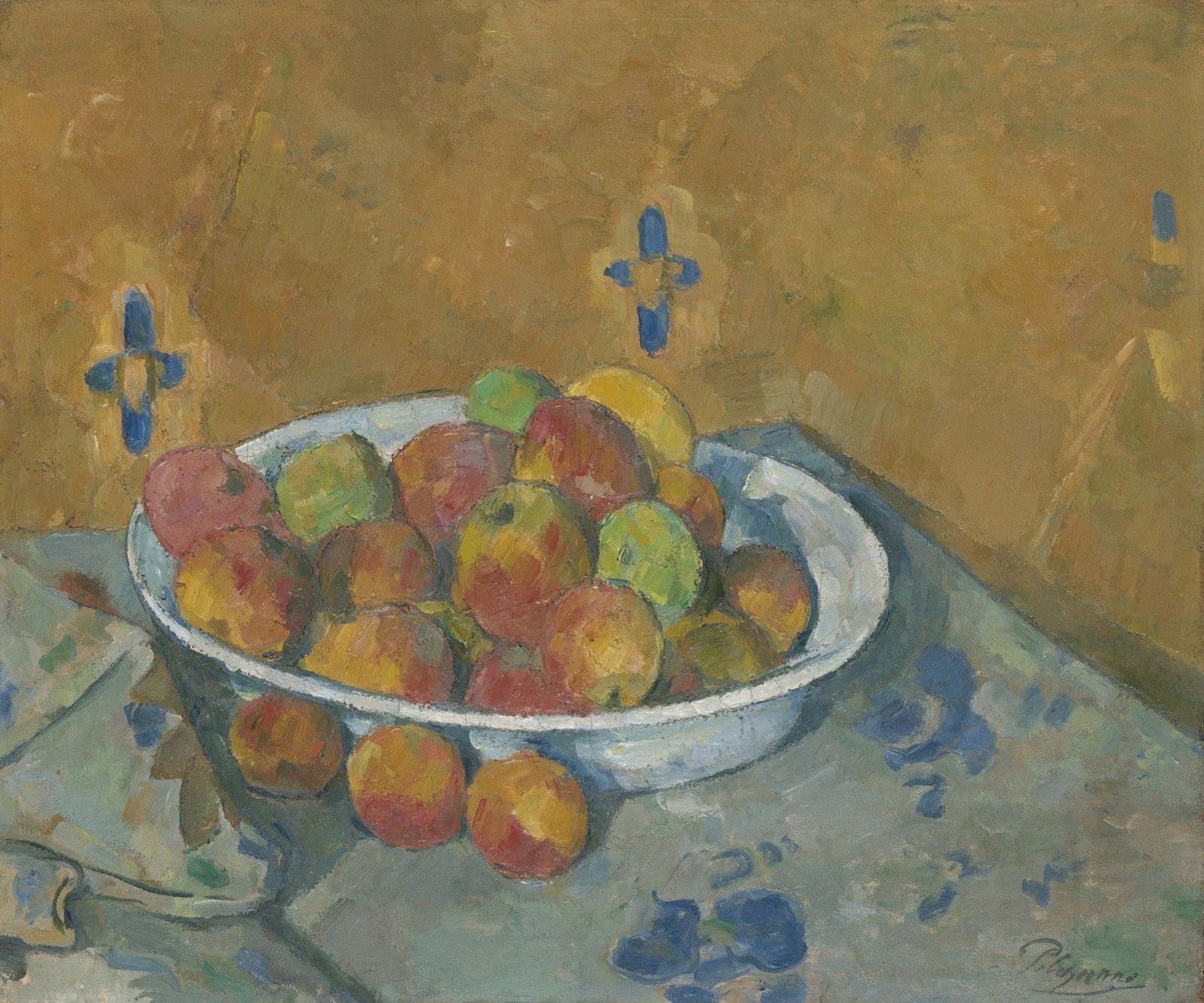
Before you is The Plate of Apples, a small oil on canvas by Paul Cézanne. A shallow white-rimmed bowl piled with fruit tilts toward us on a draped, blue-patterned cloth, with three loose apples scattered in front. Cézanne doesn't paint a bowl of fruit so much as construct one, plane by plane, with patches of color.
Cézanne, c. 1877
The work sits inside the loose window of Cézanne's early still-life practice, between 1872 and 1882, when he was developing the constructive brushwork that would feed Post-Impressionism. The catalogue marks it as oil on canvas, French, still life. No exact date is legible on the surface itself, so what we're looking at is a sensibility more than a snapshot.
A tilted plate, a diagonal cloth
Look at how the composition is built: a centered elliptical bowl anchors the picture, the table edge recedes along a diagonal, and the bowl's rim runs a strong horizontal across the middle. The eye enters at the loose apples in the lower left, climbs into the central apple mound, sweeps right along the far rim, then drops to the lower right.
Diffuse light, warm against cool
The light is diffuse and slightly from the upper left; you can feel it in the brighter highlights on the left shoulders of the apples and the left arc of the bowl rim. There are no hard cast shadows. Instead, Cézanne pushes the warm ochre wall back and the cool blue cloth forward, while the apples carry the warmest reds and yellows of the whole canvas at center.
Where the eye enters
Now drop to the lower left, where the eye lands first. Three foreground apples sit on a draped cloth. The orange-red of each apple is set directly against the cool blue-grey around it, and neither side is muted by neutral mixing at the boundary. That's complementary contrast doing real spatial work, not an outline.
The mound, plane by plane
Climb into the central apple mound. The volume here is built from distinct, angled patches of red, yellow, and green paint sitting side by side. Edges between adjacent apples are defined less by outline than by abrupt shifts in color temperature and value. Even the whites of the bowl rim aren't a single tone; they're a patchwork of cool blue-grey, warm cream, and pale yellow.
One apple, four hues
Pull in close on a single apple and count the colors. There are at least four distinct hues: warm yellow on the upper-left shoulder, crimson red in the central mass, a brighter orange where the two meet, and an olive-green along the right flank and lower edge. The marks follow the fruit's volume, not its contour, and roundness comes from how these planes meet, not from gradients.
Highlight on the left, falloff to the right
Sweep right along the bowl's far rim. The brightest white highlights are concentrated on the left side, a short, thick stroke cluster. As the rim curves down and to the right, those whites thin and warm into cream. Light isn't a constant painted along the arc; it's a falloff, and copying the same bright white all the way around would flatten the shape.
A shadow that isn't drawn
Now look at where the bowl meets the cloth. The bottom edge of the bowl is defined by a darker blue shadow band, not by a drawn line. That shadow was brushed in wet-into-wet, with the darker blue bleeding softly into the paler cloth tones, while a thin, hard contour of dark blue-green runs along the lower edge of the white rim to do the contour work for you.
An active, painted field
Behind the bowl, the ochre wall is not a flat backdrop. It consists of broad, visible vertical and diagonal brushstrokes that shift in value from a pale yellow-ochre to a warmer, slightly redder brown. The so-called empty space is treated with the same active painting as the subject, and that surface vibration is part of why the bowl feels set into its world rather than pasted onto it.
P. Cézanne, lower right
The eye path drops to the signature, 'P. Cézanne,' written in dark, cursive script in the bottom right corner against a muted green ground. The letterforms are fluid and confident, with the descender of the P looping beneath the baseline before sweeping right into the surname. Feathering at the edges suggests the ground was still workable when he signed.
Look closer
7 details, each checked against a close-up of the picture.
-
Central apple mound
The volume of the apples is built from distinct, angled patches of red, yellow, and green paint.
The crop centers on a pile of apples heaped in a shallow white-rimmed bowl, with the fruit forming a low mound that crests near the upper middle and spills toward the lower left. Each apple is built from clearly separate, wedge-shaped patches of pigment: ochre and yellow on the upper-left lit shoulders, brick-red and crimson on the mid-bodies, and yellow-green to olive on the shadowed sides and undersides. Edges between adjacent apples are defined less by outline than by abrupt shifts in color temperature and value, and a fine craquelure web runs across the whole surface. The whites of the bowl rim are not a single tone but a patchwork of cool blue-grey, warm cream, and pale yellow strokes that wrap the curve.
-
Individual apple modeling
A single apple contains at least four distinct hues (red, yellow, green, and orange).
The crop isolates a single apple modeled with short, slightly arched brushstrokes that follow the fruit's volume rather than its contour. Four distinct hues sit side by side on its surface: warm yellow on the upper-left shoulder, a crimson-red in the central mass, a brighter orange where the two meet, and an olive-green along the right flank and lower edge. Edges between these zones are not smoothed but constructed from adjacent, overlapping strokes, so the transitions read as a patchwork of facets rather than a gradient. The lighter, warmer notes cluster on the upper-left while cooler greens and deeper reds gather on the shadowed right and bottom, giving the form its volume.
-
Complementary contrast on cloth
Bright blue-grey strokes of the cloth contrast with the warm ochre tones of the apples resting on it.
The crop shows three foreground apples sitting on a draped cloth, with portions of additional apples visible in a white-rimmed bowl at the top edge. The apples are built from warm ochre, cadmium yellow, and brick-red strokes, while the cloth reads in cool blue-grey, pale teal, and broken white. Complementary contrast is strong: the orange-red of each apple is set directly against the surrounding blue-grey, and neither side is muted by neutral mixing at the boundary. Edges where apple meets cloth are softened by adjacent strokes rather than outlined, with the apple's color running slightly into the cloth and vice versa. The cloth's own brushwork is diagonal and ribbon-like, suggesting a fold running from upper left to lower right.
-
Bowl and table intersection
The bottom edge of the bowl is defined by a darker blue shadow meeting the pale blue cloth.
The white-rrim of the bowl curves across the upper third of the crop, its lower edge meeting a band of darker blue-grey paint that reads as a cast shadow where the vessel rests on the cloth. Below this shadow band, the cloth is built from short, choppy strokes in pale powder-blue, slate, and cool white laid side by side rather than blended. Three apples interrupt the cloth, their warm orange and yellow planes contrasting with the cool ground. A thin, hard contour of dark blue-green runs along the lower edge of the white rim, separating the bowl from its shadow.
-
Bowl rim highlights
The brightest white highlights on the bowl rim run along its front lip, while the left arc stays cool blue-grey.
The crop shows the front lip of the bowl rim, where the brightest whites of the picture run as a band of thick, near-white strokes. Toward the left the rim turns away and cools into pale blue-grey, and below the lip the bowl's side drops into blue-grey shadow. To the right of the rim, chunky patches of yellow, ochre, orange and crimson read as piled apples, each patch a separate, unblended stroke. A single diagonal red-orange stroke crosses the upper area, and a greenish tone is visible at the far right edge, suggesting another apple or the tablecloth.
-
Background paint application
The ochre background consists of broad, visible vertical and diagonal brushstrokes.
The crop shows an ochre field built from overlapping brushstrokes that shift in value from a pale yellow-ochre to a warmer, slightly redder brown. Strokes run vertically through the center-left and tilt diagonally from upper-right to lower-left across the right half, with shorter, broken marks scumbled on top. A small cluster of dark, almost blackish dashes sits in the upper right, and a sliver of blue paint intrudes at the far left edge where the tablecloth begins. Edges between strokes are soft where wet-into-wet and crisper where a lighter stroke crosses over a darker one, giving the plane a vibrating surface rather than a flat wash.
-
Artist signature
The name 'Cézanne' is written in a dark, cursive script in the bottom right corner.
The crop centers on a cursive signature reading 'P. Cézanne' executed in dark, near-black paint against a muted green ground. The letterforms are fluid and confident, with the descender of the 'P' looping beneath the baseline before sweeping right into the surname. Surrounding the signature, the green field shows directional brushwork with lighter scumbled passages and small areas where the underlying canvas or lighter ground appears through. Edges of the letters vary: some are crisp where fresh paint met dry paint, while others feather slightly into the green, suggesting the signature was applied while the ground was still workable.
The Plate of Apples in context
Fifth floor, rue de l'Ouest
The blue lozenges on a dark yellow ground place this still life in a small fifth-floor apartment at 67 rue de l'Ouest in Montparnasse. Cezanne lived and worked there on and off from about August 1875 to March 1879 [2]. He rented it from a wine merchant named Laligand for 230 francs a year [2]. This same wallpaper appears in two portraits of Madame Cezanne, now in Stockholm and Boston, and in four other still lifes [2]. Some writers have confused it with a different lozenge paper, dark red on green, in a later apartment on the same street [2].
The pastry cook who collected
The painting's first known owner was Eugène Murer, born Eugène Meunier, a pastry cook, novelist and hotelier who collected Impressionist painting [2][3]. His dinners for the Impressionists, held in the restaurant beside his patisserie on the boulevard Voltaire, were at their height in 1877, and Cezanne was among the guests [2][3]. A visitor to Murer's hotel in Rouen in 1884 counted one Cezanne on the dining-room walls, and Murer's novel Pauline Lavinia of 1887 describes a collector's home where Cezanne's apples were on show [2]. Paul Alexis listed the still life itself as Plat de pommes when he described Murer's collection in Le cri du peuple on 21 October 1887 [2]. Murer later lived at Auvers, near Dr Gachet, and died there in 1906 [3].
A signature added later
Cezanne rarely signed his work. Paul Smith suggests he signed this one at Murer's request when Murer acquired it, as with other Cezannes in that collection [2]. When that happened isn't known. The catalogue's date of about 1877 rests partly on the signature and partly on a related sheet of drawings [2]. The signature went on once the paint was dry, but the catalogue isn't consistent about its colour: the essay calls it grey, the technical report dark blue [2]. A note adds that Rewald's catalogue raisonné, discussing the signature, mentions that doubts have been cast on its authenticity [2].
Apples as bodies
In a well-known essay of 1968, the art historian Meyer Schapiro argued that apples carried real meaning for Cezanne, drawing on their role in Latin love poetry as gifts of seduction [2]. Smith finds no overt symbolism here. He does note that the fruits behave a little like bodies, standing, leaning and facing one another [2]. He also rejects an older claim that Cezanne cut the sunken contours with a palette knife. Instead, he argues that most were formed by thick paint built up on either side, though he may have scored a few edges [2]. The technical report puts more weight on incision, finding that a pointed implement such as a brush handle was probably drawn through semi-dry paint around some apples and the rim of the plate [2].
Munich, Berlin, Chicago
After Murer the painting is next recorded with the Galerie Heinrich Thannhauser in Munich by 1916, then with F. Schoen in Berlin, Paul Cassirer in 1925 and J. K. Thannhauser in Lucerne in 1926 [1]. Paul Rosenberg sold it on 15 February 1930 to Walter S. Brewster of Chicago, and Kate L. Brewster bequeathed it to the Art Institute in 1949 [1]. Exhibition records show its date drifting, from about 1883 at the Brewsters' house in 1933 to about 1887 at Aix in 1953, and about 1874 in a 2005 exhibition on Cezanne and Pissarro [1][2].
- Paul Cezanne, The Plate of Apples, 1949.512: object record, provenance and exhibition history . Art Institute of Chicago (public API)
- Cat. 2, The Plate of Apples, c. 1877: entry by Paul Smith, technical report by Kim Muir with Giovanni Verri, in Cezanne Paintings and Watercolors at the Art Institute of Chicago (2026) . Art Institute of Chicago
- Eugène Murer . Wikipedia