Mostly calm, a few sparks of red
How Canaletto keeps a busy Paduan canal quiet, then wakes it up with a few small notes of colour
- Artist
- Canaletto
- Title
- The Porta Portello, Padua
- Date
- c. 1741/1742
- Medium
- oil on canvas
- Image
- Public domain (CC0)
Open in Simple Art
Watch this story on iPhone and iPad, with offline downloads and a painting every day.
About 4 minutes of looking, in 10 parts.
The Porta Portello, Padua
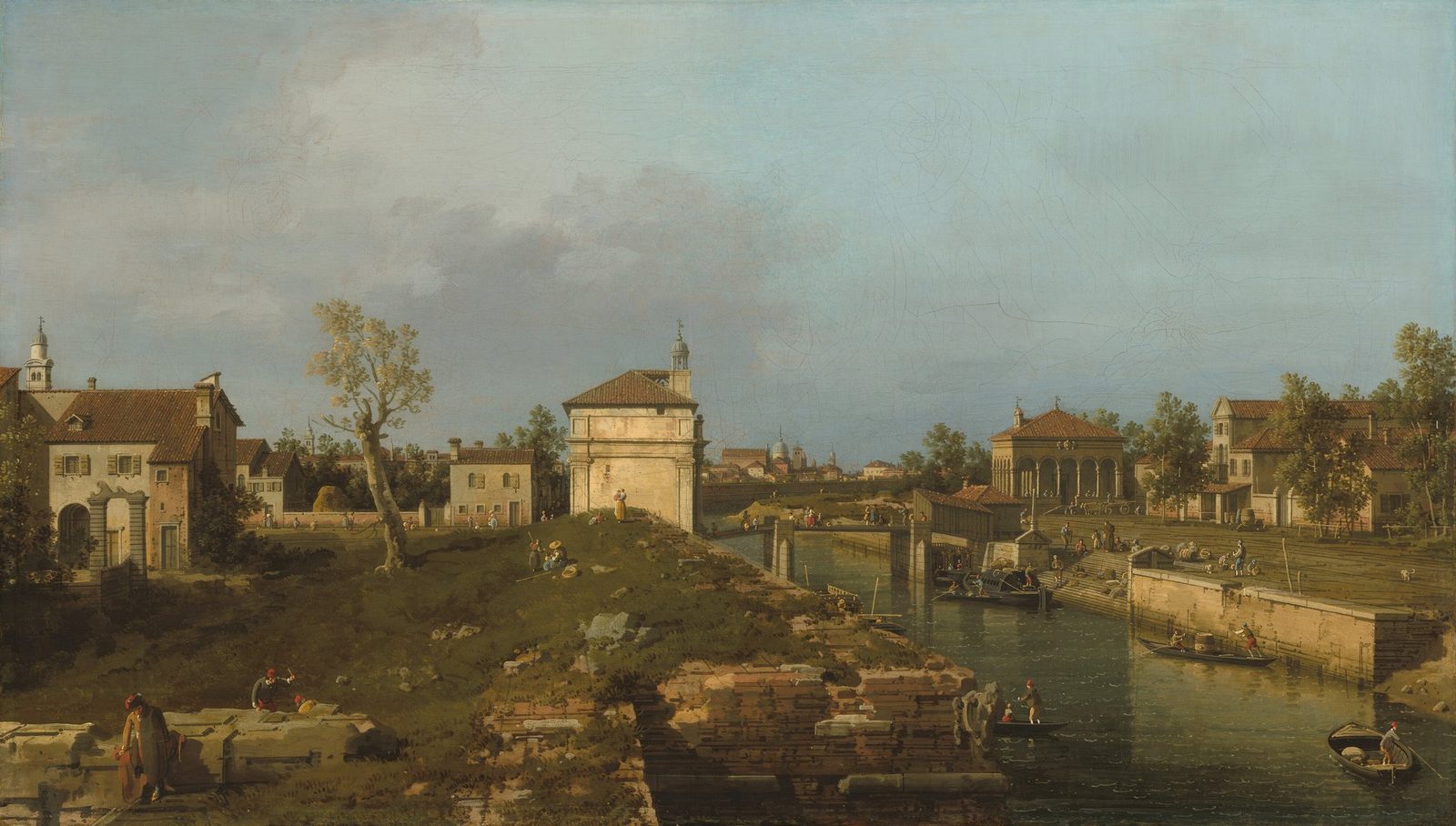
A canal runs across the bottom of this picture, edged with stone quays, boats and little figures. Behind it stand pale buildings, a tree and a bridge, under a soft grey sky. Nothing shouts. Notice how calm it feels.
Padua, about 1741 to 1742, oil on canvas
This is Canaletto's view of the Porta Portello in Padua, painted in oil on canvas around 1741 or 1742. Porta is the Italian for gate. It is a veduta, a carefully observed view of a real place, here a busy canal rather than a grand square.
Three bands and a diagonal
The picture is built in three bands: sky at the top, buildings across the middle, water below. A diagonal cuts through them, running from the stone quay at the lower left towards the bridge on the right, and your eye tends to travel along it.
Soft light on the water
The light is soft and even, as on a lightly overcast day, and nothing casts a hard shadow. Look at the water here. Pale grey, white and ochre strokes are dragged sideways across a dark green-brown, and their feathered edges suggest gentle ripples and reflections.
Figures on the quay
Down at the lower left, the quay is made of big stone slabs, painted with broad horizontal strokes. A figure in a red cap leans over the wall, handling something draped, perhaps a hide. Beyond him, another raises a stick. Each is only a handful of strokes.
A tree made of dabs
Now up to the tree in the middle. Its crown is not drawn leaf by leaf. It looks like a green mass with separate dabs of ochre and yellow on top, mostly on the side facing the light, and pale sky shows through the gaps.
The pale building
Beside the tree stands a pale building with a small cupola, and here the handling changes completely. The cornice and the courses of stone are thin, ruler-straight lines, and the cupola catches a soft highlight against the dark foliage behind. Crisp geometry for the building, loose touches all around it.
A band of shadow
Move right to the bridge. Its shadowed side and the arch beneath join into one continuous dark band that runs on into the lock. These are among the darkest notes in the picture, and they carry your eye across towards the right. Tiny figures stand out against the dark.
Small notes of red
Most of the colour is muted, cool sky and water against warm ochre stone and earth. Then come a few small, strong notes. Here a terracotta-red awning and a figure in rose pink are the brightest warm touches on this stretch of quay, and the eye goes straight to them.
Rowers in a few strokes
Finally, the boats at the lower right. One figure, with a red cap and a pale shirt, is perhaps six to eight strokes, gripping a pole that angles into the water. Another oarsman is a quick zigzag of leg, body and arm. Yet every pose is clear.
Look closer
10 details, each checked against a close-up of the picture.
-
Central pale gate and embankment
The pale gate block shows ruled architectural lines in its cornice and ashlar courses, and its small cupola catches a soft highlight against the darker foliage behind it.
The crop centers on a pale cream gate block with a terracotta-tiled pitched roof and a small lantern cupola. The cornice and ashlar courses are rendered as thin, ruler-straight darker lines incised into a warm beige ground, with crisp horizontal edges that read as drafted geometry rather than loose painterly strokes. The cupola sits against a patch of dark olive-green foliage, and a faint warm highlight is visible on its curved upper surface, while the right side fades into shadow. Below, the embankment shows broader, scumbled brushwork in ochre and umber with small figures applied as quick dots of red, white, and blue, their edges softened rather than drawn. The whole surface is overlaid by a network of fine craquelure visible against the sky and walls.
-
Left foreground palace archway
The archway and window shutters on the left building are drawn with razor-sharp edges and straight ruled lines that contrast with the loose tree beside them.
The archway shows two pilasters with fairly straight, drawn vertical edges framing a darker recess; the wall above is pale cream with fine craquelure and small dark dots (pock marks or nail holes) reading as crisp specks. The window shutters on the upper floor are rendered as flat rectangular planes with thin horizontal lines for louvers, their edges meeting the wall in clean, almost ruled breaks of value. Beside this, the foliage is built from short, broken dabs of olive, ochre, and dark green that smear into the building rather than sit on top of it, and the tree silhouette is bumpy and irregular. The contrast is therefore between the architectural geometry (clear verticals, square corners, parallel louver stripes) and the painterly vegetation (irregular clumps, no continuous contour).
-
Stone bridge and lock gates
The bridge's dark archways and the adjacent lock structure create a tonal threshold that leads the eye from the center toward the right-hand pavilion.
The crop centers on a horizontal stone bridge spanning the upper half, with small figures walking its deck including a prominent red-skirted figure at roughly (0.32, 0.27). Beneath the bridge runs a continuous band of deep olive-brown darksum that forms the bridge's shadow side and the recessed arch opening at left, meeting the lighter, slightly desaturated blue-green water below. To the right, a lock structure with vertical wooden boards and dark interior recesses contains tiny figures lit against shadow. The water occupies the lower two-thirds, broken by moored boats with warm tan and dark hull accents, and a gondola at lower right. The crackle pattern is visible across the entire surface, particularly conspicuous in the sky and lighter stone areas.
-
Central tree foliage
The tree's canopy is built from broken, separate strokes of ochre and green paint that read as dense foliage only when viewed from a distance.
The canopy is composed of numerous short, dabbed strokes of pigment laid over a mid-green ground rather than drawn with linear detail. The marks cluster more densely in the center and upper portions of the crown, leaving irregular gaps of pale blue-grey sky reading between them. Opaque touches of warm ochre and yellow sit on the sunward (upper-left) side of the foliage mass, while the lower-right of the crown carries cooler, darker olive-green notes. A fine network of age craquelure crosses both paint and ground, confirming these are distinct, slightly raised dabs rather than blended passages.
-
Foreground quay laborers
The lower-left quay shows weathered stone slabs and two small figures built from simple dark and red strokes that establish human scale.
The crop centers on a quay constructed of large, blocky stone slabs rendered with broad horizontal strokes in muted olive-grey and ochre. Two small figures appear in the lower center: one figure in dark clothing with a red cap stands handling a brownish draped form (perhaps a hide) over the wall, painted in just a handful of strokes. In the upper right, a second figure in a red cap raises a stick-like implement, with a smaller companion in yellow-ochre nearby. The stone joints read as quick dark hatch marks rather than precisely ruled lines, and the upper edges of the slabs catch a thin warm highlight against the deep olive-brown sky/foliage mass behind.
-
Canal water reflections
The canal water shows soft, diffuse reflections of the sky and buildings, with the lightest passages appearing as horizontal strokes of grey-green and white.
The water surface features a dark greenish-brown base interrupted by horizontal, broken brushstrokes of pale grey, white, and ochre simulating reflections. These short, overlapping strokes create feathered edges, suggesting gentle ripples. Darker vertical masses, such as the reflection of the bridge pier, integrate softly into the horizontal flow. On the lower right, a small figure in a red cap and yellow jacket is rendered with opaque dabs of color.
-
Boats and rowers lower right
The two boats at lower right contain figures rendered with only a few brushstrokes each, yet their seated postures and oars remain clearly readable.
The crop shows two principal boats on green-brown water under a warm yellow-ochre stone quay whose reflections bleed softly below. The lower-right boat holds a figure with a vivid red cap and pale shirt rendered in perhaps six to eight strokes, gripping a pole that angles into the water; a second crouching shape sits forward, defined by little more than a dark silhouette and a highlight on the back. A second boat in the upper third shows a standing oarsman in red breeches sketched as a vertical zig-zag of leg, torso, and arm against the lighter wall. Edges between hull and water are softened by short horizontal highlight dabs that double as ripples, while the figures' silhouettes are crisp against the warm stone. Craquelure runs through everything as a fine dark mesh, and the overall tonality is shifted amber by aged varnish.
-
Figures on the grass mound
Two tiny figures on the grass, one standing with a stick and one seated, are indicated by no more than four strokes of yellow, red, and dark paint.
The crop centers on a mossy grass mound at the foot of a pale rendered wall and a gnarled tree trunk at left. Two very small seated figures huddle against the trunk: one is a fleck of mustard yellow (a hat) above a smudge of brick red, the other a paired dab of red and dark earth. They read at this scale as two comma-like marks rather than resolved bodies. To their right, a standing woman in vermillion bodice and slate skirt is built from roughly eight strokes, and a seated group with a wide straw hat uses yellow ochre, indigo, and a thin line of white for the handkerchief. The mound itself is scumbled with olive and raw umber over a mid-green ground, with a darker shadow band running horizontally beneath the seated figures.
-
Warm accents by the loggia
Tiny red caps and terracotta roof tiles are the strongest warm notes on this stretch of quay, set against flat ochre and yellow-brown ground.
The crop captures the lower-left to mid-right band of the veduta, centered on the quay. An arcaded loggia fills the upper half, with an ox cart and small figures on its steps; tiny red and white touches pick out caps and shirts. Surrounding these warm accents the ground plane is rendered in flat ochre and yellow-brown washes, while the tree mass on the right is built from olive-green dabs with darker accents. The seated crouching figures along the waterline are blocked in with small dark strokes; their edges blend into the mid-value pavement. The dark arches against the pale columns create the strongest value jump in the crop.
-
Sky craquelure and scumbled paint
The upper sky displays a network of fine craquelure and thin, scumbled layers of blue-grey over warmer ground that produce atmospheric depth.
A predominantly pale blue-grey field, near-continuous across the crop, with an extensive web of fine, dark craquelure lines that curve and branch irregularly. Warmer, faintly peach-beige tones break through in the lower-left quadrant and as scattered patches, suggesting an underlying ground showing through thin, scumbled upper paint. Canvas weave is intermittently visible beneath the paint film, particularly in the smoother upper-right. Value range is very narrow: the differences between the cool dominant (~#A8BFB8) and the warmest undertone (~#BFA99B) are subtle, producing most of the perceived depth. The craquelure lines themselves read as the darkest marks, threading as both fine single strands and denser curved clusters in the upper-center.
The Porta Portello, Padua in context
A journey to the mainland
In 1740 or 1741 Canaletto left Venice for a tour along the Brenta canal, probably going no farther than Padua [2]. The museum's catalogue suggests the route ran from Fusina to Dolo and beyond, and that his patron and agent Joseph Smith may have encouraged the change of scene [2]. The timing matters: the War of the Austrian Succession, which broke out in 1741, cut the flow of foreign visitors to Venice, and English demand for his views fell considerably [2].
On the trip Canaletto made thirty or so drawings from nature, which fed later paintings, etchings and capriccios produced in his studio [2]. His nephew Bernardo Bellotto came along. Bellotto had been in his studio since about 1735 and was by then emerging as an independent artist [2].
Not the Brenta after all
The picture was long said to show a view on the Brenta, but the catalogue places the Porta Portello on the south bank of the Piovego, a waterway on the eastern edge of Padua that leads towards Venice [2]. The view looks northwest towards the city, whose skyline is dominated by the church and campanile of Santa Maria del Carmine and what may be the bell tower of Santa Giustina [2].
The pale building with the cupola at the centre is the gate itself [2]. Originally called the Porta Ognissanti, it was built in 1518-1519 in the style of a Roman triumphal arch to designs by Guglielmo Grigi, known as Il Bergamasco. It survives today as the Porta Venezia [2]. Guidebooks of the time praised it as the most ornate entrance to the city. Yet Canaletto chose its plain south side, giving only a glimpse of the columns on the main front [2]. The colonnaded building on the right has gone, and the bridge he painted was replaced in 1784 [2].
Drawings and liberties
A pen and ink drawing at Windsor looks like a sketch made on the spot, taken from closer in and from an imagined point above the canal [2]. Differences between drawing and painting, such as a bridge with three piers instead of two and a grassy slope in place of the paved square, lead the catalogue to conclude that Canaletto took liberties with the site, and that the canvas was probably painted from drawings back in his Venice studio [2]. He also made a highly finished drawing of the composition, now in the Albertina in Vienna, probably intended for a collector, and painted a second version that differs mainly in the figures and boats [2].
Rodolfo Pallucchini saw in the Brenta pictures a new calm and closeness to nature that anticipated Corot, and the catalogue notes that the soft light and palette of earth tones and greens look ahead to Canaletto's English period [2]. Technical study found a light grey ground, visible in small areas of the foreground, and a pink-brown ground under the sky that shows through the thin, quickly painted clouds [1]. The tiled roofs are textured with small drops of paint, the ripples and figures were added in liquid strokes over dry paint, and X-radiographs show that the left edge of the gate was moved slightly [1].
Canaletto or Bellotto?
Because uncle and nephew worked side by side in these years, the authorship of many early 1740s works has been disputed between them [2]. Francis F. Madan bought this canvas in 1943 as a Bellotto, and in 1948 K. T. Parker called it 'doubtless an early work of Bellotto' [1][2]. A Bellotto drawing in Darmstadt is nearly identical to the Windsor sheet, suggesting the two artists sketched the site together [2]. But the museum's catalogue judges the drawing of the architecture and the handling of the figures to be entirely typical of Canaletto, and treats the painting as his own work [2].
The recorded history begins with L. T. N. Gould in Suffolk, who sold it in 1943 to Colnaghi in London [1]. After Madan's sale at Christie's on 15 July 1955, where it was offered as Canaletto, it passed through H. Cevat and the dealer David M. Koetser to the Samuel H. Kress Foundation. The foundation acquired it on 11 March 1957 [1][3]. They gave it to the National Gallery of Art in 1961 [3]. David Bull cleaned and restored the painting in 1993, treating a loss about 15 centimetres square at the centre of the canvas [1].
- Canaletto, The Porta Portello, Padua (1961.9.53): object record, provenance, exhibition history and technical summary (Internet Archive copy, 13 March 2025) . National Gallery of Art, Washington
- Diane De Grazia and Eric Garberson, with Edgar Peters Bowron et al., Italian Paintings of the Seventeenth and Eighteenth Centuries (Systematic Catalogue, 1996), Canaletto biography and entry on 1961.9.53, pp. 22-34 . National Gallery of Art, Washington
- The Porta Portello, Padua [K2175]: Kress Collection Digital Archive record . National Gallery of Art, Washington