The Races — A Walkthrough
How Degas compressed sport, industry, and sky into one shallow horizontal band
- Artist
- Edgar Degas
- Title
- The Races
- Date
- 1871-1872
- Medium
- oil on wood
- Image
- Public domain (CC0)
Open in Simple Art
Watch this story on iPhone and iPad, with offline downloads and a painting every day.
About 4 minutes of looking, in 11 parts.
A racecourse pressed against a city
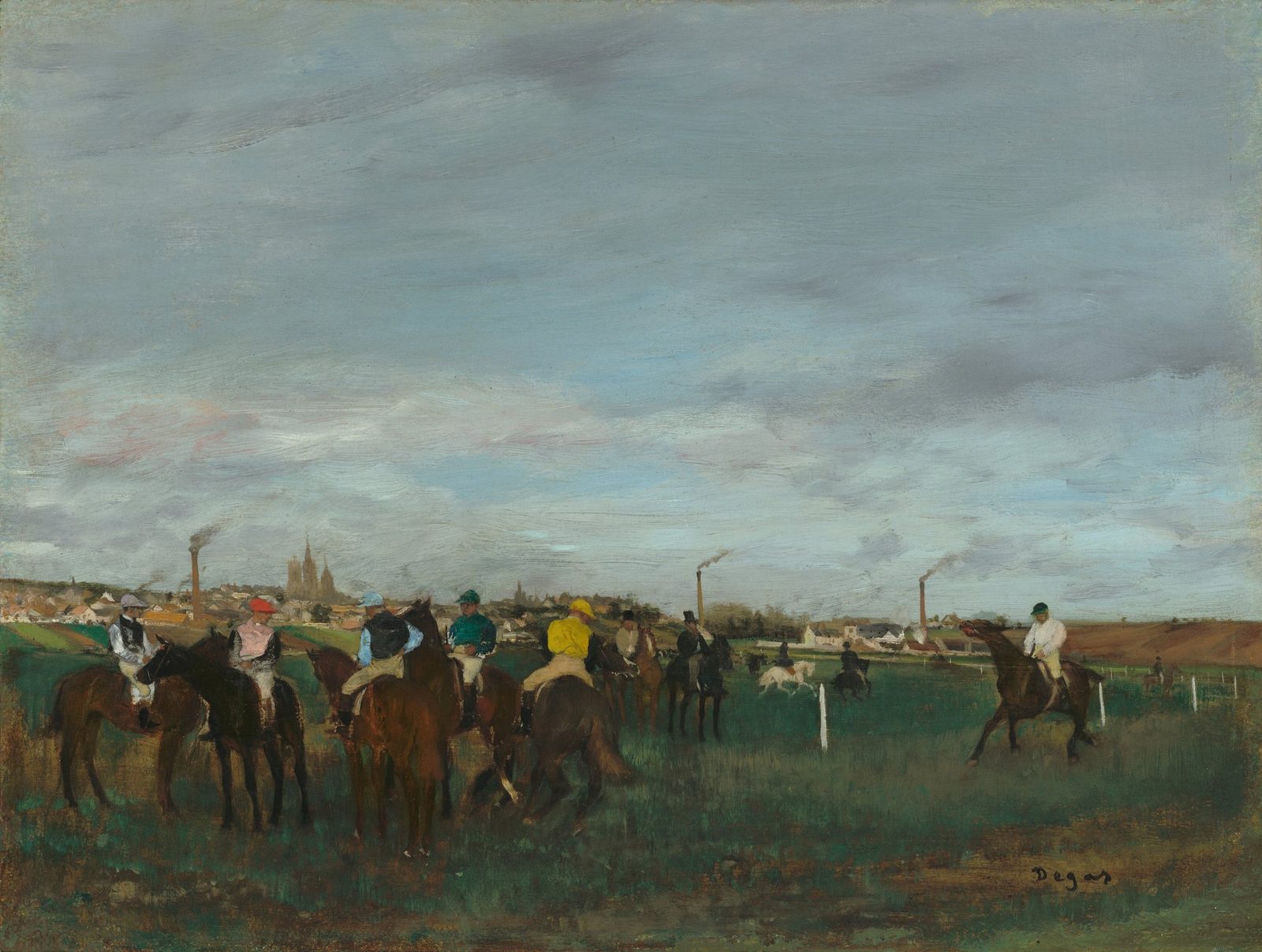
Before you, a wide sky collapses onto a thin line of smokestacks, and beneath that, a row of jockeys crowds the lower band of the canvas. Edgar Degas has compressed an entire afternoon of racing into a shallow strip — and the compression is the whole subject.
Degas, 1871-1872, oil on wood
This is The Races, painted between 1871 and 1872 in oil on a wood panel. It belongs to Degas's early Impressionist years, when he treated the racetrack like a stage set and sketched modern leisure with a deliberately casual hand.
Three stacked horizontals
The picture is built as three stacked bands: a broad sky, a thin horizon of rooftops and chimneys, and a dense foreground of horse-and-rider silhouettes. A simple horizon line ties them together, and most of the action lives in the lower third.
Flat overcast daylight
There are no cast shadows anywhere. The light is soft, cool, and top-down — a clouded-over afternoon at the track. That's why every jockey cap reads as a flat plane of color rather than a lit, modeled form.
Yellow as punctuation
Your eye lands first on this yellow cap and silk. Degas laid the ochre on thick and left it unblended against muted greens and browns — that's what makes it read as bright even under flat light. The edge against the dark horse is crisp; the edge against the olive field is softer and scumbled.
One dark silhouette
The cluster of horses isn't painted individually — it merges into one continuous umber mass. Individual animals are only hinted at by small value shifts on rumps and shoulders, while the riders' caps become a row of colored punctuation: pink, green, blue, red.
No drawn contour
Watch where the leftmost horse's rump meets the grass. There is no outline. Degas laid the dark body as one wet mass, then stroked the green up into and through the lower edge. The contour emerges from the meeting of two color passages, not from a drawn line.
The white-shirted counterweight
Now let your eye travel right across the empty field to this single rider. His white shirt is the brightest passage in the lower half, and his horse lifts a foreleg in a crisp diagonal against the green. He balances the heavy left-side cluster and keeps the composition from tipping.
A band of industry
Climb up to the horizon: a compressed skyline of Gothic spires and factory chimneys. Degas reduced the whole town to a few value shapes and dropped each vertical in a single confident stroke — a chimney on the left, a spire cluster near center, two more chimneys on the right.
Smoke as atmosphere
The plume from the central chimney dissolves because its strokes break into gaps, not because the values match the sky. The smoke is actually warmer in tone — ochre against cool grey-blue — and the silhouette fragments rather than softens.
Strokes that don't blend
The foreground grass is built from individual, unblended strokes of teal-green laid over a warm ochre imprimatura. Each bristle load sits beside the next; the lighter ground reads clearly through the gaps. No shadows, no glazing — rapid, side-by-side marks that let the support unify the field.
Look closer
9 details, each checked against a close-up of the picture.
-
Jockey cluster and yellow rider
The yellow-capped jockey anchors a dense group of riders whose dark horse bodies form a continuous silhouette against the green field.
The crop centers on a cluster of six to seven jockeys mounted on chestnut and bay horses, their bodies rendered in loose, broken strokes of oil that leave much of the underlying ground visible. The yellow cap of the rider at right is the most saturated local color, surrounded by cool blues, a teal jacket, pinks, and reds that read as flat planes rather than modeled forms. Horse bodies merge into a continuous dark mass, with edges of the chestnut flanks and haunches feathered into adjacent horses using shared umber tones. The green field below is built from short vertical and diagonal strokes of varied green, with the grass line dissolving into the horse legs rather than terminating crisply. Above, the town skyline is suggested with a few scattered dabs of pinkish roof tones and dark vertical spires against a pale, uniform grey-blue sky.
-
Yellow cap and silk
The jockey's yellow cap and shirt are painted with thick, saturated ochre-yellow strokes that sit unblended on top of adjacent muted greens and browns.
The crop centers on a jockey's back, where a saturated ochre-yellow cap and matching silk dominate roughly the upper-left half. The yellow paint is laid on thickly with visible directional strokes that follow the curve of the shoulders and the dome of the cap; small flecks of red-orange peek through the cap's crown and the nape of the neck. Edges between the yellow silk and the dark horse below are crisp and unblended, while the boundary against the muted olive-green background to the right is softer and broken by scumbled strokes. A small wedge of red pigment is visible at the throat, and a bright yellow stroke at the right elbow reads as a highlight catching diffuse overcast light. The yellow shapes sit as opaque islands of color, neither glazed into nor mixed with the surrounding browns and greens.
-
Isolated rider on right
A single rider in a white shirt and dark cap is isolated on the right, astride a horse with lifted forelegs, separated from the main group by an empty stretch of green field.
The crop isolates a single mounted rider centered on a dark bay horse with raised forelegs, standing in a muted green field. The rider's shirt is the brightest passage, built from thick, broken white impasto strokes that read against the dark mass of the horse below. The cap is a small, dense dark green-black accent placed precisely at the figure's top, and a tiny red fleck marks the horse's mouth/bit area. The horse is constructed through layered scumbles of dark brown and near-black, with the lifted foreleg forming a crisp diagonal against the green ground. Background architecture (chimneys, rooftops) appears at left, and a warmer brown slope rises at right; all background passages are kept softer and lower in contrast than the central figure.
-
Leftmost horse silhouette
The leftmost horse's rump and tail meet the grass in a blurred, unbroken transition without a drawn contour.
The leftmost horse reads as a single dark umber mass dominating the frame, with the jockey's white shirt and black vest capping the top. The horse's lower haunches and legs descend into a field of olive and yellow-green brushstrokes where the brown form literally breaks apart into the surrounding grass — no drawn outline closes the silhouette. The tail edge on the right is a ragged, vertical smear of dark paint that sits over the green rather than being delineated. A thin band of horizon with pink-roofed buildings and a turquoise field strip caps the top, painted in broad, flat planes that push the figure forward.
-
Horizon skyline
Church spires and smoking factory chimneys appear as small, dark vertical marks crowded into a thin horizontal band just above the field.
The crop is dominated by a wide, low-contrast sky of pale blue-grey, with a thin horizontal band of town silhouette pressed into the lower third. Vertical marks punctuate this band: a tall brown-grey factory chimney on the left with a diagonal smoke plume, a prominent Gothic-style church cluster of tapering spires slightly left of center, and two more chimneys on the right, each trailing thin grey smoke. The buildings themselves are reduced to short brown, ochre and rust dabs of roof and wall, with no architectural detail. At the very bottom edge, the tops of jockeys' heads intrude as quick ovals of red, green, yellow and grey-blue cap against the darker field line.
-
Foreground grass texture
The foreground grass shows individual, unblended strokes of green and brown with the lighter ground visible between them.
The foreground is built from discrete, mostly vertical-to-diagonal strokes of dark teal-green laid over a warmer, ochre-brown underlayer. Individual bristle loads sit side by side without softening into one another; the edges of each stroke remain crisp against its neighbors. The lighter ground reads clearly through the gaps and thinner passages, especially along the bottom edge and in scattered breaks across the middle band. A cluster of near-black, thicker strokes anchors the upper-left, while the right portion thins out so the brown ground dominates. No cast shadows are present, consistent with diffuse overcast light, and the overall key stays low and atmospheric.
-
Smoke dissolving into sky
The smoke from the central chimney is painted in pale grey with the same value as the adjacent sky, dissolving its outline.
A thin vertical chimney stack rises from below the frame, with a small dark notch at its top, against a pale sky brushed in cool grey-blue horizontal strokes. The smoke drifts up and to the right in warm tan/ochre strokes that are markedly warmer than the surrounding sky rather than matching its value. The plume reads as a series of broken, feathered marks that thin and scatter as they travel, with the sky visibly showing through the gaps rather than being softly blended over. Edges throughout are crisp and gestural, not blurred, and the dissolution effect comes from fragmentation of strokes plus a temperature shift, not from value equivalence.
-
Distant white horse and rider
A small white horse and rider in the middle distance are rendered as two pale strokes that merge with the green field.
The crop centers on a tiny white horse and rider rendered as a cluster of pale cream and grey strokes, with a single small rust-orange dab suggesting a jockey's jacket. The horse reads as roughly two horizontal pale smears (back and belly) joined by a small upright neck stroke, and its lower edge dissolves into the surrounding green field rather than being outlined. To the right sits a far more solidly painted dark jockey in navy-black on a darker mount, giving a strong value contrast that pushes the pale horse forward. A pale sky band and a tiny white gabled building with a dark roof-line sit in the upper background, while the green field below is laid in with loose, slightly vertical brush streaks that the horse sits on top of.
-
Degas signature
The dark brush signature 'Degas' sits on the brown foreground in the lower right, unframed and integrated into the paint layer.
The crop isolates the artist's signature 'Degas' written in dark, almost black-brown paint across a mottled ground of olive-ochre and umber. Below the name, a band of cool teal-green brushwork reads as grass, applied with vertical, scumbled strokes that sit on top of the warmer earth tones. The signature itself is a single fluid gesture per letter, with rounded, slightly bulbous terminals on the D, g, and final s where the brush lingered or was reloaded. The paint of the letters is thin and matte, soaking into the surrounding ground rather than sitting as a raised impasto, and the edges are soft where wet paint was pulled into a half-dry layer.
The Races in context
A small panel, sold at once
The National Gallery of Art dates The Races to 1871-1872 and records it as an oil on wood panel, only 26.6 by 35.1 centimetres, signed 'Degas' at the lower right [1]. Its provenance starts with a sale straight from the studio. The dealer Durand-Ruel bought it from the artist in April 1872 [1]. The Gallery takes the Durand-Ruel stock numbers and sale dates from Michael Pantazzi's notes in the catalogue of the 1988-1989 Degas retrospective in Paris, Ottawa and New York [1].
The racecourse as modern life
Horse racing became increasingly popular in France during the 1860s, according to the Gallery's 1998 exhibition texts, and several prestigious races were founded, most notably the Grand Prix de Paris in 1863 [3]. Degas first brought the subject to the Salon in 1866 with Scene from the Steeplechase: The Fallen Jockey, which the same texts describe as his first image of modern life made for the Salon [3]. He also knew the racing world of Normandy [4]. He often stayed with the Valpinçon family at Ménil-Hubert, not far from the stud farm and steeplechase course at Le Pin, where he probably saw many races [4].
That Salon picture is large and dramatic, showing a jockey thrown to the ground [3]. The Races, made a few years later, is small and quiet by comparison. The Gallery's description notes jockeys gathered on a field, while two horses run on a track behind them [1].
Before the photographs
Degas's later horses owed something to photography [5]. The Gallery's exhibition texts record that he wrote down, in a notebook, the title and date of the magazine La Nature, which reproduced Eadweard Muybridge's first photographs of horses in motion in Paris on 14 December 1878 [5]. Those images showed that a galloping horse tucks its legs beneath it rather than stretching them out like a rocking horse [5]. The Races predates that publication by about six years, so Muybridge's photographs cannot have informed it [1][5].
A singer's picture, then a collector's
Durand-Ruel sold the panel on 7 May 1873 to Jean-Baptiste Faure, then bought it back on 28 February 1881 [1]. Faure was an operatic baritone and a major collector of new painting [6]. Wikipedia credits him with 67 canvases by Manet and many works by Monet, alongside paintings by Degas [6]. The Gallery then lists Jules Féder in Paris and Erwin Davis in New York. At Davis's sale on 19 March 1889, the piece appeared as lot 62 under the title Before the Races [1]. No prices are recorded on the Gallery's page [1].
A racing family in Pennsylvania
Cottier and Co. sold the picture in 1894 to Peter A. B. Widener, whose collection hung at Lynnewood Hall in Elkins Park, Pennsylvania [1][7]. It then passed to his son Joseph E. Widener, who gave it to the National Gallery in 1942 [1]. The match of subject and owner was fitting. Joseph Widener was a leading owner and breeder of Thoroughbreds, especially steeplechasers. And in 1924 he became president of the Westchester Racing Association, which owned Belmont Park [8].
The Gallery included the panel in its 1998 exhibition Degas at the Races, titling it Before the Race [1]. That show was the first museum exhibition devoted to Degas's horse and racing subjects, bringing together 41 paintings, 67 drawings and prints, and 19 sculptures [2]. When its page was archived in August 2025, The Races hung in Gallery 82 of the West Building [1].
- Edgar Degas, The Races (1942.9.18): object record, visual description, provenance, exhibition history and bibliography (Internet Archive copy, 22 August 2025) . National Gallery of Art, Washington
- Degas at the Races (exhibition, 1998): overview page (Internet Archive copy, 22 September 2019) . National Gallery of Art, Washington
- Degas at the Races: Scene from the Steeplechase: The Fallen Jockey (exhibition object text, Internet Archive copy, 10 October 1999) . National Gallery of Art, Washington
- Degas at the Races: Children and Ponies in a Park (exhibition object text, Internet Archive copy, 10 October 1999) . National Gallery of Art, Washington
- Degas at the Races: Horse Balking (Horse Clearing an Obstacle) and Muybridge (exhibition object text, Internet Archive copy, 11 November 1999) . National Gallery of Art, Washington
- Jean-Baptiste Faure . Wikipedia
- Peter A. B. Widener . Wikipedia
- Joseph E. Widener . Wikipedia