The river paints it twice
How Monet builds a calm stretch of the Seine as a warm picture above and a cooler echo below
- Artist
- Claude Monet
- Title
- The Seine at Giverny
- Date
- 1897
- Medium
- oil on canvas
- Image
- Public domain (CC0)
Open in Simple Art
Watch this story on iPhone and iPad, with offline downloads and a painting every day.
About 3 minutes of looking, in 9 parts.
The Seine at Giverny
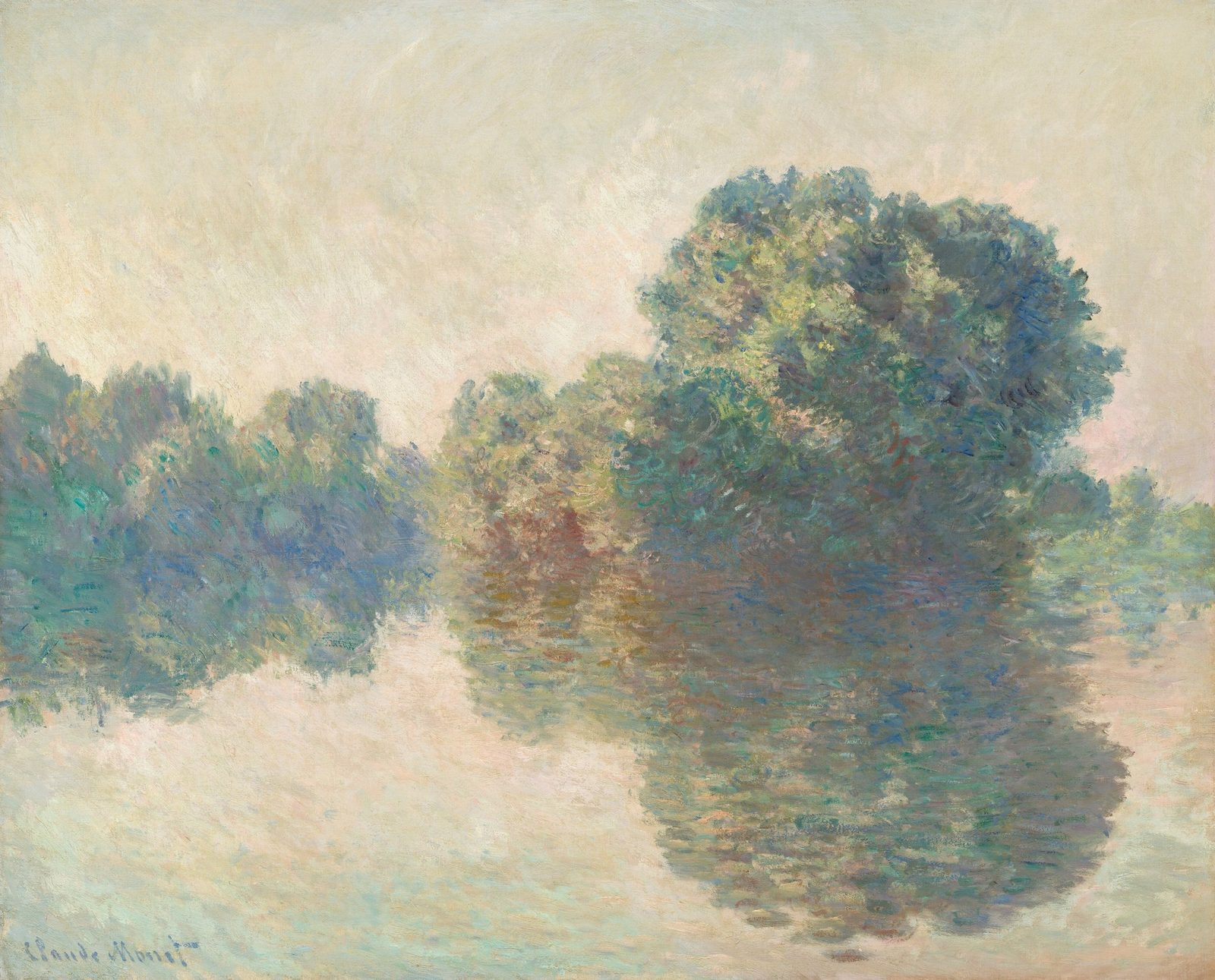
A big rounded tree fills the right side, and below it the river lies so still that it holds a second, cooler copy of everything above. Nothing moves. The picture seems to be made of two paintings, one stacked on top of the other.
1897, oil on canvas
This is Claude Monet's The Seine at Giverny, painted in oil on canvas in 1897. He signed it in the lower left corner, Claude Monet, in dark paint over a warm, light ground.
Heavy right, open left
The horizon runs straight across the middle. Above it, the heavy mass of the tree crowds the right, while the left stays low and open. Below the line the water repeats the arrangement, so the whole canvas folds along the riverbank like a mirror.
Warm sky, cool leaves
There's no sun to be seen. The light is soft and even, so the scene is described with temperature instead of shadow. At the top of the tree, peachy cream sky sits right against cool blue-green dabs, with no mixed band between them. That clash keeps the leaves fresh rather than muddy.
Dabs, not smears
Look closely into the brightest part of the canopy. Small oval dabs of yellow-green, teal, lavender and blue-violet sit shoulder to shoulder, and their edges stay crisp. They don't appear to have been touched again once placed. From a distance they fuse into one shimmering green.
A spark in the dark
Lower in the tree is one of the darkest pockets in the picture, deep viridian and blue-violet woven together. Look just left of centre and you'll find a small vermilion mark. It doesn't lighten the shadow, but it makes the greens around it seem to vibrate.
A tree without outlines
Now take in the whole tree. The upper crown is brighter, with warmer greens and flecks of pink, while the right and lower parts sink into cooler blue-greens. Only a few short russet strokes hint at branches inside. The volume comes from colour piled on colour, not from a drawn edge.
Edges that dissolve
Follow the far bank to the left. The tops of the distant bushes have no outline at all. Green dabs float up into the sky, and pale strokes drift down into the leaves, so the edge is simply where the leaf strokes start to outnumber the sky.
Water made of dashes
Drop into the water below the big tree. It's all short horizontal strokes of teal, sage and dusty blue, with ochre and salmon near the edges. The tree's dark shape isn't traced in reflection. The eye finds it from nearby colours, and the direction of the strokes tells us this is water.
Look closer
9 details, each checked against a close-up of the picture.
-
Rounded tree mass
The right-hand tree is a dense cluster of overlapping cool green and blue strokes, with only a few short russet marks hinting at branches inside it.
The crop centers on a rounded, billowing tree mass rendered in short, dabbed strokes of cool blue-green, teal, and yellow-green, with scattered small touches of pale pink and a few warm ochre marks at the lower left. The foliage reads as one softly modeled volume: the upper-left crown is brighter (warmer green and pink flecks), while the right and lower portions sink into cooler blue-greens and deeper values. Edges along most of the silhouette against the cream sky are soft and broken, though some crisper tufts do appear along the right-hand outline and a few short russet-red strokes in the mid-lower mass read as small interior branches or trunk fragments, so it is not strictly 'no interior hard edges.' The lower quarter carries smudgy horizontal strokes in muted blues, browns, and pinks, reading as the tree's reflection on water.
-
Tree core shadow
This pocket holds some of the darkest blue-violet and deep viridian strokes in the painting, with one small vermilion mark among them.
Dense pocket of tree shadow built from thick, layered oil paint. Deep viridian and blue-violet strokes interlock with mid greens (sage, olive) and short navy accents, with longer diagonal flicks trailing off toward the upper right. A small vermillion mark sits left of center, functioning as a complementary note rather than a representational detail. Edges are mostly softened by wet-into-wet blending, though a handful of drier, harder dark strokes survive on top, giving the mass its broken texture.
-
Horizontal water strokes
Short horizontal strokes of blue, green, and ochre in the water sit directly below the tree but do not replicate its exact edge.
The crop is filled almost entirely with short, broken horizontal strokes laid in a loose scumble. Dominant hues are muted teal, sage green, and a pale dusty blue, interspersed with warmer touches of ochre, salmon, and rose near the lower and left edges. No firm contour marks a tree's edge into the water; instead the dark blue-green mass at the top dissolves through a transition band of mixed, slightly lighter strokes. The texture shows individual daubs of paint sitting side by side, with very little blending, so the weave of the canvas is visible between marks in the thinner passages.
-
Foliage dabs in canopy
Individual round brush dabs of yellow-green and teal are placed side by side and remain unblended on the canvas surface.
The crop is filled with small, oval-shaped dabs of pigment laid down in a roughly horizontal, scumbled mass that reads as sun-touched canopy. Individual strokes retain crisp, ridged edges where teal, yellow-green, lavender and blue-violet sit shoulder-to-shoulder without being softened into one another. A few brighter yellow-green dabs punch forward as highlights, while deeper blue and violet passages recede into shadow; a pale cream-pink sliver at the upper right indicates the sky bleeding through gaps in the leaves. Layering is visible: cooler greens sit over warmer underpainting, and a touch of red-brown fleck (lower right) suggests an underlying warm ground.
-
Dissolved bank silhouette
The tops of the distant bushes dissolve into the sky through separated, dry strokes with no continuous contour line.
The crop captures the upper boundary where the tops of distant bushes meet the sky. The pale cream-and-pink sky is laid in with broad, slightly directional strokes that read as a single mass, while the foliage below is built from short, detached dabs and dashes of blue-green, sage, and dusty rose. There is no drawn outline along the crest of the bushes; instead, the edge reads as an alternation of leaf-colored strokes and sky-colored gaps, with some green marks isolated inside the sky area and some pale strokes drifting down into the foliage. Values stay close between the two zones, so the silhouette is found by counting marks rather than by following a line.
-
Sky against foliage
Warm peach sky strokes sit directly adjacent to cool blue-green foliage dabs at the tree's upper contour without intermediate mixing.
The crop captures the upper crown of a rounded tree set against a soft, hazy sky. On the left, the sky is warmed with peachy-cream strokes that lighten and cool slightly toward the top into a neutral pale gray-cream. The tree's upper silhouette is built from short, broken dabs of blue, teal, and blue-green, accented with small touches of warmer olive and the occasional pink-tinged stroke. Where peach sky meets the foliage, the two are placed directly edge-to-edge; I can see no continuous band of pre-mixed intermediate color, only a few scattered peach strokes that penetrate slightly into the leaf mass.
-
Warm ochre accent in bank
A concentrated patch of warm brown and ochre strokes sits amid the cooler greens of the central riverbank.
A dense cluster of warm rust, ochre, and reddish-brown strokes occupies the central area, sitting on top of and breaking through a cooler green and olive ground. To the upper right, vivid teal and blue-green brushwork reads as foliage, with curling, comma-like marks that carry directional energy. The lower portion shows muted olive and greyish reflections with horizontal, dragged strokes that suggest water. Edges throughout are soft and interpenetrating; there are no hard contours, just adjacent dashes of contrasting hue that the eye blends. The warm patch is the highest chroma and value step in the center, while the surrounding greens and blues recede.
-
Left bank recession
The left-hand vegetation is built with smaller, more muted strokes in lower-value blue and ochre than the central tree.
The crop shows a field of small, broken, roughly vertical-to-diagonal strokes layered over a mid-value ground. Hues are dominated by muted blue-greens and soft sage, punctuated by low-chroma ochre, dusty rose, and pale cream flickers that read as distant foliage rather than sunlit leaves. Edges between marks are soft and wet-into-wet in places, with a few drier, slightly scumbled touches that let the canvas weave show through. Values stay compressed in the middle range with no near-white highlights, which keeps the mass reading as recessive bank rather than forward tree canopy.
-
Signature
The dark signature in the lower-left corner reads 'Claude Monet' against the warm ground.
The crop captures the artist's signature 'Claude Monet' rendered in cursive script using a dark navy-blue pigment, applied over a warm, light-toned ground. The background field is composed of loose, layered brushstrokes in cream, pale sage green, dusty pink, and ochre, with visible directional strokes running roughly diagonally from upper-left to lower-right. The signature sits on top of these layers, with the dark pigment pooling slightly into the weave of the canvas. A small detached blue dab appears just to the right of the final 't', likely a stray mark from the brush. Edges of the letters are softened and slightly broken, suggesting the paint was applied while still wet, picking up texture from the underlying surface.
The Seine at Giverny in context
Signed, but not dated
The National Gallery of Art records the painting as oil on canvas, 81.5 by 100.5 centimetres, inscribed 'Claude Monet' at the lower left [1]. Because the inscription doesn't carry a year, the date of 1897 rests on the Gallery's record and on Daniel Wildenstein's catalogue raisonné, where the picture is number 1494 [1]. When the page was archived in November 2025, the painting hung in Gallery 80 of the West Building [1].
The Gallery's visual description notes that the sky and its reflection are painted with longer, curving strokes of off-white and pale pink, and that the largest tree stands just right of centre [1].
Mornings on the Seine
In the late 1890s Monet painted the river near his home in a series now known as Mornings on the Seine. The Metropolitan Museum of Art explains that he began it in 1896 and, because of bad weather, didn't finish until 1897 [2]. He painted from a boat converted into a floating studio, rising at dawn for long periods to catch the changing light before lining the canvases up on easels in his studio to finish them together [2]. Fifteen were shown at the Galerie Georges Petit in 1898, according to the Met [2].
The Art Institute of Chicago describes the same campaign for its Branch of the Seine near Giverny (Mist), dated 1897. The museum says Monet travelled by rowboat before dawn to one spot on the river, where he worked on 14 canvases at once [3]. It also notes that he ordered the nearly square canvas specially, and that half the scene is a reflection on the water [3].
Part of the series?
The Gallery's record doesn't describe its painting as one of the Mornings on the Seine [1]. Its canvas is clearly wider than it is tall, unlike the Chicago picture, which measures 89.9 by 92.7 centimetres [1][3]. Wildenstein numbers the Chicago canvas 1475 and this one 1494, so the catalogue raisonné places them in the same stretch of Monet's work, but that alone doesn't settle whether Monet counted this picture among the series [1][3].
One sale, several Monets
According to the Gallery, Monet sold the painting to the New York dealer James F. Sutton, who died in 1915 [1]. It passed to his widow and was sold at the American Art Association in New York on 26 October 1933 as lot 72, where George Roberts bought it for Chester Dale [1].
That same sale brought other Monets to Dale. Banks of the Seine, Vétheuil was lot 48 that day and was bought by Dale himself [4]. Rouen Cathedral, West Façade was lot 58 and went first to Wilbur L. Cummings of Greenwich, Connecticut, who sold it to Dale in 1935 [5].
Dale lent The Seine at Giverny to the Philadelphia Museum of Art, which showed his collection from 1943 to 1951, and it came to Washington with his bequest in 1963 [1].
- Claude Monet, The Seine at Giverny (1963.10.180): object record, visual description, provenance, exhibition history and bibliography (Internet Archive copy, 24 November 2025) . National Gallery of Art, Washington
- Claude Monet, Morning on the Seine near Giverny: object record (Internet Archive copy, 11 March 2026) . The Metropolitan Museum of Art, New York
- Claude Monet, Branch of the Seine near Giverny (Mist), 1897: collection record . Art Institute of Chicago
- Claude Monet, Banks of the Seine, Vétheuil (1963.10.177): object record and provenance (Internet Archive copy, 14 April 2025) . National Gallery of Art, Washington
- Claude Monet, Rouen Cathedral, West Façade (1963.10.49): object record and provenance (Internet Archive copy, 27 November 2025) . National Gallery of Art, Washington