Three red poles and a pink wall
How Canaletto measures out a long Venetian façade with three tall uprights and a clear light
- Artist
- Canaletto
- Title
- The Square of Saint Mark's, Venice
- Date
- 1742/1744
- Medium
- oil on canvas
- Image
- Public domain (CC0)
Open in Simple Art
Watch this story on iPhone and iPad, with offline downloads and a painting every day.
About 4 minutes of looking, in 10 parts.
The Square of Saint Mark's
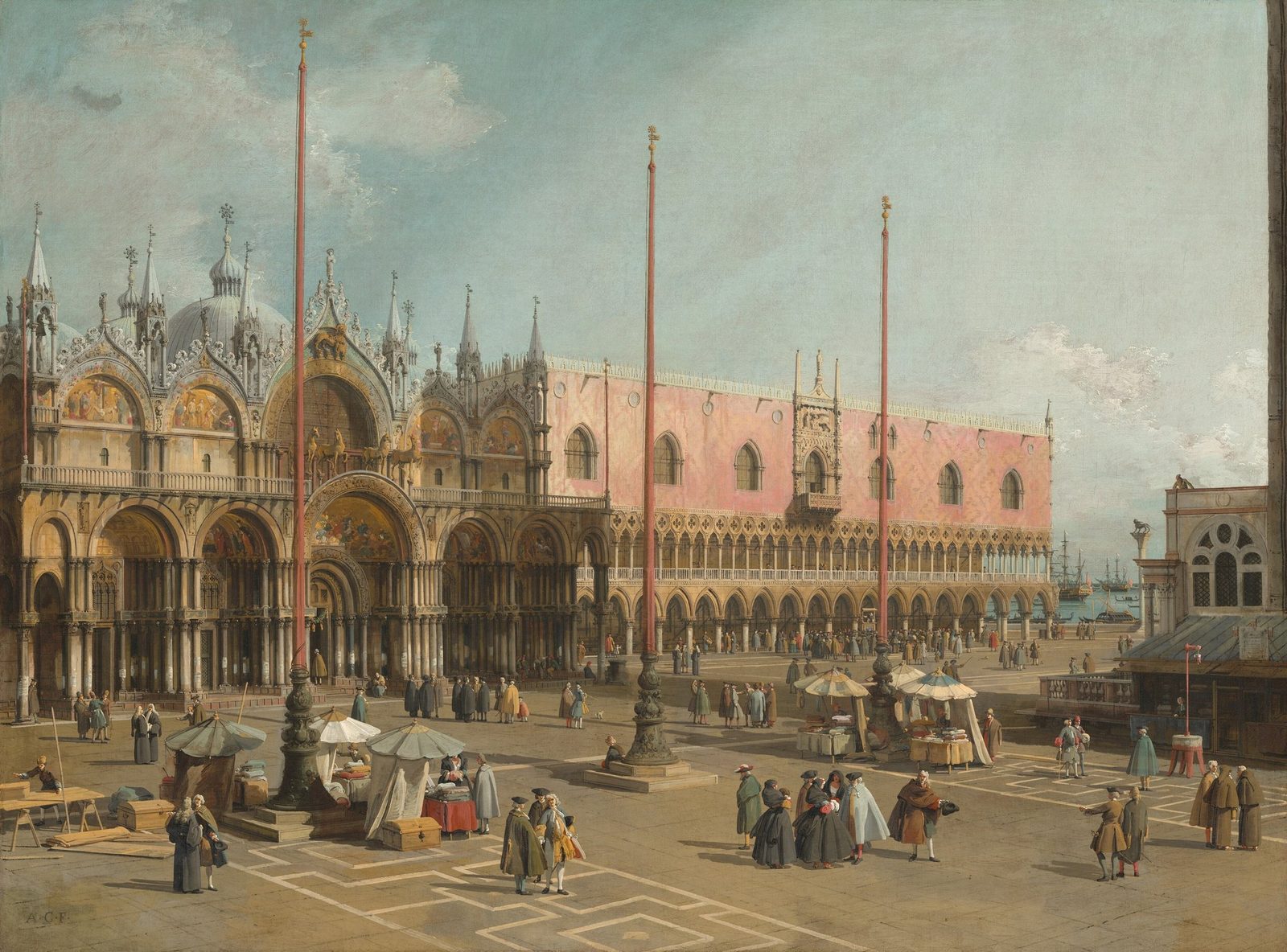
A long pink wall runs almost the whole width of this picture, and three tall red poles stand up through it. Below, the square is busy with tiny figures. On the right, the view opens out towards masts on the water. Start by finding those three poles.
Venice, 1742 to 1744, oil on canvas
This is Canaletto's view of the Square of Saint Mark's in Venice, painted in oil on canvas between 1742 and 1744. The museum records the initials A.C.F. at the lower left, for Antonio Canal fecit, Antonio Canal made it.
One long band, three uprights
The design is mostly horizontal. The buildings make a broad band across the middle, with sky above and paving below. The three poles cut through that band at intervals. They work like marks on a ruler, breaking a very long façade into lengths your eye can measure.
Light from the upper right
The light seems to come from the upper right, so the broad face of the Doge's Palace is in full sun. The wall looks like one even pink, with windows and arches drawn over it afterwards. The deepest darks hide to the left, under the basilica's arches.
Warm wall, cool sky
Up at the roofline, warm rose stone sits directly against a pale, cool blue sky. That meeting of warm and cool is what makes the wall glow. The edge is crisp along the parapet, and one red pole slices straight through both wall and sky.
Four golden horses
Now move left to the basilica. On the balcony above the main door stand four horses in golden bronze tones. The leftmost horse is the brightest, catching the light on its flank. It is hardly richer in colour than the others, just lighter against the dark arch behind.
Domes against the sky
Above, the domes and pinnacles stand against a sky of long, curving strokes. Look closely at the edges. There is no hard outline. Each shape is held by a slightly darker stroke along its rim, which keeps the silhouette sharp without making it look drawn.
The foot of the middle pole
Follow the middle pole down into the square. It rises from a richly decorated dark pedestal, perhaps bronze, on a two-stepped stone base. A child in a cap sits on the lowest step, and that small figure tells you just how big the whole thing is.
A pointing arm
Down at the lower right, two men stand on the paving. One, in a tan-brown coat and black tricorn, throws his arm straight out. His companion wears an olive-grey cloak and a startling brick-red stocking. Each figure is only a few marks, yet the gesture reads at once.
Out to the water
Finally, look through the last arches on the right. Masts and fine rigging rise against a pale sky, a covered boat sits on dark water, and a column topped by a winged lion frames the view. The water is just short horizontal strokes.
Look closer
8 details, each checked against a close-up of the picture.
-
Rose-pink Doge's Palace facade and arcades
The rose-pink Doge's Palace wall stretches from the basilica corner to the right edge, with pointed Gothic windows and a repeated arcade below.
The crop is dominated on the right by a broad, flatly painted rose-pink wall of the Doge's Palace, broken only by a row of small pointed Gothic windows (dark openings with thin stone tracery) and a continuous ground-level arcade of slender columns and round arches. Where the wall meets the basilica corner, the pink gives way to a vertical seam of grey-white stonework, then to the basilica's heavily ornamented Gothic facade with its gold-ground mosaics, pinnacles, and arcaded loggia. Three thin red flagpoles run as hard vertical lines through the composition, crossing the architecture without tonal adjustment, which tells us they were laid in over (or beside) the masonry rather than modelled into it. Edges between the pink wall and the arcade colonnade are crisp, while the column shafts themselves are read with two thin value notes (lit face / shadow core) rather than full modelling.
-
Basilica spires and sky separation
The basilica's domes and pinnacles are held against the sky by a slightly darker stroke along each edge rather than a hard outline.
The crop shows the upper portion of St. Mark's Basilica: three bulbous domes, multiple crocketed pinnacles topped with crosses, and a large arched mosaic lunette on the right. The sky is built with long, curving brushmarks in pale blue-grey that sweep horizontally and curl into soft cloud forms; these marks sit visibly on top of an underpainted ground. The domes are rendered in cool pearl-grey with darker vertical hatching following their curvature, and each pinnacle's silhouette is defined by a slightly darker stroke against the sky rather than a single hard line. Small dabs of white and pale grey form the crockets and finial crosses, while the mosaic lunettes use short, broken touches of ochre, rose, and grey-green to suggest figural scenes.
-
Rose facade against cerulean sky
The palace wall is painted in warm rose and terracotta hues that lie directly beside the soft cerulean sky above the roofline.
The crop presents the upper register of the Doge's Palace facade: a broad pink-rose wall face rises from the lower arcade up to a crenellated parapet, topped by pinnacles and a winged-lion relief. A vertical red flagpole bisects the composition, slicing across both wall and sky. The sky occupies the upper third, painted in a pale cerulean with visible scumbled brushwork and slightly warm undertones. The wall-to-sky edge is crisp at the parapet but softened where crenellations interrupt the line. Windows are rendered as cool dark arched openings that punctuate the warm wall surface, and the pink mass is broken by a richly modelled stone balcony in the left third.
-
Gilded horses and basilica mosaics
Four gilded horse statues stand on the central balcony above the main basilica portal, flanked by arched mosaic lunettes.
Four horse statues straddle a stone balcony in golden-bronze tones, set against the deep grey shadow of the recessed arch behind them. Above and flanking the balcony, arched lunettes contain Byzantine-style mosaics with figure groups rendered in vermilion, lapis, and emerald against a punchwork of tessera-shaped flecks in burnished gold. The leftmost horse reads brightest because the raking light from the upper right catches its flank and neck; the rightmost horses sit slightly more in shadow with cooler olive tones along their bellies. A bright vermilion vertical (the flagpole) slashes across the left third, separating a thin sliver of architecture from the main composition. The carved Gothic ornament framing each arch is painted with fine parallel hatch marks that read as crisp three-dimensional mouldings despite being only millimetres across.
-
Shadowed arcade under the basilica
The ground-floor arcade of the basilica casts deep shadows that read as near-black rectangles contrasting with the sunlit stone columns.
The crop isolates a two-story Venetian Gothic arcade rendered in a narrow value range. Sunlit column shafts read as warm ochre (roughly #c4a378) where they face the upper-right light source, while the recessed bays between them drop into near-black umber (roughly #2a1f15). The arcade rhythm is set by paired colonnettes with foliate capitals, and the deep arches frame thin strips of golden mosaic visible in the upper lunettes. Gothic tracery in the lower windows creates a sharp lacy edge against the dark interior, and a single warm pink-red column on the right anchors the composition with the only saturated accent. Edges are crisp where stone meets shadow, and slightly softened where atmospheric haze bleeds into the upper arches.
-
Central flagpole and ornate base
The central flagpole rises from an ornate dark pedestal, perhaps bronze, set on a two-tiered stone plinth, with a child seated on the lowest step.
The crop centers on a tall crimson flagpole rising from a heavily ornamented pedestal that sits atop a two-tiered square plinth of warm stone. The pedestal reads as cast bronze or patinated metal, built up from stacked bulbous drums carved with rosettes, acanthus-like lobes, and a floral finial; its surface mixes dark olive-green mid-tones with near-black recesses and small warm-grey highlights catching the upper-right light. A child in a cap and grey coat sits on the lowest plinth step at lower left, anchoring the base in scale, while behind the pole the arcade of the Doge's Palace recedes in pale buff and rose, with small staffage figures in muted greens, greys, and ochres. Edges between the flagpole and the architecture are crisp where the red pole cuts the bright arcade, but soften where it meets the shaded upper-left background, indicating atmospheric perspective rather than hard inking.
-
Ships and lagoon glimpse
Ship masts and hulls are visible through the rightmost arcade bays and beyond the palace corner where the square opens to the water.
The crop shows the right side of the Doge's Palace's pink Gothic arcade on the left, opening through several pointed-arch bays to a lagoon view. Tall ship masts with thin rigging lines rise against a pale blue-grey sky, while dark hulls sit on horizontal water marked with short parallel strokes. A covered ceremonial barge (sandolo or burchiello) occupies the mid-water, and on the right edge a tall stone pier/column crowned with a bronze winged lion frames the view. The water reads as cooler and darker than the sky, with the wet zone beneath the barge holding the deepest value. Small figures in dark coats cluster in the lower-left arcade shadow, providing scale against the architecture.
-
Pointing figure with companions
A man in a tan-brown coat thrusts his right arm out horizontally beside a companion in an olive-grey cloak near the lower-right edge of the square.
Two staffage figures seen at close range on a flagstone pavement. The left figure wears a warm tan-brown coat with a high collar, white stockings, and a black tricorn; his right arm thrusts out horizontally as a clean pointing gesture, the wrist and cuff read as a crisp notch against the lighter ground. The right companion wears a cooler olive-grey cloak with a small buttoned slit at the back, white hair, and a vivid brick-red stocking that punctuates the lower half. Their coat hems form a soft, slightly broken silhouette against the stone, and the warm pavement carries a low, cool cast-shadow to the figure's left, consistent with light arriving from upper right. At the top edge, cropped legs and a teal skirt establish that these men sit within a much wider figure crowd.
The Square of Saint Mark's, Venice in context
An unusual corner of the square
Eighteenth-century view painters treated the Piazza San Marco as their standard view of Venice, and Canaletto painted it dozens of times from different spots [2]. The National Gallery of Art's systematic catalogue says this canvas looks southeast across the far eastern end of the square, probably from an upper window at the east end of the Procuratie Vecchie [2]. It calls the result unique among his views of the square. That is because his other oblique views of the basilica and the Doge's Palace were taken from the clock tower and give more room to the Piazzetta and the waterfront [2].
The three flagstaffs stand on bronze pedestals cast by Alessandro Leopardi in 1505, and the large umbrellas beside the outer two belong to cloth merchants [2]. The catalogue also picks out details that are easy to miss: a Dominican friar preaching from a temporary pulpit in the Piazzetta, a swag hung over the central doorway of San Marco that may point to preparations for a feast, and a beam with a pulley wheel on the palace that Canaletto had already drawn around 1726 [2]. A red-and-white structure by the booth at the foot of the campanile has never been fully explained. The catalogue suggests, cautiously, that it may have been a dentist's sign [2].
Dated by a gate
The catalogue argues that the painting must have been made after 1742 because it shows Antonio Gai's bronze gates to the Loggetta, which were commissioned in 1735-1737 and installed in 1742 [2]. So it proposes a date of about 1742-1744 for this canvas and its companion, a period when Canaletto often signed his best pictures [2]. The initials A.C.F. at the lower left are read as Antonio Canal Fecit [1].
Opinion has not always been so settled. W. G. Constable and J. G. Links, and Fern Rusk Shapley in 1979, dated the pair to the mid-1730s, and the conservator Viola Pemberton-Pigott suggested around 1740 [2]. Constable also judged the handling of the pair lifeless and mechanical, and a 1972 census of Italian paintings in North American collections listed this canvas as School of Canaletto [2]. The 1996 catalogue rejects those doubts, saying the 1993 conservation confirmed the quality of both pictures and that the large, fluidly painted figures compare with signed views at Windsor dated 1743 and 1744 [2].
How it was painted
According to the museum's technical summary, the canvas has a thick reddish brown ground that strongly affects the colour of the paint above it, especially in the sky [1]. The sky was painted first, with spaces left for the buildings. Then the upper right corner of the Doge's Palace was later extended over sky that had already been painted [1]. Thin, semi-translucent dark paint was used to outline the architecture and figures, and highlights on the faces were dabbed in pink or yellow. The figures were painted over the white pattern of the paving, but before the thin black lines that mark out the individual stones [1].
The catalogue adds that in parts of the pavement Canaletto brushed cool grey over greenish browns, while towards the centre warmer earth tones shift to cool greys in the immediate foreground [2]. There is a vertical band of loss at the centre, matching damage in the companion picture, which suggests the two canvases were once stored face to face [1]. The thinly painted sky is badly abraded, and the painting was cleaned and restored by Catherine Metzger in 1993 [1].
From Castle Howard to Washington
The painting and its companion came from Castle Howard in Yorkshire, seat of the earls of Carlisle [2]. The museum thinks they were probably bought by Henry Howard, 4th Earl of Carlisle, who visited Venice in the autumn of 1738 and presumably kept buying Canaletto's work after he returned to England [2]. Lady Oxford saw 'several views of Venice by Canaletti lately put up' in the drawing room at Castle Howard in 1745. The pair has been thought to be among them, though the exact date of acquisition is uncertain [1][2]. The museum's own summary says the earl made them part of the decoration of his house [4].
J. G. Links suggested that the earl may have used an agent other than Canaletto's usual go-between, Joseph Smith. But he argued that the two Washington pictures, signed with initials, must have come from Canaletto himself [1]. Both still have carved and gilded frames in the style of William Kent of the kind fitted to several of the Castle Howard Canalettos [2]. Most of the Canalettos at Castle Howard were sold in the late 1930s or destroyed in a fire in 1940 [1]. This pair was sold in 1938 by the trustees of Geoffrey Howard to Barbara Hutton, who gave both to the National Gallery of Art in 1945 [1].
The museum's audio guide places the picture in the trade in views bought by wealthy young British travellers on the Grand Tour, as reminders of Venice once they were home [3]. It now hangs in Gallery 31 of the West Building [3].
- Canaletto, The Square of Saint Mark's, Venice (1945.15.3): object record, inscription, provenance, exhibition history and technical summary (Internet Archive copy, 23 April 2025) . National Gallery of Art, Washington
- Diane De Grazia and Eric Garberson, with Edgar Peters Bowron et al., Italian Paintings of the Seventeenth and Eighteenth Centuries (Systematic Catalogue, 1996), Canaletto entries on 1945.15.3 and 1945.15.4, pp. 24-31 . National Gallery of Art, Washington
- The Square of Saint Mark's, Venice: artwork page and audio guide transcript (Internet Archive copy, 15 September 2025) . National Gallery of Art, Washington
- Canaletto, Entrance to the Grand Canal from the Molo, Venice (1945.15.4): artwork overview (Internet Archive copy, 8 October 2025) . National Gallery of Art, Washington