Manet's The Tragic Actor: A Character Study in Brushwork
How Édouard Manet turns one figure, one costume, and a dropped sword into the whole play
- Artist
- Edouard Manet
- Title
- The Tragic Actor (Rouvière as Hamlet)
- Date
- 1866
- Medium
- oil on canvas
- Image
- Public domain (CC0)
Open in Simple Art
Watch this story on iPhone and iPad, with offline downloads and a painting every day.
About 5 minutes of looking, in 11 parts.
A man, a costume, a single dropped sword
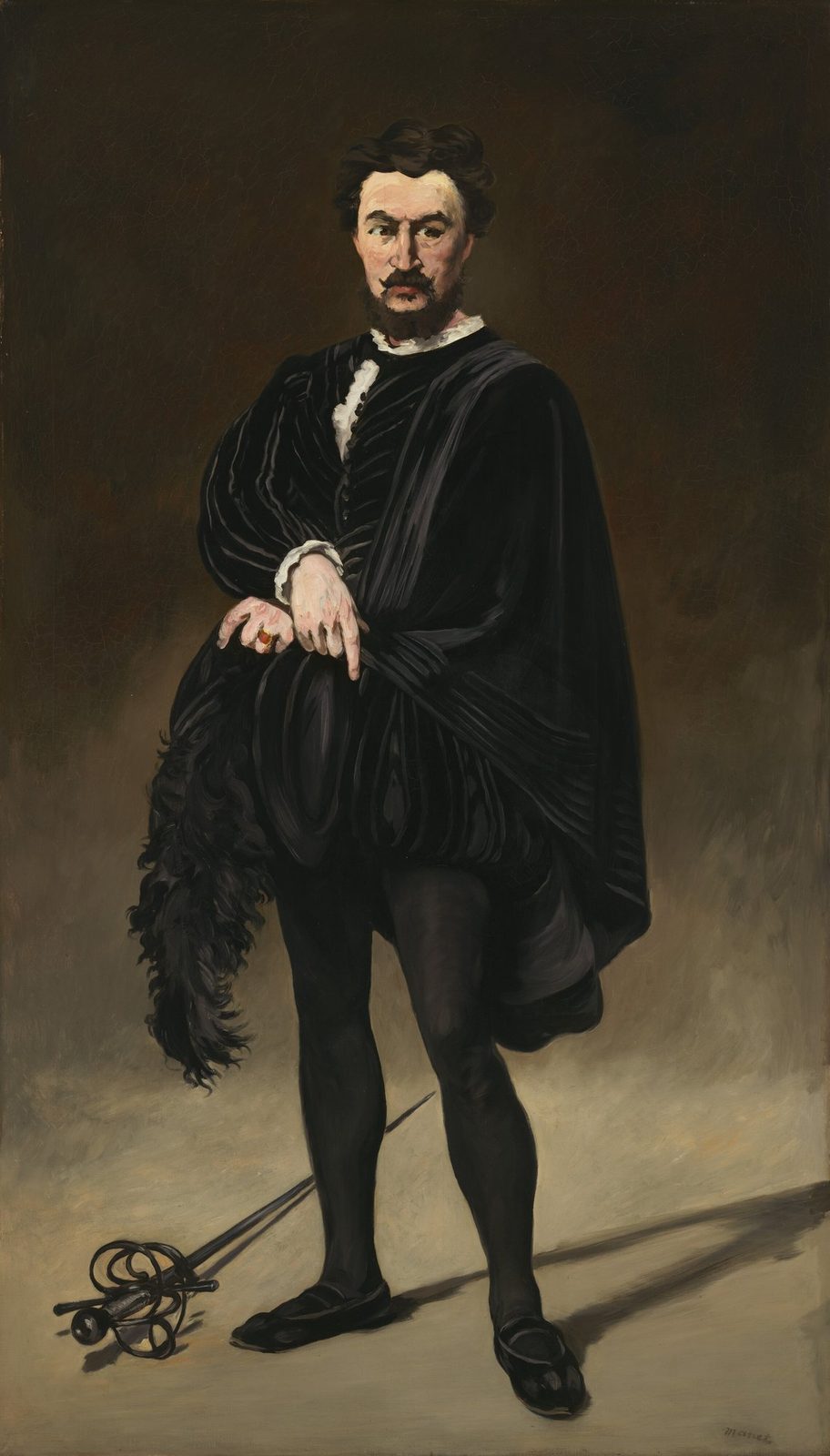
We open on a full-length figure standing in near silence — a bearded man in black, one hand gesturing downward, a rapier lying at his feet. The painting does not show a scene; it shows a mood, a held breath. Watch how Manet turns one figure, one costume, one dropped prop into the entire play.
Manet, 1866
This is Édouard Manet's The Tragic Actor, painted in 1866, depicting the French actor Rouvière in the role of Hamlet. It is oil on canvas, and it is a character study — not a moment of action, but a portrait of a man thinking the part.
A pyramid cut by a diagonal blade
The figure forms a vertical pyramid anchored across the canvas, head near the upper third and shoulders spreading down to the legs. A long diagonal of the fallen rapier slices across the lower band, breaking the pyramid's stability. The eye travels: face, white collar, gesturing hand, down the cape, out along the blade, and back up.
Stage light, earth envelope
Light falls from the upper left, slightly frontal, with a hard but soft-edged quality like stage lighting. The palette is almost monochrome — warm umbers and ochres wrap a single dark mass of costume, and the face, collar, cuffs, and hand read as the only bright notes. Everything else is supporting cast.
Three values, no gradation
The face is built from abrupt value jumps — bright cream forehead, mid-tone rose cheek, dark beard — with no smooth gradation between them. Edges are hard, transitions are visible, and the form is read from the jumps, not from blending. That is alla prima: place light and dark side by side and leave the brush alone.
White as shape, not surface
The lace collar and the vertical chest slash are pure white, dropped directly onto the black costume with no grey halftone between them. Manet lets the underlayer do the shadow work, so the whites stay high-key and crisp. Notice the irregular, slightly ragged edge where the wet white met the dry black.
One saturated note
The hands are painted in soft pink and cool grey, almost the same value as the cuffs — but on the lower ring finger, a single flat dab of vermilion. That is the only spot of saturated color in the entire painting. Reserve one note, place it last, and the eye locks on it; the rest of the hand falls into supporting role.
Sweeping fans, visible ribs
The left puffed sleeve is built from broad, curved strokes that fan outward like tulip petals. Each stroke is a fat ribbon of dark paint left unblended, with thin slivers of warmer brown showing between adjacent strokes. The ribbed texture is read from those highlight edges and the gaps, not from any rendering of shadow inside the strokes.
Value, not hue, does the work
The cape on the right falls in long diagonal strokes placed edge-to-edge. The value shifts between strokes are narrow — light grey beside near-black — but the hue stays uniformly dark. Manet suggests an entire passage of fabric through stroke direction and weight of paint alone, no outlines, no local color change.
A calligraphic hilt on warm ground
The rapier guard is drawn as a few looping, calligraphic dark strokes, with the warm ochre floor left untouched between them so the undercolor fills the negative space inside the basket. The pommel catches a single white-grey highlight, and the blade runs up to the right in one tapered black band.
The warm earth envelope
Behind and beneath the figure, the ground is brushed in long horizontal strokes of raw umber and warm grey. This ochre field does not blend into the black costume; it sits apart, and that is the point — the warm earth envelope isolates the figure's blacks and makes the pale face and whites pop by contrast.
Look closer
9 details, each checked against a close-up of the picture.
-
The actor's face
The face is built from abrupt value shifts—bright forehead, mid-tone cheek, and dark beard shadow—with no smooth gradation between them.
The crop centers on a bearded man's head and shoulders against a flat olive-brown ground. The forehead is laid in with thick, opaque cream and pink strokes that read as nearly white against the dark hair; the transition into the hairline is a hard, unblended edge. The cheek is a warm mid-value rose-pink, and below it the beard is a mass of dark, broken strokes that abut the cheek with a sharp value jump rather than a soft blend. The right side of the nose carries a clean cast shadow that turns abruptly darker, and the eyes sit in shadowed sockets with small bright dabs for the catchlights. The collar is scumbled white over a dark underpainting, showing long parallel brush marks.
-
Hands with red ring
A small red ring sits on a finger of the figure's right hand, painted as a flat note of vermilion against the pale flesh.
The crop isolates two hands emerging from cream-white cuffs against a deep black sleeve. The larger right hand (figure's left) hangs downward with fingers loosely flexed, modelled in broad, loaded strokes of cool pink, ivory, and gray-violet in the shadow planes. The smaller left hand (figure's right) sits lower in the frame, fingers bent inward, with a small saturated vermilion dab on the ring finger that reads instantly as a jeweled ring against the muted flesh. Edges are soft and brushy where the fingers meet the black, sharper along the cuff rims where the white stops against black. The overall value range is compressed: most of the picture sits in the mid-to-dark register, with the cuffs and the red note as the only high-value or high-chroma accents.
-
White collar and chest slash
The white lace collar and vertical slash are built from thick, unmodulated highlights that sit on top of the black costume without intermediate grey tones.
The crop isolates the lower face and chest of a bearded figure in a black costume. The white lace collar across the neck and the vertical chest slash are rendered as dense, opaque passages of near-pure white paint that terminate abruptly against the surrounding black; there is essentially no grey halftone bridging the two values, so the white reads as an applied shape rather than a lit surface. The dark costume itself is not flat black but contains cool blue-grey and warm umber streaks that describe folds and a puffed sleeve, while the beard is built from short, dark brown-black strokes with only tiny warm accents near the chin and a single saturated red-orange note on the lower lip. Edges between the white slash and the black jacket are crisp and slightly irregular, indicating wet-on-dry placement rather than blended modelling.
-
Puffed sleeve brushwork
The left puffed sleeve is made from broad, curved strokes that fan outward and remain visibly separate, creating a ribbed texture.
The crop is dominated by a voluminous black puffed sleeve rendered in discrete, parallel brushstrokes that curve from upper-right toward lower-left, fanning like the petals of a tulip. Each stroke is a fat, slightly tapered ribbon of dark paint with thin slivers of warmer brown showing between adjacent strokes, producing a ribbed or corrugated effect rather than a smoothly modeled volume. The strokes retain their individual edges—dry, slightly ragged, and unblended—reading clearly as marks rather than dissolved tone. A white lace cuff at lower center and two pale hands (one pointing, one resting) sit against the dark mass, and the upper-left background is a flat, scumbled olive-brown with visible craquelure across the entire paint film. Light catches only the leading edges of the sleeve strokes, leaving the recesses nearly black, so the ribbing is read through highlight edges rather than cast shadow.
-
Warm ochre ground
The lower floor shows alternating horizontal strokes of raw umber and warm grey that are not blended into the black costume above.
The crop is dominated by a warm ochre field above a roughly horizontal seam, then a warm grey-beige floor below. In the upper register, broad, arcing brushstrokes sweep from upper right toward the center, leaving a slightly cool, scumbled mid-value where the strokes overlap. A dark horizontal band (the seam/shadow) runs across the lower third, and beneath it a single long, dry diagonal stroke of raw umber/black cuts from the lower left up to the right, its broken, hard-edged mark left unblended against the lighter ground. The floor strokes read as flat, slightly streaky horizontals that do not feather into the dark band, so the cast shadow sits on top of the floor rather than merging with it.
-
Dark cape drapery
The right-hand cape falls in flat, diagonal strokes linked edge-to-edge, shifting value without changing the underlying dark hue.
The crop shows the right-hand fall of a black cape rendered in long, diagonal brushstrokes that sweep from upper left to lower right. The strokes are placed edge-to-edge, tiling across the surface without overlap gaps, and the value shifts between strokes are narrow—lighter grays lie directly beside near-blacks, but the underlying hue remains uniformly dark. Toward the bottom, the strokes fan outward in a splayed pattern, and along the right edge the dark mass meets a warm ochre-brown background that shows fine craquelure. A few lighter passages near the upper left suggest the cloth catching the light, while the deep center reads as the shadowed body of the fold.
-
Rapier hilt and guard
The rapier guard is described by looping dark-grey strokes that sit loosely over the ochre ground, allowing the warm floor to show through between them.
The crop isolates the lower portion of a rapier resting on an ochre floor, with a black shoe entering from the lower right. The guard is built from several looping, calligraphic dark strokes that overlap and cross, leaving irregular gaps where the warm ground tone (around #9A8759) reads through as the basket's interior. The pommel at lower left is a single rounded mass with a small white-grey highlight placed at its upper edge, while the blade shoots diagonally up to the right in a long, slightly tapered black band with a thin lighter edge along its upper side. Edges between the dark metal and the floor are crisp where the brushstroke ended sharply, and softer where the paint was dragged, and the ground itself is laid in with broad, slightly directional strokes of olive and tan.
-
Feathered accessory texture
The black feathered accessory on the left is built from broken, filament-like strokes that let the warm ground show through between them.
The crop isolates a dense cascade of black feathered material against a warm brownish-ochre ground. Individual feather barbs read as separate, broken strokes that curve and taper, with the warm ground plainly visible between them rather than being filled in with opaque black. Values run from near-black at the core of each feather to slightly cooler grey-violet along the edges where thinner paint lets the ground modulate the tone. The marks are gestural and curved, never drawn as continuous contours, so the silhouette breaks into many wispy tips rather than one clean outline.
-
Painter's signature
The dark signature in the lower right reads 'Manet' in quick, cursive strokes of dark paint.
A cursive signature reading 'Manet' sits across a warm, muted olive-khaki ground marked by faint horizontal striations (either wood grain or scumbled brushwork). The letterforms are drawn in a thin, dark brown-black fluid line, with the initial 'M' and final 't' showing a slightly heavier downstroke while the connecting 'a-n-e' forms a quick, low-amplitude wiggle. Edges of the paint are crisp where the stroke is thin and barely feathered at the start of the 'M' and end of the 't', suggesting a moderately loaded, fairly stiff brush moving fast. There is no halation or bleed into the ground, so the dark line was likely laid onto a dry, slightly absorbent surface rather than into wet paint.
The Tragic Actor in context
Madrid, 1865
The Metropolitan Museum's essay says that after Olympia was judged the most shocking work of the 1865 Salon, a dejected Manet travelled to Spain in August that year [2]. At the Prado, Wikipedia notes, the art of Velázquez was a revelation to him [5]. French Wikipedia adds that he met the critic Théodore Duret in a Madrid restaurant during the trip [6].
A jester and actor in black
One picture in particular struck him. Velázquez painted Pablo de Valladolid, a jester and actor at the court of Philip IV, around 1635, and the portrait has been in the Prado since 1827 [3]. Wikipedia quotes Manet's letter to Henri Fantin-Latour calling it perhaps the most astonishing piece of painting ever made, and saying of the background: "It is air that surrounds the man" [3].
Wikipedia describes the jester standing full length in black, with a declamatory gesture, on a neutral ground where nothing but the cast shadow shows where his feet rest [3]. It adds that the background's original colour, according to a technical study by Carmen Garrido, is brown [3].
Philibert Rouvière
French Wikipedia says Rouvière was born in Nîmes in 1805 and first trained as a painter, entering the studio of Antoine-Jean Gros in 1827 and exhibiting portraits [4]. He turned to the stage, and his greatest success was Hamlet in the adaptation by Alexandre Dumas and Paul Meurice, which he created in 1846 at Saint-Germain-en-Laye and later played at the Théâtre-Historique and the Porte-Saint-Martin [4]. His acting was described as fiery and uneven; Baudelaire wrote two admiring articles on him, in 1855 and on his death [4].
He died in poverty in Paris on 19 October 1865, and his tomb in the Montmartre cemetery carries a relief of the ghost scene from Hamlet by Auguste Préault [4]. French Wikipedia calls him the initial model for Manet's picture, which the museum dates to 1866, so it was probably finished after his death [4][1]. French Wikipedia also lists an etching of The Tragic Actor from 1866 [6].
Refused, then shown by Manet himself
The Met says Manet was rejected from the Salon of 1866 and then learned he would be excluded from the Exposition Universelle of 1867. So he built his own pavilion and showed about fifty pictures [2]. Wikipedia names The Fifer as one of the paintings refused in 1866 [5]. The Tragic Actor was number 18 in that 1867 exhibition on the avenue de l'Alma [1].
The museum records that Durand-Ruel bought it in January 1872, although two older sources give December 1871 [1]. The singer Jean-Baptiste Faure is thought to have owned it next, though no record of the transaction survives [1]. Durand-Ruel had it again by December 1878, showed it in New York in 1895, and sold it on 27 February 1895 to George Washington Vanderbilt III of Biltmore [1]. His widow, Edith Stuyvesant Gerry, bequeathed it to the National Gallery in 1959 [1].
- Edouard Manet, The Tragic Actor (Rouvière as Hamlet) (1959.3.1): object record, visual description, provenance, exhibition history and bibliography (Internet Archive copy, 2 November 2025) . National Gallery of Art, Washington
- Rebecca Rabinow, 'Édouard Manet (1832-1883)', Heilbrunn Timeline of Art History, October 2004 (Internet Archive copy, 16 June 2026) . The Metropolitan Museum of Art, New York
- Portrait of Pablo de Valladolid . Wikipedia
- Philibert Rouvière . Wikipedia (French)
- The Fifer . Wikipedia
- Édouard Manet . Wikipedia (French)