Cézanne's Vase of Tulips: A Walk Through Constructive Form
Following the painter's eye-path through a late still life, one facet at a time
- Artist
- Paul Cezanne
- Title
- The Vase of Tulips
- Date
- c. 1890
- Medium
- Oil on canvas
- Museum
- Art Institute of Chicago
- Image
- Public domain (CC0)
Open in Simple Art
Watch this story on iPhone and iPad, with offline downloads and a painting every day.
About 5 minutes of looking, in 12 parts.
A still life that thrums with architecture
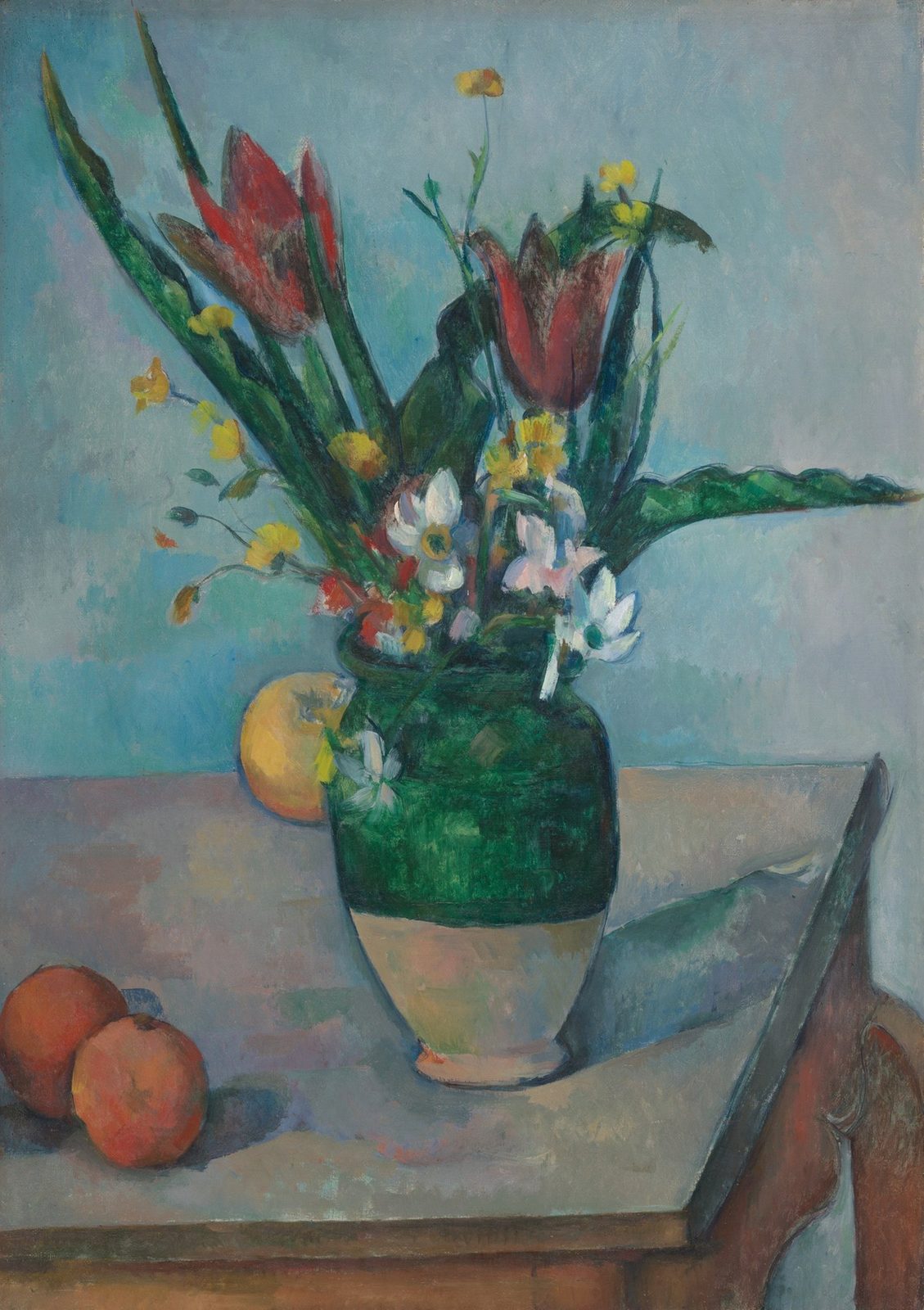
Before you, a still life that seems to thrum with quiet architecture. A rounded green vase rises from a tabletop, its bouquet of red and white blossoms reaching upward. This is Paul Cézanne's 'The Vase of Tulips,' painted around 1890, and the longer you look, the less it behaves like a flower painting.
Cézanne's late-still-life laboratory
Cézanne was building a language of form in his late years, and a still life gave him the perfect laboratory — a bouquet he could rearrange, tilt, and interrogate on a table, with no deadline but his own.
A column built of flower and fabric
Look at how the whole thing is built like a column. The roughly triangular bouquet rises from a centered vase, and a strong horizontal table line and a vertical drape on the right anchor it. The painter placed the focal cluster of blossoms near the lower-middle of the picture — right where one third crosses another.
Light made of temperature, not shadow
Now notice the light. It comes softly from the upper left, with no hard cast shadows anywhere. Cézanne isn't chasing a sunbeam — he's letting color temperature do the modeling, with cooler passages receding and warmer ones advancing.
Cool envelope, warm advances
The whole palette is a cool envelope: turquoise wall, green vase, green foliage. Against that calm blue field, the red tulips, the yellow fruit, and the peach-toned apples feel almost like small fires pushed forward toward you.
Apples with no drawn line
Begin at the lower-left, where two apples sit on the table. There is no drawn line around them. Their contours dissolve through a narrow band of small warm pink-orange dabs pressed against cool lavender and slate-blue passages of the tabletop. Temperature contrast, not line, describes the edge.
Yellow fruit modeled in color notes
Move up to a yellow fruit draped on the vase rim. See how its roundness isn't drawn with shading — it's assembled from a pale creamy highlight on the upper left, warmer ochre and a touch of reddish-orange drifting across the mid-belly, and a cool bluish rim that locks it to the background.
Red petals as diagonal planes
Push up into the red tulip petals. Watch the brushwork: broad slanting strokes that run from upper-left down toward the lower-right, alternating warm scarlet with cooler brick and maroon in the shadowed folds. Those diagonal planes ARE the form — there's almost no line anywhere.
White blossoms from a dark underlayer
Now settle on the heart of the bouquet, the white blossoms. Cézanne laid a cool, dark blue-green underpainting first, then dragged thick, opaque white strokes across only the lit half of each petal. He left the underlayer exposed at the shadow edge instead of blending. That gap is what makes the petals feel sculptural.
One leaf, one hard edge
Let your eye travel rightward along the extended leaf. It's a single broad mid-green stroke, reinforced by a darker green contour band running along its underside — and that hard edge alone does most of the work of separating leaf from sky. Resist the urge to soften it.
The vase built in flat strokes
Swing back to the upper-left of the vase. Instead of feathering a smooth highlight, Cézanne placed just a few flat, unblended light-valued strokes — pale sage and creamy off-white — along the lit edge, and let the darker emerald body do the rounding.
A tabletop of adjacent planes
And beneath everything, the tabletop itself isn't one tone. It's a patchwork of muted blue-grey, mauve, and dusty rose, laid in as flat adjacent planes. He refused to blend them. The eye does the work of uniting them into a single surface.
Look closer
8 details, each checked against a close-up of the picture.
-
Central Floral Cluster
White blossoms are rendered with thick, opaque white paint over blue-green shadows.
The crop centers on a cluster of white blossoms, each petal built from broad, blocky dabs of opaque cream-white pigment that sit atop cooler, greenish-blue underpainting. The white strokes are flat, mid-value planes rather than smoothly blended highlights, and they stop abruptly at edges where the blue-green shadow color reasserts itself, creating crisp internal contours. A pale yellow center anchors the foremost bloom, with small flecks of cadmium-yellow and ochre dabbed into the surrounding dark green foliage. Value contrast is high between the bright whites and the deep blue-greens of the leaves behind, but hue remains cool and muted overall, with the whites carrying a faint bluish tint near their bases rather than reading as pure paper-white.
-
Red Tulip Petals
The red petals are built from parallel, diagonal strokes of varying red and orange hues.
The crop centers on a tulip's cup of red petals, painted with broad, slanting strokes that run from upper-left down toward the lower-right. Layered passages of scarlet, crimson, and warm orange-red sit beside cooler, muted brick and maroon tones in the shadowed folds near the petal bases. The petal edges against the pale teal background are left soft and broken, with thin gaps of sky showing through, while the interior forms are modeled by alternating warm and cool reds rather than by hard lines. A green leaf on the right is built from narrow vertical streaks of olive and sap green, and a sliver of yellow blossom appears at the lower left.
-
Apple Contours
The edges of the apples are not sharp lines but broken transitions of color into the table.
The crop centers on the lower contour of the front apple where it meets the cool table plane. The apple edge dissolves through short, interlocked dabs of warm pink-orange that step into dusty lavender and slate-blue passages of the tabletop; no single hard outline encloses the fruit. Along the shadow side of the apple's base, cooler notes (mauve, blue-green) push up into the red, modeling weight through color temperature rather than a drawn line. The canvas weave shows through in a few pale spots near the contact area, and the transition reads as a mosaic of small planar strokes that sit side by side.
-
Vase Highlight
The light side of the vase uses light green and white patches to suggest curvature.
The crop isolates the upper-left portion of a rounded green vase with blooms spilling over the rim. The vase body splits into a deep emerald-green shoulder (upper half) and a warmer tan-peach lower half, with the two zones meeting at a soft horizontal seam. On the lit left side, broad vertical strokes of pale sage-green and creamy off-white sit against the darker body, reading as highlights that bend with the cylindrical form. A bright white daisy-shaped blossom overlaps the left rim, and a yellow fruit sits on the table just behind the left shoulder. The background and tabletop read in cool grey-blue and dusty lavender, and the shadow falling on the surface is built from blue-grey and muted violet strokes that echo the background.
-
Yellow Fruit and Vase Rim
The yellow fruit contains streaks of orange and pale yellow to define its roundness.
The crop is dominated by a rounded yellow fruit occupying the left and center, modeled with a pale creamy highlight along its upper-left contour and warmer, slightly orange passages drifting across its mid-belly and lower edge. Short, broken brushstrokes of deeper ochre and a touch of reddish-orange sit near the bottom curve, suggesting shadow and weight. A dark olive-green notch at the top reads as a stem/calyx area, and a cooler bluish rim brushes the fruit's left side, linking it to the muted teal-blue background plane. On the right, the vase's rim and a sliver of yellow petal/leaf meet the fruit with a soft, unfinished edge, so the two forms interlock rather than meet in a hard line.
-
Extended Right Leaf
The leaf tapers to a point with a visible boundary of dark green against the blue background.
The crop is dominated by a single elongated green leaf sweeping horizontally from the left edge, where it meets a darker vertical mass, toward a tapered point on the right. The leaf is built from broad, overlapping strokes of mid-green (#4a8050 approx.) with cooler yellow-green passages along its upper ridge where the diffuse upper-left light would fall. Its lower edge is defined by a thin but clear band of dark green pigment (close to #1f4a36) that sits against a flat, cool blue background field below and a paler, almost chalky blue-white sky passage above. The far-right tip narrows in a wedge shape, with the dark green contour continuing unbroken until the leaf dissolves into the background.
-
Table Texture
The tabletop is composed of broad, flat patches of grey, blue, and mauve.
The crop isolates a tabletop rendered as a patchwork of broad, flat color fields in muted blue-grey, mauve, and dusty rose, interspersed with smaller warm ochre and cool teal passages. Brushstrokes are visible as overlapping, planar marks that sit side-by-side rather than blending into smooth gradients, leaving the surface clearly worked. Edges between color areas are softened but legible, producing a constructed mosaic rather than a unified tone. The cool field frames warmer accents: a reddish apple form at lower-left and the yellow curve of a fruit along the top edge, with the vertical green vase edge anchoring the corner.
-
Right-side Table Edge
The edge of the table on the right merges with the background via a rough, unblended transition.
The crop captures a sharp diagonal where a dark teal-green edge descends from upper-center toward lower-right, separating a pale blue-gray background (upper area) from a warm reddish-brown table plane (lower area). The transition between the brown table and the blue background on the right is abrupt: visible individual brushstrokes of warm brown sit directly next to strokes of cool blue-gray with no intermediate blended zone, producing a slightly serrated boundary. A pale blue-green shape intrudes from the bottom edge, edged with a thin highlight that suggests a curved vessel or fold. The dark diagonal band itself is built from layered, slightly broken strokes where a deeper green-black core shows through lighter teal passages.
The Vase of Tulips in context
One of a pair
Paul Smith's entry in the Art Institute's 2026 catalogue pairs this picture with Tulips in a Vase in the Norton Simon Museum, Pasadena, which shows red tulips in a similar green jar on the same small table [2]. This table has a scalloped apron and curved cabriole legs. It appears in other works painted at the Jas de Bouffan, the Cezanne family house outside Aix, and Smith uses it to argue that both still lifes were made there rather than in Paris [2]. But the museum's own label is more cautious, noting that scholars don't agree which of Cezanne's homes held the table [1]. Cezanne's niece Marthe Conil claimed to have seen him at work in the house's Grand Salon after his father's death in 1886, though the catalogue treats her memory as possibly unreliable [2].
Tulips from Aix
Aix had an old claim on the flower, since the scholar Peiresc is recorded as growing the first tulip in France in his garden there in 1611 [2]. An article of 1881 listed the red tulips cultivated around Aix, and Smith matches the open, pointed flowers here with Tulipa oculus-solis, which bloomed after about 20 March, and the closed heads in the Pasadena picture with an earlier species [2]. If the identification holds, the Pasadena canvas was begun first and this one about two weeks later [2].
Real flowers, faithful fruit
Vollard and others reported that Cezanne sometimes painted paper flowers because real ones faded too fast [2]. But Smith argues that these tulips, narcissi and wildflowers were real, since they are such specifically seasonal blooms. He suggests that the smaller canvas, 59.6 by 42.3 centimetres against 72.4 by 41.9 for the Pasadena work, helped Cezanne take this one further [2]. Apples keep for months after the autumn harvest and oranges are picked from November to June, so fruit and spring flowers could plausibly have shared the table [2].
Veronese, Delacroix and a colour manual
The painter Maurice Denis recalled Cezanne in 1906 talking about the colour contrasts in Veronese's Marriage at Cana and drawing a diagram of them, a scheme he also found in a flower watercolour by Delacroix [2]. And Smith sees that scheme here, in blue shadows beside orange and yellow fruit and red tulips against green [2]. The only book on colour Cezanne owned, by Jean Désiré Régnier, warned that pure orange beside pure blue could be hard on the eye. So Smith reads the blue and orange edges of the oranges, and the warm tone mixed into their blue shadow, as a response to it [2].
Chocquet's still life
The first recorded owner was Victor Chocquet, a customs official who defended the Impressionists at their exhibitions of 1876 and 1877 and owned about thirty-two works by Cezanne [1][3]. After Chocquet died in 1891 the picture passed to his widow. At the sale of the collection at the Galerie Georges Petit in July 1899 it was lot 13, Fleur et Fruits, sold to Durand-Ruel for 1,300 francs [1][2]. Then Annie S. Coburn of Chicago acquired it in May 1924 and bequeathed it to the Art Institute, which records the bequest in 1933 [1][2].
Its date has shifted over time. It was shown in London in 1905 as from 1880 and in Chicago in 1932 as about 1885. Now, the museum dates it to about 1890 [1].
- Paul Cezanne, The Vase of Tulips, 1933.423: object record, provenance and exhibition history . Art Institute of Chicago (public API)
- Cat. 8, The Vase of Tulips, c. 1890: entry by Paul Smith, technical report by Kim Muir with Giovanni Verri, in Cezanne Paintings and Watercolors at the Art Institute of Chicago (2026) . Art Institute of Chicago
- Victor Chocquet . Wikipedia