Drawn from no viewpoint at all
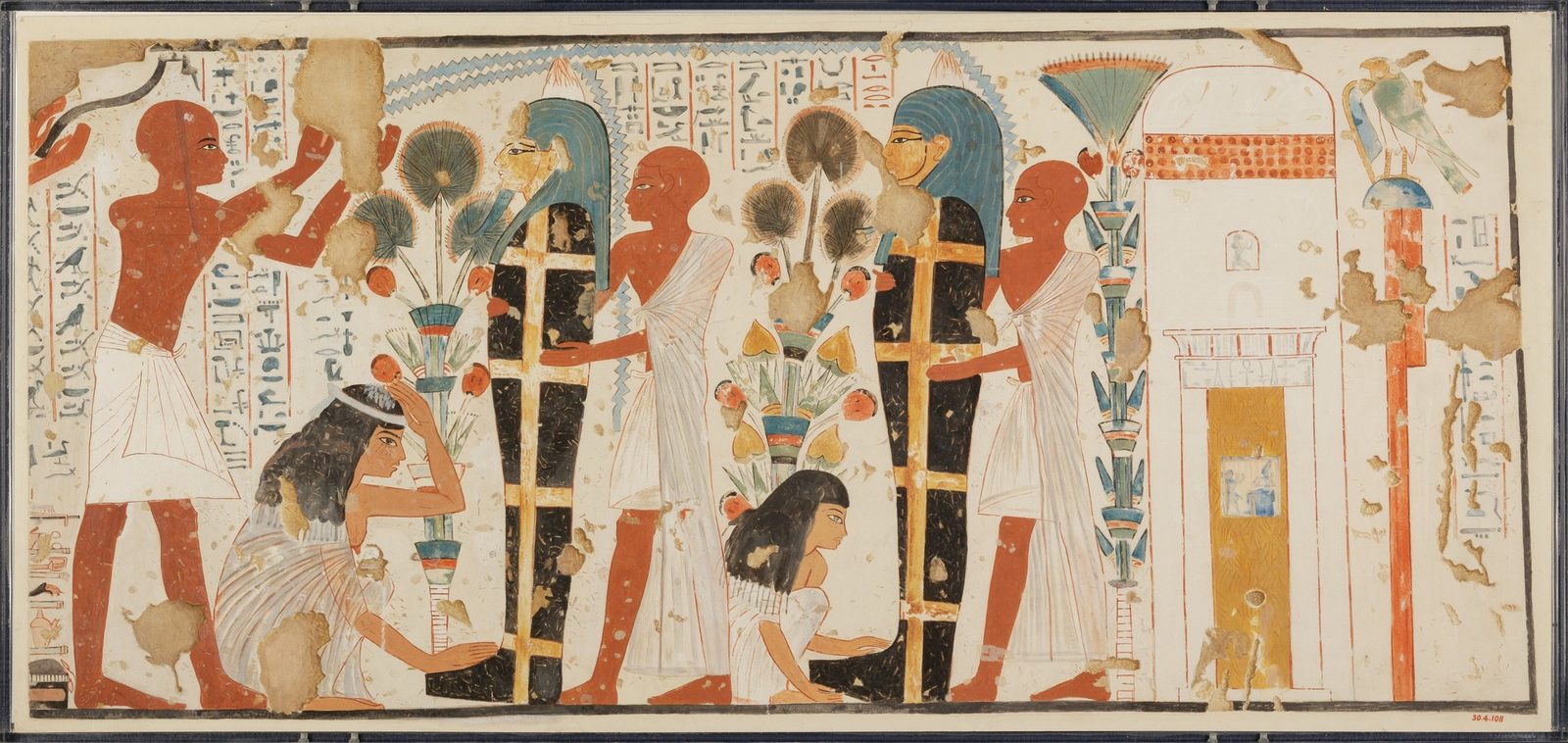
Egyptian painting states what each thing is: a frontal eye in a profile face, everyone on one line
- Artist
- Charles K. Wilkinson
- Title
- Purifying and Mourning the Dead, Tomb of Nebamun and Ipuky
- Date
- ca. 1386–1330 BCE
- Medium
- Tempera on paper
- Image
- Public domain (CC0)
Open in Simple Art
Watch this story on iPhone and iPad, with offline downloads and a painting every day. This one is free in the app.
About 3 minutes of looking, in 10 parts.
Tomb of Nebamun and Ipuky
A funeral, read left to right like a line of text. Everyone stands on one line at one size. Nothing gets smaller with distance or casts a shadow, and no part of this was drawn from a viewpoint.
And an honest complication
The scene comes from a Theban tomb of about thirteen hundred BCE, but this sheet is a twentieth-century copy in tempera on paper, made by Charles Wilkinson. That matters more than you would expect.
One line to stand on
The spatial system is a single groundline near the bottom. Every figure's feet rest on it and every coffin base sits on it, and below it there is no floor and no receding surface at all.
The eye gives it away
Here is the convention everyone half remembers. Skull, nose, lips and chin are in strict profile, and set into that profile face is a complete almond eye with a round iris, drawn as if you were looking at him head on. The shoulders are square to you; the legs below are in profile again.
Flat, and still the subject
The coffin is flat black with gold bands and no shading anywhere, and it is plainly what this half of the picture is about, because it is the darkest thing on a pale ground. Contrast alone makes it the focal point.
Colour as a code
The kneeling mourner raises a hand to her head, with tears drawn as short strokes below the eye. Her skin is a pale orange-tan, clearly lighter than the men's red-brown. The colour is a code for who she is, and has nothing to do with how light fell on her.
Text is not caption
The hieroglyphs are painted with the same flat fills and the same contour as the people beside them, inside a ruled grid of thin red lines. Word and image share one surface, laid out with equal care.
A motif, not a plant
The offering stand has flat blue-green fans and orange discs for fruit, near-symmetrical around a stem, nothing foreshortened or overlapping. It is a designed sign that means offering.
Pushed back by line weight
The shrine at the right is ruled lines and pale fills, drawn far more lightly than the figures, with thin contour and weak colour. It sits back in the picture without being smaller, bluer or further away. The weight of the line does the work.
He painted the damage
This tan shape cuts straight through a painted arm. It is a loss, and Wilkinson painted the bare mud plaster exactly as he found it, straw fibres and all, instead of inventing what was gone. Once you have seen one, you find them all over the sheet.
Look closer
8 details, each checked against a close-up of the picture.
-
the priest's head and shoulders
The head is drawn in strict profile but the eye inside it is drawn frontally, as if seen head-on, and the shoulders are turned square to the viewer above legs in profile.
This is the convention everyone half-remembers, and here it is undeniable. The skull, nose, lips and chin are drawn in strict profile. Set into that profile face is a complete almond-shaped eye with a round iris, drawn as though you were looking at the man head-on. The shoulders are square to the viewer while the legs below run in profile. Each part of the body is shown from whichever angle identifies it most clearly, and the parts are then assembled. The skin is a single flat red-brown with no modelling of any kind.
-
the mummy case
The coffin is flat black with gold bands and a blue striped headdress, with no shading or modelling anywhere on it.
Flat black with gold bands, a blue-green striped wig, a gold face, and a red ointment cone on top. There is no shading on it anywhere, and yet it is unmistakably the subject of this half of the picture, purely because it is the darkest thing on a pale ground. The speckling through the black is not brushwork: it is chopped straw in the wall's mud plaster, faithfully recorded by the copyist. An attendant's arm crosses in front of the coffin, so overlap IS used here - just never to push anything into distance.
-
the kneeling mourner
The mourner kneels with one hand raised to her head in a fixed gesture, drawn with shoulders frontal and legs in profile like every other figure.
She kneels with one hand raised to her headband. Profile face, frontal almond eye, and beneath that eye a short run of dark strokes that read as tears. Her skin is a pale orange-tan, clearly lighter than the men's red-brown - and that is a code for gender, not a record of how light fell. Correcting my own claim: her torso sits closer to profile than the standing figures do, so the frontal-shoulder rule is relaxed for kneeling figures rather than applied everywhere.
-
a painted loss
The irregular tan patches are painted losses - the copyist reproduced the wall's missing plaster rather than inventing what was gone.
A large irregular tan shape cuts straight through a painted arm. It is a loss - a patch where the ancient paint had gone - and the copyist painted the bare mud plaster exactly as he found it, straw fibres and all, rather than inventing what was missing. Once you see one, they are everywhere on this sheet.
-
hieroglyph columns
Columns of hieroglyphs are painted with the same flat colours and the same contour line as the figures beside them.
Vertical columns of blue-grey hieroglyphs, separated by thin ruled orange-red lines, painted with exactly the same flat fills and contour as the human figures next to them. Birds, hands and water signs read clearly as shapes. The text sits inside a ruled grid, so it has been laid out with as much care as the figures - it is not caption, it is part of the surface.
-
the groundline
Every figure's feet rest on a single straight groundline near the bottom edge, with no ground plane drawn above or below it.
Every foot and every coffin base rests on one single dark horizontal line near the bottom edge. Below it is plain cream and then the border. There is no floor, no ground plane, no receding surface - just a line to stand on. The feet are in profile and both of them show the inner arch, which is another fixed convention rather than an observation.
-
offering stand with lotus
The plants are flat shapes of blue-green and orange with dark contour lines, repeated in near-symmetry rather than observed from life.
Fan-shaped palm and papyrus forms in flat blue-green, outlined in orange and dark contour, with plain orange discs for fruit, all arranged in near-symmetry around a central stem. Nothing is foreshortened and nothing within the plant overlaps anything else. It is a designed motif that means 'offering', not a study of a specimen.
-
the shrine and its door
The shrine at the right is built from parallel ruled lines and flat fills, its door a plain ochre rectangle with a small figure in a niche above.
The shrine is made of ruled parallel lines and flat fills: an arched white structure, a band of orange dots, a cornice carrying an ankh frieze, and an ochre door - which is not plain after all, it has vertical woodgrain strokes and a small panel. The whole building is drawn far more lightly than the figures, in thin red-orange contour with pale washes, so it recedes in emphasis without receding in space.
A tomb painting and its copy
What this sheet is
This isn't an ancient object. It's a full-size copy in tempera on paper, painted by Charles K. Wilkinson, of part of a funeral scene in the tomb of Nebamun and Ipuky (TT 181) at Thebes. [1] The Met's record dates the copy to 1920-21 and the original painting to about 1386-1330 BCE, during the reigns of Amenhotep III and IV. [1] But a caption in another Met essay, apparently for the same facsimile, gives about 1930, the year the museum accessioned it, so the copy's date is reported differently. [2][1]
The tomb of two sculptors
The tomb's owners were Nebamun, head sculptor of Pharaoh, and Ipuky, sculptor of Pharaoh, in the late Eighteenth Dynasty. [6] It sits at El-Khokha in the Theban necropolis, where Wilkinson painted this copy. [1] The scene shows the funerals of both men, who died at different times. [1]
Wilkinson himself proposed a reading of the women. In his caption, the scene may show twice-widowed Henutnefret mourning her two husbands, caressing Ipuky's feet as a young girl and, as an older woman, casting dust on her head for Nebamun. [5] He admired the ancient painter who, "with true economy", showed the rites for both men in one picture. [5]
Why the Met copied tombs
The Met's trustees created the Department of Egyptian Art and announced an Egyptian Expedition on 15 October 1906. [2] From the outset the Expedition aimed to record the monuments as fully as possible, especially the decorated tombs of Thebes, and in 1907 it set up a Graphic Section under the British Egyptologist Norman de Garis Davies. [2] Over the next thirty years Davies, his wife Nina and a group of young artists painted more than 350 facsimiles. [2]
The department was cautious about collecting original paintings, since they usually belong to standing monuments. [5] Davies said the copies would illustrate "the history of draughtsmanship and painting", and they also helped explain objects in the collection. [5]
The artists traced the walls, often by candlelight, then painted inside the tombs by sunlight reflected in with mirrors. [3] The earliest copies were in watercolour, but tempera soon became the standard because it better matched the matt opacity of ancient paint. Most copies record damage and losses at a scale of 1:1. [3] Met sources give slightly different end dates for the programme, 1937 in some and 1941 in another. [4][5][3]
Charles Wilkinson at Thebes
In 1920 Davies needed a new assistant trained in the fine arts and asked the Slade School in London, where Wilkinson had just finished his training. [5] The school's director, Henry Tonks, recommended him, believing that winters in Egypt would help a young man left weakened by active service in the First World War. [5] Wilkinson found the Graphic Section's methods well established and became its one full-time copyist, a post he held for twelve years. [5]
He later turned to the ancient Near East. By 1983 he was Curator Emeritus of the Met's Department of Near Eastern Art, and he's credited with founding its Department of Ancient Near Eastern Art. [5][7]
From working copy to museum object
About half the facsimiles went on show in 1930 with a small catalogue by Ambrose Lansing. And virtually all were placed on view in 1976, when the first phase of the reinstalled Egyptian galleries opened. [5] This sheet entered the collection in 1930 through the Rogers Fund. [1] Writing as the last surviving member of the Expedition, Wilkinson described the copies in a Met Bulletin first issued in 1979. [5][1]
The Met now values the facsimiles as records, because monuments in Egypt continue to be damaged, and as evidence of how the tombs looked in the early twentieth century. [5][3] The bare patches Wilkinson painted are part of that record. [3]
- Purifying and Mourning the Dead, Tomb of Nebamun and Ipuky (30.4.108): object record, provenance and references . The Metropolitan Museum of Art
- The Egyptian Expedition, 1906–1936 (Diana Craig Patch) . The Metropolitan Museum of Art
- Egyptian Wall Paintings in Gallery 132 . The Metropolitan Museum of Art
- The History of the Department of Egyptian Art (Catharine H. Roehrig) . The Metropolitan Museum of Art
- Charles K. Wilkinson and Marsha Hill, Egyptian Wall Paintings: The Metropolitan Museum of Art's Collection of Facsimiles (1983), publication page and PDF . The Metropolitan Museum of Art (MetPublications)
- Theban tomb list . Digital Egypt for Universities, University College London
- Wilkinson, Charles . Dictionary of Art Historians