A laugh and a stolen treat
How Judith Leyster's quick, loose brush keeps a moment of mischief on the move
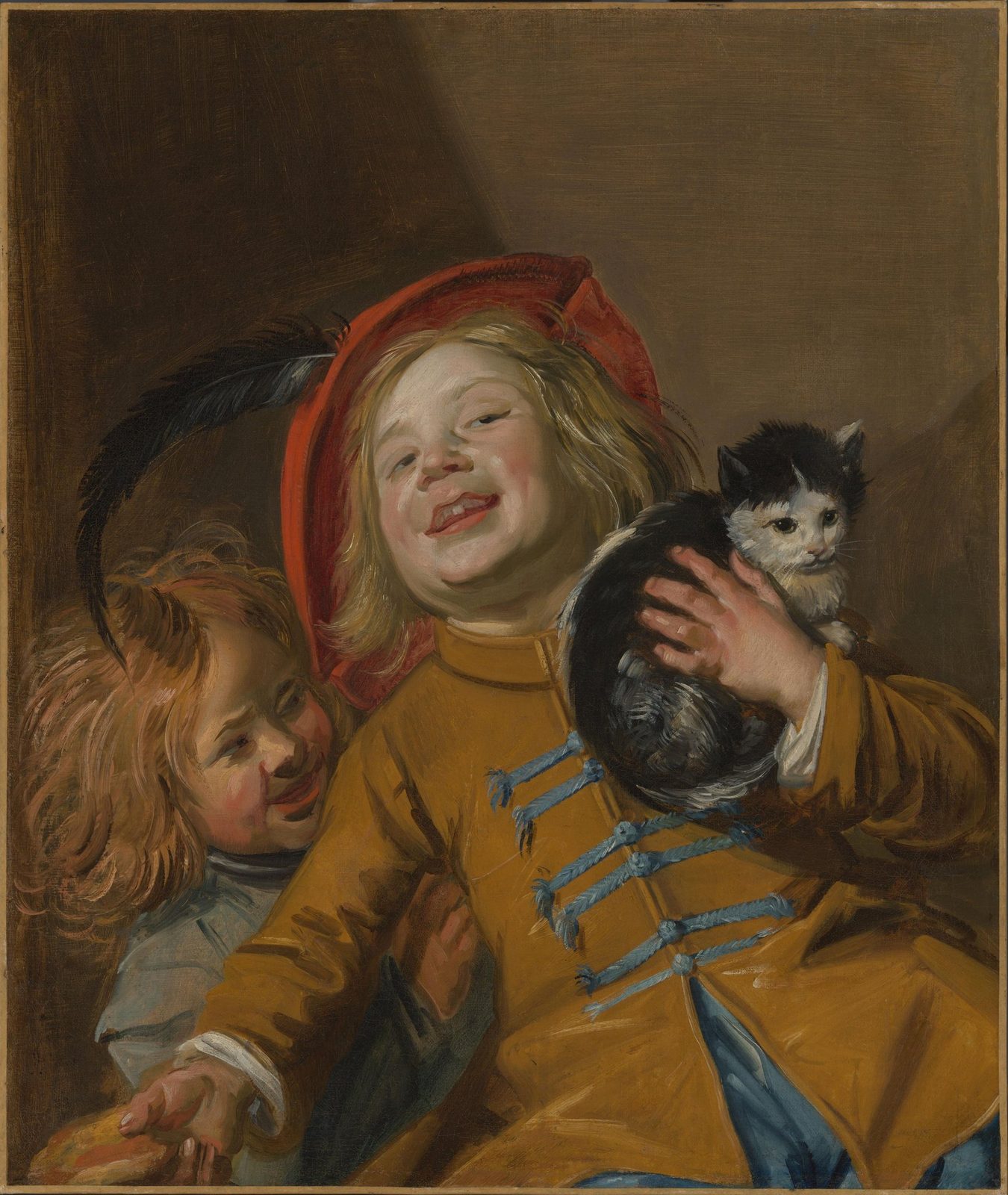
- Artist
- Judith Leyster
- Title
- Two Children with a Cat
- Date
- c. 1630
- Medium
- Oil paint on canvas
- Museum
- Rijksmuseum
- Image
- Public domain (CC0)
Open in Simple Art
Watch this story on iPhone and iPad, with offline downloads and a painting every day.
About 4 minutes of looking, in 10 parts.
A laugh caught mid-breath
A boy in a red hat laughs past us, a kitten clamped against his chest. Behind him a smaller child leans in, grinning. It looks like a moment that will be over in a second, and the painting is built to keep it moving.
Judith Leyster, about 1630
This is Two Children with a Cat, painted in oil on canvas around 1630 by Judith Leyster, who signed it. The museum describes two young children in festive clothes teasing a young cat, and points to her loose painting style as the source of its liveliness.
A triangle of figures
The group makes a rough triangle. The red hat sits near the top, and the yellow coat spreads out towards the lower corners. Your eye tends to travel from the open mouth across to the kitten's face, down to the smaller child, and back up the row of blue fastenings.
Light from the upper left
The light seems to come from the upper left. Look at the rim of the red hat, where a pale streak of red catches it, while the inside of the brim sinks to a deep, almost black red. The face is brightest on that side too.
The stolen treat
Now drop to the lower left corner. According to the museum, the boy has just snatched a treat from under the cat's nose, and is keeping the kitten away from the other child's grabbing hands. This hand is blocked in with a few broad strokes, simplified rather than carefully drawn.
Teeth as a few white dabs
Back up to the laugh. The mouth is one dark shape, and the teeth are just a few small dabs of white laid on top of it. No single tooth is drawn. The dark gaps between the dabs do that work, and the grin stays quick and loose.
White fur over grey
Now the kitten. Its white fur appears to be short strokes of warm white over a cooler grey, so the grey reads as shadow. The black fur on its head is longer and rougher, and where black meets white the edge is broken rather than outlined.
Blue on yellow
Follow the blue fastenings down the yellow coat. They are thick, saturated strokes that seem to sit on top of the ochre, each with a small knot. These cool blues against the warm yellow stop that big mass of coat from feeling heavy.
Fingers sinking into fur
Look at the hand holding the kitten. The knuckles carry small bright touches of pink, but the fingertips soften into the black fur, with no hard line where skin ends. That softness lets you feel the fur under the fingers.
Two ways to lose an edge
Compare two soft edges. On the kitten, black and white fur meet in short, broken strokes. On the boy's hair, long strokes of blond simply thin out into a brown background of a similar tone, so the outline seems to dissolve.
Look closer
10 details, each checked against a close-up of the picture.
-
Laughing face
The teeth are rendered with small, bright white dabs against a dark open mouth.
The crop centers on a laughing child's tilted face, executed with broad, gestural strokes of creamy flesh tones over a darker underlayer. The mouth is open in a wide grin; the interior is a dark maroon-umber, and across the upper edge sit three to four small, opaque white dabs that read as teeth catching the light. Eyes are reduced to slanted almond shapes with dark upper-lid strokes and a small touch of white in each, and the cheek is built up with rosy pinks blended wet-into-wet into the paler forehead. Hair is sketched with long, sweeping strands of ochre and cool brown that feather off the edge of the face without a hard contour, and a slash of red-orange (the hat) frames the upper border.
-
Cat's fur
The white fur is created with short, directional strokes of white over a grey underlayer.
The cat's white fur is built from a cool, slightly bluish-grey underlayer, with warm off-white and cream strokes laid on top in short, directional dabs that follow the curvature of the head, neck, and chest. The strokes are most visible on the forehead and cheek, where individual marks of light and mid-tone grey are stacked to model volume rather than blended smooth. The black fur on the crown and ear bases uses longer, more vertical strokes in deep umber and near-black, with ragged, broken edges where the two furs meet. A soft pink-tinged nose and yellow-green eyes with dark pupils anchor the face amid this loose handling.
-
Blue smock lacing
The blue ribbons are applied as thick, saturated linear marks that sit on top of the ochre fabric.
The crop isolates the bodice of the ochre smock with six blue ribbon laces applied as diagonal linear strokes. Each ribbon is built up in thick, opaque paint that reads as physically raised against the flatter ochre ground beneath. The ribbons sit in parallel pairs angled roughly top-left to bottom-right, with small knot-like bulbous forms where they meet at the center. Where ribbons cast a slight shadow, the blue is modulated toward green-grey; where lit, the edges are sharpened with paler blue-white touches. The ochre fabric is brushed with directional sweeps that conform to the shape of the body, and its surface shows fine age cracking but little impasto.
-
Holding the cat
The fingers are softly blended into the cat's fur, with a bright highlight on the knuckles.
A left hand grips down into black fur with fingers spread and slightly curled. The lit side (upper-left) shows warm pinks and ochre-orange on the bent joints, with the highest values sitting as opaque dabs on the proximal knuckles of index and middle fingers. Fingertips dissolve into the dark mass through soft, blurred edges where warm mid-tones feather into near-black; the lower finger edges become indistinguishable from fur. Surrounding the grip, loose grey-white strokes suggest separate cat hairs against a darker ground, while a yellow-ochre sleeve edge appears at the lower right. The surface shows fine craquelure and dry, dragged strokes typical of aged oil.
-
Red hat highlights
The top edge of the red hat has a bright, pale-red highlight where the light hits the rim.
The crop shows the top half of a laughing child's face framed by a red hat. A thin, bright pale-red highlight runs along the upper-left rim of the hat, contrasting with the deep, almost blackish-red shadow that fills the hat's interior and the right side. Beneath the hat, loose ochre-blonde hair is laid in with directional strokes that turn with the skull, brighter on the lit side and cooling into greenish-brown on the shadowed right. The forehead and left cheek read as warm pinkish flesh against a dark olive-brown ground, with visible craquelure in the paint film.
-
Hair and background
The blond hair of the child blends softly into the brown background with minimal hard edges.
The crop is dominated by long, downward-sweeping strokes of ochre and umber hair, interlaced with thin, loaded white highlights that follow the same diagonal flow toward the lower right. At the upper edge a wedge of saturated red (the hat) intrudes, and the lower portion holds a dense black mass (the cat) with a small wedge of warm pinkish flesh. The right margin of the hair does not terminate in a hard contour; individual strands and feathery half-strokes trail off into the warm brown ground, so the silhouette is read as a soft, frizzy edge rather than a line. The brown background itself shows thin, streaky scumbles of slightly warmer and cooler tans, with no uniform field, which helps the hair's tips sink in by value and hue proximity.
-
Smaller child's eye
The eye is a dark dot with a tiny white pinpoint of reflected light.
The crop isolates the smaller child's eye, painted as a single small dark brown-black mark with one off-white pinpoint dab sitting just inside its upper edge to suggest a catchlight. Around it the flesh is built with broad, visible strokes in pale ochre-cream along the brow ridge above, warm rose-pink on the cheek below and to the left, and cooler olive-brown shadows to the right where the form turns away from the upper-left light. The eye's upper edge is softened by a slightly lighter scumble that suggests a moist lid, while the lower edge blends wetly into the pinkish cheek. No outlines are drawn; the eye's shape is carried entirely by the dark dot's value contrast against the surrounding lit flesh.
-
Ochre smock folds
The folds of the yellow smock use deep brown shadows and pale yellow highlights for volume.
The crop is dominated by a warm ochre garment occupying roughly the central and right two-thirds, modeled into rolling ridges and deep hollows. Shadow recesses along the left and lower edges shift from a saturated rust-brown toward a murky olive-green, while the raised planes carry broad, scumbled strokes of pale lemon-yellow that sit on top of the mid-ochre. Edges between lit and shadowed faces are softened rather than sharp, with the darkest accents left as thin glazing-like streaks rather than crisp lines. In the upper right, blue-grey ribboning with small knotted bosses intrudes, contrasting cool accents against the warm field, and the craquelure network confirms a fairly aged oil surface.
-
Feather detail
The black feather consists of long, sweeping, dark brown and black strokes.
A single sweeping dark arc curves from upper right down through the left, set against a dark brown ground laced with fine craquelure. The arc is built from long, confident strokes: a deep umber/brown underlayer with near-black passages, and a cool grey-blue highlight dragged along the upper edge that reads as a wet sheen on a glossy surface. Below the arc, loose ochre, sienna, and russet strokes interlock to suggest hair or fur, with quick reddish accents breaking the warmer mass. A saturated red-orange vertical band anchors the right edge, its edges crisp against the dark field. The contrast between the hard right edge of the red and the soft, broken termination of the dark arc on the lower left shows deliberate handling.
-
Lower hand
The fingers of the lower hand are painted with broad, simplified shapes rather than precise anatomy.
The crop isolates a cluster of fingers rendered in chunky, block-like strokes of warm rose-pink, terracotta, and umber. Highlights ride the upper edges of each digit as small dabs of pale pink and white-tinged flesh tone, while the undersides drop into dense maroon and brown. Edges between fingers are soft and merged rather than crisply drawn, and the contour against the muted olive background is broken into a few broad swipes. The surface shows fine craquelure and a few long directional drags of the brush that flatten anatomy into planes.
Two Children with a Cat in context
A Shrovetide tease
The Rijksmuseum's Dutch catalogue description identifies the clothes as festive Shrovetide costume, worn by two young children teasing a young cat [2]. Its English text adds that the cat seems afraid of the little boy and might lash out, turning the fun into 'a mix of laughter and tears' [1].
The painting is signed. The RKD's study of Frans Hals's workshop transcribes a monogram with the remains of a date at the lower left, 'JL* 16..' [5]. Because the last digits are lost, the date rests on style. The museum's record gives c. 1630, while its wall text and its 'In detail' page give 1629 or c. 1629 [1][2][3]. The RKD notes that Leyster's dated paintings survive from 1629 onwards, which is why the picture is usually placed around 1629-1630 [4].
A face from Hals's workshop
According to the RKD study, the laughing boy is based on the same model as a Laughing boy with a flute known in several versions from Hals's workshop [5]. Its author argues that Leyster could only have found this model in that workshop, and that she turned the head to the left to fit a composition built on repeating diagonals [4]. The result, in the study's words, is her most 'Halsian' painting [4]. Later copies kept the borrowed boy and dropped her second child [4].
The documents fit a close connection without proving formal training. The National Gallery in London says that in about 1629 she was probably a pupil of Hals, and that in 1631 she witnessed the baptism of one of his children [8].
Engraved as a Hals
Cornelis Danckerts (1604-1656), an engraver and art dealer from a family of printers, reproduced the composition in a copper engraving now in the Rijksmuseum (RP-P-1885-A-9027) [6]. The print is inscribed 'f. Hals pinxit', even though the painting it copies carries Leyster's monogram [6]. Its verse asks whether the one who laughs is truly happy or hides pain [6]. And Hofrichter read the moral as a reference to the 'choleric inscrutability of cats' [5].
The RKD study argues that the Hals inscription cannot be dismissed as a slip, since engraving was laborious, and suggests that Leyster painted the picture in Hals's workshop under his supervision [4]. That reading remains an argument rather than a documented fact. The attribution has moved over time: C. Grimm catalogued the painting in 1972 and 1974 as after Hals, but listed it as Leyster's in 1990, as do F.F. Hofrichter's 1989 monograph and the 1993 Haarlem and Worcester exhibition catalogue [2].
A short, well-documented career
Leyster was 18 or 19 when a Haarlem poet praised her talent. Her earliest signed and dated paintings, The Jolly Drinker and The Serenade, both of 1629, are in the Rijksmuseum [7]. She joined the Haarlem painters' guild in 1633 and later disputed an apprentice with Hals, receiving only partial compensation [7]. The National Gallery notes that she had three pupils in 1635 and married the painter Jan Miense Molenaer in 1636, after which few of her works are known [8].
After her death she was largely forgotten until the late nineteenth century, when scholars recognised her monogram, JL with a shooting star, on paintings credited to others [7]. The Rijksmuseum notes that only about 20 of her paintings survive [3]. This one is on loan to the museum from a private collection [1].
- Judith Leyster, Two Children with a Cat (SK-C-1846): object record . Rijksmuseum, Amsterdam
- Two Children with a Cat (SK-C-1846): Linked Art data record, including description and literature . Rijksmuseum, Amsterdam
- In detail: Two Children with a Cat . Rijksmuseum, Amsterdam
- Frans Hals and his workshop, 1.10: A connection with Judith Leyster . RKD Studies, RKD Netherlands Institute for Art History
- Frans Hals and his workshop, catalogue A4.2.7 - A4.2.11 (A4.2.10: Judith Leyster, Two children with a cat) . RKD Studies, RKD Netherlands Institute for Art History
- Frans Hals and his workshop, documentary prints C11 - C20 (C15: Cornelis Danckerts) . RKD Studies, RKD Netherlands Institute for Art History
- Judith Leyster (Dutch masters story) . Rijksmuseum, Amsterdam
- Judith Leyster (1609-1660): artist biography . The National Gallery, London