Still faces, moving world
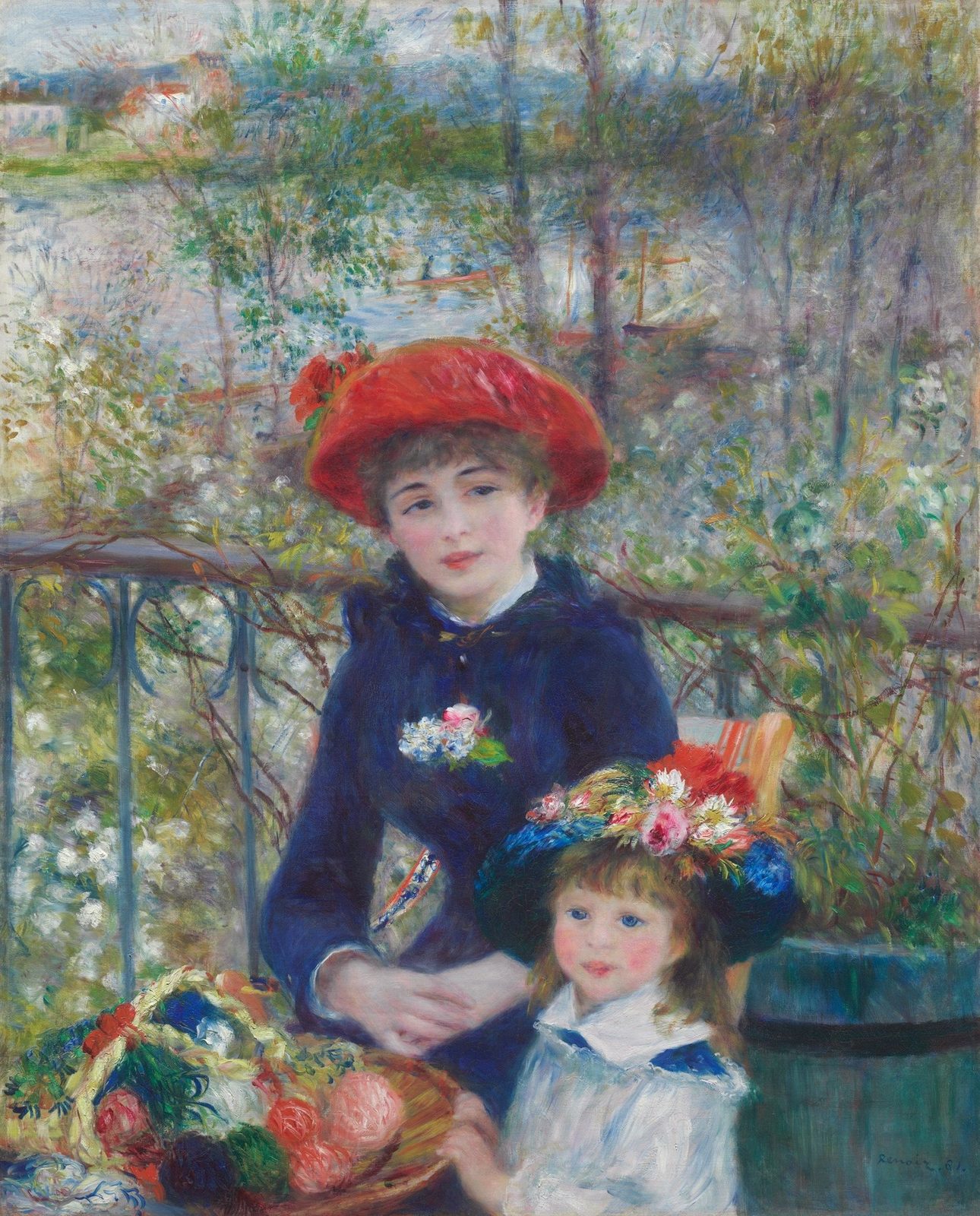
Renoir keeps two faces calm and carefully handled while the river, trees and flowers around them break into loose touches of colour
- Artist
- Pierre-Auguste Renoir
- Title
- Two Sisters (On the Terrace)
- Date
- 1881
- Medium
- Oil on canvas
- Museum
- Art Institute of Chicago
- Image
- Public domain (CC0)
Open in Simple Art
Watch this story on iPhone and iPad, with offline downloads and a painting every day.
About 4 minutes of looking, in 10 parts.
Two Sisters (On the Terrace)
A young woman in a red hat and a little girl in a flowered hat sit close together on a terrace. Behind them, a river and trees dissolve into flecks of colour. Watch how differently the faces and the world around them are painted.
Renoir, 1881, oil on canvas
Pierre-Auguste Renoir painted this in 1881, on the terrace of a restaurant at Chatou, beside the Seine. Despite the title, the museum notes that the two models were not related. He showed the picture at the Impressionist exhibition the following year.
A triangle in front of a rail
The two figures make a broad triangle, with the red hat near its top and the basket and the girl's shoulders along the base. The railing runs straight across behind them, dividing the terrace from the river, which rises almost to the top edge.
A red hat without an edge
Start with the older girl. Her hat is laid in with broad, curving strokes of vermilion and crimson, and along its top it has no hard edge, melting into the greens behind. Her face is gentler: pale pinks and peach, with cool lavender-grey in the shadows.
The younger girl's face
Now the younger girl. The museum describes Renoir's faces here as controlled and almost porcelain-like, and from a step back that's how hers reads. Up close it looks like small dabs of pink and rose over a creamy peach, softened wherever they meet.
A hat full of flowers
Above her face, the flowers on her hat are a different world. Short, comma-shaped dabs of red, pink and yellow crowd together on a deep blue hat, and the white daisy petals look like the last touches, laid on top.
Flowers on blue flannel
The older girl wears the blue flannel of a woman's boating outfit, with a spray of flowers pinned to it. The flowers are thick dabs of white and cream that seem to stand up from the surface, while the blue around them is brushed in longer, broken strokes.
A railing that comes and goes
Follow the railing to the left. Its iron curves aren't drawn as continuous lines. They're made of short strokes that start and stop, and in places the leaves and spots of light seem to eat into them. Thin reddish branches cross in front.
Coloured wool in the basket
At the lower left, the girl's hand rests on a basket that the museum identifies as holding skeins of brightly coloured yarn. They echo the flowers on her hat. Coral, straw yellow and blue-green sit next to each other here, kept separate rather than mixed.
Looking past the hat
Look past the red hat to the river. The water and far bank are pale blues and off-whites in small, unresolved flecks, with no detail at all. Against that soft, cool haze, the warm red of the brim seems to come forward.
Look closer
8 details, each checked against a close-up of the picture.
-
Older Girl's Face and Hat
The red hat is rendered with broad, curved strokes and lacks a hard outline against the background.
The crop centers on a young woman's head and shoulders beneath a wide, vivid red hat. The hat is built from broad, curving strokes of vermilion, crimson, and warm rose that sweep from the crown down toward the brim; the upper edge of the red dissolves into the green-and-white foliage rather than being a hard line, while the lower edge tucks behind the forehead with a slightly darker crimson note. Her face is a soft mosaic of pale pinks, peach, and cool lavender-grey shadows, with the brightest highlights catching the bridge of the nose, the left cheekbone, and the inner eye corner. The lower third shows a dark blue collar/dress with cobalt and Prussian blue strokes, set against loosely broken green, blue, and white background foliage. Edges throughout are intentionally soft—cheek against hair, hair against hat, hat against sky—creating that characteristic Impressionist haze.
-
Younger Girl's Face
The cheeks and chin are built from small dabs of pink and rose over a creamy peach base, softly merged where they meet, with no hard contour.
The crop isolates the younger girl's face against a dark, loosely brushed background. Her cheeks are constructed from clustered dabs of cool pink and rose that sit on top of a creamy peach base, while the chin shows warmer peach and ochre strokes blended into pale ivory along the jaw. The lips are a single concentrated stroke of coral-pink with a darker accent at the corner. Edges are soft throughout — there is no hard contour line around the cheek or chin; the flesh dissolves into the surrounding hair and shadow through adjacent dabs rather than blending on the surface. The eye area shows a cooler blue-white highlight on the lower lid contrasting with the warm cheek directly below.
-
Flower Basket
The basket contains distinct clusters of red, yellow, and blue-green paint that are not blended into a single mass.
The crop centers on a wicker basket overflowing with blooms, rendered in thick, separate dabs rather than smoothed transitions. Distinct clusters are clearly readable: a mass of coral-red and pink rose forms on the right (roughly the lower-right third), warm straw-yellow strokes describing the basket weave across the upper-middle and far right, and cool blue-green foliage passages occupying the left and upper-left quadrant. Edges between these color zones are soft but the hues themselves remain unmixed — red sits next to green next to yellow with only narrow transition strokes bridging the temperature shifts. A pale arm and hand enter from the right, painted in pinks and lavenders that further isolate the warm floral mass against cool flesh tones.
-
Younger Girl's Hat Flowers
The flowers on the hat consist of multi-colored dots and short strokes of red, yellow, and blue.
The crop shows the floral cluster atop a blue hat, built from short, comma-shaped dabs of pigment with soft, feathered edges that blend into neighbors rather than sit in hard contour. White daisy-like blooms with yellow centers are flanked by fuller pink-and-rose flowers and small red-orange buds clustered at upper right. The hat surface itself reads as deep blue with brighter turquoise accents, and warm orange touches at the upper edge create a temperature contrast against the cooler blues on the left. Layering is loose: darker strokes peek between lighter ones, producing an optical shimmer rather than a flat fill. Below the floral mass, loose brown and green strokes define the hair and a hint of forehead with similarly broken marks.
-
Railing Detail
The metal railing's curves are broken and dissolve into the surrounding foliage and light.
The crop isolates a section of a wrought-iron style railing rendered in cool teal-blue (around #2E6E7E) set against a fractured field of foliage greens, ochres, and broken whites. The rail's curves are not drawn as continuous lines; instead, the arcs are constructed from short, hatched strokes that start and stop, with the lower and inner edges literally eaten by adjacent yellow-greens and pale dabs of sunlight. Reddish-brown branches (around #8B3A2A) cross the foreground as thin, calligraphic marks, often passing over the rail so that depth is established by overlap rather than by tonal recession. Edge quality is highly variable: along the upper-left of each loop the paint is left broken and granular, while the lower contours are reinforced with a slightly darker, more saturated stroke that anchors the form against the brighter background.
-
The Background Gap
The distant water and sky are painted in pale blues and whites, creating a sense of aerial perspective.
The crop's middle-left band shows the distant background rendered in pale powder blues, off-whites, and faint lavender, with the marks laid down in short, broken dabs that barely resolve into discrete shapes. Above this, greenish foliage is built from cooler, bluer greens that lose chroma as they near the waterline, and on the right, vertical strokes of dark olive and aubergine read as tree trunks interrupting the distance. A horizontal red-orange stroke cuts across mid-frame: a long rowing boat with two figures on the water. The lower third is dominated by a saturated, curving mass of vermilion and rose, the underside of the red hat, whose crisp value contrast against the pale wash makes the background recede.
-
The Corsage
The white flowers on the blue dress are painted with thick, impasto-like dabs of light paint.
The crop shows a dense cluster of flowers — predominantly white blossoms with small pink/red rose-like blooms at the top, set against a deep navy blue dress and flanked by green leaves on the right. The flowers are built from short, thick dabs of light paint (whites, creams, and pale pinks) that sit physically proud of the surface, while the surrounding blue is applied in longer, broken vertical and diagonal strokes that let warmer tones bleed through. Edges between the floral cluster and the dress are soft and irregular, formed by juxtaposed dabs rather than drawn contours, so the eye reads the mass through value contrast alone. Within the white flowers, warm cream and pale yellow dabs nestle next to cool lavender-grey shadows, giving volume without a smooth gradient.
-
Artist's Signature
The name 'Renoir' is visible in the bottom right corner, written in a dark, thin script.
The crop isolates the bottom right corner of the painting, dominated by a blue-green ground that reads as roughly equal parts teal, viridian, and a muted purple-blue. Across the top and bottom thirds, vertical streaks of darker pigment settle into the weave, suggesting thinned paint drawn top-to-bottom. Centered horizontally and set just above mid-height sits the word 'Renoir' in a thin, dark cursive, with a partially legible '81' trailing to the right. The script sits crisp on top of the brushed ground; no halo or scumble softens its edges, and the letters remain readable despite the mottled color beneath.
Two Sisters (On the Terrace) in context
Spring at the Maison Fournaise
The Art Institute's catalogue says this picture closes Renoir's series of boating scenes at the Restaurant Fournaise in Chatou, which began in 1875 [2]. Why he stopped going there isn't known [2]. In the late summer of 1880, busy with Luncheon of the Boating Party, he urged the collector Georges de Bellio to come to lunch at Chatou, calling it the most attractive spot in the countryside around Paris [2].
The catalogue calls Two Sisters the springtime counterpart to that summer feast, with leaves still unfurling and blossom on the trees [2]. On Easter Monday, 18 April 1881, Renoir wrote to the critic Théodore Duret that he was reluctant to leave for a planned trip to England. He said he was struggling with trees in bloom, women and children, and that the weather was fine and he had his models [2].
Who the models were
The seated young woman was Eugénie Marie Darlaud, known as Jeanne, an eighteen-year-old aspiring actress [2]. In 1923 the dealer Paul Durand-Ruel recalled her as her younger sister Anne, who acted as Jane Demarsy and also modelled for Renoir. The art historian François Daulte later identified the sitter as Jeanne [2]. The research of Colin Bailey shows the sisters were daughters of a bookbinder and a brocade weaver [2]. Jeanne entered the Conservatoire in August 1882 and acted on the French stage until 1899. She died in 1914 [2].
The little girl has never been identified [2]. The catalogue points out that the two figures barely engage with each other, or with the basket of wool, an unlikely object to find at a restaurant that rented out boats [2].
A dealer's picture
Durand-Ruel bought the painting from Renoir on 7 July 1881 for 1,500 francs, entering it in his stock book as Femme sur une terrasse au bord de la Seine [1]. The catalogue notes that this was the sum Renoir had reportedly received for a much larger portrait three years earlier, and speculates that the dealer may have commissioned the work [2].
The title Les deux soeurs was assigned for the seventh Impressionist exhibition in March 1882 [2]. Renoir himself had refused to take part, because he thought Gauguin and Pissarro too political. Durand-Ruel lent 25 of his Renoirs from stock instead [2]. The dealer kept this picture for himself for more than four decades, and it was exhibited at least seventeen times while the family owned it [2]. In 1922, the year of his death, it was transferred to the firm's New York branch. Mrs. Lewis Larned Coburn of Chicago bought it on 4 February 1925 for $100,000, and bequeathed it to the Art Institute in 1933 [1][2].
Second thoughts
There are no known preparatory sketches [2]. Infrared and X-ray images show that Renoir changed a good deal as he went. Two figures walking along the far riverside path were painted out and replaced by a single rower in a skiff [2]. A second row of curving decoration on the railing was removed, and heavier foliage behind the figures was replaced with finer, more open leaves [2]. He also reworked the young woman's face, and the outline of an earlier eye is still faintly visible in the X-ray [2]. On the child, he wiped away opaque flesh paint from the cheeks in favour of a thinner, more translucent layer [2].
A turning point
Later in 1881 Renoir travelled to Algeria and then to Italy, where he saw Raphael in Rome and Titian in Florence [3]. According to Wikipedia, the Italian trip convinced him that he had gone as far as he could with Impressionism. In the following years he worked in a harder, more linear style, sometimes called his Ingres period [3].
The catalogue notes a related shift already visible in this picture. In the 1870s Renoir's brushwork treated figure and background alike. In Two Sisters, the figures are modelled with a more controlled brush and barely visible strokes, while the landscape stays loose [2].
- Pierre-Auguste Renoir, Two Sisters (On the Terrace), 1933.455: object record, label text and provenance . Art Institute of Chicago (public API)
- Cat. 11, Two Sisters (On the Terrace): catalogue entry by John Collins, with technical report, in Renoir Paintings and Drawings at the Art Institute of Chicago . Art Institute of Chicago (public API)
- Pierre-Auguste Renoir . Wikipedia