A path of open water
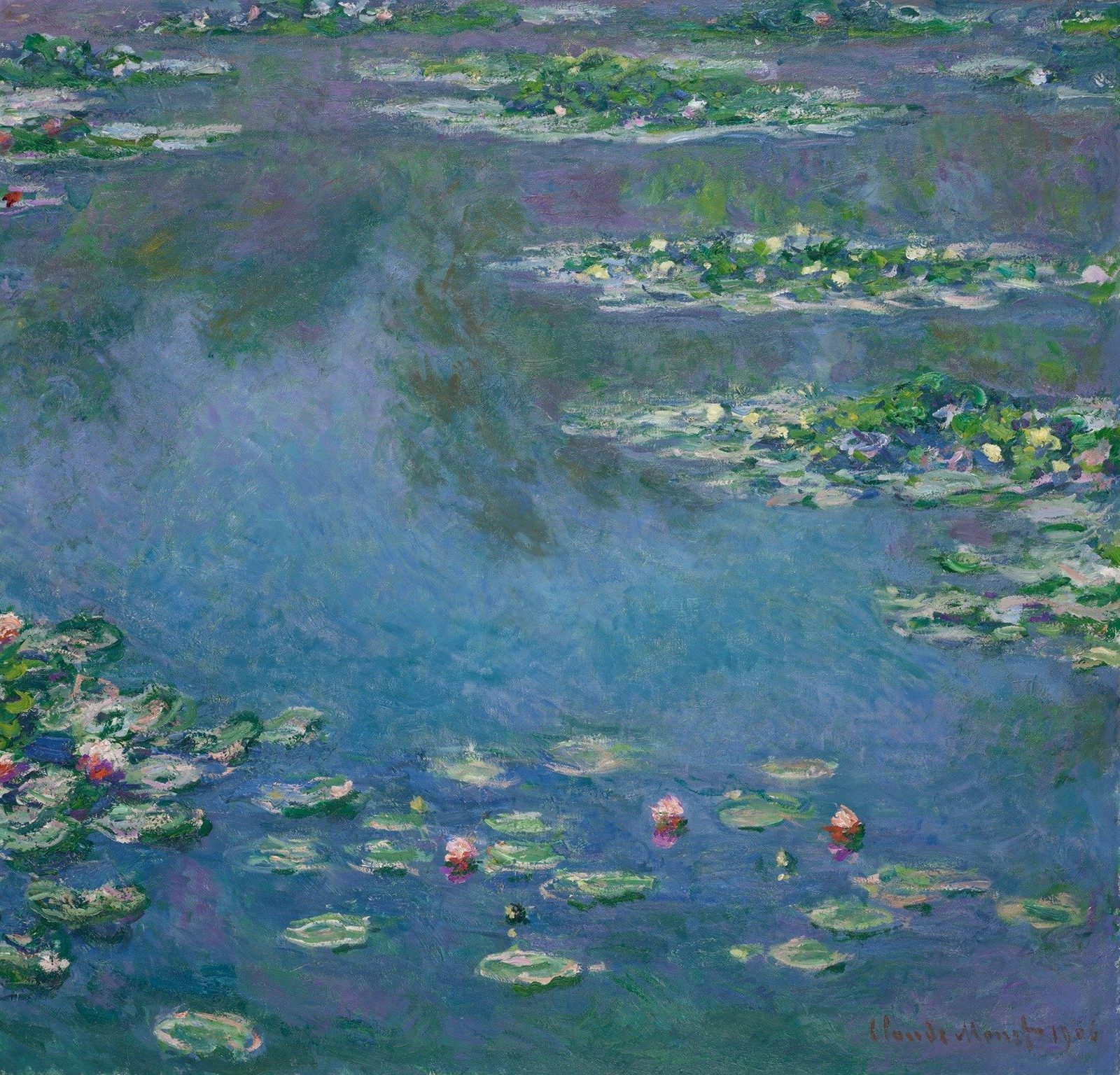
Monet leaves out the shore and the sky, and lets lily pads frame a channel of reflected light
- Artist
- Claude Monet
- Title
- Water Lilies
- Date
- 1906
- Medium
- Oil on canvas
- Museum
- Art Institute of Chicago
- Image
- Public domain (CC0)
Open in Simple Art
Watch this story on iPhone and iPad, with offline downloads and a painting every day.
About 4 minutes of looking, in 10 parts.
Water Lilies
There's no bank here, no sky and no horizon. Just the surface of a pond, with lily pads floating at the edges and open water winding through the middle. Everything above the pond appears only as a reflection.
Claude Monet, 1906, oil on canvas
This is Claude Monet's Water Lilies, painted in oil on canvas and signed and dated 1906. It belongs to a group on this subject made between 1903 and 1908, from the water garden at his property in Giverny. Monet himself called these pictures an obsession.
Lilies framing a path
Follow the shape of the open water. Clusters of lilies at the lower left and upper right frame it, and between them a path of pale blue runs from the bottom of the picture towards the top. With no horizon, the pads alone tell you the water lies flat and stretches away.
Trees and clouds in the water
The brightest passage is the water in the middle, deep teal shading into pale, luminous blue. Look for the soft, dark vertical shapes in it. Those look like trees reflected from the bank, and the paler patches like cloud. The sky is in the picture, but only in the water.
Distant pads in flat bands
At the top, a raft of pads floats on water tinged with mauve. Notice how they're painted: long horizontal strokes of green, violet and cream, with no hard edges. Squeezed into thin bands like this, the pads seem to lie further away.
One pink flower
Down in the foreground is a single water lily. Its petals are dabs of rose, pale pink and white, with a deeper magenta just below, perhaps its reflection. Set among blue water and green pads, that little pink looks far brighter than it would on its own.
Pale touches over a darker pink
Look at the blossoms here more closely. They seem to start with a darker pink, with lighter pinks and near-whites placed on top in small, thick touches that stand slightly proud of the surface. The water around them is laid in broader horizontal strokes.
Where leaf meets water
In the cluster at the lower left, pads and water meet without a border. Teal, deep blue and yellow-green sit side by side, and the edge of each leaf appears simply where one colour gives way to the next.
A pad with a warm rim
This single pad near the bottom shows the layering. It's a green oval, darker in places and lighter where the brush has dragged across it, and along its rim runs a warm band of salmon and ochre. That warm edge helps lift it off the cool water.
Small flecks of light
Scattered across the water here are tiny flecks of pale yellow and near-white. They seem to have gone on late, sitting crisply on top rather than blended in, and they catch your eye like glints on the surface.
Look closer
7 details, each checked against a close-up of the picture.
-
Central pink blossoms
The pink blossoms are created from small, thick dabs of light pink and white paint over a darker base.
The crop centers on two pink blossom clusters floating on a blue water field, each formed by clustered, impasto-like dabs of light pink and near-white paint that sit proud of the surface. Beneath and between these pale dabs, a darker pink-magenta undertone shows through, anchoring the bright marks. The blossom edges are not drawn—rather, they emerge from the contrast of warm light pinks against the cool, broken blue ground, with occasional green and blue dabs mixing optically at the perimeter. Surrounding lily pads are rendered in horizontal sweeps of muted green, sage, and blue-green, their forms implied through tonal shift rather than contour lines.
-
Complementary contrast
A single pink blossom of rose, pale pink and white dabs sits among blue water and green pads, with a deeper magenta touch below it.
A pink-magenta water-lily blossom sits slightly upper-centre, its petals rendered in dabbed strokes of rose, pale pink, and white. Directly beneath and around it, emerald and viridian greens form a reflected foliage mass that anchors the bloom. The surrounding water is built from broken, mostly horizontal strokes of teal, cerulean, and a deep blue near the bottom, with a lighter turquoise band reading as the brightest passage. Edges are all soft—no hard contour separates blossom from water; instead the pink and green are juxtaposed so that each appears more saturated by the other's proximity (pink against green is the classic complementary pair).
-
Upper lily-pad rafts
At the top, a cluster of lily pads in horizontal strokes of green, mauve and cream floats on the water without hard outlines.
The crop shows a raft of lily pads on mauve water, built from short, overlapping strokes that run mostly horizontally, so no single edge reads as a leaf or branch outline. Values stay compressed in a middle-dark register, with mauve and violet-greys woven between darker blue-greens, and a small pale pink-white dab near the lower-centre that breaks the field as the only near-white accent. Edges between colours are softened by adjacent wet-into-wet mixing: olive strokes butt against lavender strokes without a drawn line, producing a smudged, blurred boundary typical of broken Impressionist handling rather than blended smooth transitions. No horizontal hard horizon sits inside this strip; the top edge fades upward into unresolved greys, and the bottom edge dissolves into a brighter watery band below.
-
Lily pad boundary
The edges of the lily pads blend directly into the blue water without a defined border line.
The crop shows a tangle of green and blue pigment masses where lily pad forms meet water. No continuous outline separates leaf from water; instead, the boundary is built from adjacent dabs of cool teal, deep ultramarine, and yellow-green that sit side by side. A small pink-orange blossom is visible in the lower-left quadrant, ringed by cooler greens. White and pale-pink flecks scatter across both the pad and water areas, pulling them together optically. Edges alternate between soft (where wet-into-wet blending is visible) and broken (where dry dabs sit next to bare ground).
-
Cool water gradients
The middle band transitions from a deep teal to a pale, luminous cerulean blue.
The crop shows a horizontal band of water surface rendered in cool tones. The upper-right quadrant holds the darkest passages — a deep teal-green that breaks into separate, feathery strokes, consistent with reflected foliage overhead. Moving down and left, the value lightens and the chroma cools into a luminous cerulean that occupies the central area, applied in short, slightly curved horizontal dashes. The lower portion thins to a paler, slightly lavender-tinted blue with a few warm cream passages peeking through where the paint is more thinly dragged. Edges between zones are wet and soft, not hard: no single stroke is fully outlined, and the transitions rely on adjacent broken colour rather than blended gradients.
-
Surface highlights
Small flecks of white and pale yellow are scattered across the water's surface to simulate light reflection.
The crop is dominated by a cool, mid-value field of teal and blue-green paint representing water, broken by loose horizontal and slightly diagonal brushstrokes. Several flat oval lily pads float in the middle and lower area, each built from a lighter yellow-green center ringed with a darker olive edge, sitting on top of the water without cast shadows. Small, isolated dabs of pale yellow and near-white sit scattered across the water, most notably above and around the lily pads, functioning as the brightest marks in the field. A cluster of pink-coral and magenta flecks occupies the upper edge, and a partial red signature 'Clau…' appears in the lower right.
-
Foreground leaf structure
A foreground pad is built from overlapping strokes of light and dark green, with warm salmon and ochre touches along its rim.
The crop reads as a narrow vertical strip dominated by dark teal-green at the top that gives way to a mid-section cluster of warm ochre and salmon-pink marks against lighter green. Heavy vertical smearing softens every edge so individual brush marks are not crisp, yet the color masses clearly stratify: deep blue-green overhead, ochre/coral accents at center, and a mixed field of sap and olive greens below. Dark green strokes appear to overlap lighter green ones, and the warm ochre sits as a brighter interrupting layer on top, consistent with broken Impressionist handling. Edges between strokes are feathered rather than hard, suggesting wet-into-wet blending rather than crisp alla prima placement.
Water Lilies (1906) in context
Digging a pond
Monet bought his house at Giverny in 1890 [1]. In 1893 he bought a plot below the property, across the road and the railway, and asked the Prefect of the Eure for permission to dig a basin fed by an intake from an arm of the river Epte [3]. He planted water lilies ordered from the Latour-Marliac nurseries, and in 1901, after buying a neighbouring plot, he tripled the size of the pond [3].
The Art Institute says the water garden became his main subject for the next two and a half decades, featuring in around 250 paintings [1]. Its catalogue dates the start of this group to 1903, after a significant renovation of the garden [2].
Losing the bank
Monet's earlier pond pictures, like the Art Institute's Water Lily Pond of 1900, kept the usual zones of land and water, a glimpse of sky, and the Japanese bridge he had built over the pond [2]. From 1903 he shifted his viewpoint. In most works he dropped the sky altogether, leaving it only as a reflection [2]. Some still hold a clue to the bank, like a sliver of shore in a Denver canvas or overhanging foliage in one at Dayton, but in this picture the trees and sky appear only as reflected shapes [2].
The catalogue points to the near-square format and to the way the lilies gather in two opposite corners, divided by a diagonal of water, which defeats any sense of which way is up [2]. In an interview published after his death Monet said the flowers were only the accompaniment and that the real subject was the mirror of water [2]. The art historian Paul Tucker, by contrast, saw the lilies in this canvas as what keeps the whole picture buoyant [2].
Nine layers of paint
The surface looks quick, but it was not [2]. Technical examination shows several working sessions, with as many as nine distinct paint layers in one area at the upper right, and brushwork underneath that does not match the final forms [2]. X-rays show that Monet placed several lily groups very early, sometimes straight onto the ground, and that he first planned denser lilies in the foreground and then painted some of them out [2].
The catalogue compares this canvas with the 1900 Water Lily Pond [2]. The earlier picture leaves much more of the off-white ground bare, while here very little ground shows, even though Monet used a similar range of pigments in both [2]. The signature and date, 'Claude Monet 1906' in reddish-brown at the lower right, were added when the paint was dry [2].
Postponed twice, shown in 1909
In August 1908 Monet wrote to the critic Gustave Geffroy that these landscapes of water and reflection had become an obsession, and that he had destroyed some and started others again [2]. He had already put off the exhibition twice, and the catalogue reports a 1908 account that visitors found the pictures overworked [2]. After a trip to Venice in late 1908 he declared them finished [2].
The exhibition opened at Durand-Ruel's Paris gallery on 6 May 1909 with almost fifty paintings, under the title Les nymphéas, séries de paysages d'eau [2]. It was supposed to close on 5 June but was extended by a week, and Monet refused the dealer's wish to send it on to London and Berlin [2]. This canvas was number 15, listed as 'Série 1906' [1].
Bernstein, Durand-Ruel and Ryerson
The provenance shows the painting changing hands quickly [1]. Durand-Ruel, with a three-quarter share, and Bernheim-Jeune, with a quarter, bought it from Monet on 3 June 1909 for 14,000 francs. Yet the stock book records a sale to Henri Bernstein in Paris on 29 May for 20,000 francs. The Durand-Ruel archives describe such apparent chronological anomalies as not unusual [1]. Durand-Ruel bought it back in August 1909 and sent it to New York in 1911 [1].
On 10 February 1914 the Chicago collector Martin A. Ryerson bought it from Durand-Ruel in New York [1]. The museum gives the price as $5,000 and cites a receipt for this and two other Monets bought that day for $20,000 in total [1]. It came to the Art Institute with Ryerson's bequest in 1933 [1].
- Claude Monet, Water Lilies (1933.1157): collection record with description, provenance and exhibition history (public API) . Art Institute of Chicago
- Jill Shaw, 'Cat. 44, Water Lilies, 1906', with technical report, in Monet Paintings and Drawings at the Art Institute of Chicago (public API) . Art Institute of Chicago
- Monet's garden in Giverny . Musée des impressionnismes Giverny