Monet's Water Lily Pond: Two Worlds on One Surface
A close reading of the 1900 Giverny canvas for painting students
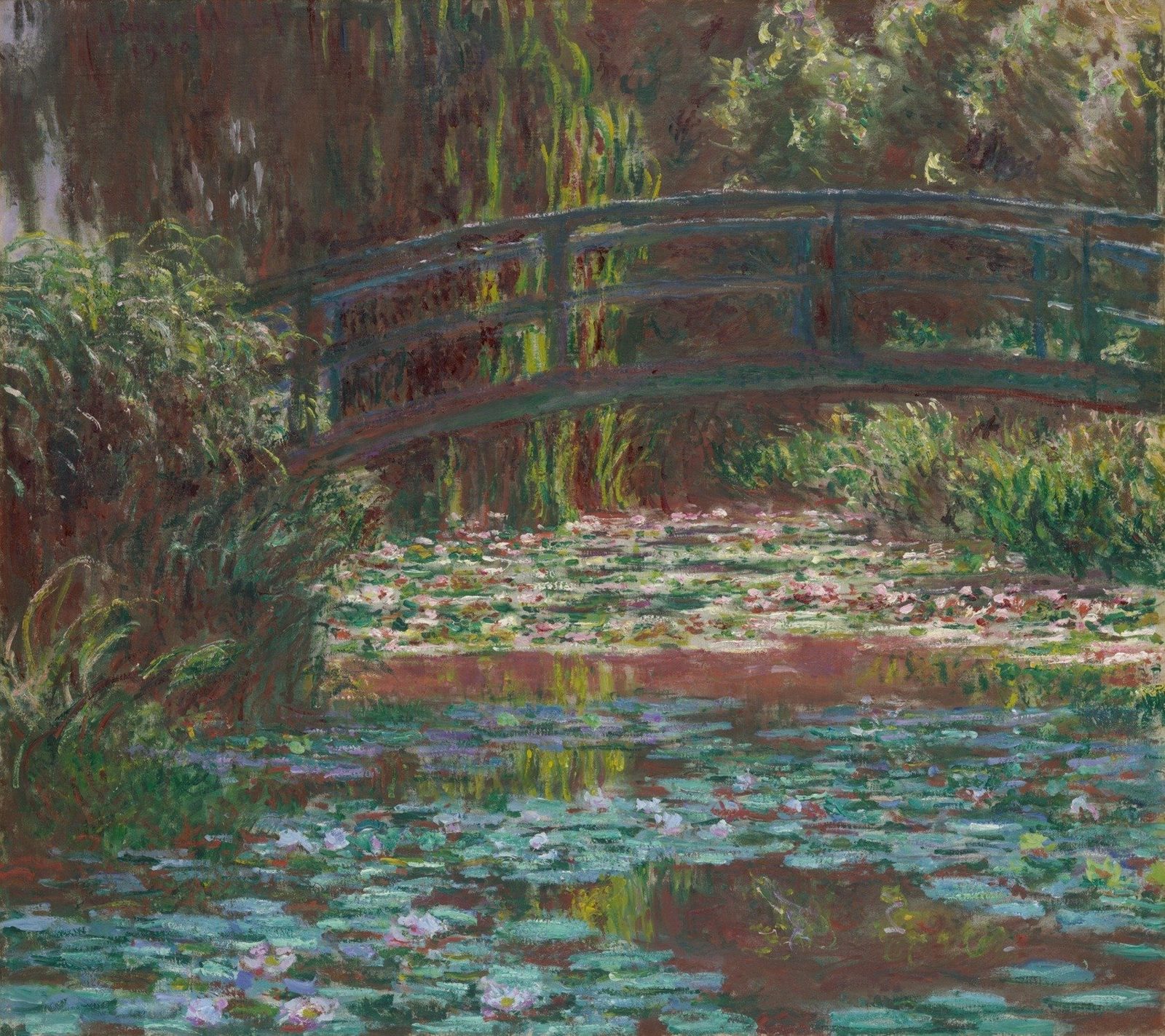
- Artist
- Claude Monet
- Title
- Water Lily Pond
- Date
- 1900
- Medium
- Oil on canvas
- Museum
- Art Institute of Chicago
- Image
- Public domain (CC0)
Open in Simple Art
Watch this story on iPhone and iPad, with offline downloads and a painting every day.
About 5 minutes of looking, in 11 parts.
Entering a Giverny pond
Before you, a Giverny pond captured in oil in 1900. An arched wooden footbridge spans a still surface carpeted with water lilies, framed by overhanging foliage and reflected tree trunks. Take a moment to let the whole settle before we move closer.
Monet at Giverny, 1900
Claude Monet painted this in 1900, late in his career and deep into his Giverny water-lily series. He worked outdoors, in front of the subject, letting broken brushwork and high chroma do the work of light. The whole scene is a single dense garden view, and we are about to unpack how he built it.
An arc above, water below
A horizontal arc, the bridge, bisects the canvas near the upper third, separating a dense vertical foliage zone above from a horizontal, dappled water zone below. Diagonals sweep from the bridge's apex down into the bright lily cluster. Two stacked worlds share one surface.
Dappled, filtered light
The light is overhead, diffused and filtered through a thick canopy with no single hard source. Values are compressed: the deepest darks are the deep green and brown masses on the left and under the bridge, while the brightest passages are the white-pink lily pads near the center. The whole canvas reads soft, dappled, and high-key.
Greens warmed by pinks
The palette is analogous greens and blue-greens, warmed locally by the reddish bridge and the pink lily blooms. Cool teal-greens and blue-violets dominate, with hot pink, ochre, and rust as accents. Notice how the same red and green hues reappear upside down in the water below the bridge.
Where the eye begins
Our eye starts on the left, where the foliage is densest and darkest. The marks are mixed: short dabs cluster in the upper portion, longer diagonal sweeps cut down through the middle, and soft scumbled smears occupy the lower half. This is not one stroke type but a system of overlapping gestures.
Vibrating foliage
Moving right and up into the canopy, bright yellow-green strokes sit directly beside deep emerald and burgundy-red verticals. There is no blending. The eye optically mixes these adjacent hues at a distance, and the foliage appears to vibrate rather than feel muddy. Place pure colors next to each other, let the viewer do the rest.
An arch from two passes
Following the bridge's top rail to its apex, the curve is built from a single sweeping gesture: a long, loaded horizontal smear of cool blue-green laid first, then a warmer ochre-brown pass dragged along the same arc. Short vertical dabs in maroon, blue, and yellow-green suggest the railing. There is no drawn line anywhere.
The heart of the pond
Now we drop down into the focal cluster, the bright center of the canvas. Short, pale mint-green horizontal strokes form a flat bed, then pink, magenta, white, and deep carmine dabs are dropped on top. Some are dry-brushed with crisp edges, others bleed softly into the green beneath. A wrist-sweep band runs along the bottom.
Dragging reflections down
Beneath the bridge, a thick rust-red band sits as the upper mass. From it, vertical streaks of the same rust-red drag straight down into the teal and mint field, then break into shorter segments. This is the reflection shorthand: one drag downward, then a few chopped interruptions to break the mirror image.
Broken color on water
Finally, drift right across the lower water. A dark teal-green ground is interrupted by horizontal clusters of pale blue, cyan, and near-white dabs. The marks are thick enough to register as raised ridges, with the undercolor haloing through the edges. No blending happens here, only abutted strokes that mix in the viewer's eye.
Look closer
8 details, each checked against a close-up of the picture.
-
Central Lily Cluster
Bright pink and white dabs are layered atop pale green horizontal strokes.
The crop centers on a horizontal band where short, pale mint-green strokes run left-to-right, suggesting a flat water surface or lily pads seen from above. Resting on top of this green field are clustered dabs and commas of hot pink, magenta, soft white, and deep carmine, with edges that are mostly soft but occasionally crisp where a single loaded stroke sits cleanly over the green. A thicker maroon-red horizontal band runs across the lower third, then breaks into short vertical and diagonal streaks of turquoise, sky blue, and violet at the very bottom, indicating the water's reflection. Layering is visibly wet-into-wet in places where pink edges bleed into the green, while other flower dabs appear dry-brushed on top with clean overlaps. Values stay mostly mid-range, with the brightest white-pink spots acting as the highest chroma accents against the cooler, muted greens below.
-
Bridge Arch Detail
The bridge's curve is formed by long, curved horizontal smears of blue-green and ochre paint.
The crop centers on a curving arch rendered with two roughly parallel bands of dragged, horizontal paint that bow gently across the middle of the frame; the upper band reads as a cooler blue-green mixed with dulled white, while the lower band is a warmer, muddier ochre-brown. Between and below these two arcs sit short vertical dabs in maroon, blue, and yellow-green, which read as the stanchions of a railing and as reflected tree trunks in the water. The far left edge breaks into a cluster of stippled yellows, sap greens, and pinks that read as overhanging foliage. Edges are everywhere soft; the curve is built from overlapping wet-into-wet smears rather than a single drawn line, and the boundary between bridge and water is left ambiguous.
-
Foliage Contrast
Deep emerald greens are juxtaposed with bright yellow-green highlights in vertical dabs.
The crop is dominated by short, vertical dabs of paint that read as foliage and reflected tree forms above and below a horizontal blue-gray band (the bridge) that crosses the lower third. Bright yellow-green strokes sit side-by-side with deep, near-black emerald and burgundy-red verticals, producing high local contrast rather than blended transitions. Edges are soft and broken: individual marks remain visible as discrete touches of pure colour, with no smooth gradation between neighbouring dabs. The bridge band itself is rendered in cool blue-grays with a softer, more horizontal stroke rhythm that interrupts the dominant verticality.
-
Water Reflections
Vertical streaks of reddish-brown paint mirror the reddish foliage and tree trunks in the water.
The crop is dominated by horizontal banding: a thick rust-red band across the top quarter (the bridge/canopy shadow), then a dense field of teal, mint, and dark-green water with scattered white-pink dabs (lily pads and blossoms). Vertical strokes of the same rust-red pigment drop down from the upper band into the water zone, breaking into shorter, broken segments as they descend. The left edge carries a column of yellow-green vertical smears, echoing the same downward gesture. Edges between rust and water are not blended but simply abutted, leaving crisp color transitions that read as reflection.
-
Left Edge Foliage
The foliage consists of short, staccato vertical strokes of olive and dark brown.
The crop is densely worked, with marks that read as foliage and shadow rather than as discrete short strokes. Paint sits in varied gestures: short dabs cluster in the upper-left, longer diagonal sweeps cut down through the middle, and soft scumbled smears occupy the lower half. Values swing from near-black reds in the lower-left through mid olive-greens in the upper area to scattered pale yellow-white highlights. Edges are almost entirely soft and broken, with no clean contours; transitions rely on juxtaposed colour notes rather than blended gradations. A few longer verticals suggest stems or hanging fronds, but the dominant vocabulary is mixed-direction dabbing and sweeping, not uniform vertical staccato.
-
Bridge-to-Water Transition
The bottom edge of the bridge dissolves into the surrounding greenery with soft, blended edges.
The crop captures a diagonal sweep of dark reddish-brown and forest green paint reading as the bridge's lower edge, dissolving downward into a tangle of foliage and reflected water. Edges throughout are soft and broken—wet-into-wet blending and short, overlapping comma-shaped strokes prevent any contour from being drawn cleanly, so the bridge and undergrowth seem to share the same pigment soup. The lower register is a mosaic of cooler greens punctuated by small accents of magenta-pink and dull violet, with a few pale yellow-green dots scattered as filtered light. Values stay compressed in the mid-darks, with only a few half-strength highlights preventing the patch from reading as a single mass.
-
Lower Right Water Surface
Small, fragmented dabs of light blue and white are scattered across a darker teal base.
The crop is dominated by a dark teal-green base interrupted by horizontal clusters of lighter dabs. Pale blue, cyan, and near-white strokes sit on top in short, broken marks roughly 5-15 pixels wide, often grouped in loose horizontal bands. Warm maroon-brown patches interrupt the cool field on the left and lower-center, reading as reflections of unseen banks or stems. Yellow-green flecks and a single pink sliver in the upper right add chroma accents. Edges are soft and unblended — strokes abut rather than merge, so the surface reads as discrete touches rather than a continuous wet layer.
-
Upper Right Canopy
Pale greens and whites are mixed with hints of blue-violet in the upper canopy.
This crop shows dense, broken brushwork in the upper canopy region. The surface is layered with short, dabbed strokes of pale yellow-green and cream sitting atop a darker olive-brown ground, with occasional pink and blue-violet notes punctuating the field. Vertical darker passages near the right edge suggest tree trunks descending through the foliage. Edges throughout are unresolved and soft, with no hard contours anywhere. A horizontal band of dark blue-grey crossed by a thin lighter line at the very bottom edge reads as the bridge railing just beneath the canopy.
Water Lily Pond in context
Permission for two bridges
When Monet applied in 1893 to divert water from a branch of the Epte for a pond, he also asked to build two bridges. He received the permits by July despite local concern [2]. Within a few months the pond, about a thousand square metres, and a Japanese-inspired wooden bridge were finished [2].
In his application to the prefect of the Eure, he argued that the water garden would be agreeable and a pleasure for the eyes. But he also said he meant to use it as a source of motifs [2]. He painted the bridge at least twice in 1895 and the water lilies at least eight times in 1897 to 1898 [2].
Two summers, eighteen canvases
In the summers of 1899 and 1900, broken only by working trips to London, Monet painted the bridge and pond eighteen times [2]. The twelve canvases of 1899 are mostly near square. They face the bridge head on and share a fairly cool palette [2]. The six of 1900, including this one, vary more in viewpoint, and none shows the full arch from the front [2].
The catalogue connects these off-centre views with prints by Utagawa Hiroshige, several of which Monet owned [2]. Following the historian Paul Tucker, it also sees the broken, strongly contrasted brushwork as a return to his manner of the 1870s, away from the blended tones of the Mornings on the Seine [2]. By May 1901 Monet had already bought more land to enlarge the pond [2].
Left out of the 1900 show
Durand-Ruel's exhibition of Monet's recent work in late 1900 included twenty-six pictures, twelve of them devoted to the water lily motif [2]. This canvas wasn't among them. But the catalogue argues that Monet signed, dated and sold it around the time of the show, which suggests he considered it finished [2].
Reactions were mixed. Some critics praised the radiance of the series, while others found the viewpoints too alike. Charles Saunier of La revue blanche compared the paintings to the work of a cinematographer who recorded colour but not nuance [2].
What the X-ray shows
The linen canvas isn't a standard size, and the stretcher was probably custom ordered [2]. Its weave matches seven other Monets in the Art Institute, among them three Stacks of Wheat and Branch of the Seine near Giverny (Mist). The museum takes this to mean they were cut from the same bolt of fabric [2].
There are few changes of design. But the X-ray shows that Monet painted out some foliage, real or reflected, under the bridge [2]. A few black particles at the back of the pond look like charcoal, though the museum finds the evidence too thin to say whether he drew first [2].
Paris, a prince and Chicago
Monet sold the painting to the dealer Léonce Rosenberg in December 1900, and the Prince de Wagram acquired it in 1904 [2]. Rosenberg had it again by July 1914, when he sold it to Durand-Ruel in Paris for 21,000 francs [2]. Passed to the New York branch, it was shown there in February 1915 and sold on 8 April 1915 to Arthur Meeker of Chicago for $7,400 [2].
The Wildenstein catalogue says Durand-Ruel took it back on deposit around 1923, but the firm's archives report no record of this [1]. Annie Swan Coburn owned it by the time of her bequest, and it entered the Art Institute in 1933 [1].
- Claude Monet, Water Lily Pond, 1900 (1933.441): object record, description and provenance . Art Institute of Chicago (public API)
- Jill Shaw, 'Cat. 37, Water Lily Pond, 1900', with technical report, in Monet Paintings and Drawings at the Art Institute of Chicago (public API) . Art Institute of Chicago