One mark, eight directions
Van Gogh builds a whole landscape out of a single kind of brushstroke
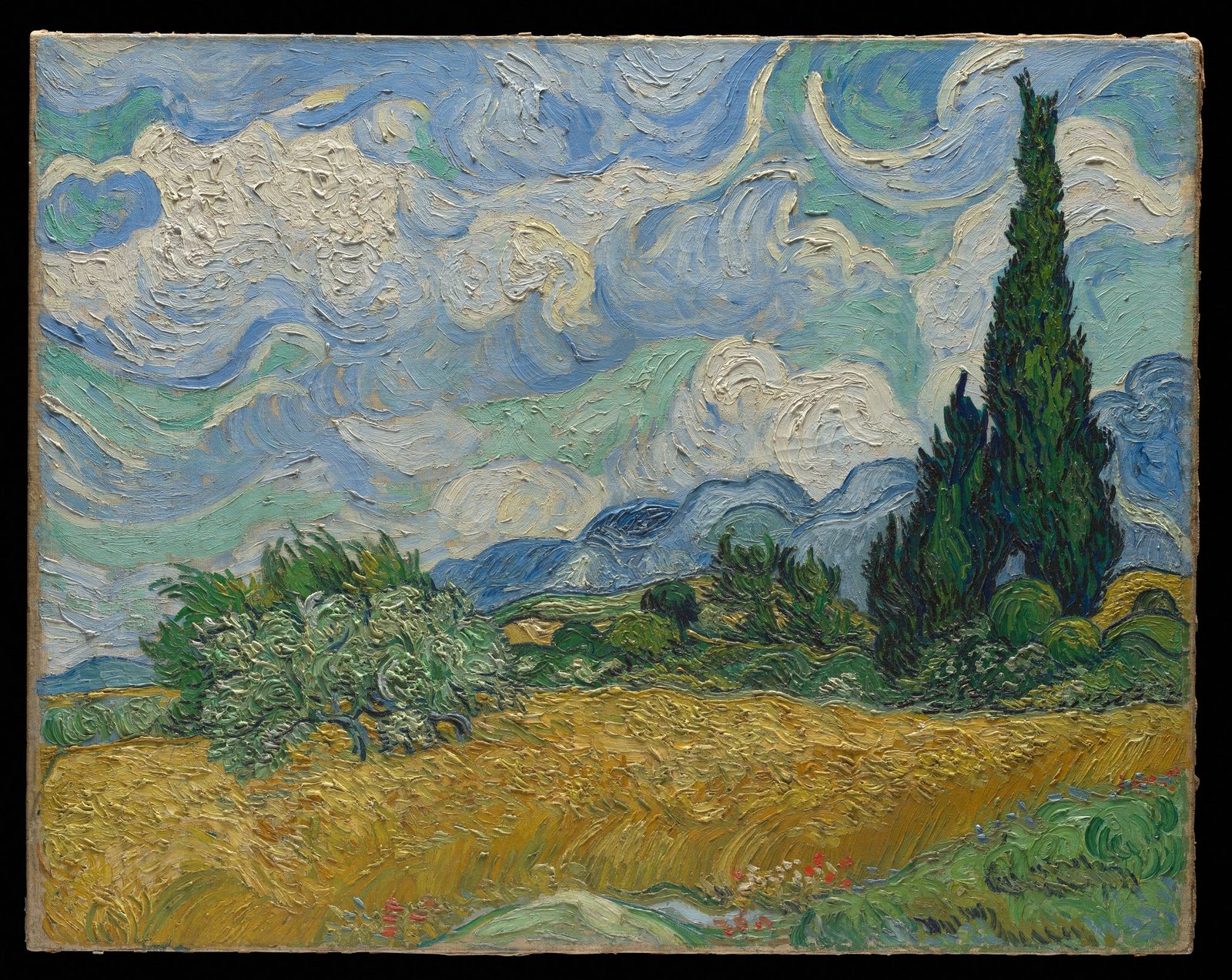
- Artist
- Vincent van Gogh
- Title
- Wheat Field with Cypresses
- Date
- 1889
- Medium
- Oil on canvas
- Image
- Public domain (CC0)
Open in Simple Art
Watch this story on iPhone and iPad, with offline downloads and a painting every day. This one is free in the app.
About 4 minutes of looking, in 11 parts.
Wheat Field with Cypresses
Almost all of this painting is made with one brushstroke, short and thickly loaded. From place to place, the only thing that changes is which way it points.
Saint-Remy, 1889
Van Gogh painted this in oil in 1889, while living at the asylum in Saint-Rémy. Cypresses were his obsession that summer. On the twenty-fifth of June he wrote to his brother Theo that their lines and proportions were as beautiful as an Egyptian obelisk, and that a cypress is the dark note in a sunlit landscape, one of the hardest to get exactly right.
Three bands, one vertical
The structure is simple: three horizontal bands, sky, then hills and low green, then wheat, with the field boundary near the lower third. Against all that calm there is exactly one strong vertical, the only shape that crosses two bands.
The cypress is not solid
Up close the cypress stops being a shape. It is a stack of short strokes hooking upward in three greens, near-black at the core, brighter yellow-green on the ridge of each mark. Watch the outline: sky colour is driven back into it, so the edge becomes a row of spikes.
The cloud is one gesture
On the same side of the sky, this cloud is a single cream scroll, curling over and turning back like a breaking wave, pulled in one rotation without lifting the brush. The paint stands high enough to cast its own shadow.
The quiet side
Travel left and the sky calms completely into long horizontal ribbons, blue and cream with a band of turquoise and almost no rotation. Between the strokes there is bare canvas, left uncovered on purpose, warming the passage from underneath.
Distance without haze
The hills are as sharp and as thickly painted as anything in front. What changes is the stroke: long and continuous, following the ridge, where the foreground marks are short and turn constantly. Calm marks and cool colour are enough to push the hills back.
One mark, many angles
This bush is the clearest lesson in the picture. One curled comma-hook, repeated at every angle, with nothing blended. The dark strokes between the clumps are drawing, used only where one mass meets the next.
Why the field moves
From across the room the wheat looks like long diagonals. Close to, it is short blocky dashes laid in runs that fan and curve. The stroke never changes size; only the path of the run bends, and that is what makes the field feel like wind.
The only pure red
About a dozen vermilion dabs sit low in the field, the only pure red in the painting, scattered on a loose diagonal. There is startlingly little of it. Ten times as much and the field would stop being yellow.
The one hard edge
Where the cypress meets the wheat is the hardest edge in the painting, dark straight into light with no half-tone, and he runs a line of near-black commas along the join. In the cloud every edge dissolves. He chose this one edge to be hard.
Look closer
8 details, each checked against a close-up of the picture.
-
cypress crown
The cypress is built from short upward-curving strokes of near-black green over warmer mid-green, and pale sky colour is cut back into its silhouette so the edge stays ragged rather than smooth.
The cypress is not a solid shape. It is a dense stack of short, upward-hooking strokes in three greens - a near-black blue-green, a mid forest green, and a brighter yellow-green that catches the top edges of the marks. Cream and pale blue strokes from the sky are driven back INTO the silhouette on both sides, so the outline is a row of spikes rather than a line. The darkest strokes sit at the core and along the left, which is the only thing giving the tree any sense of round volume.
-
cloud scroll, upper right
The cloud is a scroll of cream and white impasto that curls back on itself, with paint ridges standing high enough to catch light.
A single cream scroll dominates the crop, curling from lower left up and over to the right and turning back on itself like a breaking wave. It is laid over a bed of blue strokes that run parallel to it, and between the two runs a band of clear sea-green. The impasto is thick enough that the ridges throw their own shadows and read as texture even before you register the colour.
-
wheat field strokes
The field is long parallel diagonal strokes of chrome yellow and ochre running lower-left to upper-right, with occasional green and blue strokes laid between them.
Correcting my own first reading: these are not long straight parallel diagonals. They are short blocky dashes, each roughly one brush-width, laid in sweeping runs that fan out and curve as they cross the field. Chrome yellow, ochre and a dull olive alternate, with occasional cream, green and blue-grey dashes dropped between them. The curve of the runs is what makes the field feel like it is bending, and red poppy dabs appear along the lower edge.
-
pale bush at left
The bush is made of curled comma-shaped hooks in pale sage green and off-white, each stroke separate and unblended.
The bush is built almost entirely from curled comma-hooks about a brush-width wide, in sage green, olive and off-white, each one turning a different way. Dark blue-black strokes run between the clumps and do the job of drawing - they separate one mass from the next and read as the shadowed gaps between foliage. Nothing is blended; every mark keeps its own edge, and the ochre field and blue hill show through at the top and right.
-
cypress meets the field
Where the dark cypress mass meets the yellow wheat the edge is hard and unblended, with no transitional half-tone between the two.
This is the hardest edge in the painting. The dark green and near-black mass of the cypress and its neighbouring bushes stops dead against the yellow wheat with no half-tone between them. Van Gogh then reinforces it: a run of near-black comma strokes sits right along the boundary acting as an outright contour line. Immediately above it, the rounded bush forms are drawn with curved strokes that follow their own domed shape, and one of them is nearly a spiral.
-
distant hills
The Alpilles are painted in long, wavy blue and blue-white strokes that follow the ridge contours, edged with dark blue lines and as thick as the sky paint.
Correcting my own first reading: the hills are not smoother or flatter than the foreground, and the impasto is just as thick. What actually changes is the LENGTH and consistency of the stroke. Here the marks are long and continuous and all follow the contour of the ridge line, so the eye reads them as one calm shape; everywhere else the marks are short and change direction constantly. The colour is blue, blue-white and cream with no warm notes at all.
-
red poppies in the wheat
A scatter of small pure red dabs sits low in the yellow field; it is the only pure red anywhere in the painting.
Roughly a dozen small vermilion dabs sit low in the ochre field, most no larger than a fingernail. They are the only pure red anywhere in the painting. Around them are cream and olive dashes and, at the lower left, a pale blue-green watercourse. The red is placed in a loose diagonal scatter rather than a clump, which keeps it reading as flowers in grass instead of as a single red object.
-
green-blue sky at left
At the left the sky shifts from blue to a distinctly green turquoise, painted in long horizontal ribbons rather than swirls.
The calm counterweight to the churning right-hand sky. Here the marks are long horizontal ribbons - blue, cream and a strong turquoise-green band running through the middle - with almost none of the rotation seen elsewhere. Bare tan canvas is clearly visible between many of the strokes; the surface is not fully covered, and that raw ground warms the whole passage from underneath.
Behind Wheat Field with Cypresses
A year at Saint-Rémy
In December 1888, Van Gogh suffered a breakdown in Arles during which he cut off part of his left ear, and Paul Gauguin, who'd been staying with him, left abruptly [2]. Fearing another crisis, he voluntarily entered the asylum at nearby Saint-Rémy in May 1889, and over the following year he painted some 150 canvases there [2].
At first he was confined to the hospital grounds, painting its corridors and the walled garden he could see from the spare room he was given as a studio [2]. Later he worked in the surrounding countryside, making series of olive groves and of cypresses, which he saw as characteristic of Provence [2].
His letter to Theo of 25 June 1889 sounds steady. He wrote that his health was still very good and work was distracting him, though he admitted that "Finding something to do all day is the big thing here" [3].
Study and repetition
The cypresses took hold by late June, when he resolved to devote one of his first Saint-Rémy series to them [1]. This canvas is his first version of the composition, painted from nature in late June 1889, at about the time he made The Met's vertical Cypresses in the same heavy paint [1].
On 2 July he sent Theo a set of reed-pen drawings after works in progress, including a large drawing of this composition now in the Van Gogh Museum, Amsterdam [1]. A stroke of green at the lower left of the wheat, repeated in the drawing but missing from the later painted versions, shows that the drawing was made from this canvas [1].
In September he painted two studio versions, one the same size, now in the National Gallery, London, and a smaller one intended for his mother and sister, now in a private collection [1]. Earlier that month he'd warned Theo that there would be "almost the same ones twice, the study and the final painting" [1].
The canvas is a standard size 30, a weave he ordered from the Paris firm of Tasset et L'Hôte, and thread-count analysis shows it came from the same bolt as 67 other paintings he made between February 1888 and July 1890 [1].
Sent to Theo
On 28 September 1889 he sent Theo a batch of canvases, listing "Wheatfield and cypresses" twice, the study and the studio version [1][4]. In the same letter he said he'd make reductions of "the best canvases" for his mother and sister, and a reduction of this composition was among them [4]. The Met records that he regarded the picture as one of his best summer landscapes [1][2].
Theo died in 1891, and the painting passed to his widow, Johanna van Gogh-Bonger, who held it in trust for their son [1]. An estate list of late 1890 called it Peupliers dans champs de blé, and in 1898 it was shown in The Hague as Poplars in a Corn Field [1].
From Paris to New York
In December 1900 Jo van Gogh-Bonger sold it, with seven other works, through Julien Leclercq to the French artist Émile Schuffenecker for 9,400 francs [1]. It then passed through the prince de Wagram and the Berlin dealer Paul Cassirer to Franz von Mendelssohn of Berlin in 1910 [1].
The Mendelssohn family kept it, later in Switzerland, until 1951, when it was sold to the Zurich collector Emil Bührle. His son Dieter Bührle sold it to The Met in 1993, with a gift from the Annenberg Foundation [1]. Under the terms of its acquisition, the museum lists it as a work that may not be lent [1].
By the First World War, the Fauves and the German Expressionists had taken up Van Gogh as a pioneer of modern art [2]. In 2023 this painting was a centrepiece of The Met's exhibition Van Gogh's Cypresses, the first to focus on the trees [5].
- Wheat Field with Cypresses (object record 1993.132) . The Metropolitan Museum of Art
- Vincent van Gogh (1853–1890) (Heilbrunn Timeline of Art History) . The Metropolitan Museum of Art
- Letter 783, to Theo van Gogh, Saint-Rémy-de-Provence, 25 June 1889 . Van Gogh Museum / Huygens ING, Vincent van Gogh: The Letters
- Letter 806, to Theo van Gogh, Saint-Rémy-de-Provence, 28 September 1889 . Van Gogh Museum / Huygens ING, Vincent van Gogh: The Letters
- Van Gogh's Cypresses (exhibition, 22 May to 27 August 2023) . The Metropolitan Museum of Art