Yellow takes centre stage
How Van Gogh raises the horizon and lets a field of wheat fill his canvas
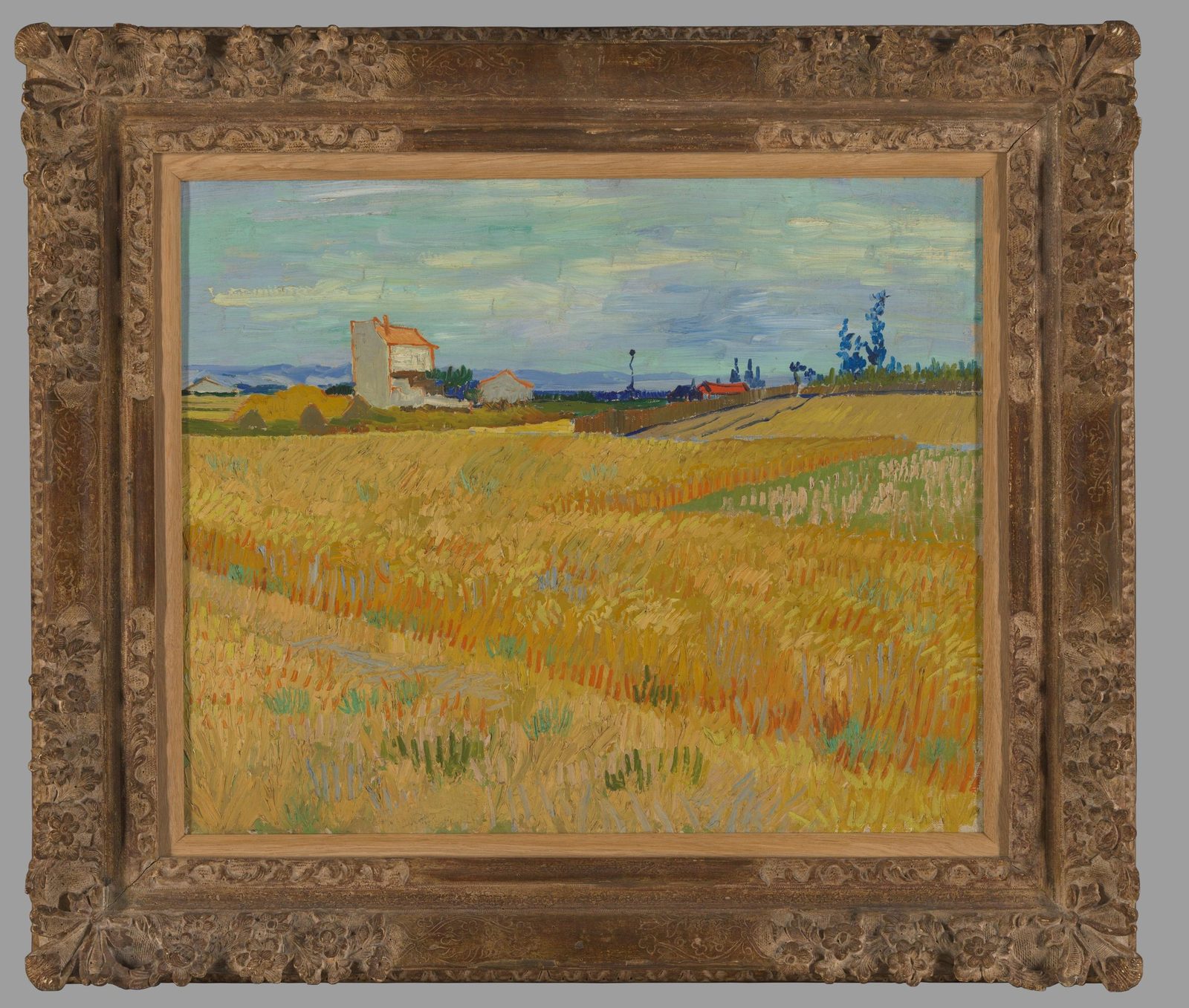
- Artist
- Vincent van Gogh
- Title
- Wheatfield
- Date
- 1888
- Medium
- Oil paint on canvas
- Museum
- Rijksmuseum
- Image
- Public domain (CC0)
Open in Simple Art
Watch this story on iPhone and iPad, with offline downloads and a painting every day.
About 4 minutes of looking, in 9 parts.
A field of wheat, 1888
Most of this picture is wheat. Van Gogh gives the field well over half the canvas, so the yellow has nowhere to hide. Your eye wanders across it for a while, then finds the small white house on the left.
Arles, 1888, oil on canvas
In the spring of 1888 Van Gogh left a busy Paris for Arles, in the south of France. The museum says he was captivated by the vibrant colours of the landscape there. He painted this field in oil on canvas that same year.
A high horizon
Notice where the land stops. The horizon sits high, so the yellow of the wheat takes centre stage. The sky gets only a band across the top, and the farmhouse, the trees and the distant blue hills are squeezed into a thin strip between them.
Short strokes of gold
Now the wheat closest to you. It is made of short strokes of ochre and gold, laid side by side and not blended, most of them leaning the same way. Among them are flicks of orange-red and small green tufts. Follow one row of marks and it seems to carry you back towards the house.
Cream, grey and orange
Climb to the farmhouse. Its wall looks like little more than two tones, a warm cream where the sun catches it and a cooler grey on the shadowed side. The roof is a single orange-red shape, and where it meets the sky, orange sits right against turquoise with nothing in between.
The darkest notes
Slide right along the horizon to the cluster of trees. They are painted in deep blues, darker than anything else here, with lighter touches on their right-hand edges. The museum notes that Van Gogh intensified the blue of the mountains and sky to sharpen the contrast with the yellow. These trees seem to play the same part.
An edge without a line
Now the horizon itself. There is no drawn line. Bands of blue, dark foliage, olive ground and yellow wheat interlock in broken strokes, so you feel the edge rather than see it outlined. Just right of centre, a thin dark upright rises above it. It looks like a factory chimney.
Long strokes for the sky
Lift your eyes into the sky and the rhythm changes. Here the strokes are long and horizontal, blue and turquoise with streaks of cream for the clouds. The clouds are dragged out sideways rather than dabbed, so the sky seems to drift slowly across the picture.
Paler on the right
Back down to the right side of the field. The strokes here carry more pale cream and light yellow than those on the left, which stay a warmer, more even ochre. It reads as sunlight falling more strongly on this side, done simply by changing the mixture from stroke to stroke.
Look closer
8 details, each checked against a close-up of the picture.
-
The farmhouse
The white walls are composed of thick, vertical white and cream strokes with an orange-red roof.
The crop centers on a tall, boxy farmhouse whose walls are built from thick, mostly vertical white and cream strokes with cooler grayish-blue undertones in the recessed corners and warmer ivory highlights catching the right side. The roof reads as a single bright orange-red plane, painted with slightly diagonal dashes that follow the slope and leave the tile form suggested rather than drawn. To the right, dense dark green and blue-green foliage is blocked in with short, blunt strokes that sit against the wall's pale edge. Below, a band of olive and ochre grass carries long horizontal-to-diagonal sweeps, and a narrow sliver of turquoise sky crosses the top with broken cloud tucks.
-
Foreground wheat strokes
The wheat is rendered as short, rhythmic comma-shaped strokes of ochre and gold.
The crop reveals thick, directional impasto strokes in the foreground wheat field. Most strokes are short, curved commas of ochre and gold that lean consistently toward the upper right, suggesting wind-swept grain. Interrupting the yellow field are upright orange-red dashes (likely poppies or wheat ears), tight clusters of green marks (weeds/clumps), and a curving pale blue stroke (a stream or footpath cutting across middle). Edges between strokes are crisp and raised rather than blended, leaving tiny ridges of light along each mark. Values stay high-key overall, with the deepest note being the dark olive dabs in the lower-left tuft of green.
-
Complementary horizon
Bright orange rooftops sit directly against a saturated turquoise-blue sky.
The crop centers on a building's upper corner where a saturated orange-red roof edge meets a turquoise sky. Roof paint is laid on in thick, diagonal-to-horizontal impasto strokes that follow the slope, with darker reddish-orange shadows under the eaves and brighter cadmium-orange highlights along the ridge. The wall to the left is a creamy off-white worked with long, slightly curving strokes that lean diagonally. Below, a dark brown band suggests shadowed wall or ground, and to the right a dense cluster of dark forest-green foliage is built with short, vertical, dabbed strokes. The sky shows broad horizontal strokes, clearly lighter and more luminous on the right side and cooler/denser at the upper left, with the roofline cutting sharply into it without any softening.
-
Sky handling
The sky consists of long, horizontal streaks of blue mixed with curling cream-colored cloud strokes.
The crop shows the upper portion of a sky rendered with long, predominantly horizontal brushstrokes that read as a single sweeping gesture from left to right. Cream and pale yellow strokes sit on top of and beside cooler blue-green passages, with the cream tones forming slightly thicker, more loaded marks that suggest small cloud puffs elongated by the stroke direction. Edges between colors are soft and blurred where the strokes overlap wet-into-wet, but tiny ridges of paint remain visible along stroke boundaries, confirming physical impasto. A subtle gradient runs across the field, with the lower-right area picking up slightly warmer, lighter tones consistent with light entering from the upper right.
-
The blue tree
The distant trees are painted in deep blues, the darkest notes against the yellow field.
The crop centers on a cluster of blue trees against a pale sky, with a broad yellow field filling the lower half. The trees are built from short, vertical-to-diagonal dabs of dark blue, with lighter cobalt accents catching light on the right-facing edges, while their left sides sink into near-black ultramarine. A thin, dark horizontal band of brown-green separates the trees from the field, acting as a shadow line and a tonal hinge between the two complementary masses. The field below is laid in long, slightly diagonal strokes of warm ochre that read as a single plane, and the sky is brushed in horizontal sweeps of pale blue and cream. Edges between the tree canopy and sky are broken and feathery, never hard, which keeps the foliage shimmering against the lighter background.
-
Industrial smokestack
A thin, dark vertical mark, probably a chimney, rises above the horizon.
The crop shows a thin, dark blue-violet vertical mark rising from a low, jagged silhouette of distant buildings or trees, with a pale wisp extending upward into a sky of horizontal cerulean and cream strokes. The middle band reads as deep blue-purple mass meeting a green horizontal strip, then transitioning to a warm ochre field in the lower half composed of short, vertical and slightly angled dabs. Edges are broken and unblended: the smokestack is a single loaded stroke, not a crisp line, and the horizon meets the field through juxtaposed color rather than a drawn contour.
-
Field highlights
The right side of the field uses paler, brighter yellows than the left side.
The crop isolates the right side of a wheat field, dominated by short, vertical-to-diagonal impasto strokes in saturated yellows, ochres, and orange-reds. The right portion (roughly x>0.55) shows more cream and pale yellow strokes (#E6C77A range) intermixed with the brighter yellow-orange mass, while the left half reads slightly warmer and more uniformly orange-ochre. A horizontal green band crosses the upper third with pale vertical dabs suggesting a hedge or furrow line, and the bottom-left contains thin bluish-gray strokes peeking through the yellow mass. Edges are crisp and broken everywhere; no blending is visible — each dab of impasto retains its own contour.
-
Horizon line transition
The boundary between the field and the sky is a soft, broken line of varied colors.
The crop captures a wide horizontal band where sky, distant trees, and wheat field converge. The top edge shows cobalt and ultramarine sky punctuated by horizontal cream-white cloud strokes that read as streaks rather than soft washes. Below sits a dense, broken band of dark blue-green impasto forming the tree/foliage line, painted in short jagged marks that do not form one continuous silhouette. Beneath that is a transitional middle ground of olive, ochre, and rust verticals, then the field's saturated yellows and raw umbers laid in with long diagonal strokes. The boundary between sky and land is not a line but a stack of three or four irregular color bands that interlock.
Wheatfield in context
A first look at the harvest
The Rijksmuseum records the painting as made in Arles in 1888 and numbers it F 564 and JH 1475 in the Van Gogh catalogues [1]. Its data record also carries the older title 'Korenveld te Arles', or 'Wheatfield at Arles' [2]. Martin Bailey dates it to June 1888 and describes the crop just before the harvest, with the hills of Les Alpilles as a narrow band on the horizon [7].
On 12 June 1888 Van Gogh told Theo that he had 'two or three new drawings and also 2 or three new painted studies' [3]. The editors of his letters count this Wheatfield among those new studies. They call it an initial exploration of the subject of his larger canvas The Harvest [3]. In a later note they describe it again as a preparatory study for that painting [4].
The Harvest and a week in the fields
The Harvest, now in the Van Gogh Museum, measures 73.4 by 91.8 cm. It shows a half-mown wheatfield with ladders, carts and a reaper at work in the background [6]. Van Gogh rated it highly, telling Theo that the canvas 'absolutely kills all the rest' [6].
Once The Harvest was finished, he spent about a week working in the fields from around 14 June until rain began on 20 June, according to the letter editors [4]. On 21 June he described 'a week of concentrated hard work in the wheatfields right out in the sun' [4]. The Van Gogh Museum counts ten paintings and five drawings from just over a week, ended by a heavy storm [6]. If the editors are right, the Rijksmuseum's study came shortly before that burst of work rather than during it [3][4].
Blue, yellow and orange
In a letter to Emile Bernard of about 7 June 1888, Van Gogh wondered about 'the effect of a more intense blue in the sky', observing that Fromentin and Gérôme had seen the southern earth as colourless [5]. He answered with a rule of thumb: 'if you do blue, then do yellow and orange as well' [5]. Bailey links that advice to the moment Van Gogh was finishing this picture [7]. The Rijksmuseum notes that he made the mountains and sky bluer to strengthen the contrast with the yellow wheat [1].
Bailey also points to a smudge at the very bottom of the canvas, which he reads as confirmation that the picture was painted outdoors: Van Gogh probably caught the wet paint on his sleeve while carrying it [7]. He had arrived in Arles only on 20 February 1888, after a train journey lasting a day and a night, hoping to find the light and colour of 'Japanese' landscapes in Provence [9].
From Arles to Amsterdam
The Rijksmuseum's press release says that Van Gogh made a series of wheatfield paintings within a few weeks that summer, one of which entered the collection of Pieter de Boer and his wife Nellie Pressburger [8]. The painting is now on long-term loan to the museum from the Stichting Collectie P. & N. de Boer [1]. The sources consulted here give no earlier owners, so its history between Arles and the De Boer collection remains unrecorded in this article.
The museum gives the painting's size as 61 by 50 cm, with a second measurement of 63.4 by 52.2 cm and 82.2 by 71.2 cm in its frame [2]. It hangs with the two other De Boer loans and the Rijksmuseum's own Van Gogh self-portrait [8].
- Vincent van Gogh, Wheatfield (SK-C-1845): object record . Rijksmuseum, Amsterdam
- Wheatfield (SK-C-1845): Linked Art data record . Rijksmuseum, Amsterdam
- Letter 623, to Theo van Gogh, Arles, Tuesday 12 June 1888, with notes . Van Gogh Museum and Huygens ING, Vincent van Gogh: The Letters
- Letter 629, to Theo van Gogh, Arles, Thursday 21 June 1888, with notes . Van Gogh Museum and Huygens ING, Vincent van Gogh: The Letters
- Letter 622, to Emile Bernard, Arles, on or about Thursday 7 June 1888 . Van Gogh Museum and Huygens ING, Vincent van Gogh: The Letters
- Vincent van Gogh, The Harvest (F 412): collection entry . Van Gogh Museum, Amsterdam
- Martin Bailey, 'The paint was still wet: a closer look at three Van Gogh paintings heading to the Rijksmuseum' (5 April 2024) . The Art Newspaper
- Rijksmuseum receives three Van Gogh paintings on long-term loan (press release) . Rijksmuseum, Amsterdam
- Vincent van Gogh's Style: From Dark to Light, 1886-1888 . Van Gogh Museum, Amsterdam