A whole town on the ice
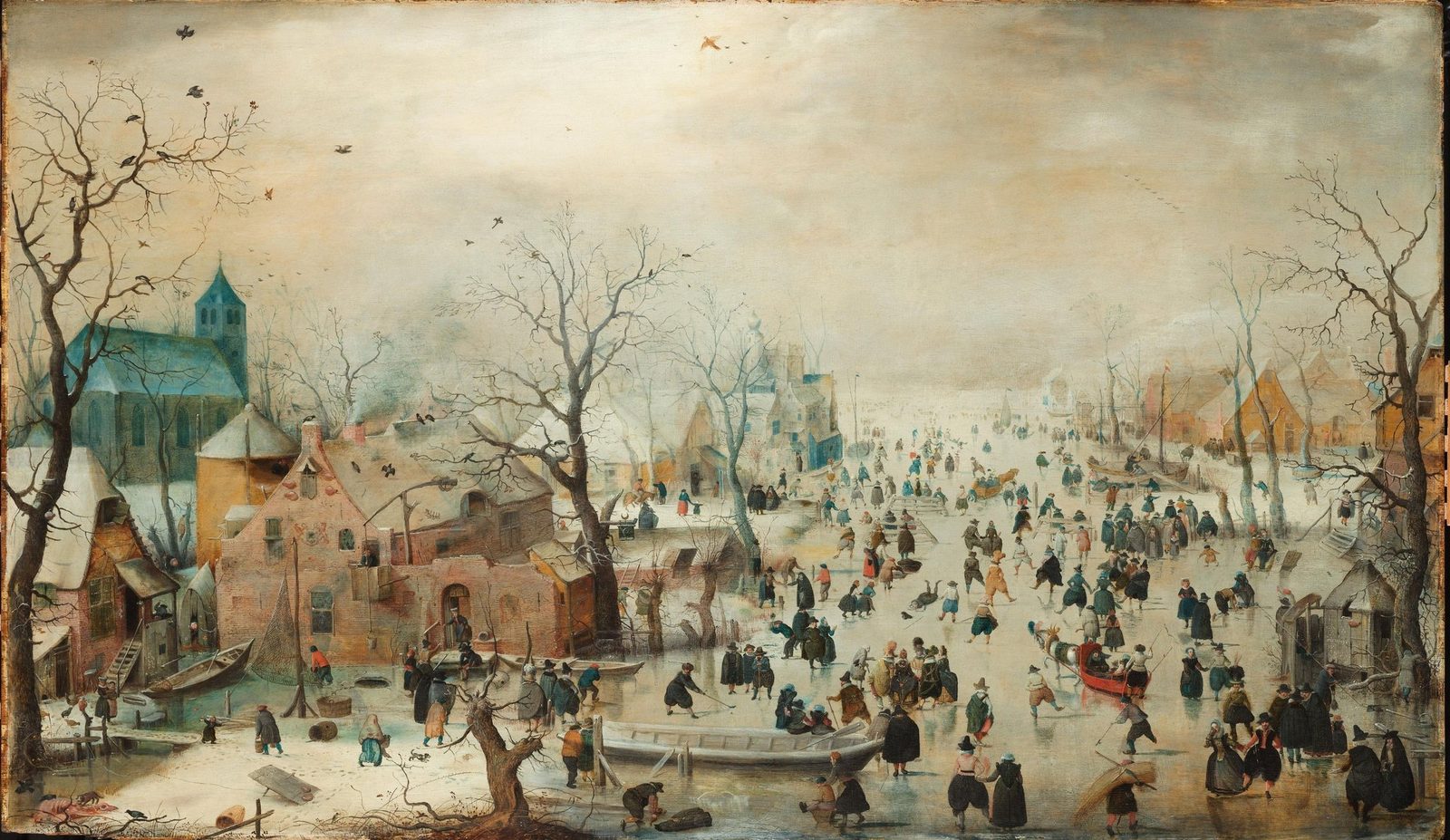
How Avercamp keeps hundreds of tiny figures readable with a high viewpoint, crisp silhouettes and a fading distance
- Artist
- Hendrick Avercamp
- Title
- Winter Landscape with Ice Skaters
- Date
- c. 1608
- Medium
- oil on panel
- Museum
- Rijksmuseum
- Image
- Public domain (CC0)
Open in Simple Art
Watch this story on iPhone and iPad, with offline downloads and a painting every day.
About 4 minutes of looking, in 9 parts.
Winter Landscape with Ice Skaters
We look down from high above onto a frozen river packed with people. They skate, stroll, pull sleighs and stand about talking, while a village crowds the bank on the left under a pale winter sky. There's far more here than you can take in at once, so let's go slowly.
Avercamp, c. 1608, oil on panel
This is Hendrick Avercamp's Winter Landscape with Ice Skaters, painted in oil on panel around 1608 and signed. The Rijksmuseum notes that most people here are out for pleasure, and some from need. In the left foreground, crows and a dog feed on a horse that has frozen to death.
Heavy left, open right
The structure holds it all together. Heavy buildings anchor the lower left, while the ice runs away in a long diagonal towards the misty distance on the right. Tall bare trees stand up through the middle, like hinges between the two halves.
The church in blue-grey
Start at the church on the left. Its blue-grey walls aren't built stone by stone. You can see vertical strokes with thin darker lines between them, and from a little way off they read as weathered masonry. The tower is a slightly stronger blue, and its edges stay crisp against the pale sky.
Branches like handwriting
Now lift your eyes to the bare tree. Its trunk and main boughs are a dark brown-black, and the limbs taper into twigs barely thicker than a hair, almost like handwriting against the sky. Look for the tiny birds perched along the upper branches, little dark notches of the same tone.
The heart of the crowd
Follow the ice to the right, where the crowd is thickest. The figures are crisp silhouettes against the pale ice, mostly dark blue or black, with notes of red in skirts, breeches and a curved sleigh. In such a cool, muted picture, those reds jump out. Can you find someone lying flat on the ice?
A figure with a long stick
Just below, a man in an ochre coat and tall dark hat leans forward, holding a long stick down towards the ice. Beside him a figure in a black cloak stands still, and a long boat sits at an angle on the ice. Every stick, hat brim and hull edge has the same crisp, dark edge.
Marks in the snow
Drop down to the snowy bank in the lower left. The pale ground isn't a flat colour. Fine brown and grey streaks run across it, tapering at their ends, and tiny dark specks look like footprints. Small white flecks catch the light. It's a lively surface made from very small, quick marks.
Fading into haze
Now sweep right, along the row of gabled houses. The nearest orange wall still glows, but further back the same colour fades to a dusty tan, and the farthest roofs are almost grey. Drift across the ice and the figures change too. The near ones have sharp dark outlines. The distant ones are soft brownish smudges.
Look closer
7 details, each checked against a close-up of the picture.
-
Central Skating Crowd
A high density of figures with red and blue clothing are clustered on the ice.
The crop shows a pale, slightly warm cream-tan ice field populated by dozens of small figures in dense clusters near the center and dispersing toward the edges. Red notes appear in skirts, breeches, and the prominent curved sleigh at lower right, while deep blue and near-black coats, plus ochre-browns, dominate the rest of the palette. Figure edges are mostly crisp and silhouetted against the light ground, with only minimal shadowing; some cast shadows are hinted at with short gray-green strokes beneath skaters. A few figures are isolated as gestures—particularly a prone body mid-frame and a bent kolf-player at left—surrounded by groups in conversation, giving the eye a path through the density.
-
Atmospheric Perspective
Figures in the far distance are rendered with lower contrast and softer edges than foreground figures.
The crop shows the right half of a winter scene: bare birch trunks rise through the midground, orange-walled village buildings recede along the right, and dozens of small dark figures skate, walk, and stand on the pale ice. Foreground figures (lower right and bottom edge) have crisp dark contours and clearly separated hat, coat, and leg shapes; the distant figures near the left horizon are reduced to a few soft brownish smudges with no internal detail. The orange walls of the nearer house still read as saturated ochre, while the same hue further back mutes toward a dusty tan that almost merges with the off-white sky/ice band. The ice surface itself acts as a low-contrast mid-value, which is what flattens near-far separation and lets the haze push things back.
-
Church Architecture
The blue-grey walls of the church show visible vertical brushstrokes and weathered stone textures.
The crop centers on a church building with a prominent blue-grey roof and walls. The wall surface clearly displays vertical brushstrokes that read as weathered stone courses, with thin dark verticals interspersed among the blue-grey washes creating rhythmic texture. The tower rises with a steeper profile and slightly more saturated blue, its edges crisp against the pale sky. Bare tree branches in the foreground are drawn with thin, dark, somewhat calligraphic lines that contrast with the broader, softer washes of the architecture. A small ochre structure at the lower right introduces a warm color note against the dominant cool palette.
-
Kolf Players
A figure in an ochre coat and dark hat leans forward holding a long thin stick angled down towards the ice, beside a figure in a black cloak and a boat lying at an angle on the ice.
The crop centers on a bent figure in a tan/ochre coat and dark hat, holding a long thin stick angled down toward the pale ice, flanked by a standing figure in a black cloak and broad-brimmed hat who also grips a vertical shaft. A long boat cuts diagonally across the middle ground, its gunwale painted with a soft tonal break between warm grey-brown hull and lighter interior. Foreground figures (a seated child, a woman in a dark skirt with red accents) anchor the lower edge with heavier value masses, while the background dissolves into small standing figures in ruffs and pinks, their edges softened against the milky bluish-white frozen surface. Sticks, hat brims, and the boat's edge all share the same crisp dark contour treatment against the lighter ground.
-
Bare Tree Silhouettes
The thin, dark branches of the tree are painted as crisp, calligraphic lines against the pale sky.
The crop is dominated by a tracery of bare deciduous branches rendered as thin, dark lines against a pale, warm-gray sky. The main trunk and primary boughs carry a saturated dark brown-black value, while secondary limbs taper into finer calligraphic twigs, some barely thicker than a hair. Tiny dark birds are dotted along the higher branches, painted as small notches of nearly the same value. The sky reads as a thin, scumbled wash with subtle horizontal streaking and a faint cream-beige warmth, never reaching pure white. Branch edges against the sky remain crisp along the upper contours but soften where limbs recede into distant, hazier trees on the right.
-
Foreground Ice Texture
The pale snowy ground in the lower left is crossed by fine brown and grey streaks, with small white flecks and tiny dark specks that read as footprints.
The crop shows a frozen surface rendered with a pale cream-beige ground, overlaid with fine brown and grey-brown streaks running roughly horizontally across the plane. Small bright white flecks sit scattered like reflected sky highlights, and tiny dark specks read as footprints or dirt. The marks appear to be thin glaze-like strokes laid on a smooth lighter underlayer, with the streaks tapering and feathering at their ends rather than reading as uniform lines.
-
Right-side Village Row
A series of small, snow-capped rooftops recede diagonally toward the horizon.
The crop captures the right-hand village row, where three to four angular gabled rooftops step down toward the right edge, their slopes dusted with pale grey-white snow against warmer ochre wall planes. Bare tree branches in dark brown-black ink-thick strokes cut diagonally across the composition, silhouetted against both the buildings and the pale blue-grey sky. Tiny figures in dark cloaks punctuate the lower foreground, and a small wooden outbuilding with a slanted roof sits at the lower right. Atmospheric haze softens the farthest roof edges into near-monochrome, while the nearest ochre wall retains its saturated value and warmth.
Winter Landscape with Ice Skaters in context
His largest winter
In the museum's 2007 catalogue, Jan Piet Filedt Kok calls this one of Avercamp's early works and the largest, most ambitious winter landscape he ever painted [1]. He describes Avercamp as the first Dutch artist to paint winter and its pleasures, building on southern Netherlandish models: the high horizon, complex village buildings and prominent bare trees recall Flemish immigrants in Amsterdam such as Hans Bol and David Vinckboons [1].
The catalogue puts the panel in the same period as Avercamp's Winter Landscape with a Castle in Bergen, Norway, which shares its composition, palette and high horizon [1]. The Rijksmuseum's later Ice-skating in a Village shows a further stage, with a much lower horizon [1]. Tree-ring dating found the youngest heartwood ring was formed in 1582, so the oak panel could have been ready by 1593, though a date in or after 1599 is thought more likely [1].
Stories in the crowd
The building in the left foreground carries the two lions of the Antwerp coat of arms and a sign reading 'De Halve Maan', so it is thought to be a brewery or an inn called The Half Moon [1]. Around it, the catalogue picks out bare buttocks at a lavatory, an amorous couple on a haystack, a fisherman with an eel spear over his shoulder, and a bird trap surrounded by footprints [1]. That bird trap comes from Pieter Bruegel the Elder's Landscape with Skaters and Bird Trap of 1563, which Avercamp could have known through one of its many copies [1].
The catalogue notes that the carefully detailed costumes show people from every class [1]. Some writers have read the bird trap and the gnawed horse as hidden allusions to the fragility of life, and Ariane van Suchtelen has suggested that a barely visible flour mill on a white mountain at the right could be a symbol of transience [1]. These remain interpretations rather than established meanings [1]. Avercamp signed the picture 'HAenricus / Av' on the wall of a wooden shed covered in graffiti [1].
How the ice was built
Technical study shows a summary underdrawing for the buildings, a white chalk ground, and a sky, ice and landscape laid in first in several transparent layers [1]. The figures were then painted on top in short strokes, often overlapping boats and trees already in place, and some were moved, painted out or added later [1]. The farmhouse roof was first about 3 cm higher, and some details were scratched into the wet paint [1].
The museum rates the condition as fair: the paint isn't very abraded, but there is raised paint along the grain and strong craquelure, and the panel has a history of flaking, though the paint is now stable [1].
The mute of Kampen
Avercamp was baptised in Amsterdam on 25 January 1585, and his family moved to Kampen in 1586 when his father became the town's apothecary [1]. Deaf and unable to speak from birth, he was known as 'de Stom' or 'de Stomme' [1]. A 1607 record suggests he was then living and studying with the painter Pieter Isaacsz in Amsterdam, and he was back in Kampen by 1613 at the latest, where he was buried on 15 May 1634 [1].
The Getty Museum cautions against older accounts that tied his eye for detail to an isolated, unhappy life, noting that historians writing from a disability-studies perspective have questioned those assumptions [2]. It points out that several earlier painters were also nicknamed 'de Stomme', and that Avercamp built his scenes from preparatory drawings of single figures and groups he adjusted and reused [2]. And the Getty sets his work against the Little Ice Age, when unusually cold winters turned Dutch waterways into scenes of both leisure and labour [2].
Into the collection
An ice scene with many figures, of similar size, was sold in Rotterdam on 19 July 1748, but the museum marks the link as uncertain because the sale catalogue hasn't been found [1]. The painting appeared in the sale of Gijsbert de Clercq (1850-1911) in Amsterdam on 1 June 1897, lot 1, where the dealer C.S. Roos bought it for 345 guilders [1]. Roos sold it to the museum for 550 guilders with support from the Vereniging Rembrandt, though the provenance gives 1897 while the acquisition field reads January 1898 [1].
- Hendrick Avercamp, Winter Landscape with Ice Skaters (SK-A-1718): object record and catalogue entry (Jan Piet Filedt Kok, 2007) . Rijksmuseum, Amsterdam
- Witnessing Winter with Hendrick Avercamp, the 'Mute from Kampen' . J. Paul Getty Museum, Getty News