Constructive Brushwork: Gauguin's 1890 Figure-and-Still-Life
How one painter's flat, Cézanne-derived language makes a woman and her apples equal architecture
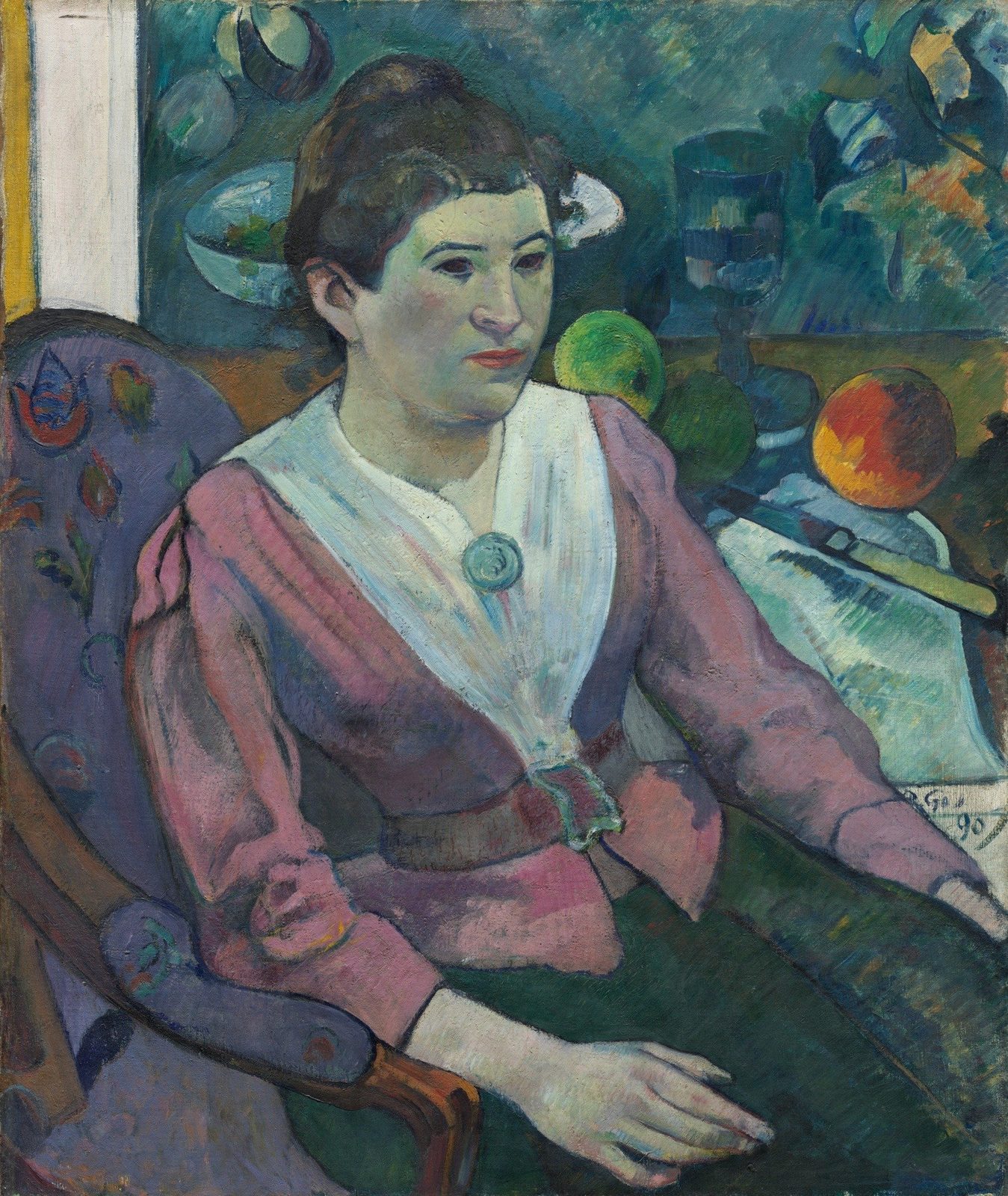
- Artist
- Paul Gauguin
- Title
- Woman in Front of a Still Life by Cezanne
- Date
- 1890
- Medium
- Oil on linen canvas
- Museum
- Art Institute of Chicago
- Image
- Public domain (CC0)
Open in Simple Art
Watch this story on iPhone and iPad, with offline downloads and a painting every day.
About 5 minutes of looking, in 12 parts.
A woman, a chair, and a bowl of fruit
Before you, a seated woman in a rose-pink jacket anchors a composition split between figure and still life. A white collar catches the light against a teal-green wall, and behind her right shoulder a green apple glows near the upper-right quadrant.
Paul Gauguin, 1890, oil on linen
This is Paul Gauguin's Woman in Front of a Still Life by Cezanne, dated 1890 and painted in oil on linen canvas. The handling reflects his early 1890s Cézanne-influenced practice—flattened, planar brushwork and saturated local color.
Centered figure, asymmetric balance
The figure sits centered, but the picture is asymmetric: a tall carved chair on the left balances a still-life block in the upper right. Watch the diagonal guide—your eye travels from the face down to the hands, then sweeps up the right diagonal through the apples before returning left along the chair.
Cool shadows on a warm face
Light enters from the upper left, falling across the forehead and white collar. Now zoom into the face: the shadow planes along the nose, beneath the jaw, and along the neck are built from cool green and blue-grey passages rather than warm browns. Color is doing the modeling that chiaroscuro usually does.
An apple as three color zones
Move to the green apple behind her shoulder. It is not one base color smoothly shaded; it is three distinct zones—a warm yellow-green highlight, a cooler mid-green across the body, and a dense dark green at the lower-right edge. Each plane is a separate brushstroke sitting next to its neighbor.
An edge made of stroke direction
Drop down to the V where the white collar meets the rose-pink jacket. There is no drawn line. The pink sweeps diagonally, the white runs more vertically, and a single cooler stroke rides the join to do the modeling. The hard edge is a change in stroke direction, not a contour.
Hands as broad planes
Sweep down to the clasped hands in the lap. The fingers are reduced to broad tapering planes in cream, mint, and muted rose—no knuckles, no nails, no tendons. A cool grey-green shadows the underside. The hand reads as geometric facets, not as anatomy.
Warm fruit, cool flecks at the rim
Back up to the still life and the red-orange apple. Saturated red and orange sit against muted green, with a brighter yellow-orange zone on the lower-left flank reading as the lit side. A few short grey-blue strokes intrude on the upper edge—those cool flecks at the rim make the warm center glow.
Decorative dabs vs planar strokes
Now slide left to the chair upholstery. Short comma-shaped dabs of orange and green scatter across a violet-blue scumbled ground, each one loaded and slightly impastoed. Notice how different this decorative flicking is from the broader planar strokes of the figure—a second brushwork language inside the same canvas.
Light as a single geometric plane
Return to the figure and look at the lit side of the left sleeve. The rose-pink is not a gradient—it is a single broad plane, unified by diagonal strokes running upper-left to lower-right, bordered by a deep indigo-blue shadow. The boundary is defined by a warm-cool temperature shift, not by a drawn line.
A soft edge, alive with optical mixing
Drift to the right shoulder, where pink meets green. There is no clean boundary—short alternating strokes of each color let a muted purple-blue emerge in between. The edge stays alive through optical mixing rather than a single gradient or a hard line.
Gauguin 90
In the lower right corner, a dark navy inscription reads 'Gauguin 90' with a trailing flourish. The pigment sits in the visible canvas weave, drawn as one decisive pass over a scumbled cream and rose ground—the dark value already existed, so the signature feels integrated rather than glued on top.
Look closer
10 details, each checked against a close-up of the picture.
-
Sitter's Face
The shadows on the face are rendered using cool green and blue tones rather than browns.
The crop isolates the sitter's head and upper shoulders, showing a face turned in three-quarter view with light striking from the upper left. The shadow planes—along the right side of the nose, beneath the jaw, on the left cheek, and along the neck—are built from cool green and blue-grey passages rather than warm browns or umbers. A clear division runs down the bridge of the nose where the lit plane (pale ochre-cream) meets the shadowed plane (blue-green). The lips are a saturated red-orange placed as a single dense stroke, and the eyes are dark, simplified shapes with reddish-brown irises. Hair is massed in dark brown with a few red-tinged highlights, and the white collar below is modeled with pale blue-grey strokes that echo the face's shadow chroma.
-
Inscription/Signature
There is a handwritten inscription or signature in the lower right foreground.
The crop captures a handwritten signature executed in dark navy pigment that reads 'P. Go' over '90' with a trailing flourish, set against a softly scumbled cream and rose-pink ground. The letterforms are linear, slightly broken, and uneven in weight, with the dark paint sitting in and catching on the visible canvas weave. A horizontal teal-green band crosses the upper edge of the crop, a denser teal-blue mass fills the lower right, and a mossy green stroke enters along the bottom margin. Edges of the inscription are soft rather than crisp, and the strokes read as single, committed drags rather than reworked or retouched marks.
-
White Collar Edge
The edge of the collar is defined by a sharp contrast in value against the pink jacket.
The crop frames the central chest and shoulder area: a broad white collar (warm cream mixed with cool blue-white strokes) meeting a rose-pink garment. The boundary is not a single hard line but a meeting of two stroke directions — long diagonal pink sweeps running roughly upper-right to lower-left, abutting shorter, more vertical strokes in the white. Along that meeting zone a darker blue-green/mauve contour stroke (a shadow or accent pass) rides the V-edge, mediating the value jump. A round teal-green brooch sits at the join of the collar points. Impasto is evident: paint sits thick on the ridges of strokes and the canvas weave shows through in thin spots, especially in the upper-right white area.
-
Resting Hand
The fingers are simplified into broad, pale shapes with minimal anatomical detail.
The crop isolates a single relaxed hand resting against a deep forest-green field. The fingers are reduced to broad, tapering planes in pale cream, cool mint-green, and muted rose, with no visible knuckles, nails, or tendons. Edges are soft and slightly broken, with thin dark contour lines along the upper silhouette of the back-of-hand and between fingers. A warm pink wedge at upper left (jacket) and a small wedge of carved orange-brown wood at lower left frame the hand, while a sliver of cooler pink at the wrist hints at a sleeve cuff. Shadowing along the underside of the fingers is achieved with cool grey-green rather than brown, and the highlights along the knuckles are placed with single pale dabs.
-
Green Apple
The apple consists of distinct planes of light green, yellow, and dark green.
A green apple dominates the upper half of the crop, constructed from visibly distinct color zones rather than smoothly blended tones. The upper-left quadrant holds warm yellow-green highlights, the center and upper-right read as a cooler medium green, and the lower-right edge and bottom curve fall into a dense dark green almost merging with the surrounding dark background. Below the apple, a cream-white tablecloth plane meets a muted rose-pink shape (the jacket) along a soft diagonal edge near the lower-center. The transitions between the apple's color zones are not hard lines but rather adjacent patches of impasto where one stroke ends and another begins, with short, parallel brushmarks tilting roughly from upper-left to lower-right across the fruit's body.
-
Red-Orange Apple
The apple uses saturated red and orange hues that contrast with the green background.
The crop is dominated by a roughly spherical form rendered in saturated red and orange, with a brighter yellow-orange zone on its lower-left flank that reads as the lit side. The right and upper-right of the form shift into a darker, cooler red-brown, and a few short grey-blue strokes intrude on the upper-left edge, separating the fruit from the muted green background. Below the form, broad diagonal planes of blue-grey and white sit on a dark olive-green field, with a small black rectangular notch at the lower-center. Edges are soft and broken, built from adjacent rectangles of colour rather than a single drawn contour, and the canvas weave shows through thinner passages, especially in the cool background.
-
Chair Upholstery
The fabric is rendered with short, curling dabs of violet, blue, and orange paint.
The crop isolates a violet-blue field scattered with curling, paisley-like motifs. Short, comma-shaped and C-shaped dabs sit on top of a scumbled ground: orange-red flickers register as the warmest notes, with small green and blue flecks acting as cool counterpoints. The marks are loaded and slightly impastoed, leaving raised edges that catch light against the flatter background. A pink fabric edge intrudes on the right and reads as a separate, more broadly brushed plane of color.
-
Collar Brooch
The brooch is rendered as a simplified blue-grey circle with a single light highlight.
The crop isolates a roughly circular brooch form painted in muted teal-grey (~#6b9596) sitting against a field of rose-pink and off-white vertical strokes. A single pale highlight (~#d6dcc8) sits in the upper portion of the disc, with the lower edge fading into a darker, slightly cooler grey-green. Edges are soft and irregular; the circle bleeds into neighboring strokes rather than being sealed with a hard contour. A few darker dashes inside the disc hint at form without describing it.
-
Jacket Highlight
The light on the left sleeve is represented by a broad plane of pale pink.
The crop is dominated by a broad plane of rose-pink occupying the right and center, bordered on the left by a deep indigo-blue zone that reads as the unlit side of the form. Within the pink plane, the paint is built up with diagonal brushstrokes running from upper-left to lower-right, unifying the lit surface as a single facet rather than modelling it into many smaller shifts. Darker coral and rose accents are layered inside the pink, producing tonal variation through hue rather than through hard edges. The boundary between the pink highlight and the cool blue is softened but readable, defined by a near-complementary color shift rather than an outline.
-
Shoulder Transition
The boundary between the pink jacket and green background is a soft, blended edge.
The crop isolates the figure's left shoulder and upper back, where the jacket is rendered in a range of rose-pinks that shift from a warmer dusty rose on the lit upper plane into cooler mauve and violet-purple as the form turns into shadow along the underside. The background to the right is built from layered greens - a teal upper band, mid blue-greens, and a darker olive lower passage - and it meets the pink form without a single clean line. Between them is a narrow transitional zone where the two color families contaminate one another, producing cooler purples and a bluer green-pink. The paint surface is clearly loaded: ridges of pigment catch the light along the shoulder ridge, and the brushwork runs in long diagonal drags that follow the fall of the form rather than any flat boundary.
Woman in Front of a Still Life by Cezanne in context
A sitter with many names
The Art Institute now describes the seated woman as unidentified [1]. Its exhibition history shows how often she was given a name. In London in 1911 the picture was shown as Portrait of a Girl, and in 1924 as L'Arlésienne [1]. Between 1933 and 1955 it was exhibited as Mlle. Marie Henry or a variant of that name, and between 1959 and 1972 as Marie Derrien or Portrait of Marie Derrien [1]. None of these identifications is kept in the museum's present title [1].
The painting is inscribed on the right 'P. Go.' with the date '90' [1].
The pearl on the wall
The still life behind her is Paul Cezanne's Still Life with Fruit Dish of 1879 to 1880, now in the Museum of Modern Art, New York [1][2]. MoMA's label calls it a prized possession of Gauguin, who described it as 'an exceptional pearl, the apple of my eye', and says he parted with it unhappily, only when he needed money for medical care [2].
MoMA gives the Cezanne's size as 46.4 by 54.6 cm, and the Art Institute gives its Gauguin as 65.3 by 54.9 cm. So the two canvases are almost exactly the same width [1][2]. The label adds that Cezanne made about two hundred still lifes, and that here he created a shallow, compressed space that flattens the dish, glass and fruit [2]. The Art Institute notes that Gauguin painted the still life at nearly the scale of the original, and that it was one of five or six Cezannes in his collection [1].
The same still life, ten years on
The Cezanne appears again in Maurice Denis's large Homage to Cézanne of 1900, set in Ambroise Vollard's shop in the rue Laffitte, where it stands on an easel among the Nabi painters [3]. There the Cezanne is called Fruit Bowl, Glass and Apples [3]. Wikipedia's account notes that it had belonged to Gauguin, who is evoked in this way although he is not pictured, having left France for the South Seas in 1895 [3].
Denis showed the painting at the Salon of the Société nationale des beaux-arts in Paris and at La Libre Esthétique in Brussels in 1901, where reactions were mixed [3].
Into the Winterbotham Collection
According to Georges Wildenstein's 1964 catalogue, as cited by the museum, the painting passed through the Bernheim-Jeune gallery in Paris [1]. It was with the Leicester Galleries in London by 1924 and with the Chester H. Johnson Gallery in Chicago by 1925, which sold it to the Art Institute that year [1]. It's one of thirty-five works in the museum's Winterbotham Collection [1].
The earliest exhibition on the museum's list, in 1911, was a London show pairing Cezanne and Gauguin at the Stafford Gallery [1]. More recently, it hung in the Art Institute's Cezanne exhibition of 2022 [1].
- Paul Gauguin, Woman in Front of a Still Life by Cezanne, 1925.753: object record, provenance, exhibition and publication history . Art Institute of Chicago (public API)
- Paul Cézanne, Still Life with Fruit Dish, 1879-80, 69.1991: collection page and gallery label (Internet Archive copy, 1 November 2020) . The Museum of Modern Art, New York
- Homage to Cézanne . Wikipedia