A screen of trees
How Monet lets a woman in white be glimpsed through a curtain of trunks and broken colour
- Artist
- Claude Monet
- Title
- Woman Seated under the Willows
- Date
- 1880
- Medium
- oil on canvas
- Image
- Public domain (CC0)
Open in Simple Art
Watch this story on iPhone and iPad, with offline downloads and a painting every day.
About 3 minutes of looking, in 9 parts.
Woman Seated under the Willows
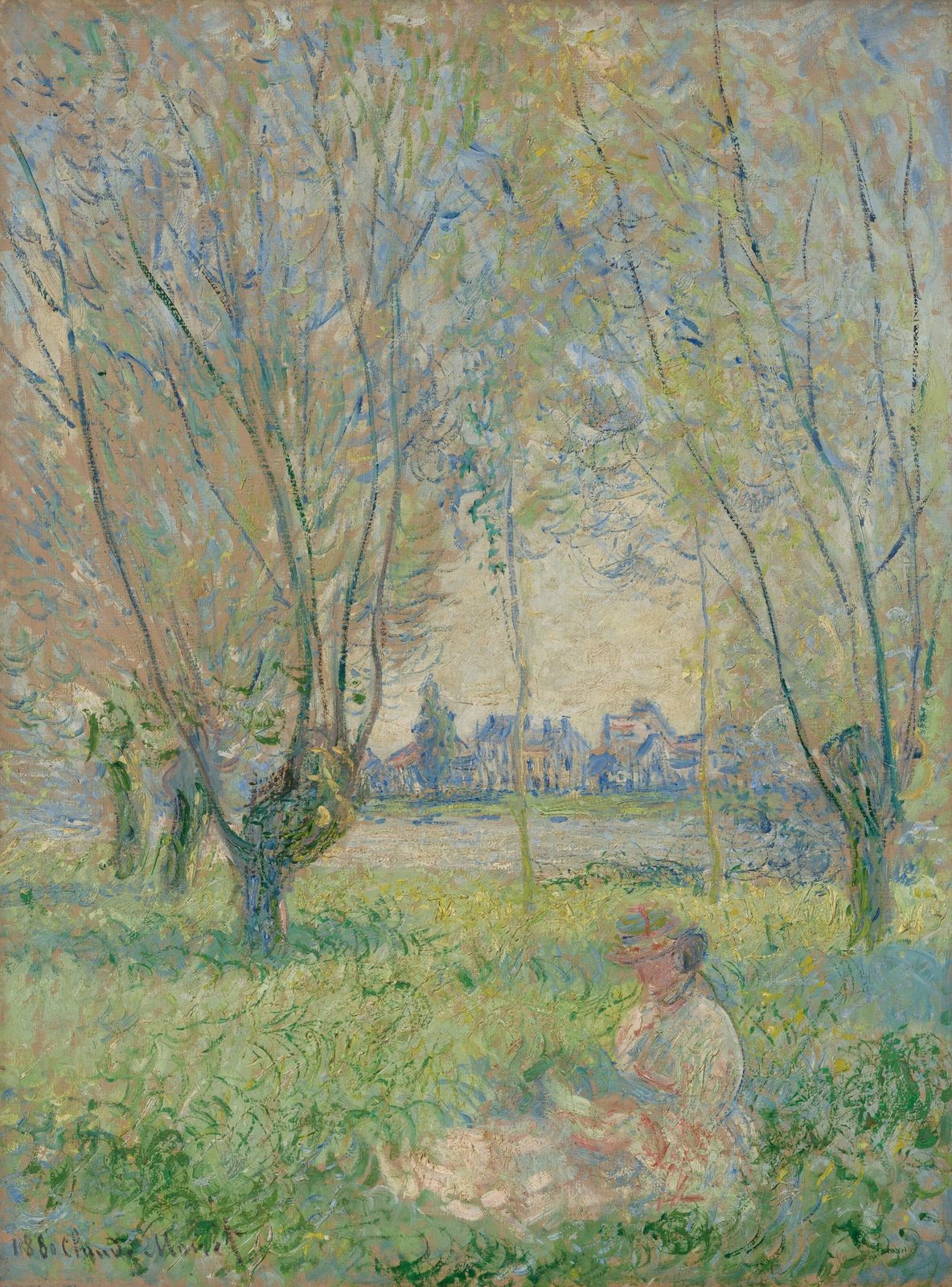
Tall, thin trees rise the full height of the canvas, and their feathery tops filter the daylight. Low in the grass, almost tucked away at the lower right, a woman in a pale dress is sitting quietly. We seem to see her through a screen.
1880, oil on canvas
This is Claude Monet's Woman Seated under the Willows, painted in oil on canvas in 1880. Down in the lower left corner he signed and dated it in dark paint, 1880 Claude Monet, and the letters sit almost inside the grass.
Verticals, and one small figure
The design is a row of upright trunks marching across the picture. Only one thing breaks the rhythm: the seated figure, small and off centre. A pale band of village runs just below the middle, and your eye slides down the trunks to reach it.
A village in soft light
Look through the trunks to the village. The houses are short horizontal dashes of pale blue and cream, with roofs suggested by slightly cooler strokes. There's barely a shadow anywhere, just one small rust-red touch. That low contrast is what pushes the village back into the haze.
Warm ground, cool strokes
Up in the canopy, a warm peach tone seems to show through almost everywhere. Over it sit short strokes of cool blue, sage green and creamy white, with a few lemon-yellow dabs. Warm and cool are placed side by side rather than mixed, so the leaves seem to shimmer.
Trunks drawn on top
Now follow one of the trunks at the top left. It's a thin dark line in navy and near black, and it looks as though it was laid over the patches of colour, not left among them. The leaves came first, it seems, and the dark verticals afterwards.
An edge made of colour
Lower down, the edge of a trunk isn't a line at all. It's a narrow band of separate marks, cool blues and greens against warm cream and pink. Small gaps of warmer ground show between them, and from a step back your eye reads the band as a clean contour.
Grass in separate strokes
In the foreground the grass is made of short dabs laid side by side, crossing each other on the diagonal. Yellow and lavender sit right next to the greens without softening into them. Close up they stay apart; from a distance they fuse into a sunny meadow.
The brightest patch
Finally, the woman herself. Her face is only a few pink and blue-grey smudges under a brimmed hat with a coral band. Her dress is thick, unblended cream, peach and pale blue, and it's probably the brightest passage in the picture. That brightness against the green, not drawing, is what finds her for us.
Look closer
8 details, each checked against a close-up of the picture.
-
Seated woman in white
The woman's pale dress is rendered with broad, unblended strokes of cream and peach that sit distinctly above the surrounding green grass.
The crop shows a seated figure whose face is reduced to a few pinkish and blue-grey smudges beneath a brimmed hat trimmed with a pink-coral band. Her dress is built from thick, unblended strokes of cream, pale pink, peach, and scattered light blues that sit as discrete ridges of paint rather than a smooth form. The surrounding grass is a tapestry of short, separate dashes in yellow-greens, blue-greens, and ochre, with no continuous contour separating dress from ground; instead, dress and foliage interlock through juxtaposed color notes. A loose blue contour line traces the right shoulder, reading more as a chromatic vibration than a hard edge. The canvas weave is visible in the thinner passages around the figure's lap.
-
Trunks and feathery foliage
The tree trunks appear as thin dark vertical lines laid over adjacent patches of blue, yellow and peach broken colour.
The crop is dominated by a warm peach-pink ground (likely the primed canvas showing through) overlaid with broken patches of pale blue, chrome yellow, sage, and white that read as feathery foliage. Thin dark vertical strokes in navy and near-black register as tree trunks, applied last over the foliage patches rather than reserved through them; one trunk reads as a single thin line near the right edge, others as doubled or feathered verticals in the center. A diagonal swipe of mid-green cuts from upper-middle to lower-middle, sitting on top of the trunks in places. Edges are dry and broken: where blue meets peach there is no blended seam, only a granular, hatched boundary. Darkest values are confined to the trunk lines and a few short blue accents; the rest of the surface stays mid-to-light.
-
Village in diffused daylight
The distant village is built from short horizontal strokes of soft blue and cream, with only a few small accents such as a rust-red stroke and almost no shadow.
A band of loosely brushed buildings occupies the middle of the crop, built from short, broken horizontal strokes of pale blue, lavender-blue, and warm cream that sit on top of one another with small gaps of the cream-toned ground showing through. Rooflines are suggested rather than drawn, formed by slightly denser and cooler blue strokes against the lighter wall strokes below. A thin, near-vertical yellow-green line runs down the right of center, reading as a tree trunk or sapling interrupting the skyline. The foreground is a thin horizontal register of green and blue dashes, while the upper sky is creamy yellow applied in broad, scumbled sweeps. Contrary to the claim of 'no visible shadows or dark accents,' at least one small rust-red stroke sits within the right-hand cluster of buildings, and several mid-value blue strokes read as accent marks against the cream passages.
-
Warm sky through cool canopy
The upper canopy juxtaposes warm peach ground showing through against cool blue and green foliage strokes.
The crop is dominated by a warm peach-pink ground that reads through nearly every area where the upper layers thin out. Over that ground, short, broken strokes of cool cerulean blue, sage green, and pale cream-white are laid in loose clusters, with brighter lemon-yellow dabs concentrated in the upper left. Thin, sketchy dark navy lines run roughly top-to-bottom at irregular intervals, registering as vertical tree-trunk passages rather than solid forms. Edges between strokes stay soft and unblended, so the warm ground optically mixes with the cool overstrokes to produce a shimmering, vibrating foliage field. The canvas weave is visible in thinly painted zones, confirming the lean, translucent handling.
-
Foreground grass texture
The grass is built from short, discrete strokes of green, yellow, and lavender that remain unblended at close range.
The crop reveals a dense thicket of short, individual strokes laid down side-by-side rather than blended. Pigment is applied in dabs and dashes approximately a few millimeters long, oriented in crisscrossing diagonals that suggest swaying blades. Greys of the canvas weave show through where paint is thin, and individual strokes of yellow and lavender sit directly beside green strokes without softening into them. Toward the top, a vertical column of cool blue, ochre and rose marks the tree trunk, with foliage feathering outward in looser, longer gestures.
-
Trunk edge as color junction
The trunk's edge is a narrow band of juxtaposed cool blue-green and warm cream-pink strokes rather than a single drawn line.
The crop shows a vertical band of tree trunks executed in overlapping, multi-hued strokes: warm browns, dusty pinks, deep teal, and dark blue-green running roughly top to bottom. The so-called edge is not a single hard line but a narrow zone 3–6 brushstrokes wide where cool blues and greens (around #6ba3c4 and #2d5f6e) sit against cream-pink ground tones (#e8d4c0) and yellow-green foliage accents (#b0a847). Across that zone you can read individual comma-like marks that partially cover and partially leave gaps of the warmer ground, producing a perceived edge through color contrast rather than through a continuous contour.
-
Ascending branch strokes
The right-hand trees contain upward-curving strokes of blue and ochre that cross over the vertical trunks.
The crop isolates a dense thicket of feathery foliage built from short, broken dabs of light green, pale blue, and yellow-white laid over a warm peach-ochre ground that reads as distant light or pale architecture. Several near-vertical dark blue strokes function as trunks, their edges soft and broken where foliage overlaps them. On the right side, distinct upward-curving arcs of mid-blue and ochre sweep across the verticals, visibly passing in front of and behind the trunk strokes to create a sense of interlaced depth. Values stay tightly clustered in the high-key range, with the deepest darks reserved for the trunk lines and the brightest tints sitting as scattered highlights in the canopy.
-
Painter's signature
The lower left corner contains the artist's painted signature and date integrated into the grass strokes.
A row of dark, cursive characters sits across the lower-left third of the crop, painted in a deep navy-black that reads as the most saturated dark in the frame. The lettering is partly absorbed by the green-blue ground, with individual loops catching more pigment than their connecting strokes, so the reading is uneven. Surrounding the letters is a scumbled field of cadmium-like greens, cerulean blue, and a warm, raw-umber-tan undertone where the canvas weave shows through. White and pale-blue highlights sit at the upper left, applied in short, comma-shaped dabs that suggest foliage catching light. Edges throughout are soft and broken; no contour is fully sealed.
Woman Seated under the Willows in context
A tall canvas dated 1880
The National Gallery of Art records the picture as oil on canvas, 81.1 by 60 centimetres, signed and dated '1880 Claude Monet' in black paint at the lower left [1]. The Gallery's visual description reads the sandy band in the distance as either a path or a river, lined on the far side by loosely painted blue buildings under a pale yellow sky [1]. But it doesn't name the place [1].
The canvas is number 613 in Daniel Wildenstein's catalogue raisonné of Monet's paintings [1]. When the Gallery's page was archived in November 2025, the painting was marked as not on view [1].
Madame Monet, or someone else
For more than twenty years the Gallery's own publications called the picture Madame Monet under the Willows, from the catalogue of the Chester Dale collection in 1942 to the summary catalogues of 1965 [1]. The same title appears in Fern Rusk Shapley's Comparisons in Art of 1957 and in John Walker's 1963 book on the Gallery [1]. Later entries in the bibliography drop it, and the current title doesn't identify the sitter [1].
That old title is hard to square with the date on the canvas. Camille Monet died at Vétheuil on 5 September 1879 and was buried two days later in the cemetery beside the church [2]. From 1878 to 1881 Monet, Camille and their two children shared a small house in Vétheuil with the family of Ernest Hoschedé [2]. The Gallery's record names none of the people in that household as the model. So who sat for the figure, if anyone did, remains open [1].
Same year, different routes
Another canvas dated 1880 in the same collection, Banks of the Seine, Vétheuil, is inscribed 'Claude Monet 80' at the lower right [3]. That picture went from the artist to the New York dealer James F. Sutton, reaching Chester Dale through the Sutton sale at the American Art Association in 1933 [3].
Woman Seated under the Willows took a different route. The Gallery records that it went from the artist to Durand-Ruel in New York and Paris, who sold it to Chester Dale on 22 November 1927 [1]. Both date and source come from Dale's own papers in the Gallery's curatorial files [1]. And the following year it was number 13 in the Loan Exhibition of French Masterpieces of the Late XIX Century at the Durand-Ruel Galleries in New York [1].
Maud Dale's catalogues
Maud Dale published the painting twice in 1929, in her book Before Manet to Modigliani from the Chester Dale Collection and in an article on the collection in Art News of 27 April [1]. A painter and art critic, she married Chester Dale in 1910 and is credited with introducing him to the idea of collecting modern art [4]. Dale made his fortune in finance. He served as president of the National Gallery of Art from 1955 until his death in 1962 [4].
The painting came to the Gallery with Dale's bequest in 1963, appearing in the Chester Dale Bequest display there in 1965 [1]. It was later reproduced in the catalogue of the 2003 Edinburgh exhibition Monet: The Seine and the Sea [1].
- Claude Monet, Woman Seated under the Willows (1963.10.178): object record, visual description, provenance, exhibition history and bibliography (Internet Archive copy, 22 November 2025) . National Gallery of Art, Washington
- Claude Monet's Vétheuil in Summer (1998 exhibition): introduction . The Frick Collection, New York
- Claude Monet, Banks of the Seine, Vétheuil (1963.10.177): object record and provenance (Internet Archive copy, 14 April 2025) . National Gallery of Art, Washington
- Chester Dale . Wikipedia